I’m 19, and for as long as I can remember, my older brother was different.
His name is Ronan, and when we were kids, he moved through our house like someone borrowing space instead of living in it.
He was always polite and quiet.
He never slammed doors or picked fights or did any of the things older brothers in movies seemed to do. He just kept parts of himself locked away so tightly that even when he was sitting right next to me, I felt like he was standing somewhere far off in the dark.
We looked normal from the outside. That was the strange part.
My father, Victor, liked things neat. He liked polished shoes by the door, pressed shirts, folded napkins, and family photos where everyone looked grateful to be there. My mother, Helena, was beautiful in a controlled way.
We had a nice house, nice dinners, nice manners.
We were the kind of family people described as solid.
But even as a kid, I knew solid things were not supposed to feel so brittle.
I think I was maybe nine the first time I saw Ronan leave.
I couldn’t sleep. I had gotten scared by a thunderstorm and went to the hallway for water. The whole house was dark except for the kitchen light over the stove. I remember standing there barefoot, my hand on the wall, when I saw him move past the front window.
At first, I thought that I was imagining it.
Then I heard the front door click shut, and I froze.
I crept to the window and pulled the curtain back just enough to see. Ronan was walking down the driveway in a gray hoodie, shoulders hunched, moving fast but quietly, like he had done it before.
I waited for one of my parents to come storming out after him.
They didn’t. The house stayed still.
He came back just after sunrise.
I know because I waited in the living room pretending to watch cartoons. When the door opened, he stepped inside, looked at me on the couch, and stopped.
We stared at each other.
“Where did you go?” I whispered.
He looked tired. “Nowhere.”
“You left.”
He gave the tiniest smile. “Go eat breakfast, Nina.”
That should have been the end of it, but it wasn’t.
I saw it again a week later. Then again, after that.
Sometimes he would leave for one night, sometimes two nights in a row. Always after midnight. Always back by morning. He never carried a bag or looked excited.
It wasn’t like sneaking out to a party or meeting friends. It felt heavier than that.
But I never told our parents.
One night when I was 11, I waited outside his room until I heard his window slide open. I caught him halfway through climbing out.
“Ronan.”
He nearly slipped. Then he looked down at me and exhaled hard. “Jesus, Nina.”
“Where do you go?”
He swung one leg back inside and crouched by the window. Moonlight hit one side of his face, and for a second, he looked older than he was.
“You should be asleep.”
“I’m not stupid,” I snapped. “You do this all the time.”
He studied me for a moment, then smiled in that same sad way. “You’ll understand one day.”
I hated that answer.
“What does that even mean?”
But he just reached over, tapped my forehead with two fingers, and climbed out the window.
That day never came.
As I got older, I started noticing other things.
My father was hardest on Ronan, but not in a normal way. Dad watched him all the time, like he was guarding a locked door. My mother, on the other hand, treated Ronan carefully, almost formally, like she was always trying not to make things worse.
At dinner, if Ronan spoke too long, my father would cut him off.
If Ronan missed a family event, my mother would say, “He’s tired,” before anyone even asked.
Once, when I was 15, I heard them arguing in the kitchen after midnight.
My father hissed, “This has gone on long enough.”
My mother said, very quietly, “Then tell her.”
Silence.
Then his voice again, colder this time. “Absolutely not.”
I stood in the hallway with my heart pounding, but I never heard Ronan’s name. I only heard my mother start crying.
The next morning, everyone acted normally.
That was how our family handled pain. We ironed it flat and set the table over it.
When Ronan turned 18, he disappeared.
His room was half empty. A few shirts were gone, his sketchbook was missing, and the watch our grandfather left him was gone too.
I remember standing in his doorway, staring at the bed, waiting for him to step out of the bathroom and tell me I was being dramatic.
But he didn’t.
My parents said they were looking for him, but something felt off. They made phone calls, yes. My father spoke to two police officers. My mother cried once at the table. But there was no real panic or urgency.
It felt like a theater performance. Like they were performing the idea of worried parents without actually being them.
I asked my father, “Do you know where he is?”
He looked at me too fast and said, “Of course not.”
That was when I knew he was lying.
Three years passed, and whatever secret Ronan had, I finally understood one thing for sure: My parents were part of it.
Yes, I know. 19 is young. I’ve heard every version of that speech. But Daniel is 24, and he is the steadiest person I have ever known.
He doesn’t perform kindness. When I panic, he gets quieter. When I ramble, he listens. When my father gets too controlling, Daniel squeezes my hand under the table and reminds me with one look that I’m not trapped.
So despite everything, I woke up that morning happy.
The church was full of cream roses and candlelight. My dress fit perfectly. My mother helped button the back with shaking fingers, and I thought she was emotional because I was getting married.
My father kissed my cheek and told me, “Today will be perfect.”
I remember thinking it sounded less like a blessing and more like an order.
Then the doors opened.
And my brother walked in. Alive.
For one insane second, I thought I was hallucinating.
Ronan stood at the back of the church in a dark coat, older, sharper, but unmistakably himself. My heart started pounding so hard I thought I’d pass out.
He walked straight toward me.
Daniel stepped closer to my side, not blocking Ronan, just grounding me.
Ronan stopped right in front of me and said quietly, “Now I can finally tell you the truth about what’s been happening in our family all these years… and where I’ve been.”
“SHUT UP!” our father suddenly shouted.
The sound cracked through the church.
Every head turned, but my brother didn’t even look at him.
“No. Everyone deserves to know,” he said calmly.
My hands were shaking so badly that I had to clutch my bouquet with both of them. I stared at him and managed to whisper, “Know what?”
That was when I saw my father’s face. Panic was written all over it.
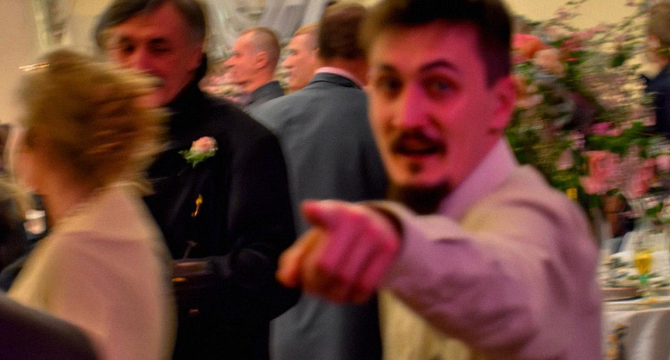
Ronan turned slightly then, enough to point directly at Victor. “Ask him where I used to go at night.”
My father took a step forward. “You ungrateful little-“
“Say it,” Ronan said. “Tell them.”
No one moved. My mother looked like all the blood had drained out of her body.
Ronan looked back at me. “You used to ask where I went. You remember?”
My throat tightened. “You said, ‘You’ll understand one day.'”
“Yeah. I did,” he swallowed hard. “I wasn’t sneaking around for fun. I was going to see someone.”
The church was so quiet I could hear my own breathing.
“A woman,” he said. “The woman who raised me in secret. The one Dad kept hidden all these years.”
My father barked, “Enough!”
Ronan ignored him. “Her name is Marisol.”
I looked at my mother. She had one hand over her mouth, but she was not confused. She was devastated. There is a difference, and once you see it, you can never unsee it.
Ronan kept talking.
“She’s my real mother.”
I actually took a step back, and Daniel caught my elbow before I fell. My mind kept rejecting the words, like they were in the wrong order.
“What?” I said.
Ronan’s voice stayed calm, but I could hear years of buried rage under it. “Dad had an affair with Marisol. She got pregnant. To protect his image, he brought me into this house and had me raised here. Publicly, I was Helena’s son. Privately, I spent nights with the woman who actually gave birth to me.”
I turned to my father. “That’s not true.”
He said nothing.
That silence was the loudest thing I have ever heard.
Ronan pointed at him again. “They always knew where I went. Both of them. Every time I left, they knew.”
My mother made a sound then, this tiny broken inhale, and I looked at her.
She whispered, “I begged him to tell the truth.”
I felt my stomach twist. “You knew?”
Her eyes filled. “Not at first. But yes. For years.”
Ronan laughed once, bitter and empty. “The perfect family, right?”
Guests were staring now, some openly, some trying not to. My aunt looked horrified. Daniel’s mother was crying.
Ronan kept going because at that point, there was no stopping him.
“When I turned 18, Dad decided I was a liability. He said I was too old, too angry, too likely to talk.” He looked at Dad with open disgust. “So he sent me away. Told everyone I’d gone missing. But he knew exactly where I was. I was with Marisol. Permanently. Hidden somewhere easier to control.”
My father finally snapped, “I gave you a life!”
Ronan’s whole face changed. “You gave me a lie.”
Then he looked at me again, and somehow that hurt worst of all.
“I came back because I couldn’t let this continue. Not at your wedding. Not while he stood here pretending to be the father of some perfect, honorable family.”
The room erupted after that.
People were talking over each other. My father was shouting Ronan’s name. My mother was crying.
Daniel stepped in front of me for one second when Victor moved too fast. I couldn’t think. My whole body felt numb and burning at the same time.
My wedding dress suddenly felt like a costume.
I turned to my father because I needed him to deny it. I needed him to shout that Ronan was lying, that this was revenge, and that there was some explanation that didn’t end with our entire childhood rotting from the inside out.
He didn’t deny it.
He just stood there, breathing hard, jaw tight, eyes darting around the church like he was calculating damage.
That was his answer.
My mother sat down hard in the front pew as if her legs had given out. I stared at her, stunned, because part of me had always believed she was simply quiet, simply careful, simply trying to survive my father’s moods.
But this? She had known.
Maybe not at the start. Maybe not when Ronan was born. But she had known long enough to become part of the silence.
I walked to her slowly.
“Mom,” I said. “How could you let me grow up not knowing?”
She looked up at me with tears all over her face. “Because by the time I learned the truth, I had already spent years pretending. And then I didn’t know how to tear the house down without burying all of us in it.”
That should have made me feel sorry for her, but it didn’t.
Daniel touched my back gently. “Nina.”
I looked at him, then at the altar, then at the guests who were pretending not to watch the worst moment of my life.
I finally understood what Ronan meant all those years ago.
“You’ll understand one day.”
He had not meant that I would forgive them. He had meant that one day I would see the shape of the lie we were all living inside.
Some truths don’t just explain the past. They destroy it.
The ceremony never really recovered.
A few people left, while a few stayed, stunned and embarrassed. My father walked out after someone from Daniel’s family told him he should be ashamed of himself. My mother remained seated, crying into both hands.
Ronan didn’t come closer again. He just stood near the aisle, looking like a man who had finally set down something heavy and had no idea what to do with his empty hands.
And me? I was shaking. I was humiliated. I was heartbroken.
But I also knew one thing with perfect clarity that I was not going to let my father own another room with his lies.
So I took Daniel’s hand.
And in a church still buzzing with scandal, grief, and broken illusions, I asked him, “Do you still want to do this?”
He looked at me like I was the only solid thing left in the world. “Yes.”
We didn’t have the perfect wedding. We had a wrecked one, but that felt more honest than anything my family had ever built.
Later, after most of the guests were gone, Ronan found me outside the church steps. For a second, we just looked at each other like strangers.
Then I said, “You should have told me.”
His eyes filled. “I know.”
“Was Marisol good to you?”
He nodded. “She loved me the only way she was allowed to.”
I closed my eyes.
When I opened them, I hugged him for the first time in years.
Everything in my life before that moment feels split now. Before the truth. After the truth.
I got married yesterday, and my brother came back from the dead, at least the version of dead my parents sold me. My father lost the image he worshipped, and my mother lost the silence she hid inside. And I lost the family story I used to tell myself when I wanted to feel safe.
But I got my brother back.
And now I have to learn whether that is enough to build anything real from what’s left.
What would you have done if you were in my place? Would you forgive your parents for hiding the truth from you? Would you think your brother was at fault too?

 admin
admin