At 39, I learned hunger has a sound. It was the quiet scrape of my fork against an empty plate while my children pretended not to notice I hadn’t served myself dinner.
“Mommy, aren’t you eating?” Noah asked, his small face pale beneath the kitchen light.
I smiled and reached across the table to wipe sauce from his chin. “I ate earlier, sweetheart.”
My oldest, Lily, looked down immediately.
At thirteen, she was old enough to know I was lying.
After my husband, David, died, our lives collapsed into pieces. First came the funeral bills, then the late notices, then the landlord’s warnings, and then the refrigerator slowly emptied until opening it felt like punishment. I was raising four children alone in a tiny rental house with leaking pipes, cracked windows, and a front door that only closed if I kicked it twice.
Some nights, I stood in the kitchen after the kids fell asleep and pressed my hand over my mouth so they wouldn’t hear me cry.
“I’m trying, David,” I whispered into the darkness. “I swear I’m trying.”
But trying didn’t fill the cupboards.
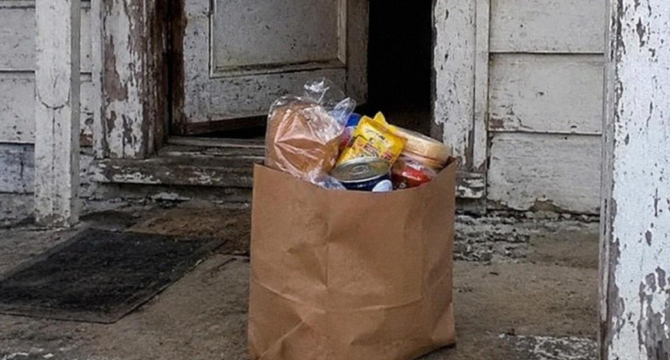
One freezing morning, I opened the front door to leave for work and froze. A brown paper grocery bag sat on the porch. Inside were bread, milk, eggs, apples, peanut butter, and a box of cereal Noah loved but I hadn’t been able to buy in months.
Lily appeared behind me, rubbing sleep from her eyes. “Mom… where did that come from?”
“I don’t know.”
“Did someone leave it for us?”
I stared out at the empty street, unease crawling slowly through my chest.
“Maybe it was a mistake.”
But the next morning, another bag appeared.
Then another.
Every single day.
When Caleb mentioned his shoes hurting his feet, a brand-new pair appeared outside by sunrise. When Noah got sick, children’s medicine sat neatly beside the groceries. When winter arrived, four coats appeared in the exact sizes of my children.
My kids started calling the stranger “the porch angel.”
But I wasn’t comforted. I was terrified.
Because nobody knew how badly we were struggling.
Nobody.
I had stopped answering calls months ago because I was too ashamed to admit how close we were to losing everything. After David’s funeral, we moved quietly across town into that tiny rental house. I never posted the address online. I barely even told relatives where we were living.
So how did someone know exactly what my children needed?
Some nights, I stood behind the living room curtains staring into the dark street outside, convinced someone was watching us. Then one night, around two in the morning, headlights swept suddenly across my bedroom wall.
I bolted upright. A car engine idled briefly outside.
Heart pounding, I rushed to the window barefoot and pulled the curtain aside just in time to see an old truck disappearing down the road. The next morning, there wasn’t a grocery bag on the porch.
Only an envelope.
My hands shook as I opened it. Inside was a single sheet of paper with three sentences written in uneven handwriting:
“Your husband once saved my life. I couldn’t save his. So now ‘m trying to save yours.”
I read the letter three times before my legs finally gave out beneath me.
“Mom?” Lily’s voice shook behind me. “What is it?”
I quickly folded the paper before the younger kids could see it.
“Nothing,” I lied too fast.
But Lily stepped closer, studying my face carefully. She had David’s eyes — observant, gentle, impossible to fool.
“You look scared.”
I was scared. Terrified. Because whoever wrote that letter knew things they shouldn’t.
That night, after the children fell asleep, I sat in the dark living room with every light turned off except the small lamp beside the couch. Rain tapped softly against the windows while the old clock above the kitchen sink crept toward 2 a.m.
I forced myself to stay awake.
At 1:47, headlights appeared again. My entire body tensed instantly.
The truck rolled slowly past the house before stopping near the curb. I held my breath as I watched a tall figure climb out, wearing a dark coat and a knit cap.
A man.
He moved quietly toward the porch, carrying a grocery bag. My pulse hammered painfully as I rushed toward the front door. But the second the floor creaked beneath me, the man froze. For one brief moment, he looked directly toward the house. Then he turned and hurried back toward the truck.
“Wait!” I shouted, yanking the door open.
The freezing air hit me immediately.
The truck engine roared to life.
“Please!” I cried. “Who are you?”
But the man drove away into the darkness without looking back. I stood trembling barefoot on the porch, staring after the disappearing taillights. Then I noticed something near the steps.
A silver lighter.
I picked it up automatically. And the second I turned it over, my blood ran cold.
D.H.
David’s initials.
My husband’s lighter.
“No,” I whispered.
My hands shook so badly that I nearly dropped it. David carried that lighter everywhere for years. He used to flick it open absentmindedly while helping the kids with homework or sitting on the porch after dinner.
I stumbled back into the house feeling physically sick. How could a stranger have my husband’s lighter?
The next morning, while the kids were at school, I climbed into the attic searching through old storage boxes like a madwoman. Dust filled the air while winter wind rattled softly against the roof.
“Come on,” I muttered desperately. “Come on…”
Finally, I found one of David’s old work jackets stuffed into a plastic bin. Something heavy shifted inside the lining when I picked it up.
Confused, I reached into the inner pocket.
And froze.
Newspaper clippings, envelopes, photographs, and stacks of receipts and bank withdrawal slips.
I slowly spread everything across the attic floor. At first, none of it made sense.
Then I started reading.
One receipt showed a hospital bill paid anonymously for a woman I’d never heard of. Another envelope contained money sent to a homeless shelter every Christmas for eight years. There were handwritten letters thanking David for groceries, rent payments, medication, and even funeral expenses.
Tears blurred my vision.
“What is all this?” I whispered.
My husband worked overtime constantly. He always claimed we needed savings. But now I realized where so much of that money had gone.
To strangers.
People he quietly helped without ever telling me. Then I found the newspaper clipping.
The headline read:
LOCAL MAN SAVES WORKERS FROM FACTORY FIRE
Beneath it was a photograph of David standing beside another man outside a burned building. David’s arm wrapped around the survivor’s shoulders while both men stared at the smoking ruins behind them.
The second man’s face was badly scarred.
And beneath the photo caption was his name.
Michael.
My stomach tightened instantly.
At the bottom of the mysterious letter was a single handwritten initial.
M.
I stared at the article for a long time while the attic suddenly felt too small to breathe inside. I thought I finally understood who had been leaving food outside our door.
But three days later, the groceries stopped coming.
By the fourth day without groceries, panic returned.
The refrigerator held two eggs, half a gallon of milk, and one pack of hot dogs. Noah stood beside me, clutching my sweater.
“Is the porch angel okay?”
I forced a smile. “I hope so, sweetheart.”
That night, during a snowstorm, two police officers knocked on my door.
“Mrs. Harper,” one asked gently, “do you know a man named Michael?”
My heart dropped.
They found Michael unconscious after crashing his truck 15 miles away. Inside were groceries, medicine, winter boots, and a handwritten list with my children’s names and sizes.
At the hospital, I finally saw him.
His face and neck were scarred from the factory fire in the clipping. When he saw me, tears filled his eyes.
“Your husband saved my life,” he whispered. “Twice.”
He told me David had pulled him from the fire years ago, then later paid for his rehab when painkillers and alcohol nearly destroyed him.
“Without David,” Michael said, crying, “I would’ve died long before now.”
Then he broke me.
“The night David died, he was coming to save me again. I called him drunk during a snowstorm. He came for me. On the way back, that truck ran the red light.”
My grief turned sharp.
“My children lost their father because of you.”
“I know,” he whispered.
For weeks, I hated him. Then slowly, painfully, I understood: David had chosen kindness, even when it cost him everything.
A year later, Michael sat at our dinner table while my children laughed around him. Above the fireplace hung a photo of David beside Michael after the fire.
Noah pointed at it. “Dad saved all those people?”
I smiled through tears. “Yes,” I whispered. “And somehow… he was still saving people even after he was gone.”

 admin
admin