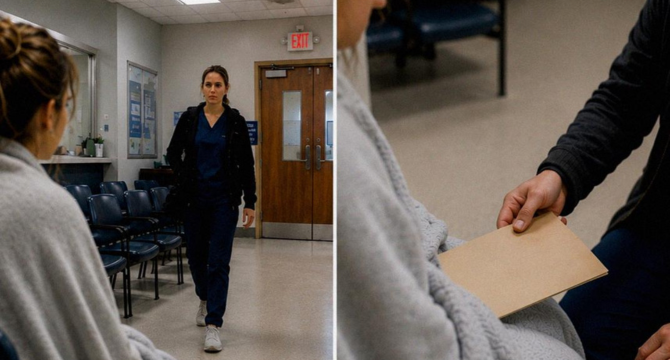
The hospital corridor smelled of antiseptic and old coffee, and the fluorescent lights above flickered in a tired rhythm that matched the slow beating of Ellen’s heart.
It was 1:47 a.m. on a Tuesday.
It was the kind of Tuesday that splits a life cleanly in two. She sat alone on a cold plastic chair, her coat still buttoned, her hands trembling around a phone that had not stopped ringing for hours.
Fifteen years of marriage replayed behind her eyes in small, ordinary pictures. Mark kissing her forehead that morning before grabbing his keys. His last text from Route 9 reading, “Driving home now. Love you, El.”
She pressed Diane’s name on her screen, and her friend answered before the first ring finished.
“Ellen, I’m getting in the car right now. Tell me where you are.”
“I’m in the hospital. He was on Route 9, Diane. A truck. They said his liver…”
Her voice cracked on the last word, and she pressed her palm hard against her mouth.
“I’m coming. Stay on the line, honey. Just stay with me.”
“He rebuilt everything from nothing, Diane. After his parents, after little Lily, he had no one. He always said I was his whole family now.”
Diane’s voice stayed steady and warm.
“And you still are. You hold on for him.”
Down the hallway, two doctors passed in low conversation, their voices clipped and rushed. Ellen caught only fragments as they moved by her.
“Rare blood type. The supply is already depleted.”
“If we don’t find a match in the window, he isn’t walking out of there.”
Ellen’s breath went shallow. She lowered the phone to her lap.
A woman in pale blue scrubs approached, clipboard pressed to her chest like armor. The name tag read Maribel, head nurse. Her face was carefully arranged into something between sympathy and procedure.
“Ms. Ellen, I have a few forms you’ll need to complete.”
“Is he alive? Please, just tell me he’s still alive.”
“He’s in surgery. The team is doing everything they can. But I have to be honest with you. Sometimes protocol limits what miracles can reach a patient in time. I want you to be prepared.”
“Prepared for what?”
Maribel hesitated, her pen hovering over the clipboard.
“For the possibility that not every door opens when we need it to.”
She walked away, leaving Ellen with a stack of papers and a silence that felt heavier than the cold seeping through the windows.
Then Dr. Alden appeared at the end of the hallway, his surgical mask pulled down, his face carrying news Ellen was not ready to hear.
“Ms. Ellen, your husband’s liver sustained severe damage in the crash,” he said. “We’re operating now, but he’s losing blood faster than we can replace it.”
Ellen gripped the armrest until her knuckles went white.
“Then give him more. Whatever he needs. Take mine.”
Dr. Alden shook his head slowly.
“It isn’t that simple. Mark has an incredibly rare blood type. Our supply is nearly depleted, and we have, at best, two hours.”
The hallway seemed to tilt. Ellen forced herself to breathe.
“What about the blood bank? There has to be more somewhere.”
“The regional storm has every highway closed north of us,” he explained. “Deliveries are grounded until morning. We need a living donor, and we need one now.”
Ellen stood, her legs trembling beneath her.
“Tell me what to do. Tell me who to call.”
“Any blood relative would be our best chance. Siblings, parents, children. Anyone who shares his line.”
The words hit her like cold water.
“He doesn’t have anyone,” she whispered. “His parents passed away years ago. His baby sister died in a house fire when he was six. He’s the only one left.”
Dr. Alden looked down at his clipboard, then back at her.
“Then start calling everyone you can think of. Distant cousins, anyone willing to be tested. We’ll screen every match that walks through that door.”
He turned and disappeared back through the surgical doors.
Ellen fumbled for her phone with shaking fingers. She called Diane first, then Mark’s college roommate, then a cousin in Ohio she had not spoken to in eight years. Every voice she reached sounded sleepy, confused, and sorry.
“I can drive down in the morning,” the cousin mumbled. “Maybe nine hours.”
“He doesn’t have nine hours,” Ellen choked out.
She hung up and pressed her forehead against the cold wall.
Nurse Maribel approached again with her clipboard pressed flat against her chest.
“Ms. Ellen, I want to be honest with you. The blood bank confirmed that no deliveries are possible before sunrise. The roads are sheets of ice.”
“There has to be something else,” Ellen whispered.
“There are protocols,” Maribel said evenly. “We follow them for a reason. I’m sorry.”
Maribel walked away, her footsteps clicking like a metronome counting down.
Ellen sank into a corridor chair and stared at the clock.
The hands crawled past 2:00 a.m., indifferent and steady.
She thought of that morning. Mark had been late for breakfast, distracted by his client meeting on Route 9. She had snapped at him about leaving his coffee cup on the counter again. He had laughed it off and kissed her forehead.
“I’ll grab it when I get home, sweetheart.”
Such a small, stupid argument. And now it might be the last thing she ever said to him.
“Please,” she whispered into the silent corridor. “Please, God, not like this. Not over a coffee cup. Not alone.”
She pictured Mark on the operating table, fighting without her, slipping further away each minute she sat helpless in that freezing hallway.
Then the surgical doors swung open.
Ellen looked up, expecting Dr. Alden with the worst kind of news. But it was not the surgeon. A young woman with a hospital badge clipped to her coat walked toward her, eyes glistening, holding something small and folded carefully in her trembling hand.
She was not dressed for a shift. Her hair was pulled back in a hasty ponytail, and her face looked pale from cold and fear.
The young woman stopped a few feet from Ellen, then knelt slowly, as if afraid Ellen might bolt.
“My name is Hannah,” she said softly. “I am so sorry to come to you like this.”
She pulled a small folded square from her pocket and placed it gently on Ellen’s lap.
Ellen unfolded it with shaking fingers.
A Polaroid. Faded yellow edges. A little boy with dark curls hugging a baby girl in a yellow dress, both grinning at the camera.
Ellen’s throat went dry. She knew that little boy. She had seen that exact smile a thousand times across 15 years of breakfast tables.
“Where did you get this?” Ellen whispered.
“I have had it my whole life,” Hannah said. Tears slid down her face. “I am Mark’s sister. I did not die in the fire.”
Ellen could not speak.
The corridor seemed to tilt.
“A neighbor pulled me out,” Hannah continued quickly. “I had burns. No one could find any living relatives in time, and the Bennetts adopted me. My mother told me the truth on her deathbed when I was 18. I have been looking for him for seven years.”
“That is not possible,” Ellen breathed.
“I work as a pediatric nurse two hours from here. Tonight, a regional alert went out for his blood type. I saw his name. I drove straight here.”
Footsteps clicked sharply behind them. Nurse Maribel stepped into the corridor, clipboard tight against her chest.
“What is happening here?”
“She says she is his sister,” Ellen said. “She has the same blood type.”
Maribel’s face hardened. “Ma’am, I am sorry, but we cannot accept an unverified walk-in donor. Not for a transfusion of this scale.”
“I have my donor card,” Hannah said, already reaching into her bag. “And my adoption papers. I keep them with me. Always.”
“Anyone can carry papers,” Maribel replied. “Protocol exists for a reason. I will not put a patient at risk based on a photograph and a story.”
Ellen stood up.
Her legs felt unsteady, but something inside her had stopped shaking.
“Look at the picture,” she said. “Look at his face. That is my husband as a child.”
“Ms. Ellen, I understand you are desperate.”
“You do not understand anything.” Ellen’s voice rose, sharper than she had ever heard it. “He is dying in there. She has the blood he needs. You will not stop this.”
Maribel’s jaw tightened.
“I will call security if I have to.”
Hannah lifted the hem of her sleeve, exposing a long, faded scar that ran from her wrist to her elbow.
“This is from the fire,” she said quietly. “I was 18 months old. I do not remember it. But I remember him. I remember a little boy carrying me on his shoulders.”
Ellen pressed the Polaroid into Maribel’s hand.
“Get Dr. Alden. Now.”
Maribel hesitated, her eyes flicking from the photo to Hannah’s scar to Ellen’s burning expression.
For the first time, the clipboard lowered.
“Stay here,” she said, and walked quickly down the corridor.
Hannah turned to Ellen, her voice breaking.
“I have to tell you something. Two years ago, I saw him. At a coffee shop in Albany. I followed him in. I stood three feet behind him in line.”
“Why did you not say anything?”
“Because I was terrified. What if he did not want me? What if knowing I was alive only hurt him?” Hannah pressed her palm to her mouth. “I kept telling myself there would be a better day. And now I am afraid I waited too long.”
Ellen took her hand.
She did not know this woman. Still, somehow, she knew everything about her.
“You did not wait too long,” Ellen said. “You came tonight.”
The clock above them clicked past 2:45 a.m.
Heavy footsteps echoed down the corridor. Dr. Alden appeared, surgical cap askew, eyes fixed on the donor card Hannah held out toward him.
He glanced at it once and looked up sharply.
“We have minutes,” he said. “Maybe less. Who is donating?”
Ellen faced Nurse Maribel directly.
“This woman is his sister. Family is family, with or without your paperwork. Let her save him.”
Maribel opened her mouth to protest, but Dr. Alden raised a hand.
“On my authority. Prep her now.”
Hannah was rushed down the corridor. Ellen sank into the chair, clutching the Polaroid against her chest, whispering every prayer she remembered.
Maribel lingered nearby, her clipboard lowered for the first time all night.
“I lost my brother once,” Maribel said quietly. “A donor we never verified. I have been building walls ever since. I am sorry I almost built one tonight.”
Ellen reached out and squeezed her hand.
There were no more enemies in that corridor. Only people who had been afraid.
Dawn crept through the windows when Dr. Alden finally returned, his mask hanging loose around his neck.
“The transfusion worked,” he said. “He is stable. He is going to make it.”
Ellen wept without sound.
Hours later, Mark stirred beneath the white sheets, his eyes searching until they found Ellen’s face.
“You stayed,” he whispered.
“Always,” she said. “And someone else has been waiting a very long time to meet you again.”
Hannah stepped forward, the Polaroid trembling in her fingers. Mark stared at the photo, then at her face, and his eyes filled with tears as recognition dawned.
“Lily?”
Hannah nodded, unable to speak.
Mark reached for her hand, and for the first time in nearly 30 years, the three of them sat together as family.
Ellen realized then that miracles often arrived disguised as strangers, and that the bonds of love could survive fire, time, and silence.

 admin
admin