I bought the piano for 50 bucks because it looked lonely. That sounds stupid, but it is the truth. It was sitting at the edge of a garage sale between a stack of warped picture frames and a treadmill with one missing wheel.
The finish was scratched to hell, one of the pedals hung a little crooked, and there was a water ring on top like someone had used it as an oversized end table for years. Still, there was something about it. Maybe it was the shape, the way the afternoon light hit the old wood, or the fact that nobody else even glanced at it.
The man running the sale saw me staring and said, “You play?”
“A little,” I said.
He snorted. “Then you probably know better than to buy this thing.”
I laughed. “What’s wrong with it?”
“Nothing dramatic. It’s just old, heavy, and nobody wants it. My sister said if I couldn’t get rid of it this weekend, she’d call a junk company.”
I looked at him. “It’s only 50 dollars?”
He shrugged. “Take it off my hands.”
That should have been my first sign that the day was about to get strange.
Nobody sells a piano for 50 dollars unless they are desperate, cursed, or both.
But I paid him. By evening, I had the thing wedged into the corner of my apartment living room after bribing two friends with pizza and beer to help me haul it upstairs.
They both left complaining about their backs. I stayed behind, weirdly proud of myself, and started cleaning it.
There is something intimate about dusting an old piano. It feels less like cleaning and more like touching the bones of someone else’s life. Dust had settled deep between the keys. The ivory was yellowed. The wood smelled faintly sweet, like old paper and polish and time.
I was kneeling on the floor with a rag and a butter knife wrapped in cloth, trying to clear out grime from between the keys, when one of them suddenly dropped lower than the others with a soft click.
Then something slid from inside.
At first, I thought it was a receipt or a dead mouse or one of those dried-up mystery objects old furniture likes to hide. But when I reached in, my fingers closed around an envelope.
It was yellowed and soft at the edges, like it had been opened and held a hundred times. On the front, in faded blue ink, was written simply: For Daniel.
I sat back on my heels and stared at it.
I should probably admit right now that I am exactly the sort of person who opens a hidden letter found inside a piano. Curiosity has always been my fatal flaw. So I opened it.
The letter was dated June 14, 1987.
Daniel,
Thank you for bringing this beautiful piano home. I know how hard we saved for it, and I know you pretended not to notice every time I stopped in front of that shop window, but you noticed. You always noticed.
One day, I hope this piano fills our house with so much music that the walls remember us after we’re gone. I hope our children learn from it. I hope, someday, our grandchildren do too.
And if anything happens to me, promise me this piano WILL NEVER LEAVE OUR FAMILY.
All my love, Eleanor
I read it three times.
That last line lodged in my chest like a splinter.
Maybe it was the capital letters. Maybe it was the way the whole note felt warm and hopeful until that final sentence turned sharp. It did not read like a casual thought. It read like a plea.
I set the letter on my coffee table and stared at the piano for a long time.
Who were Daniel and Eleanor? Why had the piano ended up in a garage sale if she had been so clear? Had Daniel broken the promise? Had their children? Had nobody known the letter was inside?
By midnight, I was doing what any sane person with poor boundaries and decent Wi-Fi would do: searching names online.
Daniel and Eleanor are not rare names, especially with no last name. I found wedding announcements, obituaries, church bulletins, property records, random Facebook accounts, and one disturbing number of Daniels who appeared to enjoy Civil War reenactments.
Around two in the morning, I found something that made me sit up.
An obituary for Eleanor. She died six years earlier. Survived by her husband, Daniel, one son, one daughter, and three grandchildren.
My stomach flipped.
The obituary mentioned that she had been a music teacher who “filled her home with songs and family traditions.” That felt close enough to be more than a coincidence.
I dug deeper and found a public record that listed the old family home as sold four years after her death. Then, after another half hour of clicking through local directories, I found a Daniel H. listed as a resident in a nursing home less than 40 minutes from me.
I barely slept.
The next morning, I told myself I was just going to ask a few questions.
That was a lie, I think we all tell ourselves before doing something nosy and emotionally dangerous.
The nursing home looked cheerful in the forced way those places always do, with flower boxes and bright curtains.
It had a sign out front that said WILLOW CREEK SENIOR LIVING, like it was a resort instead of the place people go when life has narrowed down to medications, visiting hours, and memories.
At the front desk, I asked, “Is there a Daniel H. here?”
The receptionist looked at me over her glasses. “Are you family?”
“No. Not exactly. I found something that might belong to him.”
She hesitated, then called for a nurse.
The nurse who came out was in her 50s with tired eyes and the kind of voice people use when they have spent years speaking gently to pain. I explained about the piano and the letter. She listened without interrupting.
When I finished, she let out a slow breath.
“Daniel is here,” she said. “But I should warn you, I doubt you’ll get much from him.”
“What do you mean?”
She glanced down the hall before answering. “Ever since his wife passed away, he’s barely spoken to anyone for almost five years.”
Something inside me tightened.
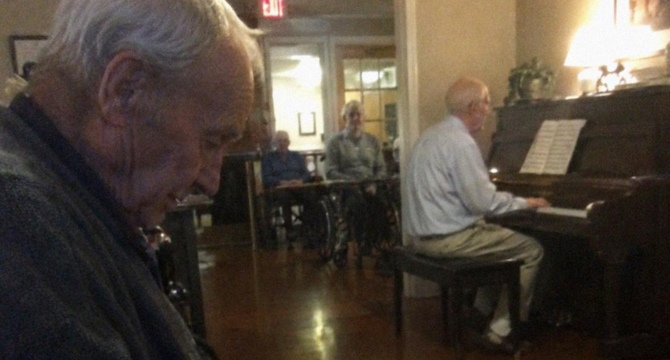
She led me into a large common room with armchairs, low bookshelves, and a television muttering in one corner. Near the window stood another piano, this one newer and shinier. An elderly woman was playing softly, her fingers trembling through a hymn I almost recognized.
Beside the piano sat a thin man in a cardigan, his hands folded in his lap, staring out the window.
“That’s Daniel,” the nurse said quietly.
I walked toward him, feeling ridiculous. I did not know what I expected.
When I reached him, he looked up at me with pale, distant eyes.
I held out the envelope.
“I think this belonged to your wife,” I said.
The change in his face was instant.
He did not need to read the front. He knew it from the paper alone. His fingers lifted slowly, shaking so badly I almost worried he would drop them. He touched the edge of the envelope like it might vanish.
Then he closed his eyes.
His mouth trembled.
He took one long breath, and for a second I thought the nurse had been wrong, because he looked exactly like a man standing on the edge of speech after years of silence.
But no words came. Only tears.
They slid down his face so quietly that it broke me more than sobbing would have.
I pulled a chair beside him and sat down.
He opened the letter. His eyes moved over the words. When he reached the last line, he let out a sound so raw and low that the woman at the piano stopped playing.
He pressed the letter to his chest.
“I’m sorry,” I whispered, though I did not even know what I was apologizing for.
At last, his lips moved.
“I lost it,” he said.
His voice was rough from disuse, barely more than air, but I heard it.
I stared at him. “The piano?”
He nodded once.
“I lost everything.”
That was all he said that day.
But it was enough to keep me coming back.
Over the next few weeks, I visited Daniel every other day, then almost every day. At first, we sat in silence more than we talked. He seemed to need somebody willing to stay without forcing anything out of him. Eventually, the silence loosened.
I learned that Eleanor had loved that piano so much that she made the family gather around it after dinner on Sundays.
She taught both their children on it.
She played Christmas carols in December, old jazz standards in summer, and the same silly little song whenever she was in a good mood and cooking too much food.
“I saved for nearly two years before I could afford it and buy it,” Daniel told me one afternoon.
After Eleanor got sick, the medical bills swallowed everything. When she died, Daniel could barely function. Their children pushed to sell the house.
He told me this flatly at first, then with anger, and then with grief so deep it seemed to hollow him out from the inside.
“They said it was practical,” he told me, gripping the arms of his chair. “They said it was too much for me, too expensive, and too many memories. As if memories were clutter. As if her things were just things.”
“What happened to the piano?”
He looked away.
“My son handled the sale. My daughter said we couldn’t keep every piece of the past.” His jaw tightened. “They let strangers walk through our home while her perfume was still in the closet.”
There was no drama in the way he said it. That made it worse.
“I told them she made me promise,” he said.
His eyes moved to mine.
“And I failed her.”
That night I went home and looked at the piano in my living room for a long time.
Then I made the worst practical and best emotional decision of my adult life.
I called a moving company.
The staff at Willow Creek thought I was slightly insane.
“You want to bring an actual full-size upright into the common room?” the same nurse asked.
“Yes.”
She crossed her arms, but she was smiling. “For him?”
“For him.”
It took planning, bribery, rearranging furniture, and a heroic amount of patience from two movers, but on a gray Thursday afternoon, the piano was rolled into Willow Creek under a blanket and unveiled in front of half the staff.
Daniel was in the dining room when they wheeled it in. A nurse went to get him.
I stood by the window trying not to look too invested, which was impossible because I was invested to an embarrassing degree.
He came through the doorway slowly with his walker.
At first, he did not understand what he was seeing.
Then he stopped so suddenly the nurse nearly bumped into him.
His hand flew to his mouth.
“No,” he whispered.
The room went still.
I stepped forward. “I brought her back.”
His eyes snapped to mine, wet already.
For one awful second, I thought maybe I had made a mistake. Maybe this was too much. Maybe grief reopening itself would only hurt him more.
Then he moved toward the piano like a man approaching a grave and a miracle at the same time.
His fingertips brushed the wood.
He traced the old water ring on top, the scratch near the left side, and the chipped corner of the music stand.
“Oh, Ellie,” he said, and his voice broke on her name.
He lowered himself onto the bench as if afraid it might disappear. He laid one hand on the keys. Then the other.
Nobody in the room moved.
The first notes came out hesitant, uneven.
Then he found the melody.
It was soft and old-fashioned and so full of ache that every person in that room seemed to lean toward it without meaning to.
Later, he told me he had written it for Eleanor on their tenth anniversary because he could not afford jewelry that year and thought maybe a song was the next best thing.
As he played, residents started gathering in the doorway. Nurses drifted in from the hall, and one woman began crying openly.
A man who never smiled started humming under his breath.
Daniel kept playing, tears running freely down his face.
When he finished, there was silence for half a heartbeat.
Then the whole room applauded.
He bowed his head and laughed through the tears. “She always said I rushed the middle section.”
I laughed too. “Was she right?”
He looked at me, and for the first time, I saw something bright in him. “Of course, she was right. It was Eleanor.”
What none of us knew then was that one of the younger nurses had recorded the whole thing on her phone and posted it online that night with a caption about a resident reunited with his late wife’s piano after years of silence.
By pure chance, Daniel’s daughter saw it.
She showed up two days later with her brother.
I happened to be there when they walked in.
His daughter, Laura, stood frozen just inside the doorway. She looked like she had been crying in the car but had not finished. His son, Michael, had the stiff, defensive posture of a man already braced for blame.
Daniel was at the piano, playing scales for hand strength.
He saw them and stopped.
The room changed.
Nobody said anything for a moment.
Then Laura whispered, “Dad?”
Daniel turned slowly on the bench.
She took a shaky breath. “I saw the video.”
He said nothing.
Michael stepped forward. “We should’ve come sooner.”
Daniel’s face hardened. “Yes.”
That one word cracked the air.
Laura started crying then, not politely, not quietly.
“We didn’t understand. We thought… we thought keeping the house was hurting you. We thought clearing things out would help.”
“Help how?” Daniel asked.
His voice was steady, but I could hear five years of swallowed pain inside it.
Michael rubbed a hand over his face. “We were scared. You weren’t eating or sleeping. You just sat in that house with the curtains closed. We didn’t know what to do.”
“So you sold her everything, including her piano.”
Michael looked down. “Yes.”
Laura shook her head, sobbing. “We were wrong.”
Daniel stared at them for so long that I almost left the room out of respect. But then he said, “You took the last place where I could still hear her.”
Laura made this awful, broken sound. “I know.”
He looked at her, then at Michael.
“I hated you for that.”
Michael nodded once, tears in his own eyes now. “I know.”
“No,” Daniel said. “I don’t think you do.”
That might have been the end of it once. Another family fracture. Another conversation, too late to save anything. But grief had already taken enough from them, and maybe the piano changed the air around all of us.
Maybe music does that, or it makes people braver than they wanted to be.
Laura knelt beside him.
“We lost Mom, too,” she said. “And we lost you right after. We didn’t know how to reach you. Every time we tried, it felt like you looked through us. I know what we did was cruel. I know it. But we were drowning too, Dad.”
Daniel’s face crumpled.
For a long time, nobody moved.
Then he whispered, “I was angry she left.”
Laura took his hand. “I know.”
“I was angry at all of you because you were still there but did not seem to understand my pain.”
Michael made a strangled sound and sat down hard in the nearest chair.
Daniel looked at both of them with the expression of a man finally too tired to keep carrying rage.
“I’m so tired,” he said.
Laura pressed her forehead to his knuckles and cried.
Michael came over then, and awkwardly, painfully, like people relearning a language they once knew by heart, they gathered around him.
I turned away because it felt too private to witness head-on.
A month later, Willow Creek organized a small concert in the common room. Residents requested songs. Daniel wore a pressed shirt and combed his white hair back. He played Eleanor’s anniversary melody first.
Then “Moon River,” because that had been her favorite.
Then a hymn for one resident, a jazz tune for another, and a ridiculous old camp song that made half the room sing along badly.
Laura and Michael sat in the front row.
After the concert, Daniel asked them to stay.
I was packing up paper cups near the snack table when I heard him say, “I don’t know how to fix all of it.”
Laura answered, “Maybe we don’t fix all of it at once.”
Michael nodded. “Maybe we just stop making it worse.”
Daniel looked at them, then at the piano.
“Your mother wanted this to stay in the family,” he said.
Laura wiped her eyes. “Maybe family can mean more than the same house.”
He considered that.
Then he gave the smallest smile. “You sound like her when you say things I don’t want to admit are wise.”
That made all three of them laugh, and just like that, the sound of their family no longer felt dead.
The piano stayed at the nursing home.
That part mattered to Daniel. He said Eleanor would have liked the idea of it filling rooms again instead of gathering dust in a stranger’s hallway. Every Thursday afternoon, he plays for the residents now.
Residents show up early. One man who never used to leave his room wheels himself down the hall twenty minutes beforehand to get the best spot by the window.
And me?
I still visit.
The truth is, I bought a piano because it was cheap and sad-looking.
I thought I was dragging home a piece of furniture.
Instead, I found a love story hidden between the keys. Not a perfect one or a neat one. The kind that survives illness, grief, bad choices, silence, and the terrible things families do when they think they are helping.
The kind that can disappear into dust and still somehow be waiting to be found.
That piano did not just give Daniel back a memory of his wife.
It gave him his voice back.
It gave his children a road back to their father.
And it gave a room full of strangers something beautiful to gather around every week.
Sometimes life changes because of huge decisions. People move across the country, leave marriages, quit jobs, survive accidents, and bury people they love.
And sometimes life changes because an old key sinks lower than the others, and a hidden letter slips into your hand.

 admin
admin