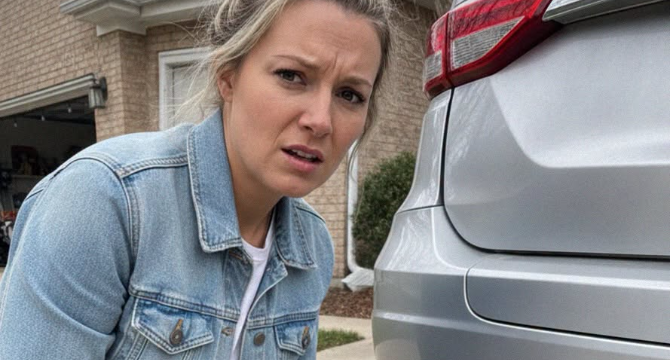
One strange clue on my husband’s car made months of little inconsistencies suddenly feel important. By 8:03 that morning, everything had changed.
“Oh, babe. You don’t know what you’re actually asking about.”
Ben said it so quietly that my anger disappeared for half a second.
“What does that mean?”
He stood beside the car, staring at the black strands wrapped around my hand.
Then he reached for them.
I pulled my hand back.
“Whose hair is this?”
“It’s not hair.”
I laughed.
“Ben.”
“I’m serious.”
He took a strand between two fingers and pulled.
It stretched slightly, then separated.
“Fiberglass.”
“What?”
“Muffler packing.”
I stared at him.
He pointed toward the exhaust.
“When the inside of a muffler starts breaking down, sometimes the packing blows out. It gets black from soot and looks like hair.”
I looked at the three-foot bundle in my hand.
“You expect me to believe this came from your muffler?”
“Yes.”
“Convenient.”
“I can show you.”
He opened the garage and grabbed a flashlight.
Our daughter, Sophie, appeared at the kitchen door.
“Did you find my purple bottle?”
“Not now, honey.”
“But—”
“Blue one today.”
She disappeared, deeply offended by this injustice.
Ben crouched behind the car and shone the light into the exhaust.
“See?”
I leaned closer.
There were more black fibers inside.
Not attached to a person.
Not evidence of some mysterious brunette rolling around in my husband’s car.
I should have felt relieved.
Instead, something about Ben’s expression bothered me.
“You knew exactly what it was.”
He stood.
“Yeah.”
“How?”
Silence.
There it was again.
That hesitation.
“Ben.”
“I’ve been having trouble with the car.”
“What trouble?”
“Nothing major.”
“Then why didn’t you tell me?”
“Because I handled it.”
“Where?”
He looked away.
My suspicion changed shape.
Not gone.
Changed.
“Where did you take the car?”
“Mike’s.”
Mike owned a repair shop 15 minutes away.
I knew him.
“You were at Mike’s?”
“Saturday.”
Saturday.
The four-hour errand.
I stared at him.
“You told me you were shopping.”
“I know.”
“Why?”
He rubbed the back of his neck.
“I didn’t want to worry you.”
I almost smiled because that sentence was so familiar.
Every bad conversation in our marriage seemed to begin with somebody deciding the other person did not need to worry.
“What is wrong with the car?”
“The muffler. Brakes soon. Transmission’s starting to slip.”
“How much?”
He did not answer.
“Ben, how much?”
“More than the car is worth.”
I folded my arms.
“So what did Mike say?”
“Sell it.”
“Okay.”
Something still wasn’t right.
“We can discuss getting another car tonight.”
Ben looked at me.
“No.”
“No what?”
“We can’t.”
I stared at him.
“Why?”
His face changed.
I had known this man for nine years.
Married him for seven.
I knew when he was annoyed, tired, lying about liking my mother’s lasagna, or pretending he remembered the name of someone from my office.
I had never seen the expression he wore then.
Shame.
Pure shame.
“Ben?”
He looked toward the kitchen window.
Sophie was inside, digging through the dishwasher for reasons known only to six-year-olds.
“We need to talk.”
My stomach dropped again.
“Are you having an affair?”
“No.”
“Then say whatever you’re trying not to say.”
He closed his eyes.
“I lost my job.”
For a moment, the words did not make sense.
“What?”
“I don’t work at Halpern anymore.”
“When?”
“January.”
It was April.
I actually laughed.
“No.”
“I’m sorry.”
“You went to work yesterday.”
“I know.”
“You left at 7:30 wearing a tie.”
“I know.”
“Where did you go?”
“Library. Coffee shop. Sometimes job interviews.”
I stared at him.
“You have been unemployed for three months?”
“Almost four.”
My hands went cold.
“Every morning you get dressed.”
“I know.”
“You pack lunch.”
“I know.”
“You complain about traffic when you get home.”
His voice dropped.
“I know.”
The black fibers fell from my hand onto the driveway.
Suddenly, the possible affair seemed almost simple.
An affair had rules in my imagination.
Anger.
Betrayal.
Someone else.
This was stranger.
He had been performing our normal life every morning.
“Why didn’t you tell me?”
“I thought I’d find something quickly.”
“For four months?”
“At first, I thought two weeks.”
“And when two weeks became two months?”
“I kept thinking the next interview would work.”
“Ben.”
“I was ashamed.”
I looked at him.
“We have a mortgage.”
“I know.”
“We have Sophie.”
“I know.”
“We have bills.”
“I handled them.”
That sentence scared me.
“How?”
He went silent.
I felt something inside me tighten.
“How did you handle the bills?”
“Can we take Sophie to school first?”
“No.”
“Laura—”
“How?”
He looked toward the house.
Then back at me.
“I used savings.”
“Our emergency account?”
“Some.”
“Some?”
He did not answer.
I walked inside.
“Laura.”
I ignored him.
Sophie was standing beside the toaster with her backpack on.
“Mom, I found the purple one.”
“Great.”
She smiled.
Then she saw my face.
“Are you mad?”
“Not at you.”
Ben came in behind me.
I grabbed my laptop from the counter.
“Can we not do this in front of her?”
I looked at him.
That was the first thing he had said that morning that I agreed with.
I got Sophie into the car.
Ben drove her to school because I no longer trusted myself behind the wheel.
At 7:42, he came back.
I was sitting at the kitchen table with our bank account open.
The emergency savings were nearly empty.
We had had $24,600.
There was $3,114 left.
I turned the laptop toward him.
“Where is 21,000 dollars?”
“Mortgage. Utilities. Insurance.”
“For four months?”
“And credit cards.”
“What credit cards?”
He sat down.
That was when I knew there was more.
“What credit cards, Ben?”
“I opened two.”
“In your name?”
He hesitated.
One second.
That was all it took.
I stood.
“In whose name?”
“Ours.”
My mouth went dry.
“I didn’t apply for any credit cards.”
“I know.”
“You used my information?”
“I had to list household income.”
“Did you sign my name?”
“I filled out the applications online.”
“Did you sign my name?”
His silence answered.
I pulled off my wedding ring.
Ben’s face went pale.
“Laura.”
I set it beside the toaster.
The clock on the oven read 8:03.
Less than an hour earlier, I had been furious because I thought another woman’s hair was hanging out of his exhaust.
Now I almost wished that had been the problem.
“How much do we owe?”
“About 18.”
“Thousand?”
He nodded.
My vision blurred.
“So 21,000 thousand from savings and eighteen thousand on cards.”
“I’m interviewing.”
“That isn’t what I asked.”
“I know.”
“Anything else?”
He rubbed both hands over his face.
“Ben.”
“I borrowed against my retirement account.”
I sat down.
“How much?”
“Twelve.”
I stopped counting.
Maybe my brain was protecting me.
Maybe numbers stopped meaning anything after a certain point.
“Why?”
“I was trying to keep everything normal.”
“For who?”
“For you. Sophie.”
“No.”
He looked up.
“You were keeping it normal for yourself.”
His face tightened.
“That’s not fair.”
“Fair?”
I pointed toward the laptop.
“You lied to me every single morning for almost four months.”
“I was trying to fix it.”
“You forged my name.”
“I knew you’d panic.”
That sentence changed the room.
I stared at him.
“You knew I’d panic.”
“I didn’t mean—”
“So you took away my ability to make decisions because you didn’t like what my reaction might be.”
“That’s not what I was doing.”
“Then what were you doing?”
He had no answer.
I started crying.
Not loudly.
That made Ben cry too.
He reached across the table.
I pulled my hand away.
“Don’t.”
He sat back.
“Why were you fired?”
He froze.
I almost laughed.
“There is more.”
“No.”
“Why were you fired?”
“I was laid off.”
“That’s not what I asked.”
He looked down.
“Technically, I was terminated.”
I felt sick.
“For what?”
Ben worked as operations manager for a regional distribution company.
For years, he had complained that his boss pushed employees too hard.
Long shifts.
Skipped breaks.
Constant pressure over numbers.
In December, Ben changed several performance reports before sending them to corporate.
My stomach dropped.
“You falsified reports?”
“I changed productivity numbers.”
“Why?”
“Because people were about to lose their jobs.”
I stared at him.
His team had fallen behind during the holidays after several employees got sick.
Management threatened terminations.
Ben adjusted the numbers to hide how bad the delays were.
Someone caught it.
“They fired you.”
“Yes.”
“Why didn’t you tell me that?”
“Because I knew what you’d say.”
“What would I say?”
“That I was stupid.”
I shook my head.
“I would have said you made a serious mistake.”
“Same thing.”
“No, Ben. It isn’t.”
That distinction seemed to surprise him.
I walked to the window.
For months, he had come home telling me stories about work.
A broken loading dock.
A new supervisor.
A ridiculous meeting about dress codes.
“Were all those stories lies?”
“Some were old stories.”
I turned around.
He actually looked embarrassed admitting that.
“You recycled work stories?”
“I didn’t know what else to say.”
I laughed through my tears.
“That’s almost impressive.”
“I’m sorry.”
“Stop saying that.”
He flinched.
“Sorry is what you say when you forget milk.”
“I don’t know what you want me to say.”
“The truth would have been nice in January.”
Silence.
Then I asked, “Who knew?”
His face told me there was an answer.
“Who?”
“My brother.”
I closed my eyes.
“Jason knew?”
“Since February.”
“And your mother?”
“Not everything.”
“Meaning she knew you lost your job.”
“Yes.”
I laughed again.
Everyone except me.
The wife sharing a mortgage with him.
The person whose name he put on debt.
I picked up my phone and called my mother.
Ben looked hurt.
I did not care.
“Mom?”
She answered cheerfully.
I started crying before I could speak.
Within 40 minutes, she was at the house.
Ben packed a bag.
He did not argue when I asked him to stay with Jason.
Before leaving, he stood beside the kitchen counter.
He looked at my ring.
“Are we done?”
I stared at it too.
“I don’t know.”
That was the truth.
He nodded.
Then he left.
The next week was humiliating.
Not publicly.
Financially.
I spent hours opening accounts I thought I understood.
I ran my credit report.
Found both cards.
Found one missed payment Ben had hidden by changing the notification email.
I called the mortgage company.
Our insurance.
The bank.
A financial counselor.
Then a lawyer.
I needed to understand exactly what had happened in my name.
Ben gave me every password.
Every statement.
Every email.
He did not fight me.
That mattered.
It did not erase anything.
But it mattered.
The hair?
Mike confirmed it was muffler packing.
He actually held up a piece from another broken muffler and said, “You wouldn’t believe how often people think this is hair.”
I almost started laughing in his garage.
Then I cried.
Poor Mike stood there holding dirty fiberglass, clearly regretting every decision that had led him to that moment.
Ben and I separated for three months.
He found another job six weeks later.
Less money.
Longer commute.
He took it.
He also started therapy.
Not because losing his job had traumatized him.
Because apparently shame had been controlling him long before January.
His father had lost their family home when Ben was thirteen.
For almost a year, his father pretended everything was fine while hiding bills from his mother.
I knew the family had struggled.
I didn’t know the details.
When Ben finally told me, I stared at him.
“You did exactly what he did.”
He cried.
“I know.”
That realization broke something open in him.
His father had hidden financial disaster because he believed providing meant never admitting failure.
Ben had spent his whole adult life promising himself he would never become that man.
Then the first time he felt like he was failing us, he copied him almost perfectly.
That explained it.
It did not excuse it.
We went to marriage counseling.
For months, I refused to wear my ring.
Ben never asked me to.
That helped.
I made rules.
No hidden accounts.
No debt without both signatures.
Monthly credit checks.
Full access to everything until I felt safe again.
Ben agreed.
Then I made one rule that had nothing to do with money.
“If something terrible happens, you tell me before you try to save me from it.”
He nodded.
“No deciding what I can handle.”
“Okay.”
“No fake work stories.”
He almost smiled.
“Definitely no fake work stories.”
Eight months after that Tuesday, I put my wedding ring back on.
Not because everything was fixed.
Because I had decided I wanted to keep trying.
There is a difference.
We are still rebuilding the savings.
The stupid car is gone.
Mike bought it for parts.
Sometimes I joke that the muffler saved our marriage.
Ben says that is a very generous interpretation.
Maybe it is.
Because the muffler did not save anything.
It just exposed something.
At 7:14 that morning, I thought I was holding proof my husband had been with another woman.
I wasn’t.
I was holding dirty fiberglass from a dying exhaust system.
But my instincts were not entirely wrong.
Something had been wrong for months.
Late nights.
Private calls.
Saturday disappearances.
The uneasy feeling that the story I was being given did not quite match the life I was seeing.
There was no other woman.
There was something I had not expected instead.
A husband so terrified of looking like a failure that he turned our marriage into a performance and called it protection.
I used to think betrayal had to involve another person.
Now I know sometimes betrayal is being denied reality inside your own home.
Ben lost his job.
That was a problem we could have survived together.
The debt was harder.
The forged applications were worse.
But the thing that nearly ended us was simpler.
He decided I could not be trusted with the truth.
These days, when something goes wrong, we say it immediately.
The dishwasher leaks.
A bill is higher than expected.
His company announces layoffs.
I get scared.
He gets scared.
We tell each other anyway.
Because that Tuesday taught us something expensive.
You cannot protect a marriage by hiding the thing threatening it.
You only make sure your spouse meets the disaster later, alone.
And yes, I still have the photograph of the black strands hanging from Ben’s exhaust.
Sometimes my phone shows it in old memories.
Three feet of filthy fibers.
The evidence of an affair that never happened.
And somehow, still the clue that uncovered everything.

 admin
admin