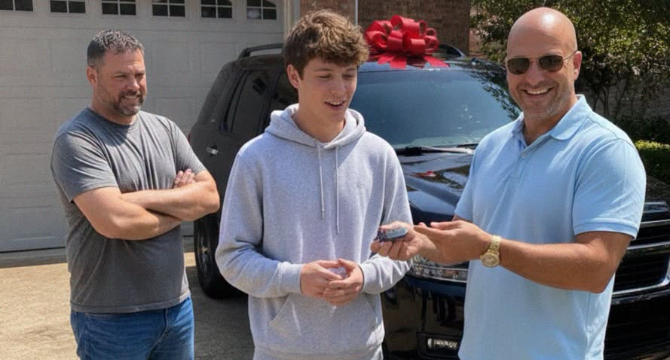
My biological father came back on my 17th birthday determined to prove he could outdo the man who’d raised me. He thought one expensive gift would settle it. Then I went inside and brought something out to the driveway.
“Come on, son. Your stepdad could never compete with this.”
Then he held out the keys and waited for me to thank him.
I hadn’t seen my father in 14 years.
He left when I was three.
For most of my childhood, it was Mom and me, and money was the thing we talked about most without actually talking about it.
I knew when the electric bill was late because Mom stopped buying coffee.
I knew new sneakers meant we weren’t ordering pizza that month.
By 13, I’d learned to stop asking for things before Mom had to say no.
Then she met Ray when I was 15.
Ray came with two kids of his own.
Danny was 11. Cara was nine. They stayed with us every other weekend, which meant our tiny house suddenly held five people, three backpacks by the door, and approximately nine thousand dirty cups.
Ray paid child support.
Mom still worked overtime.
Money didn’t magically get better.
But Ray never once made me feel like I was the extra mouth causing the problem.
He came to my football games.
Every one.
Even the season I barely left the bench.
Once, after a game where I played for maybe four minutes, I found him standing by the fence.
“You know I didn’t really play, right?”
“I saw.”
“You sat there for two hours.”
“Yeah.”
“Why?”
Ray looked confused.
“Because you were here.”
That was Ray.
No speeches.
No promises.
He just kept appearing.
When I nearly failed chemistry, he sat beside me at the kitchen table until nearly midnight, even though he understood the periodic table less than I did.
At one point I said, “You’re literally making this worse.”
“Probably.”
“Then why are you still here?”
“Because parents don’t get to quit before their kids do.”
Parents.
He didn’t seem to notice he’d said it.
I did.
A few months later, Mom married him.
That fall, she told me something I wasn’t supposed to know.
She and Ray had opened a college account for me.
“We can’t put much in,” she said. “Don’t get excited.”
“How much?”
“Whatever’s left.”
Some months, that meant almost nothing.
Ray had Danny and Cara to provide for, too.
So I tried not to think about the account.
At school, everyone was thinking about something else.
Cars.
One friend got his aunt’s old Honda.
Another got a pickup.
A girl in my English class got a used convertible and complained that it wasn’t the color she’d wanted.
I took the bus.
It honestly didn’t bother me much.
You get good at not wanting things when you know exactly what they cost.
On the morning I turned 17, Ray knocked on my bedroom door at seven.
“You’re up.”
“You woke me.”
“Same thing.”
He was holding a rectangular wooden box.
It wasn’t perfect.
One corner sat slightly higher than the others, and I could see where he’d sanded down a mistake near the latch.
But the wood was dark and smooth, and my initials were burned into the lid.
“J.M.”
“You made this?”
“In the garage.”
“That’s what you’ve been doing out there?”
“For about six weeks.”
I opened it.
Inside was a stack of bank statements tied with a piece of string.
My college account.
I looked at him.
“Mom told me about this.”
“Your mother has never successfully kept a secret.”
Then I noticed handwriting on the back of the top statement.
Ray’s.
Boots can wait: $40
I turned to the next.
Brought lunch all week: $25.
Then another.
Truck service next month: $60.
I looked up.
“What is this?”
Ray suddenly looked embarrassed.
“Nothing.”
“You wrote on all of them?”
“I was keeping track.”
“Of what?”
He rubbed the back of his neck.
“I don’t know. Just wanted you to see someday that even when it wasn’t much, we were still getting somewhere.”
I pulled out another statement.
Sorry, kid. Tight month: $15.
Then one that made me stop.
Danny needed new glasses. I’ll make it up next month: $0.
The following month.
Doubled up this month: $80.
“You didn’t have to do this.”
“Yeah.”
“Then why did you?”
He shrugged.
“College isn’t cheap.”
That wasn’t an answer.
Before I could tell him that, Mom called from downstairs.
“Birthday breakfast!”
Ray escaped immediately.
I stayed on my bed with the box.
Fourteen months since they’d opened it.
Some deposits were 80 dollars.
Some were 20.
One was five.
And one was nothing.
But there wasn’t a single month Ray hadn’t written something.
At the bottom was a folded piece of paper.
Not a bank statement, a note.
I opened it.
“Kid,”
“It isn’t enough yet.”
“We’ll keep going.”
“Ray.”
That was it.
A short note carrying more weight than Ray probably realized.
It was the best birthday present I’d ever gotten.
Three hours later, somebody knocked on our front door.
Mom answered.
I was in the kitchen.
I heard her say, “What are you doing here?”
Then a man’s voice answered.
“I came to see my son.”
I froze.
Ray came out of the garage.
Mom looked at me before stepping aside.
The man standing on our porch was taller than I expected.
Nice jacket.
Expensive watch.
Gray beginning at his temples.
I knew him immediately anyway.
There were three old photographs of him in a box in Mom’s closet.
He smiled.
“Look at you.”
I couldn’t move.
“Happy birthday, son.”
Son.
Fourteen years without a birthday card, and suddenly I was son.
“Why are you here?”
His smile faltered.
“I know I’ve got explaining to do.”
“Fourteen years of it.”
Mom said my name softly.
But he nodded.
“You’re right.”
Then his smile returned.
“But I figured today wasn’t the day for excuses. Today’s for you.”
He put his hand on my shoulder.
I almost pulled away.
“Come outside.”
“Why?”
“You’ll see.”
He led me toward the driveway.
That’s when I saw the bow.
A huge red one.
Underneath it was the brand-new black car he’d arrived in. For a second, I genuinely couldn’t understand what I was looking at.
Then my father lifted a set of keys.
“Happy birthday.”
I stared at them.
“That’s mine?”
“Paid for.”
Mom came onto the porch.
Ray stayed behind her.
His hands disappeared into his pockets.
My father noticed him.
And something in his expression changed.
This wasn’t only a gift.
It was an audience.
He held the keys higher.
“Go ahead.”
I still didn’t move.
His smile widened.
“Come on, son.”
Then he looked directly at Ray.
“Your stepdad could never compete with this.”
Ray looked down.
And through the open front door behind him, I could see the wooden box sitting on our kitchen table.
I looked at the car.
Then the keys.
Then the man who had been at my house for ten minutes after being gone for 14 years.
I walked straight past his open hand.
“Ray.”
Ray looked up.
“Come here a second.”
Ray didn’t move.
“This is between you and him,” he said.
My father laughed.
“Smart man.”
I looked at Ray.
“Please.”
That brought him off the porch.
My father jingled the keys.
“What’s going on? You don’t like the color?”
I turned toward him.
“I want to ask you something.”
“Sure.”
“What position do I play?”
His smile stayed there for half a second too long.
“Football.”
“What position?”
He looked toward Mom.
She said nothing.
“Come on. I haven’t exactly had a chance to catch up yet.”
“Okay.”
I nodded.
“What college am I applying to?”
His jaw tightened.
“Your mother kept me out of your life.”
Mom inhaled sharply.
I held up my hand.
One more.
I pointed at Ray.
“What subject almost kept me from passing last year?”
My father stared at me.
“How would I know that?”
“You wouldn’t.”
Across the street, Mrs. Patterson had stopped watering her flowers.
I didn’t care.
My father held the keys toward me again.
“Look, I know I missed things. That’s why I’m here. I’m trying to make up for it.”
“With a car?”
“It’s a pretty good start.”
He glanced at Ray.
“Better than anything he got you, I’d bet.”
I looked toward the house.
“Wait here.”
I went inside.
The wooden box was still on the kitchen table.
When I carried it outside, Ray’s face changed.
“Jake.”
I ignored him.
My father looked at the box.
“What’s that?”
“My birthday present.”
He actually laughed.
“That’s what he gave you?”
Ray’s face went red.
I opened the lid.
“No.”
I lifted out the statements.
“This is.”
My father frowned.
I handed him the first one.
He read the deposit.
“Forty dollars?”
“Turn it over.”
He did.
“Boots can wait.”
I handed him another.
“Truck service next month.”
Then another.
“Brought lunch all week.”
My father’s smile disappeared.
“What is this?”
“My college account.”
“Okay.”
“Ray and Mom opened it.”
I found the statement I wanted.
“Danny needed new glasses. I’ll make it up next month.”
Then the next one.
“Made up the $40 I missed, plus this month: $80.”
I held them out.
“Those are Ray’s kids. Danny and Cara.”
My father said nothing.
“He pays child support. He helps Mom with our bills. And every month, he still puts something away for me.”
Ray finally spoke.
“Jake, that’s enough.”
“No.”
I turned to him.
“And you called this nothing this morning.”
“It wasn’t supposed to be a big deal.”
“You needed work boots.”
“My boots were fine.”
“One of them has duct tape on it.”
“They’re comfortable.”
Even Mom laughed at that, though she was crying.
I looked back at my father.
The new car gleamed behind him.
It probably cost more than everything Ray had deposited.
That was the point my father had expected me to understand.
Instead, I finally understood the opposite.
“You bought that car with money you had.”
I held up Ray’s statements.
“Ray built my future with money he needed.”
My father’s face hardened.
“You think this guy loves you more than your own father?”
I stared at him.
“You don’t know what position I play.”
“Because I wasn’t allowed to.”
“You knew where we lived.”
He opened his mouth.
“You knew where we lived. You knew my birthday. You found me today. So don’t tell me you couldn’t reach me.”
Nothing.
“You could’ve sent a card.”
His eyes shifted toward Mom.
“You don’t know what happened between your mother and me.”
“Then tell me.”
“This isn’t the place.”
“You had 14 years to find one.”
He looked around at the neighbors.
For the first time since he’d arrived, he seemed embarrassed.
Good.
Then he tried the keys again.
“Take the car, Jake.”
I looked at them.
I had wanted a car. Of course I had.
I’d imagined driving to school instead of standing at the bus stop in the rain.
I’d imagined picking up my friends.
I’d imagined freedom.
And the car looked incredible. Black paint gleaming in the sun. Brand-new interior. Not somebody’s old hand-me-down, but the kind of car I’d never even let myself imagine owning.
For a second, I wanted those keys badly.
But then all I could see was Ray in old work boots.
Ray eating packed lunches.
Ray postponing repairs on the truck he needed to get to work.
Five dollars.
Fifteen.
Forty.
Whatever he had.
Again and again.
My father pushed the keys toward me.
“You deserve something nice.”
I took them.
Relief crossed his face.
Then I closed his fingers around them.
“I’ve wanted a car for two years.”
I looked at Ray.
“I wanted a dad for 14.”
Nobody moved.
I looked back at my father.
“I’m not waiting anymore.”
His face went blank.
“You’re choosing him?”
“No.”
I shook my head.
“He chose me.”
My father stared at Ray.
Ray didn’t look proud.
He looked miserable.
Because that was Ray.
He hadn’t wanted to beat anybody.
He hadn’t known there was a competition until somebody showed up and announced one.
My father pulled his hand away.
“You’re 17. You don’t understand everything.”
He looked at Mom.
“You’ve done a hell of a job turning him against me.”
Mom stepped forward.
“No. I never kept you away. I spent years making excuses for you.”
His face changed.
She continued.
“Maybe your card got lost. Maybe you didn’t have our number. Then I stopped because he was old enough to know I was lying.”
I hadn’t known that.
Mom wiped her cheek.
“Don’t blame me because another man did what you kept choosing not to do.”
My father looked at me one last time.
“That car will still be here if you change your mind.”
“No.”
“What?”
“It won’t.”
I nodded toward it.
“You’re taking it with you.”
He did.
He ripped the bow off first.
I don’t know why that detail stayed with me.
Maybe because it was the first thing he’d done all day that wasn’t for an audience.
He threw it into the back seat, got behind the wheel, and drove away.
The neighbors suddenly became very interested in their own yards.
Mom went inside.
I turned toward Ray.
He was already walking away.
“Where are you going?”
“Kitchen.”
“Why?”
“Dishes.”
Of course.
Ten minutes after my biological father tried to buy his way back into my life, Ray was standing at our sink washing syrup off birthday-breakfast plates.
I put the wooden box on the counter.
“You know we have a dishwasher.”
“Don’t trust it.”
“You repaired it.”
“Exactly. I know who repaired it.”
I stood beside him.
“Ray.”
He kept scrubbing.
“What?”
“Look at me.”
“Busy.”
“You’re washing a clean plate.”
He looked down, then put it in the rack.
“Next plate.”
I knew then.
He was trying not to cry.
So naturally, I made it worse.
“Thank you.”
“For what?”
“The box.”
“Sure.”
“And the account.”
“Your mom puts money in too.”
“I know.”
“And we’re not anywhere near paying for college, so don’t go applying to some castle.”
“Ray.”
He finally stopped.
“You didn’t have to do any of that.”
“Yeah.”
“Then why did you?”
For once, he didn’t have a joke ready.
He stared into the sink.
Then shrugged.
“You’re my kid.”
That was it.
No “son.”
No speech.
No hand on my shoulder.
Just three words from a man who had spent nearly two years acting like they were obvious.
I hugged him.
He froze.
We weren’t really a hugging family.
Then his wet hands landed awkwardly against my back.
“You’re getting dishwater on me.”
“You’re the one who started this.”
I laughed.
So did he.
A month later, Ray finally bought new work boots.
I know because I went with him.
When he tried to choose the cheapest pair, I made him get the good ones.
The college account kept growing.
Slowly.
Some months there was $100.
Some months $20.
Ray eventually stopped writing what he’d sacrificed on the statements after I told him it made me feel guilty.
Instead, he started writing about me.
Passed chemistry somehow – $50.
Scored a touchdown – $30.
Then one month: Proud of you, kid – $100.
I kept that one.
I kept the wooden box too.
My biological father did contact me again.
Not right away.
And there was no car the next time.
But he never again insulted Ray in front of me.
Maybe he finally understood why.
The most expensive birthday present anyone had ever offered me disappeared down our street before dinner.
The wooden box is still mine.
For years, I’d believed fatherhood was something biology either gave a man or didn’t.
Ray taught me otherwise.
One man came back wanting me to see what he could give me.
The other had spent nearly two years giving when nobody was looking.
A pair of boots that could wait another month.
A football game where I never left the bench.
Chemistry homework he couldn’t understand.
None of those things looked impressive with a red bow on top.
Together, they were worth more to me than a car.
Because my biological father came back calling me “son” as loudly as he could.
Ray never needed to.
He just looked down at a sink full of dishes and said the words he’d already been proving every day.
“You’re my kid.”
And by then, I knew I was.

 admin
admin