My brother Rob was 17 when he disappeared.
I was 11.
That meant I was old enough to remember him clearly, but young enough to believe, for a while, that missing people could simply walk back through the front door if everyone waited hard enough.
Rob was not the kind of boy people expected to vanish.
He was funny, protective, and impossible to beat at any game involving a deck of cards.
He taught me how to ride a bike by running behind me down Maple Street, shouting, “I got you, Nate!” long after he had already let go.
He was the person I ran to when our parents fought.
The person who slipped me cookies before dinner.
The person who once punched a senior named Travis for shoving me into a locker.
“Nobody messes with my brother,” he told me afterward.
Then one afternoon, he left our parents’ house to meet friends downtown.
He never came back.
There was no goodbye, no notte, and no phone call.
The police searched for months.
Volunteers combed forests, rivers, and abandoned buildings. Posters with his senior picture went up in gas stations and grocery stores.
My mother went door to door until her voice disappeared.
Nothing.
Eventually, everyone reached the same heartbreaking conclusion.
He was gone.
But my mother never did.
She kept his bedroom exactly the way he left it. Same navy comforter. Same basketball trophies. Same stack of comic books on the nightstand.
Every Christmas, she set an extra plate.
My father asked her to stop once.
She looked at him and said, “If he ever comes home, I don’t want him thinking we forgot him.”
He never asked again.
Years passed. My father died without knowing what happened to his oldest son.
Meanwhile, my mother grew smaller, softer, and more stubborn about hope.
I grew up around an empty chair.
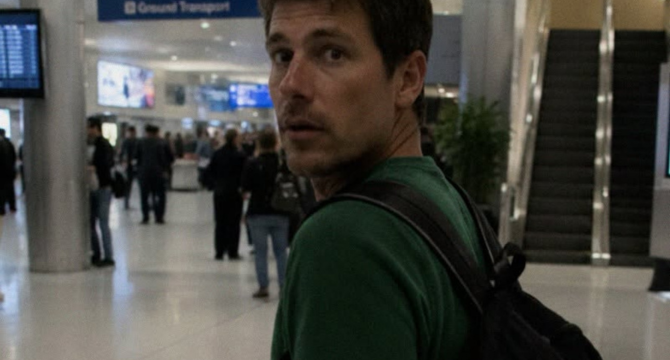
Then, last month, I had a layover at Denver International Airport.
I was flying home from a work conference, tired and annoyed, standing in line for coffee with one hand on my suitcase and the other scrolling through messages from my wife.
Someone brushed past me.
I looked up, and every hair on my arms stood up.
The man was older, of course. His shoulders were broader. His hair was threaded with gray. But the walk was the same. So was the tilt of his head.
Then he turned slightly.
I saw the small scar above his left eyebrow.
Rob had gotten that scar falling off our garage roof when he was 13 and trying to prove he could jump into a pile of leaves.
My mouth went dry.
Before I could think, I shouted his name.
“Rob!”
The man froze.
Slowly, he turned toward me.
For one impossible second, our eyes met.
Recognition flashed across his face, and his lips parted.
I thought he might say my name.
Instead, he whispered, “No.”
Then he ran.
Not walked.
Not hurried.
Ran.
I dropped my suitcase and chased him through the terminal.
“Rob!” I shouted. “Rob, stop!”
People jumped out of the way.
Someone cursed as I slammed into their rolling bag.
Rob moved fast for a man in his 40s, cutting past a family, down a moving walkway, and then toward an escalator.
I barely kept him in sight.
He rushed through a restricted exit.
An airport security officer grabbed my arm.
“Sir! You can’t go through there!”
“I know that man!” I shouted.
“He’s my brother!”
The officer looked confused.
“I need to stop him!”
The officer glanced toward the security cameras.
Then suddenly let go of my arm.
His expression changed.
He pressed a hand to his earpiece and listened for several seconds.
Then he looked back at me.
Very quietly, he asked, “Sir… are you absolutely certain that’s your brother?”
“Yes!”
The officer swallowed.
Then said something that made my heart stop.
“That man works here.”
I stared at him.
“What?”
“He used an employee access corridor. He’s not a passenger.”
“No. That’s not possible.”
The officer’s eyes softened, but his posture stayed guarded.
“What’s your brother’s name?”
“Robert. Rob. He disappeared 23 years ago.”
The officer said nothing for a moment.
Then he asked, “Do you have identification? A missing-person report? Anything that proves who you’re talking about?”
“I was 11 when he vanished. I don’t carry a missing-person file in my briefcase.”
“I understand, sir.”
“No, you don’t. He looked at me like he knew me.”
The officer took me to a small airport security office. I gave a statement. Another officer asked me questions that made me feel both desperate and foolish.
Could I be mistaken?
Was I under stress?
Had I seen recent photos of my brother?
I almost laughed at that last one.
There were no recent photos of Rob.
Only frozen ones.
Seventeen forever.
Before I left, the first officer pulled me aside.
“I can’t give you employee information,” he said.
“I need his name.”
“I can’t.”
“Please.”
He glanced toward the hallway.
Then he lowered his voice.
“I’ll say this. The man you chased has worked contract maintenance at this airport for years under a different name.”
My throat tightened.
“What name?”
He shook his head. “I can’t help more than that.”
“You already have.”
I flew home that night without remembering the flight.
My wife, Melissa, picked me up at the airport. The second I got in the car, she knew something was wrong.
“Nate?”
“I saw Rob.”
She blinked.
“What?”
“I saw my brother.”
She pulled to the curb so fast the car behind us honked.
I told her everything.
When I finished, she sat with both hands on the steering wheel.
“Are you sure?”
I looked at her.
She nodded immediately. “Okay. Sorry. I had to ask once.”
“I know.”
“What are you going to tell your mom?”
That was the question I had been avoiding since Denver.
My mother was 72. Her heart was weak. Hope had kept her alive and nearly destroyed her at the same time.
“I can’t tell her until I know.”
So I hired a private investigator.
Her name was Marisol, and she had a way of listening that made silence feel useful.
“Twenty-three years is a long time,” she warned me.
“I know.”
“And if he legally changed his name, we need a path. School records. Court filings. Social Security traces. Anything.”
“I have his birth certificate. Old police files. Photos.”
“Good. We’ll start there.”
Two weeks later, she called me.
“I found something.”
My hand tightened around the phone.
“Is he alive?”
“Yes.”
The word nearly took my knees out.
Marisol continued before I could speak.
“Your brother turned 18 six weeks after he disappeared. Shortly after that, a name change was filed in Wyoming. Robert became Michael.”
“Ward?”
“That name appears in an obituary from the same year. A man named Daniel died of pancreatic cancer. He listed one surviving son named Michael.”
My mind went blank.
“Rob didn’t have another father.”
Marisol was quiet.
“Nate, I think he did.”
I drove to my mother’s house that night.
I found her in the kitchen, wrapping leftover banana bread in foil. Rob’s extra Christmas plate was still in the china cabinet, visible through the glass.
“Mom,” I said. “I need to ask you something.”
She looked up.
“Is this about your brother?”
I froze.
Her face changed.
After 23 years, hope had made her sensitive to every shift in a room.
“What happened?” she asked.
I placed the printed obituary on the table.
“Who was Daniel?”
Her hand flew to her mouth.
That was answer enough.
“Mom.”
She sat down slowly.
“I was 18,” she whispered. “Before your father. Before this house. Daniel was my first love.”
“Was Rob his son?”
She closed her eyes.
“Yes.”
That word split my life into before and after.
“Did Rob know?”
Her tears came quietly.
“He found out.”
“When?”
“A few months before he disappeared.”
“How?”
“He found old letters in the attic. I should have thrown them away, but I couldn’t.”
I gripped the back of a chair.
“You knew he left to find his father?”
“No.” Her voice broke. “Not at first. He confronted me. He was furious. I told him Daniel had left before he was born. That your father loved him. That biology didn’t change anything.”
“But it changed something to him.”
She nodded.
“He asked for Daniel’s address. I refused.”
“Why?”
“Because I was afraid.”
“Of what?”
“Of losing him.”
I stared at her.
“You lost him anyway.”
She flinched as if I had struck her.
I regretted it, but not enough to take it back.
“Did Dad know?”
“Yes.”
That hurt almost as much.
“He raised Rob as his own,” she said. “He loved him.”
“Then why hide it?”
“Because we told ourselves love was enough.”
I thought of Rob at 17, angry and betrayed, holding letters that proved his whole life had a missing chapter.
“Mom,” I said, my voice shaking, “I saw him.”
She stopped crying.
“What?”
“In Denver. At the airport. He ran from me.”
She pressed both hands to her chest.
“My baby is alive?”
I knelt beside her chair.
“Yes.”
She sobbed then.
“Find him,” she said. “Please, Nathan. Find your brother.”
He lived outside Denver, worked maintenance contracts at the airport, and had a wife named Anna and two teenage daughters.
“He has a life,” Marisol said carefully.
“So did we.”
“I know.”
I flew back to Denver alone.
I did not go to his house first. That felt like an ambush.
Instead, I waited outside a small repair shop listed under his contract business. At 5:20 p.m., a white van pulled into the lot.
Rob stepped out.
For a second, I was 11 again.
Then he saw me.
He stopped.
This time, he did not run.
“Rob,” I said.
His face twisted.
“It’s Michael now.”
“Not to me.”
He looked away.
I crossed the lot slowly.
“Are you going to run again?”
He let out a broken laugh.
“I thought about it.”
“Why did you?”
At first, he said nothing.
Then he looked at me with eyes I had known as a child and missed as a man.
“Because for 23 years, I imagined that moment.”
“Seeing me?”
“Seeing any of you. I imagined what I’d say. I imagined apologizing. I imagined Mom yelling. I imagined you hitting me.”
“I still might.”
He almost smiled.
“I never imagined it would happen while I was buying coffee in an airport.”
My anger cracked, but only a little.
“You ran like I was chasing you with a weapon.”
“You were,” he said quietly. “You had my old name.”
That silenced me.
He leaned against the van.
“When you shouted ‘Rob,’ everything I had buried stood up at once. I panicked. I thought if I stopped, if I let you say one more word, I wouldn’t be able to keep walking.”
“Good.”
He looked at me.
“You shouldn’t have kept walking for 23 years,” I said.
His face crumpled. “I know.”
“Do you have any idea what you did to us?”
“Yes.”
“No, you don’t.”
“I do,” he said, voice breaking. “Every Christmas. Every birthday. Every time I saw a boy with his little brother. Every time my daughters asked if I had family besides their grandmother’s side.”
“You have daughters?”
He nodded.
“Two.”
“Do they know about us?”
“No.”
That hurt.
“Of course.”
“I wanted to tell them,” he said.
“But you didn’t.”
“No.”
We sat on the curb outside the shop like two strangers waiting for a bus.
Finally, he told me the story.
He had found letters from Daniel in the attic. Love letters. Medical records. A photograph of a young man holding baby Rob.
When he confronted Mom, she admitted the truth but refused to tell him where Daniel was.
Rob found the address himself.
“Daniel was dying,” he said. “Pancreatic cancer. He had written Mom because he wanted to meet me before it was too late. She never answered.”
“He told you that?”
“He showed me copies.”
Rob had left home intending to be gone for two days. He took a bus to Wyoming. Daniel was thin, weak, and terrified that Rob would hate him.
“I didn’t,” Rob whispered. “I hated Mom. Dad. Everyone who knew.”
Daniel died five weeks later.
Rob turned 18 shortly after.
“By then, I had missed posters all over town,” he said. “I called home once.”
My heart stopped.
“What?”
“I blocked the number. Mom answered. She sounded destroyed. I hung up.”
“Why?”
“Because I was ashamed. Because I had stayed too long. Because I wanted to punish her and then realized I had punished all of you.”
“So you changed your name.”
“I used Daniel’s last name. I told myself I needed to become the person they had hidden from me.”
“And us?”
His eyes filled.
“I told myself I’d come back when I could explain. Then a month became a year. A year became five. After that, returning felt less like coming home and more like walking into a funeral I had caused.”
I stared at him.
“You did cause one.”
He nodded.
“I know,” he said quietly.
I wanted to hate him cleanly.
But grief is never clean.
“Did you ever help Mom?” I asked.
His eyebrows drew together.
“What do you mean?”
“Her medical bills,” I said. “We got anonymous payments after her surgery. And every Christmas, my kids received gifts with no return address. Melissa thought they came from a church charity.”
I searched his face.
“It was you?”
He nodded again.
“Yes.”
“How did you even know she was sick?”
“I asked Kyle about her sometimes,” he admitted.
Kyle had been Rob’s best friend in high school.
“He knew?” I asked.
“Not who I was at first,” Rob said. “I used another email address. Later he figured it out. He hated me for disappearing, but he still told me when Mom got sick.”
I rubbed my face.
“Do you understand how insane this sounds?”
“Yes.”
“Good.”
He wiped his eyes.
“Is she alive?”
“Yes.”
He bent forward as if the answer hurt.
“Does she know?”
“She knows I saw you. She knows about Daniel. She wants you home.”
He covered his mouth.
“I don’t know how.”
“You start by showing up.”
Rob came two weeks later.
Not to our mother’s house.
I made him meet me first at a diner outside town because I did not trust any of us with the first moment.
He looked older there. He wore a gray sweater and carried a leather wallet full of photographs.
“These are Anna and the girls,” he said.
I pushed the photos back.
“Later.”
He nodded.
“Right.”
When we reached Mom’s house, she was waiting on the porch.
For a long moment, no one moved.
Then she said, “Robbie?”
He broke.
He just folded, as if his bones had finally given up holding 23 years of guilt.
Mom reached him before I did.
“I’m sorry,” she cried. “I’m so sorry. I should have told you.”
Rob clung to her.
“I should have come home.”
They said those two sentences over and over.
I stood on the steps and cried for the 17-year-old brother who left, the 40-year-old man who returned, and the child in me who had waited too long to see either one.
Healing did not happen that day.
It never does.
There were hard conversations. Angry ones. Questions Rob could answer and questions he could not. He stayed in a motel the first week because Mom’s house was too much for him and his absence was too much for her.
He called himself Michael.
Mom called him Robbie.
I called him Rob when I was angry and Michael when I was trying.
Eventually, he brought Anna and the girls.
They stood awkwardly in the living room beneath Rob’s senior portrait, staring at the life their father had never told them existed.
My mother hugged them like she had been saving those hugs for years.
That Christmas, 24 years after Rob disappeared, we gathered at Mom’s house.
For the first time, the extra plate was not empty.
Mom set the table with shaking hands. When she reached for the old china plate she had saved for Rob every year, she stopped.
Rob noticed.
He walked over, took it gently from her, and placed it beside his own.
Then he said, “You don’t have to save me a place anymore.”
Mom covered her mouth.
“I’m here.”
No one spoke for a long time.
Then my daughter, who had inherited my unfortunate timing, whispered, “Does this mean Uncle Rob gets two desserts?”
Rob laughed first.
Then Mom.
Then all of us.
It was not the same as if he had never left.
Nothing could make it the same.
But that night, for the first time in 23 years, my brother existed somewhere other than photographs.
He sat at the table.
He passed the potatoes.
He told my children embarrassing stories about me.
And when my mother looked at him, she no longer looked like someone waiting for a door to open.
She looked like someone who had finally heard footsteps coming home.

 admin
admin