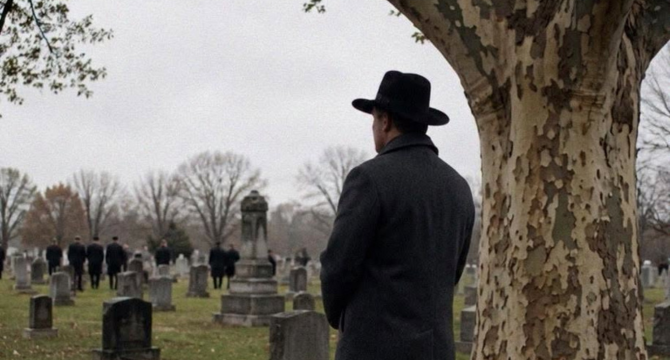
I didn’t notice him at the first funeral.
Or the second.
Honestly, I don’t think anyone did.
In a town like Bellweather, funerals were part of the rhythm of life. People brought casseroles, men stood in dark suits near pickup trucks, and women whispered over tissues and hugged too tightly. Everyone knew someone.
Except him.
He always stood alone beneath the old oak tree at the very back of the cemetery.
His hands were always folded, and he wore a black coat and a black hat. He’d just watch from a distance and disappear before the service ended.
I first paid attention after my uncle Ray passed away.
He had been loud, stubborn, and impossible to impress. At his funeral, half the town came because he had repaired their cars, lent them tools, or argued with them at least once in the hardware store.
I stood beside my aunt Marlene while the pastor spoke. She held my arm so tightly my fingers went numb.
Then I saw the man.
He stood far behind everyone, partly hidden by the oak tree, his black hat pulled low.
I leaned toward my aunt.
“Who’s that?”
She glanced over her shoulder.
Then frowned.
“I don’t know.”
“Friend of Uncle Ray?”
“I knew Ray’s friends,” she said. “That man wasn’t one of them.”
The answer stayed with me.
Two weeks later, I saw him again at Mrs. Donnelly’s funeral. She had taught second grade for 38 years and still remembered half the town’s handwriting. The man stood in the same place.
When the family began walking toward their cars, he was gone.
A month after that, he came to the funeral of Carl, a volunteer firefighter who died in his sleep at 61.
Then to the funeral of Emily, a 17-year-old girl killed in a car accident on Miller Road.
That one shook the whole town.
People filled the cemetery and spilled past the gravel drive. Her classmates clung to each other. Her mother had to be held up by two relatives.
And still, beneath the oak tree, the man stood alone.
Something about that made anger rise in me.
Maybe it was the way he never cried.
Maybe it was the way he watched without joining.
Maybe grief makes people suspicious of silence.
After the service, I approached Mr. Vance, the funeral director.
“Do you know that man?” I asked.
“What man?”
“The one in the black hat.”
Mr. Vance looked toward the oak tree.
But the man was already gone.
He adjusted his glasses. “I assumed he was with the family.”
“The family assumed he was with you.”
That made him frown.
“I’ve seen him before,” he admitted. “Never thought much of it. Some people don’t like standing close.”
“At every funeral?”
His frown deepened.
“Every funeral?”
I didn’t like the way he said it.
The next morning, I went to the cemetery office.
The caretaker, a broad man named Lewis, sat behind a desk covered in keys, maps, and half-eaten peppermints. He was new enough to still call the cemetery “peaceful” instead of “work.”
“I wanted to ask about someone,” I said.
He leaned back. “If this is about teenagers taking flowers again, I already called the school.”
“It’s not. There’s a man who stands under the oak tree during funerals.”
Lewis stopped chewing his peppermint.
“Black coat? Black hat?”
“Yes.”
He gave a short laugh, but it wasn’t amused.
“You won’t find him in any register.”
“What do you mean?”
“People have been asking about him for years.”
My stomach tightened.
“Who is he?”
Lewis slowly shook his head.
“No one’s ever found out.”
That answer didn’t sit right with me.
Bellweather had 4,000 people, and gossip traveled faster than weather. A man could not attend every funeral for years and remain unknown.
Unless people had stopped trying to know him.
I started digging.
First, I went through old newspaper photos.
Then obituaries.
Then archived funeral videos from the local paper’s online memorial page.
There he was.
Year after year, he stood beneath the oak tree and was always alone. He always left before anyone spoke to him.
Then I found the photo from 1998.
It was printed in the Bellweather Chronicle after the funeral of a former mayor. The image was grainy, taken from a distance, but the man was there under the oak tree. He was wearing the same coat, the same hat, had the same straight posture and the same unreadable face.
I set the photo beside a recent one from Emily’s service.
My hands went cold.
He looked exactly the same.
The next funeral took place four days later.
Mr. Alvarez, who had owned the bakery for nearly 50 years, was being buried beside his wife. I arrived before anyone else and parked down the road. Then I hid behind a row of headstones near the oak tree, feeling ridiculous and half ashamed.
Sure enough, just before the service began, the man appeared.
I didn’t hear a car or footsteps.
One moment, the space beneath the oak was empty.
The next, he was there.
Up close, he looked older than the newspaper photo suggested.
His face was lined, but not deeply. His hair, visible beneath the hat, was gray at the edges. He could have been 60. He could have been 75. Some people age gently. Some faces simply hold their shape.
Still, the sight of him made my skin prickle.
He stood through the service without moving.
After the last prayer, people drifted toward their cars. I stayed crouched behind the headstones, my knees aching.
This time, he did not leave immediately.
Instead, he walked to a grave no one had visited that day.
It sat near the older section of the cemetery, where names had faded, and grass grew thin around tilted stones.
The man knelt.
He reached into the inside pocket of his coat.
Then he carefully placed something against the headstone.
The moment he stood up, he turned and looked directly at me.
I froze.
For several seconds, neither of us moved.
Then he tipped his hat once and walked away.
I waited until he disappeared past the iron gate before I stumbled toward the grave.
The stone read:
“Eleanor1931-1982She Remembered Us”
At the base of the headstone was a small stone painted with a blue circle.
I picked it up.
It was smooth, ordinary, and warm from his hand.
I had never heard of Eleanor.
Which, as I later learned, was the saddest part.
The library had two file cabinets full of old newspapers. I spent the afternoon going through them until my fingers smelled like dust and ink.
Eleanor appeared first in a 1967 article.
“Local Social Worker Starts Burial Fund for Unclaimed Residents”
Then again in 1973.
“Nobody Should Leave This World Alone,” Says Eleanor
She had worked for the county welfare office.
She arranged funerals for people who died without family, like elderly men from boarding houses, women whose children had moved away, infants who lived only days, and travelers whose names took months to confirm.
She made sure they had a service.
One article called her “the woman who never let anyone be buried alone.”
I sat back in the library chair, and the blue stone suddenly felt heavier in my pocket.
My next stop was St. Mark’s Church.
The retired pastor, Reverend Cole, lived in a small white house behind the sanctuary. He was 86, sharp-eyed, and suspicious of strangers carrying folders.
I showed him Eleanor’s obituary first.
His expression softened.
“Ah,” he said. “Eleanor.”
“You knew her?”
“Everyone who needed mercy knew her.”
Then I showed him a photo of the man beneath the oak tree.
His hand tightened around the paper.
“You know him too?”
He looked toward the window.
“I know of him.”
“What’s his name?”
The reverend folded the photo and handed it back.
“His name isn’t the point.”
“It is to me.”
“No,” he said quietly. “That is the whole point.”
I leaned forward.
“Reverend, this man has attended every funeral in town for decades. People are scared of him. Curious. Some think he’s waiting for something.”
The old pastor closed his eyes. “He is…”
My pulse quickened. “What?”
“A goodbye that never ends.”
I waited.
Finally, he sighed.
“He made one promise… and he’s been keeping it ever since.”
“To Eleanor?”
“Because of Eleanor.”
He stood slowly and took an old photo album from a shelf.
Inside was a picture of Eleanor standing beside a thin teenage boy in a jacket too big for him.
The boy had dark hair, serious eyes, and hands shoved deep into his pockets.
I recognized the posture.
It was the man beneath the oak tree.
“His name is Samuel,” Reverend said. “He was 15 when his mother died.”
I looked down at the picture.
“Was Eleanor his relative?”
“No. His father left years earlier. He had no siblings or grandparents nearby. His mother cleaned rooms at the old motel and kept mostly to herself. When she died, almost nobody came.”
The reverend tapped the photograph.
“Eleanor came.”
I said nothing.
“She sat with Samuel after the service while everyone else had left. He wouldn’t move. She sat beside him until sunset.”
“What did she say?”
“Almost nothing. That was Eleanor’s gift. She never tried to make grief behave.”
The reverend smiled faintly.
“But before she left, she told him something he never forgot.”
“What?”
“People think funerals are for the dead. They’re really for the people left standing. No one should ever have to stand here alone.”
I looked at the photograph again.
“And when she died?”
His smile faded.
“Almost no one came.”
The words settled between us.
“Samuel came,” he continued. “He stood at the back, just a boy in an old black coat. Afterward, he asked me why the woman who buried everyone else had so few people there for her.”
“What did you say?”
“I had no answer good enough.”
The reverend’s voice grew rough.
“A week later, he came to my office with a handful of painted stones. Blue circles. Eleanor used to paint them with children in grief groups. She told them the circle meant someone remembered.”
I touched the stone in my pocket.
“Samuel asked if it would be wrong to leave one on her grave every time he attended a funeral. He said he wanted her to know someone had stood there.”
I whispered, “For every funeral?”
“For every one he could reach.”
“And no one knew?”
“Some of us knew pieces. Nobody knew all of it. Samuel didn’t want thanks.”
“Why not?”
Reverend Cole looked at me steadily.
“Because thanks makes a good deed belong to the giver. Samuel wanted it to belong to the dead.”
I found Samuel three days later.
He was kneeling beside Eleanor’s grave, brushing leaves away from the headstone. I almost turned back.
Then he spoke without looking at me.
“You hide loudly.”
I startled. “Sorry.”
“No, you’re not.”
That made me smile.
He stood slowly.
Up close, he was not ageless. His eyes were tired. His hands were spotted. But there was something steady about him that time had not touched.
“Are you Samuel?” I asked.
He picked up a leaf from Eleanor’s grave.
“Depends who’s asking.”
“My name is Clara. My uncle was Ray.”
“I remember.”
“You came to his funeral.”
“I did.”
“Did you know him?”
“No.”
“Then why?”
He looked toward the oak tree.
“Because someone should.”
I took the blue stone from my pocket and held it out.
“You left this.”
He looked at it for a long moment.
“I wondered if you’d take it.”
“I didn’t know what it meant.”
“Do you now?”
“I think so.”
He nodded once, then sat on the stone bench near Eleanor’s grave. After a moment, I sat beside him.
“People think you’re strange,” I said.
“I am.”
“Some people think you’re frightening.”
“People are often frightened by quiet.”
“Why not tell them?”
He turned the blue stone in his hand.
“Because then they’d thank me. Invite me to sit with the family. Ask who I was and what I knew. They’d make space for me at a grief that doesn’t belong to me.”
“But you do belong there.”
“No,” he said gently. “I witness. That’s different.”
The wind moved through the oak branches.
I asked, “Have you really attended every funeral?”
“No. I missed two when I had pneumonia in 2009. Missed another when the bridge flooded.”
He glanced at me.
“I still regret those.”
“Samuel…”
“I know. But promises don’t care whether other people think they are reasonable.”
I looked at Eleanor’s grave.
“You made the promise because no one came for her.”
He shook his head.
“I made it because she came for me.”
There was the difference.
Small, but everything.
“Do you ever get tired?” I asked.
“Often.”
“Then why keep going?”
Samuel’s eyes moved across the cemetery.
“When you are young, you think being forgotten happens after everyone dies. It doesn’t. It starts when people stop saying your name.”
He looked at me.
“I say the names.”
I swallowed.
“All of them?”
“Every one I can.”
I didn’t know what to say to that.
So we sat in silence.
For once, I understood why Eleanor had offered silence instead of speeches.
After that day, I noticed Samuel differently.
At the next funeral, he stood beneath the oak tree as always. But when everyone bowed their heads, I saw his lips move.
A name.
At another service, he steadied an elderly man who stumbled near a grave, then slipped away before the family turned around.
At the funeral of a woman who had died in a nursing home with no children and few visitors, only seven people came.
Samuel made eight.
So I made nine.
He noticed me near the back and raised an eyebrow.
I whispered, “I’m witnessing.”
He almost smiled.
Three years later…
Samuel’s shoulders had begun to stoop and his walks through the cemetery had grown slower.
I had stopped wondering how old he was and started fearing the day I would no longer see him beneath the oak tree.
That day came in November.
Lewis from the cemetery called me.
“Clara,” he said quietly. “It’s Samuel.”
The service was held on a cold Thursday morning.
I expected a small crowd.
A few church people.
Reverend Cole, if he was well enough.
Maybe Lewis.
Instead, almost the entire town came.
At first, I didn’t understand.
Then I saw the blue stones.
People carried them in their palms. On each one, someone had painted a careful circle.
A schoolteacher.
A firefighter’s widow.
Emily’s mother.
My aunt Marlene.
Mr. Alvarez’s son.
People who had never spoken to Samuel, but had seen him standing there.
People who had wondered.
People who, at some point, had realized that his silence was not emptiness.
It was presence.
Reverend Cole was too frail to stand long, but he spoke from a chair beside the grave.
“Samuel spent his life doing something most of us avoid,” he said. “He showed up for grief that was not his own.”
The cemetery was silent except for the wind moving through the oak tree.
“He never asked to be known. But today, we know him.”
After the service, people did not leave quickly.
One by one, they walked to Eleanor’s grave.
They placed blue stones beside her headstone until the ground looked like a little river of memory.
I waited until the end.
Then I placed mine beside Samuel’s last stone.
For a moment, I thought of the first time I had seen him beneath the oak tree. How I had thought he was watching us.
I had been wrong.
He had been watching over us.
I looked back once before leaving.
Two graves stood apart from the rest in the old section.
Eleanor’s, surrounded by blue stones.
Samuel’s, beneath the oak tree he had made his post for most of his life.
The man in black was gone.
But no one in Bellweather was buried alone after that.
Not if I could help it.
So here is the real question: If someone spends a lifetime quietly keeping strangers from being forgotten, does their kindness matter less because no one understood it, or does it matter more because they never needed anyone to know?

 admin
admin