I had almost forgotten about Simone and her son.
That sounds worse than it is. I did not forget them in the cruel way people forget things they never cared about.
I forgot them the way life teaches you to forget almost everything that once mattered. A season ends. A person moves away.
The spare room becomes a sewing room, then a storage room, and then just another room with a door you stop opening.
Twenty years is a long time.
Back then, Joshua was eight. All elbows and serious brown eyes and a nervous habit of saying “thank you” too quickly, like he thought kindness could be taken back if he did not earn it fast enough.
His mother, Simone, was 30 at most, though exhaustion made her look older. She had left a bad situation with two duffel bags, a winter coat that was too thin for January, and a little boy who tried very hard not to ask for things.
I was 59 that winter. Newly widowed. Living alone in a house that had gone too quiet after my husband, Peter, died.
A friend from church told me Simone needed a place for a few months until she got stable. She was working every shift she could get at the diner and cleaning offices at night.
She could pay a little, she said, but not much.
I told my friend to bring them over.
That is all it was at the start. A practical thing. I had a spare room, and they needed one.
The world had already taught me that sometimes mercy looks less like superheroes and more like ordinary people helping each other.
But then winter happened around us.
Simone would come home after midnight smelling like coffee, bleach, and cold air. Joshua would be asleep on the couch half the time because he had tried to wait up for her and lost.
Some nights, I helped him with spelling words at the kitchen table.
Some nights, I made tomato soup and grilled cheese and pretended not to notice how slowly he ate, like he was stretching out the feeling of being full.
By March, Simone had found a better job and a little apartment across town.
We hugged goodbye in my driveway. She cried. Joshua did not, but he held onto me long enough that I felt him shaking.
“You gave us a warm winter,” Simone whispered.
I told her, “You do not owe me anything. Just build a good life.”
She promised we would keep in touch.
For a while, we did. A Christmas card, a phone call, and one photograph of Joshua in a school play wearing a paper crown. Then the years did what they do.
People move. Numbers change. Time builds layers.
And still, every now and then, I would think of them.
Not often. Just enough.
By the time the box appeared on my porch, I was 79 years old and having the worst week of my life.
That was saying something.
Peter had been gone for almost twenty years by then, and I had learned how to live around grief the way you learn to live around arthritis.
It is there every day, but you adjust your grip. The sharper pain came later, from other directions.
My son lived in Arizona and called when he remembered.
My daughter lived 40 minutes away and somehow managed to be too busy for a woman who had once sat through five years of violin recitals for her.
I do not say that to sound bitter. I say it because facts become their own kind of bitterness if you sit with them long enough.
The house was all I had that still felt steady.
Then last autumn, I made a stupid decision.
A storm tore part of the roof off, and rain leaked through the ceiling in the back bedroom.
I was frightened, embarrassed, and too proud to ask my children for help.
A man from a local repair company knocked on my door two days later and said he had seen storm damage all over the neighborhood.
He spoke kindly. He wore a clean jacket. He said things like “ma’am” and “we’ll take care of you.”
By the time I realized the contract was poison, I had signed for financing that would have made Peter wonder if I had gone insane.
The payments were brutal. Then winter heating bills climbed, and my pension check was late one month because of a processing mess.
Then I used one credit card to cover another, and I stopped opening envelopes the day they arrived because I knew exactly what they would say.
That Monday morning, the bank called.
By Wednesday, I had a notice in my hand telling me foreclosure proceedings were beginning unless the arrears were settled within 30 days.
I read that sentence five times before it meant anything.
Foreclosure. Such an ugly word. It sounds like something being nailed shut.
That same afternoon, I sat in a branch office across from a young loan officer who could not have been older than Joshua had been in my kitchen all those years ago.
He looked over my papers and gave me that careful, almost pitying expression people use when they have already decided your life is over but do not want to say it too directly.
“You may want to consider selling while there’s still equity,” he said.
“This is my home,” I told him.
He folded his hands. “I understand that.”
No, I thought. You do not.
When I got home, there was a voicemail from my daughter, Melissa.
I called her back.
She picked up and said, “Did you finally talk to the bank?”
I leaned against the counter. “Yes.”
A pause. “Mom… maybe this is a sign.”
“A sign of what?”
“That you cannot keep doing this alone.”
There it was. The thing hidden inside all the gentle concern.
“I am not going into assisted living,” I said.
“I didn’t say that.”
“You did not have to.”
She exhaled sharply. “Then what is your plan?”
I looked around my kitchen. The yellow curtains I had sewn myself, Peter’s old radio on the shelf, and the mug with a chipped rim I still used every morning because he had bought it for me in Maine in 1987.
How do you explain to someone that a house is sometimes the last physical proof your life happened where you lived it?
“My plan,” I said, “is not to be spoken to like a problem.”
She got quiet. Then colder. “I have to go.”
When she hung up, I stood there holding the phone until the screen went black.
That night, I barely slept.
The next morning, I found another envelope in the mailbox, stamped with words that made my stomach drop. “FINAL NOTICE.”
By Friday, I had cried in three different rooms of my own house.
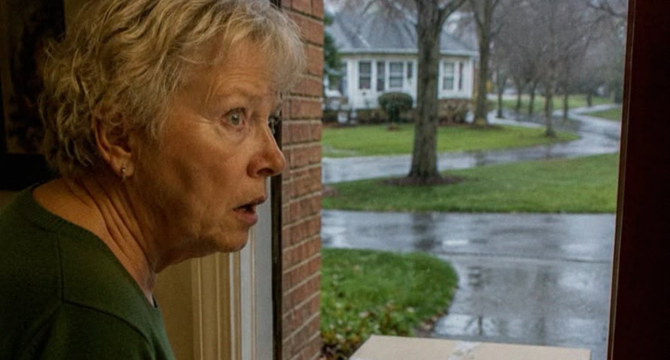
That afternoon, the doorbell rang.
I almost did not answer it. I had begun to dread every knock because it was either someone selling something, someone demanding something, or someone asking if I had considered downsizing.
But when I opened the door, no one was there.
Just a large box sitting on the porch.
It was clean, sturdy, and carefully taped. No return address or delivery sticker I recognized. Only a note fastened to the top in neat handwriting.
“Open When You Need It Most.”
My first thought, absurdly, was that it must be a scam. These days, everything is a scam. My second thought was worse.
Who knew?
Who knew enough about my life to send anything with timing like this?
I bent and picked up the note again. At the bottom, in tiny letters I had missed at first, was one more line.
“You gave us one warm winter. Let me give you something back.”
I sat down hard on the porch step.
For a second, the yard tipped sideways.
I knew those words before I fully understood them. Not from memory exactly, but from the feeling attached to them. A small boy with solemn eyes and a tired mother in my spare room.
Snow against the windows. Soup steaming on the table.
Simone and Joshua.
My hands shook so badly I had to carry the box inside in stages, sliding it across the floor like something sacred or explosive.
I set it on the dining table and stared at it for a full minute before cutting the tape.
Inside, everything was organized with a care that almost made me cry on sight.
A thick envelope labeled “READ FIRST.”
A smaller box wrapped in brown paper.
A leather folder.
And beneath all of that, old photographs.
The top photo was one I had never seen before.
Me, 20 years younger, standing in my kitchen in an apron, smiling at something off-camera while Joshua sat at the table with a pencil in his mouth and a math worksheet in front of him.
I put my hand over my mouth.
Then I opened the envelope.
“Dear Cynthia,”
“If this reached you now, then someone finally told me what kind of trouble you were in. I wish you’d asked for help sooner, but my mother always said you were too proud to do that before the walls were already shaking.”
“My name is Joshua, though I guess you knew me when I still thought long division was a personal attack.”
“You took us in when no one else wanted the complication. My mother never forgot that. Neither did I.”
“Three months before she died, she made me promise something. She said, “Cynthia is an old woman now and may need help in her life. Always find a way to check on her.”
“So I did.”
By the time I reached the end of that paragraph, I was crying.
Simone was dead.
I had not even known that.
I kept reading.
Joshua wrote that his mother had talked about me constantly, especially in the last year of her life. She had saved every photograph, every old card, every small kindness, and folded it into family history so tightly that, to him, my house had become part of the story of how they survived.
After she died, he had tried to find me.
He had eventually tracked me through public property records, church bulletins, and an old neighbor two streets over named Delaney, who still knew everyone’s business before they did.
That detail made me laugh through tears because, of course, it was Delaney.
Joshua explained that he had not wanted to intrude on my life. So he had done the next best thing. He had asked Delaney to call him if she ever saw signs that I was in real trouble.
Last week, she did.
She had seen the foreclosure notice taped to my front door when I was out. She had also seen me crying in my driveway after the bank meeting, which mortified me on a level I cannot fully describe.
Joshua wrote:
“I know this may feel sudden, but please believe me, this is not charity. This is debt, gratitude, and love, in that order.”
Then I opened the leather folder.
Inside were copies of legal documents, payment confirmations, and one letter from a real estate trust.
At first, I did not understand what I was reading.
Then I sat down again because my knees gave out.
The arrears had been paid.
Not promised. Paid.
The foreclosure action had been halted.
The predatory repair loan had been satisfied in full through legal settlement and negotiated reduction, apparently by someone with far more patience and money than the idiots who had trapped me were prepared for.
And then came the part that took my breath away.
Joshua had quietly purchased the mortgage note through a family trust after learning the company servicing my loan had a history of abusive contracts and vulnerable borrowers.
He had done it legally, indirectly, and without telling me because, as he later wrote, “I knew if I warned you too early, you’d refuse the help out of stubborn dignity and lose everything while trying to be noble.”
There was more.
The trust had been structured so I could remain in the house for the rest of my life. No rent or sale pressure.
No one, including my children, could force a move while I was living there.
When I died, the house would not go to Joshua.
It would be sold, and the proceeds would fund temporary housing grants for single mothers with children during the winter months.
The Cynthia House Fund.
I actually laughed out loud at that, then cried harder.
That ridiculous boy. A wonderful and generous, Joshua.
My fingers were numb as I went back to Joshua’s letter.
I own a construction company now, he wrote. I started small, and it has grown bigger.
We repair homes, but these days we also do a lot of housing work for seniors and families in bad situations. I got into it because I never forgot what a safe house felt like.
I looked around my dining room as I read that line and thought: You remembered better than I did.
The smaller wrapped box held things that nearly finished me.
A blue quilt from the spare room, carefully mended where it had once torn near the edge.
A Christmas ornament Joshua had made as a child from popsicle sticks and glitter, with the year written crookedly on the back.
And one final envelope from Simone.
“Cynthia, if Joshua is giving you this, then I am gone, and you are in the kind of trouble you would never admit until it gets dramatic.”
“I laughed again, then pressed the letter flat and read.”
She thanked me for that winter as if I had saved their lives outright. Maybe, in some quiet way, I had.
She told me Joshua still remembered my grilled cheese, my rules about wiping your shoes, and the way I used to leave the hall light on when he was afraid to sleep in a new place.
Then she wrote the line that undid me:
“You gave my son his first memory of safety. I spent the rest of my life trying to build from there.”
I sat at my table until dark.
At some point, I called Delaney, who answered on the first ring.
“You meddling little ghoul,” I said the second she picked up.
She gasped. “Well, did you open it?”
“I am 80 years old. I am too old to be ambushed by kindness.”
She sniffed. “Good thing kindness does not care.”
Then she told me Joshua was in town.
He had not wanted to come to the door without giving me space first. He was staying at the inn by the highway, waiting to hear if I wanted to see him.
I looked around the house that was still mine because a little boy I had once fed soup had grown into a man who knew how to protect it better than my own blood did.
“Tell him to come tomorrow,” I said, and my voice broke on the last word.
The next afternoon, he stood on my porch.
Older, of course. Broad-shouldered. Nicely dressed. Tired around the eyes in the way good men often are.
But the minute he smiled, I saw him.
Eight years old. Pencil in his mouth. Trying not to take up space.
“Hi, Cynthia,” he said.
I reached for him before I even thought about it.
He hugged me so carefully at first that I pulled back and said, “Oh, stop that. I am not made of lace.”
Then he laughed, and when he hugged me again, it felt like 20 years folding shut.
We sat in the kitchen for two hours.
He told me about Simone.
She had remarried once, briefly, then left when it turned bad. She had worked hard her whole life anyway. She had died 18 months earlier after a short fight with cancer.
In the middle of treatment, she had started making him promise strange, specific things.
“Find Cynthia.”
“Keep checking on her.”
“If she ever gets stubborn and cornered, do not let her drown.”
I wiped my eyes and said, “That sounds like her.”
He smiled. “It really does.”
I asked him why he had done all this. Really why. Not the polite version.
He looked at me across the table and said, “Because when I was a kid, your house taught me what home felt like. And after my mom died, I realized there was someone else who once cared for me like I was their child.”
That night, after he left, my daughter called.
Delaney, curse her efficient soul, had already spread the story in fragments.
“Mom,” Melissa said carefully, “is it true some man paid off your house?”
I stirred my tea. “Not some man.”
She was quiet. “I didn’t know you wanted to hold on to the house.”
“No,” I said. “You didn’t.”
Another pause. Then, “Why didn’t you tell me?”
I could have said many things. That I tried. That she had been listening but never understood me. Sometimes people do not notice you are drowning because they are busy suggesting better swimming techniques.
Instead, I said, “I suppose I did not think you’d come.”
She started crying, and I let her. Maybe families need such vulnerabilities to soften them.
By spring, the legal dust had fully settled. The house was secure. Joshua visited twice more. On the second visit, he brought plans for the Cynthia House Fund.
“We’ll start small,” he said. “Emergency winter housing. Maybe one apartment at first, then more if it grows.”
“You already did enough.”
He gave me a look so familiar it startled me.
It was Simone’s look. The one that said love is not a transaction, so stop acting like one.
“No,” he said softly. “I’m just finishing what you started.”
Sometimes I still walk past the spare room and think of that first winter. The radiator clanking and Simone coming in late and whispering apologies to the dark.
Joshua bent over homework at my kitchen table. I had believed, back then, that I was doing one temporary good deed and then life would go on exactly as before.
I was wrong.
Life keeps score in ways we do not see.
The people you shelter become the ones who return with nails, lumber, legal papers, and a promise that your home will not be taken from you while they still have breath.
That box appeared on my porch on one of the worst days of my life.
But it did not arrive by miracle.
It arrived because a tired single mother never forgot one warm winter in a quiet house, and because the little boy I once helped with homework grew into the kind of man who knew exactly when to knock, even if he did it by leaving the answer on my porch first.

 admin
admin