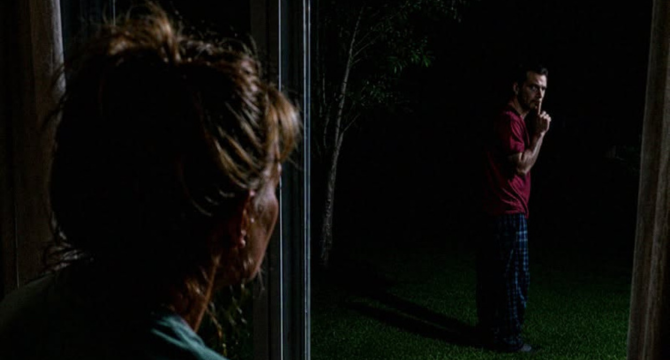
A few minutes earlier, I’d woken up and reached across the bed expecting to find him beside me. Instead, his side was empty.
At first, I assumed he’d gone downstairs for a glass of water, but after several minutes had passed, something told me to look outside. That’s when I saw him.
He stood motionless near the patio, staring toward the back fence. Something about the way he was standing made my stomach tighten.
He did not look confused or curious. He looked worried.
I hurried downstairs and stepped onto the patio.
The moment he heard the door open, he turned sharply.
“Don’t turn on the lights,” he whispered.
The seriousness in his voice stopped me cold.
“What happened?”
Instead of answering, he pointed toward the far corner of the yard. At first, I couldn’t see anything. Then my eyes adjusted.
A little girl was sitting beside the fence.
I looked at her again. She was small and thin, her dark hair loose around her shoulders. Now that my eyes had adjusted to the darkness, I noticed something else.
She looked exhausted, like someone who hadn’t felt safe enough to rest.
A knot formed in my stomach.
“Tobby…”
The distance between them remained exactly the same.
Neither moved.
The only sound was the wind rustling through the maple tree. Finally, Tobby crouched down, not closer, just lower, trying to appear less intimidating.
“Hey,” he said gently. The girl didn’t answer. “It’s okay.” Nothing. “You don’t have to be scared.”
For a moment, I thought she might run.
Instead, she lowered her eyes to something resting in her lap. It looked like a small book, though I couldn’t make out much more in the darkness.
Tobby followed her gaze. But when he spoke again, he wasn’t looking at whatever she was holding.
He was looking at her.
“What’s your name?”
The girl didn’t answer.
“Are you lost?”
Nothing.
“Did somebody bring you here?”
The little girl tightened her grip on the book-like item in her lap.
Tobby stared for a moment, and as my eyes adjusted, I finally realized it was an old notebook.
Something in Tobby’s expression changed.
Then his voice softened.
“You got that from Janie, didn’t you?”
The name hit me like a jolt. Janie was Tobby’s older sister, one he hadn’t spoken about in years.
The girl’s head snapped up.
My heart skipped. It was the first sign that she’d understood anything we’d said, and Tobby seemed to notice it too.
“Janie,” he repeated carefully.
The little girl stared at him for several seconds. Then, finally, she spoke.
“You’re Tobby.”
Every muscle in my husband’s body went still. The girl glanced down at the notebook again.
“My mom said you’d know it.”
A chill ran through me.
Mom.
Not aunt. Not grandmother.
Tobby swallowed hard. “Your mom?” The girl nodded.
Then Tobby asked the question we were both thinking.
“Where is she?”
The little girl looked down. Her fingers tightened around the braided leather strap. When she answered, her voice was barely audible.
“She can’t come anymore.”
“Can you tell us your name?”
The girl hesitated. “Ayla.”
Tobby nodded slowly, as though he was afraid any sudden movement might break whatever fragile connection had formed between them.
“Ayla.”
She looked down. The notebook never left her lap, not even for a second.
I stepped forward carefully. “Ayla, sweetheart, are you here by yourself?”
She nodded. The answer sent a fresh wave of alarm through me. My eyes moved immediately toward the street beyond the fence.
No car, no headlights, nothing but darkness.
“How did you get here?”
Ayla glanced toward the road. “Bus.”
“You took a bus?” Another nod. “From where?”
The little girl named a town nearly three hours away. I felt my stomach drop. Even Tobby looked stunned.
A child her age shouldn’t have been traveling alone across town, let alone across half the state.
“Ayla,” I said gently, “when did you leave?”
“Yesterday.”
Yesterday meant she’d been traveling for hours.
Alone. She was carrying nothing except the notebook, no suitcase, no backpack, nothing, as though she’d come here with one purpose.
To find Tobby.
The realization made my chest ache. Tobby seemed to reach the same conclusion.
“Did your mom tell you to come here?”
Ayla nodded immediately. “She said if anything happened, I had to find you.”
She tapped the notebook. “Your address is written inside.”
Then, after a pause, “Mom made me memorize it too.”
I watched my husband close his eyes, just for a second. When he opened them again, they looked suspiciously bright.
“What happened to her?”
Ayla’s gaze fell to the notebook. This time, she didn’t answer. Instead, she carefully loosened the braided strap.
The movement felt oddly ceremonial, like she’d practiced it, like she’d been told exactly when to do it.
The old leather creaked softly. Then she opened the cover.
A folded envelope rested inside, yellowed at the edges.
For a moment, nobody moved. Then Tobby looked at Ayla.
“Can we go inside?” he asked gently.
The little girl hesitated before nodding.
A few minutes later, we were sitting around the kitchen table. Ayla hadn’t let go of the notebook once.
Only then did Tobby reach for the envelope.
My breath caught.
Tobby stared at it without moving. The paper crackled softly as he unfolded it. I watched his eyes move across the first few lines, and almost immediately, something changed.
Not shock.
Recognition.
As though he’d stepped into a conversation that had started years earlier.
“What does it say?” I asked.
Tobby didn’t answer. He kept reading. I looked back down.
“Before you start asking questions, there’s something you need to understand. Ayla doesn’t know the whole story. I never told her. I wanted to, more times than I can count, but every time I tried, I couldn’t figure out where to begin.”
The words seemed to hit Tobby like physical blows. His jaw tightened. I continued.
“I know you probably hate me. Honestly, you’ve earned that right. I disappeared. I never called. I never explained. And after enough years pass, silence starts looking a lot like abandonment.”
Ayla shifted quietly. I wondered how many times she’d watched her mother write these words. The next paragraph was shorter.
“I need you to know something. What happened with Dad is only part of the story.”
I froze.
Beside me, Tobby went completely still, because apparently, whatever reason he’d spent years believing was wrong.
“Tobby?”
He didn’t answer. His eyes remained fixed on the letter. I lowered my gaze and kept reading. “The truth is more complicated than that. I tried writing you a proper explanation more than once. Every version sounded like an excuse.”
“So I left the truth here instead. Maybe if you saw it the way I lived it, piece by piece, you’d understand what I never figured out how to say. I started writing when Ayla was born. I kept writing because I knew one day she would ask questions I wasn’t ready to answer.”
“Some pages are for her. Some are for you. The last few are for both of you.”
I could hear my own heartbeat.
The final lines were written slightly darker, as though the pen had pressed harder into the paper.
“Whatever you think happened all those years ago, you’re missing part of the story. You always were. Take care of my daughter. And when you’re ready, start at page one.”
“Love, Janie.”
Ayla was asleep within 20 minutes, exhaustion finally winning. I wrapped her in a blanket and settled her on our living room couch.
Tobby sat at the dining table staring at the notebook.
Neither of us had spoken much since coming inside.
The notebook sat between us.
Waiting.
At last, Tobby reached for it. The old leather looked even more worn beneath the kitchen light. The braided strap had frayed in places.
“I haven’t seen this thing in 20 years,” he said quietly. His thumb brushed the braided leather. “Janie made that strap herself. She put one on every notebook she owned.”
One corner had been stitched back together by hand, the repair uneven in the way of something done alone, without help.
Tobby ran his thumb across the cover. Then opened it.
The first page wasn’t a letter. It was a photograph, a little girl sitting on a swing. Ayla. She couldn’t have been older than four.
Across the bottom, written in blue ink, were seven words.
“For the days she asks about me.”
My throat tightened. Slowly, Tobby turned the page.
The next sheet contained a date, ten years earlier, the year Ayla was born. Beneath it, Janie’s handwriting filled the page.
“If you’re reading this, then something happened sooner than I hoped.”
“I wanted to give this to Ayla myself one day. I wanted to sit beside her and explain everything. Life had other plans.”
“So if she’s with you, Tobby, I’m sorry, not because I sent her, but because she had to come alone.”
Tobby swallowed hard. I kept reading.
“Before I explain why I left, I need to explain something else. I loved you. I always loved you. That never changed, not for a day, not even after I left.”
Tobby’s eyes closed briefly. When he opened them again, they looked glassy.
“You spent years believing I ran away.”
“Mom believed it too. Dad encouraged it. I don’t blame either of you. It was easier than the truth.”
I felt Tobby stiffen. Across the room, the refrigerator hummed softly. Otherwise, the house was silent.
Then came the sentence that changed everything.
“I didn’t leave our family. Our family left me.”
The words seemed to hang in the air. Neither of us moved. Neither of us spoke.
Slowly, Tobby turned the page.
The next entry was dated two weeks after Janie left. His eyes moved across the handwriting, and then his expression changed.
“What?” I asked.
He shook his head. “Nothing.”
I knew him better than that. “It wasn’t nothing.”
For several seconds, he kept reading. Then he quietly slid the notebook toward me.
“I saw Tobby today.”
“He was carrying the baseball glove Dad bought him for his 12th birthday.”
Tobby froze.
“I remember that glove,” he whispered.
The next sentence hit even harder. “I parked across the street for almost twenty minutes before driving away.”
Neither of us spoke.
She hadn’t forgotten him.
She hadn’t moved on.
She’d come back.
And he’d never known.
Another folded page slipped from the notebook. Tobby stared at it, then slowly unfolded it.
The words seemed impossible, not because they were hard to understand, but because they were impossible to reconcile with the man Tobby remembered.
The paper contained only four sentences.
No greeting. No signature. No date.
“If you leave, don’t come back. If you go through with this, don’t call this family looking for help. You’re making your choice. I’ll make mine.”
The room went silent.
I didn’t need to ask who wrote it. Neither did Tobby. He knew. The handwriting wasn’t Janie’s. It belonged to his father.
For a long moment, he simply stared. Then he folded the paper carefully and placed it beside the notebook, almost gently, as though handling something fragile. Or dangerous.
The next entry began immediately.
“Tobby.” He looked up. “Did Janie ever try contacting you?”
The answer came instantly. “No.” Then he hesitated.
My stomach tightened. “What?”
His eyes drifted back to the notebook, slowly, carefully, as though he already knew what he was about to find. He turned the page.
“I called home six times during my first year away. Dad answered every time. I never got past him.”
I felt my chest tighten.
Beside me, Tobby had gone completely still.
“I asked about Tobby on every single call. Dad told me he didn’t want to speak to me.”
“No.”
The word escaped Tobby before he could stop it. His eyes were fixed on the page, wide and unbelieving.
“I believed him. For years, I believed him. Why wouldn’t I? He was our father. I thought if Tobby wanted me gone too, then maybe I deserved it.”
The silence that followed felt unbearable because suddenly, 20 years of distance looked different. Not a choice. Not abandonment. Not even stubbornness.
A wall.
One person standing in the middle, making sure neither side could see the other.
Tobby rubbed a hand across his face. Then another. I realized he was shaking. “She called.” The words barely escaped him. “She called.”
Not once. Not twice.
Six times. And every single time, he’d never even known.
Across the room, Ayla shifted beneath the blanket. Still asleep. Still unaware that her mother had spent years trying to find her way home.
And that someone had been quietly locking the door.
Eventually, he exhaled and turned another page.
The next entry was dated 11 years earlier, a year before Ayla was born. The moment I saw the date, I noticed something strange.
The handwriting had changed, not dramatically, just enough. The letters looked steadier. Calmer. Happier.
Tobby noticed it too. Then he started reading.
Several pages documented the life Janie built after she left. Then I reached an entry dated only three months earlier. The handwriting looked weaker, and the first sentence was underlined.
“The doctors say I should start preparing Ayla.”
The room went completely silent.
Neither of us moved. Neither of us spoke, because suddenly we understood something. Janie hadn’t spent 20 years writing this notebook. She’d spent the last few months finishing it.
And she’d known exactly why.
Finally, Tobby turned the page. The next entry was dated two months later. The handwriting had weakened again, but the words remained steady.
“I spent three hours today making a list of people who could take care of Ayla if I couldn’t. I started with family. Then crossed out every name.”
Tobby stared at the page. I moved closer and kept reading.
“By the end, only one name remained.”
Tobby.
My husband froze.
The final lines of the entry were underlined.
“If you’re reading this, then I need you to hear one thing. You were never the reason I stayed away. And you were never the reason I came back.”
I read the sentence twice. Then a third time.
The next page held only a single paragraph, and the moment Tobby read the first line, he stopped breathing.
“I know what Dad told you. But I need you to understand this: I never stopped hoping you would find us.”
Tobby reached for the final section, the pages Janie had marked with a strip of blue ribbon. He opened to the first one.
The handwriting looked weaker than ever, but the words were steady.
“Ayla, if you’re reading this, then I’ve run out of time. I wish I could tell you not to be angry. But you probably will be. Honestly? You deserve to be.”
A lump formed in my throat. Tobby kept reading.
“I wish I could tell you life is fair. It isn’t. I wish I could tell you people always come back. They don’t. I wish I could tell you I wasn’t scared. That would be a lie.”
The page trembled slightly in Tobby’s hands. Then we reached the final paragraph, the one Janie had underlined twice.
“If you’re wondering why I sent you to Tobby, the answer is simple. He’s the best person I’ve ever known.”
Tobby closed his eyes. I don’t think he’d been expecting that.
“He spent years believing I abandoned him. I spent years believing he’d forgotten me. We were both wrong. Don’t make the same mistake we did. Tell people you love them while they’re still there to hear it.”
Then a small voice broke the silence.
“Mom always said that.”
We both turned. Ayla was awake. She sat upright on the couch, blanket gathered around her shoulders, her eyes fixed on the notebook. Not frightened. Just tired.
Tobby stood immediately. “Ayla.”
“Did she write about me?”
The question hit harder than anything we’d read all night.
“Most of it,” Tobby said.
The little girl looked away. For a moment, I thought she might cry. Instead, she asked the question she’d probably been carrying for days. Maybe weeks.
“Was she happy?”
The room fell silent. Tobby looked down at the notebook, at the photographs, at the years his sister had poured into those pages.
Then he smiled. A real smile this time.
“Yeah.” His voice cracked. “But she missed you every single day.”
Ayla nodded slowly, as if she’d known that answer already.
Then she looked at him, not at the notebook, not at the photographs, but at him.
“What happens now?”
Tobby didn’t answer immediately. Instead, he crossed the room and sat beside her, then wrapped an arm around her shoulders the same way his sister once wrapped an arm around his.
For the first time since Ayla appeared in our backyard, his answer sounded certain.
“Now?” He looked at the notebook, then at the little girl Janie had trusted him with.
“Now you come home.”
Three months later, Ayla no longer looked like a child waiting for somewhere to belong.
The old maple tree still stood in the corner of the yard.
For reasons she never fully explained, Ayla spent hours beneath it, reading, drawing, sometimes just sitting there.
I stood on the patio one Saturday afternoon watching her argue with Tobby about something neither of them seemed particularly invested in winning.
Their voices drifted across the yard.
Neither seemed to mind.
For the first time since she’d arrived, Ayla looked exactly like an 11-year-old girl should: safe, happy, home.
Later that evening, I found her sitting beneath the maple tree with the notebook open in her lap. The setting sun filtered through the branches above her.
For a moment, she looked exactly like the photographs Janie had tucked between the pages.
I sat down beside her.
She smiled.
Then looked down at the notebook.
“I think Mom knew.”
“Knew what?”
Ayla gently ran her fingers across the worn leather cover.
“That I’d be okay.”
I looked across the yard. At Tobby gathering up the last of the day’s clutter, at the maple tree, at the place where everything had started three months earlier.
A frightened little girl with a notebook, and a family that didn’t know it was still a family.
Then I looked back at Ayla.
“Yeah,” I said softly. “I think she did too.”
Ayla closed the notebook and rested her hand on the cover.
For years, it had carried everything her mother wanted her to know.
Now it wasn’t carrying those things alone.

 admin
admin