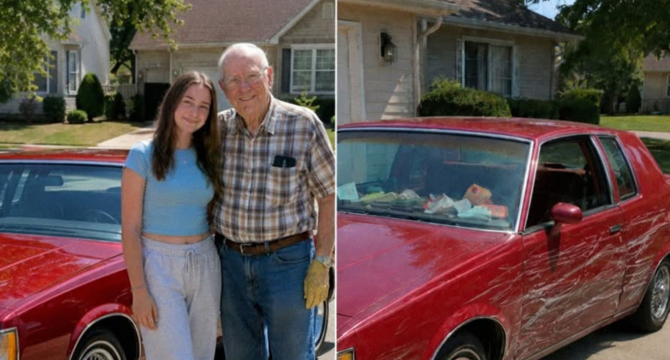
It turned out my late grandfather had left behind more than a car.
My grandpa Diego raised me the way people raise things they love.
Slowly. Carefully. With a lot of showing up.
After my mom passed away, he became the one who made sure I ate breakfast before school and knew how to check a tire’s pressure.
My late grandfather had left behind more than a car.
He never tried to fix my grief.
He just made sure I wasn’t carrying it alone.
He was at every school event my dad forgot about. He brought groceries on Sundays and stayed long enough to make sure they got cooked.
Grandpa also noticed things my father didn’t.
He noticed Rebecca.
He never tried to fix my grief.
My dad married Rebecca when I was 14.
She brought her daughter, Lisa, with her.
Lisa was a year older than me and already understood her mother’s favorite rule: if I had something, there had to be a reason she deserved it more.
Rebecca called this “fairness.”
In practice, it meant my things tended to migrate toward Lisa over time.
Lisa was a year older than me.
Grandpa watched this happen without saying much.
I didn’t understand then that his silence was not the same as inaction.
On the afternoon of my sixteenth birthday, he met me on the front steps, holding a set of keys.
Not new keys. Old ones, worn smooth from decades of use.
“That’s for the Buick, sweetheart,” he said.
Grandpa watched this happen.
I looked at him.
“Your Buick? Seriously?!”
Grandpa had kept that car since 1987. Cherry red. Original paint.
He drove it to church on Sundays and washed it himself every other Saturday.
Growing up, I watched him care for it with the same patience he brought to everything he loved.
Grandpa had kept that car since 1987.
Some things, he believed, deserved that kind of attention.
I felt honored to receive it from him. But I just wasn’t sure I could care for it the way he had.
So I politely refused.
“Grandpa, I can’t take your car.”
But Grandpa had his ways to prove his point.
“You’re not taking it,” he said. “I’m giving it.”
I felt honored to receive it from him.
He pressed the keys into my palm and closed my fingers around them, both his hands around mine for a moment.
“Take care of it, my little girl. And it’ll take care of you.”
He said it simply, the way he said most things, like the words had been sitting in him a while and just needed somewhere to land.
I didn’t know then what he meant by the second part.
Not until three months later, after he was gone.
I didn’t know then what he meant.
The car became the last place I felt close to Grandpa.
I would sometimes just sit in it in the driveway without going anywhere.
The smell of it, that particular combination of old leather and whatever cleaner he’d used on the dashboard for decades, was enough.
I hadn’t opened the glove compartment once since the day he gave me the keys.
I never opened it.
The car became the last place I felt close to Grandpa.
Rebecca took the car the same day we buried him.
She waited until we were back from the cemetery and most of the visitors had left, which told me she’d been thinking about the timing.
Then she came to find me with her hand out, her voice doing that particular thing it did when she’d already made a decision and was presenting it as reasonable.
Rebecca took the car.
“You don’t need something this expensive, Jayde,” she said. “It’ll only make you spoiled. Besides, you’re still too young.”
I was sixteen. I had a license. I had been given the car by its legal owner three months earlier.
None of that mattered to my stepmom because she had already decided.
I looked at my father.
He stood behind her with his hands in his pockets.
“You don’t need something this expensive.”
He wasn’t looking at me.
By then, I had learned what that meant.
I clutched the keys so tightly that they bit into my palm.
It didn’t matter.
Rebecca took them.
I clutched the keys.
By that evening, Lisa was in the Buick with the music up, eating fast food in the front seat, dropping wrappers on the floor my grandfather had kept spotless for thirty years.
She had the windows down and her feet up on the dashboard, and she was laughing at something on her phone.
Lisa didn’t even look happy. She looked pleased.
Like having it mattered less than knowing I didn’t.
I went to my room and closed the door and did not come out until morning.
She looked pleased.
Within the week, there were scratches along the driver’s side door and a dent in the rear bumper.
I stopped looking at it in the driveway.
The following Monday, I was getting ready for the bus when someone started pounding on the front door.
Not knocking.
Pounding.
There were scratches along the driver’s side door.
I hadn’t officially moved out yet, but I was staying in the small guesthouse beside the main house.
I opened the door.
Rebecca stood on the porch with Lisa behind her, both of them pale in a way I’d never seen before.
Behind them, on the street, were two police officers who were not in any hurry.
Rebecca grabbed my arm.
“Did you know what that crazy old man hid in the glove compartment?”
On the street, were two police officers.
One of the officers stepped forward.
“Ma’am,” he said, looking at me, “we’re going to need you to come with us.”
Turns out, Lisa had been pulled over the night before during a routine traffic stop.
Standard procedure, the officer explained. They verified insurance, registration, and ownership.
When they ran the Buick, something came back that made them look closer.
“We’re going to need you to come with us.”
We drove to the impound lot where the car had been taken.
I hadn’t been inside it in a week. It looked worse than I remembered.
The interior already looked different.
The officer asked me to open the glove compartment.
A week was all it had taken.
I stood there for a second.
Then I reached in and pulled the latch.
Inside, sitting on top of the owner’s manual, was a manila envelope with my name written on the front in my grandfather’s handwriting.
My hands went still.
I recognized that handwriting from birthday cards and grocery lists and the notes he used to leave on my lunch bag when I was small.
My hands went still.
The officer nodded at it. “Go ahead.”
I opened it carefully.
The first document was a notarized letter, dated three weeks before my birthday, signed by my grandfather and witnessed by his attorney.
It stated clearly that the 1987 Buick Regal was being gifted to his granddaughter Jayde, effective her sixteenth birthday, with full legal transfer of ownership.
I opened it carefully.
The second document was the title.
Already transferred. Already filed. Already done.
My name was on it.
Had been on it since before Grandpa died.
The third thing in the envelope was a voice recorder, the small kind, the size of a thumb. There was a sticky note attached in Grandpa’s handwriting.
“Press play.”
The third thing in the envelope was a voice recorder.
I looked at the officer. He nodded.
I pressed play.
Grandpa’s voice came out of that little device, and I was not prepared for it.
It was exactly his voice, unhurried, the same tone he used when he was explaining something he’d thought through carefully.
He said he was recording this on a Sunday afternoon in the fall, sitting in the driveway of his house. He said he had a feeling he should put some things on record.
I was not prepared for it.
He said Rebecca had visited him twice the previous year.
Both times she had told him, in her careful way, that it would mean a great deal to Lisa if the Buick stayed in the family properly. That I was young. That an older girl would take better care of it.
Surely Grandpa could see the sense in that.
He said he had listened politely both times.
Grandpa could see the sense in that.
He claimed he had also called his attorney later, once the following morning and once the same afternoon.
He said he wanted it on record that no one had pressured him and that he had made his decision about that car with a completely clear mind, because he’d had it clear for years.
And then, at the end, he said this.
“Jayde, sweetheart, if this recording found its way to you, then I hope you’re sitting in the driver’s seat. The Buick is yours. It always was. I know you’ll take care of it. More importantly, I know it’ll take care of you.”
“The Buick is yours.”
I had to stop the recording for a moment.
The impound lot was very quiet.
Rebecca, standing ten feet away, had gone the color of old concrete.
My father had driven himself to the lot. He was standing at a slight distance from Rebecca.
He was very still and very quiet in the way of a man who has just finished understanding something he should have understood two years ago.
Rebecca had gone the color of old concrete.
I pressed play again and listened to the rest.
The officers were thorough.
By the time they finished reviewing everything, the conclusion was straightforward. The car had belonged to me since the day my grandfather put the keys in my hand.
It had never legally been Rebecca’s to take, or Lisa’s to drive.
The car had belonged to me.
The Buick was returned to me that morning.
Rebecca tried to say something on the way out of the lot.
I don’t remember what it was. I wasn’t listening.
I was running my hand along the roof of the car.
The paint was a little dustier than my grandfather would have allowed, and the side door was scratched in a way that was going to need attention.
Rebecca tried to say something.
But it was still red. Still the same red it had been for three decades.
I got in and closed the door.
I sat in the driver’s seat for the first time since Grandpa died.
For a moment, I didn’t start the car.
I just sat there, learning how to be near him again.
It was still red.
The interior looked tired.
A receipt sat in the cupholder.
The floor needed vacuuming.
It had taken Lisa one week to undo habits my grandfather had spent three decades building.
But the smell was still there.
Old leather, dashboard cleaner, something underneath all of it that was just him, or the memory of him, which at that moment felt like the same thing.
The smell was still there.
I put both hands on the steering wheel and sat there for a while.
I almost put the envelope in my bag without looking at the rest of it.
Then I noticed something I’d missed: a smaller envelope tucked behind the title paperwork, folded in half, with nothing on the outside except my name again.
I opened it and recognized Grandpa’s handwriting right away.
I noticed something I’d missed.
The same way he used to write my name on birthday cards.
Just two lines:
“You were never hard to love.
Some people just made loving you look inconvenient.”
I sat in that car for a long time after that.
I don’t know exactly how long. Long enough that one of the officers came to check on me, and I told him I was fine. He nodded and left me alone, which was what I needed.
I told him I was fine.
My father knocked on the window, eventually.
I rolled it down and looked at him.
He didn’t have a speech ready. He didn’t have much of anything ready. He stood there in the thin morning light, looking like a man who had just finished adding something up and didn’t like the total.
“I should have stopped her, Jayde.”
“Yes, Dad. You should have.”
I rolled the window back up.
“I should have stopped her, Jayde.”
I wasn’t ready for more than that. Maybe someday I will be. But not that morning, in an impound lot, with my grandfather’s voice still sitting in the air around me from a recorder the size of a thumb.
That was years ago now.
I still drive the Buick.
I had the scratches on the door repainted. I fixed the bumper dent myself, the way my grandfather taught me, with a lot of patience and a YouTube video, and two afternoons in the driveway.
I wash it every other Saturday. I use the same cleaner on the dashboard.
I still drive the Buick.
People sometimes ask why I still drive an old car.
The truth is, it was never just a car.
It was the last thing my grandfather gave me.
And he chose it carefully.
Grandpa told me to take care of it.
And he told me it would take care of me.
It was never just a car.
He’d already made sure of the second part before I even had a chance to manage the first.
That’s the thing about my grandfather.
He didn’t make promises he hadn’t already arranged to keep.
He was right on both counts, which should not have surprised me.
He usually was.
He was right.

 admin
admin