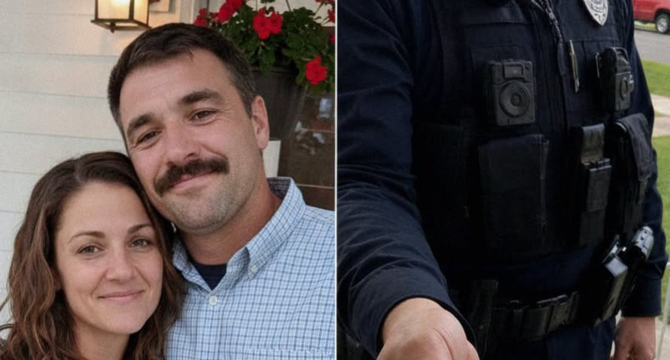
My name is Laura. I was 41 when I learned the second man I loved had been carrying a secret from the first.
Seven years after my husband, Clinton, never came home from a fire, Officer Hayes stood on my porch with a plastic bag in his hand and Bill’s wallet inside it.
Bill was the man I’d finally let into my life.
The man who’d started disappearing right when I needed him to stay.
Clinton, never came home from a fire.
“Are you Laura?” Officer Hayes asked gently.
“Yes.”
“Bill listed you as his emergency contact.”
My fingers tightened on the doorframe. “Is he alive?”
“He’s in surgery after a car accident,” he said. “Stable, but the hospital asked us to notify you. His phone was damaged, and your name was on his emergency card.”
Are you Laura?”
He handed me Bill’s things.
I opened the wallet at my kitchen table, looking for his insurance card.
Instead, my dead husband’s face slipped into my hand.
It was a photo I’d never seen. Clinton stood in his firefighter uniform, smiling like he knew I was behind the camera, even though I wasn’t.
My daughter, Ellie, came up behind me.
He handed me Bill’s things.
“Mom?” she whispered. “Is that Dad?”
I turned the photo over.
On the back, in Clinton’s handwriting, were the words:
“If anything happens to me, find Laura. She deserves the truth.”
Under that was a phone number.
My knees almost gave out.
“She deserves the truth.”
Ellie touched my arm. “Why does Bill have Dad’s picture?”
“I don’t know,” I said.
But my voice sounded like I already knew the answer would break something.
Seven years earlier, Clinton had kissed Ellie on the forehead before his shift and told her, “Be good for your mom.”
Ellie was seven then.
“You always say that,” she told him.
Ellie touched my arm.
“And you always need reminding.”
She giggled. “Come back for pancakes.”
Clinton looked at me over her head.
“I always come back for pancakes.”
He didn’t.
By midnight, two firefighters were standing on my porch. By morning, people were calling my husband a hero.
“Come back for pancakes.”
After Clinton died, people called me strong.
I hated that word.
Strong was what people called you when they wanted to stop asking if you needed help.
I wasn’t strong. I was organized.
I packed lunches. I signed school forms. I learned which bills could wait three days and which ones couldn’t.
I sold Clinton’s truck and told Ellie we needed space in the driveway.
I hated that word.
She was nine when she caught me.
“You said we needed the money,” she said.
I stopped folding towels. “We needed both.”
“Mom.”
“I know, baby.” I sat beside her on the floor. “I just didn’t want the driveway to look empty too.”
We sat there.
“We needed both.”
Work became the one place where nobody whispered around me. I worked in customer support at an insurance company, answering calls from people who were angry, scared, or both.
Then Bill transferred into claims.
He was quiet, careful, and easy to overlook until you realized he noticed everything.
The first time he brought me coffee, I was sorting through forms with one hand and rubbing my temple with the other.
“You skipped lunch,” he said, setting the cup beside my keyboard.
Then Bill transferred into claims.
“I skip lunch every Tuesday.”
“That’s not a defense.”
“Thank you,” I said. “But you don’t have to bring me things.”
“I know.”
“Then why do it?”
“Just because.”
That time, I smiled.
“That’s not a defense.”
Bill didn’t rush me after that. He left notes on my desk when a file moved departments. He texted before stopping by. He never asked about Clinton unless I said his name first.
A month later, he stood on my porch with a toolbox.
“What are you doing here?”
“Your porch light flickers.”
“I can change a bulb.”
“It’s not the bulb.”
“What are you doing here?”
“I don’t have money for an electrician, Bill.”
“Good thing I’m not one.”
I folded my arms. “I don’t like owing favors.”
“You don’t owe me anything.”
“Everyone expects something eventually.”
He looked at me for a long second. “Then I’ll wait until you believe I don’t.”
“I don’t like owing favors.”
I didn’t believe it.
But he fixed the light, refused dinner, and left before kindness started feeling like a trap.
A year passed before he held my hand.
We were on that same porch, under the steady light he had repaired. Ellie was inside pretending not to watch through the curtains.
“She’s spying,” Bill said.
“She’s 14. That’s her job.”
A year passed before he held my hand.
His fingers rested near mine, close but not claiming.
“I don’t know if I can belong to someone again,” I said.
“I’m not trying to replace Clinton.”
“Good. There’s no opening.”
“I don’t need one.”
“Then what do you want?”
He looked at me. “To stay close until you decide.”
“I’m not trying to replace Clinton.”
That got me.
Not because it was grand.
Because he waited for my hand to move first.
So I let it.
For a while, I let myself believe we were healing.
Then Bill started disappearing.
That got me.
At first, it was small. A canceled dinner. A missed call. A message left unread until morning.
“My mother needed help,” he said once.
“Is she okay?”
“She’s just getting older.”
Another night, Ellie and I sat at the kitchen table with lasagna cooling between us.
“He said six, right?” Ellie asked.
I checked my phone. “He probably got stuck at work.”
“She’s just getting older.”
“You said that last time.”
“People get busy.”
She looked at me too carefully.
I hated when she did that. It meant she had inherited my habit of reading silence.
My phone stayed dark.
I called Bill once, then twice.
Each call went to voicemail.
“People get busy.”
Ellie pushed her food around. “Mom, Bill makes you check your phone like you’re waiting for bad news.”
I froze.
“I’m not scared.”
I carried our plates to the sink even though we hadn’t eaten.
Ellie followed me.
“I like him,” she said softly. “That’s why I’m saying it.”
Ellie pushed her food around.
I gripped the counter.
“I know.”
“You don’t have to wait for people who make you feel small.”
I turned and looked at my daughter, who had grown up watching me apologize to bills, calendars, and empty chairs.
The next morning, I texted Bill before I could lose my nerve.
“You don’t have to wait.”
“We need to talk. I can’t do this anymore. I won’t wait for another man who doesn’t show up.”
He didn’t answer.
Two hours later, Officer Hayes knocked on my door.
After he left, I stood at the kitchen table with Bill’s wallet open and Clinton’s photo in my hand.
Ellie came in wearing fuzzy socks and a school hoodie.
“Mom?”
I turned the photo over again, like the words might change.
“If anything happens to me, find Laura. She deserves the truth.”
Officer Hayes knocked on my door.
Ellie read it over my shoulder.
“That’s Dad’s handwriting.”
“I know.”
“Then call the number.”
So I did.
The phone rang twice.
A woman answered. “Hello?”
“That’s Dad’s handwriting.”
“My name is Laura,” I said. “I found your number on the back of a photo.”
The line went quiet.
“My husband’s name was Clinton.”
A sharp breath came through the speaker.
“Laura,” she whispered. “I’m Taylor.”
“Why did Bill have my husband’s picture?”
“He told me you’d call one day.”
“I’m Taylor.”
My knees weakened, and I sat down.
Ellie grabbed my wrist.
“You knew my name for seven years?” I asked.
“Yes.”
“Then don’t whisper like we’re friends. Tell me the truth.”
Taylor started crying, but she didn’t hang up.
Ellie grabbed my wrist.
“I worked records then,” she said. “Supplemental first responder benefit files. Your claim crossed my desk after Clinton died.”
“I got a denial letter.”
“I know.”
“They said part of the benefit didn’t qualify because of classification.”
“That was the first decision,” Taylor said. “Then a corrected line-of-duty certification came in.”
My throat tightened. “What should’ve happened?”
“Your claim should’ve been reopened.”
“I got a denial letter.”
“But it wasn’t.”
“No.”
“Why?”
“Martin closed the file.”
I knew Martin.
He was the senior claims supervisor. Smooth voice. Cold eyes. The kind of man who could say “I understand” without understanding anything.
“Bill found this?” I asked.
“Martin closed the file.”
“Six months ago.”
Ellie stiffened beside me.
“Six months?” I repeated.
“Martin told him to drop it.”
“And Bill listened.”
“He came to me after. I gave him the photo because Clinton had brought it to records the week before his last shift.”
“Clinton knew?”
“Six months ago.”
“He was checking his benefits paperwork,” Taylor said. “He worried something would get buried if he died on duty. He told me, ‘My wife will know when something isn’t right. But she might be too tired to fight alone.'”
Taylor whispered, “I was junior, and Martin scared me. I kept a copy because I knew the file was wrong. I told myself that was courage. Really, I was hiding.”
My eyes opened.
“Send it to me.”
“Really, I was hiding.”
I hung up and walked back to Ellie.
She stood by the table, hugging herself. “What happened?”
I wanted to protect her from it.
Then I thought of every adult who’d hidden the truth and called it protection.
So I told her.
“Your dad did everything right,” I said. “Other people didn’t.”
“And Bill knew?”
“What happened?”
“Yes.”
Her eyes filled. “I liked him.”
“I know.”
“That makes me mad.”
“Me too.”
I drove to the hospital with Clinton’s photo in my purse.
By the time I arrived, Bill had been moved to recovery. He was awake, bruised and pale, when I walked in.
“I liked him.”
“Laura.”
I dropped his wallet on the blanket. “I talked to Taylor.”
His face went white.
“Look at me.”
“I was going to tell you.”
“No. You were trying to tell me without becoming the villain.”
“Martin threatened my job.”
“And that scared you?”
“I talked to Taylor.”
“Yes.”
“Do you know what scared me?” I asked. “Opening denial letters with Ellie coloring beside me because I couldn’t afford a sitter.”
He swallowed.
“I sold Clinton’s truck after that claim was denied. I told Ellie we needed space in the driveway.”
“Laura…”
“No. Not like that. Not after you sat at my table knowing my daughter had been cheated.”
His eyes reddened. “I love you.”
“Do you know what scared me?”
“You loved me without telling me the truth. I’m not sure that counts.”
“I came because of the file,” he admitted. “Then you became Laura. Ellie became Ellie. And every day I waited made me worse.”
“Then be honest now.”
“What do I do?”
“Start by not asking me to carry your guilt.”
I left.
“What do I do?”
At home, I pulled Clinton’s benefits folder from the closet.
Ellie sat beside me with a highlighter.
“This date is after the denial,” she said.
“Good eye.”
“I got it from you.”
Ellie sat beside me.
By morning, I had Taylor’s copy, Bill’s emails, my denial letter, and the archive number.
By noon, I’d hired Rebecca, an attorney.
She flipped through the folder. “They counted on you being too tired.”
“They were right then.”
“And now?”
“Now they can try.”
“They counted on you being too tired.”
Two days later, Rebecca and I walked into the company lobby.
Dana from HR hurried over. “Laura, let’s discuss this privately.”
“Private is how my husband’s file got buried.”
Martin appeared near the conference room. “Laura, grief can make old paperwork feel personal.”
“My husband is personal,” I said. “My daughter’s future is personal. Your signature on a closed file is evidence.”
Rebecca stepped beside me. “You received our evidence this morning. We have the corrected certification, the date trail, and two witnesses. Resolve this without confidentiality, or we file for bad-faith handling and request discovery.”
“Laura, let’s discuss this privately.”
Martin’s smile disappeared.
Dana opened the conference door. “Inside. Now.”
In the meeting room, they offered money fast.
Too fast.
I looked at the folder. “Where’s the nondisclosure?”
Dana folded her hands. “Standard procedure.”
I pushed it back. “You used silence to take from us. I’m not selling you more of it.”
“Inside. Now.”
The room went still.
Then the door opened.
Bill walked in, pale but steady, with a folder under his arm.
Martin stood. “You’re on leave.”
Bill placed the folder on the table. “Because you put me there.”
I didn’t thank him.
“You’re on leave.”
Bill looked at Rebecca. “I have Martin’s email telling me not to reopen Clinton’s file. I also have the original archive scan.”
Martin’s voice cracked. “You’re destroying your career.”
Bill looked at me. “No. I destroyed enough by staying quiet.”
Rebecca leaned forward. “Full denied benefit. Interest. Attorney fees. Written correction. No confidentiality clause. Corrected notice sent to the city benefits office. Martin removed from the file and reported for review.”
The company lawyer asked for a recess.
“You’re destroying your career.”
When they came back, Martin had been removed from the meeting and placed under review.
Dana’s smile was gone too.
“We accept the terms in principle.”
I didn’t cheer.
Justice didn’t feel clean.
It felt like someone had finally cut a rope from my ribs.
“We accept the terms in principle.”
That night, Ellie sat across from me. “Are we rich now?”
I laughed, tired and wet-eyed. “No, baby. We’re just not being robbed anymore.”
A month later, Rebecca confirmed Martin no longer worked there. Clinton’s record was corrected. The benefit came through with interest. Ellie’s education fund was safe, and I started a small scholarship in his name.
Bill came by once.
He stood under the porch light he had fixed. “I don’t expect forgiveness.”
“Are we rich now?”
“Good.”
“Is there any way back to you?”
“Maybe one day. But not through guilt. Not through another secret.”
“What do I do?”
“Live honestly. If I meet that version of you someday, it’ll be my choice.”
Inside, Ellie filled out scholarship forms.
“Live honestly.”
Clinton’s photo sat beside her.
This time, it wasn’t hidden in someone else’s wallet.
For seven years, I thought Clinton had left me with grief.
In the end, he left me the truth.
And this time, I made everyone hear it.

 admin
admin