When my father passed away, I felt like I had lost the only person who truly cared about me.
That sounds dramatic, I know. But grief has a way of stripping life down to the truth, and the truth was that Dad had always been my safe place.
My mother died when I was young.
I barely remembered the sound of her voice anymore, only the soft smell of her vanilla lotion and the way Dad’s face changed whenever someone mentioned her name. After she was gone, he tried to be everything at once.
He packed my lunches, learned how to braid my hair badly, sat through parent-teacher nights, and clapped the loudest at every school event, even when I only had one line in a play.
For years, it was just the two of us.
Then Linda came into our lives.
For the last 15 years, my father had been married to my stepmother, Linda. She was polished in a way that made me feel messy just by standing near her. Her nails were always painted, her hair never moved out of place, and her smile seemed to appear only when someone else was watching.
We were never close.
At first, I tried. I really did. I was still young enough to believe kindness could fix almost anything. I asked if she wanted help cooking dinner. I bought her a scarf one Christmas with money I had saved from babysitting. I even called her “Linda” carefully, hoping she would hear the respect in it.
She tolerated me when Dad was around, but whenever he left the room, it was obvious she wished I didn’t exist.
She never said anything cruel enough for me to prove. That was her talent. She worked in small cuts.
“If you’re going to sit there, at least don’t slouch.”
“Your father worries too much about you.”
“You know, Nicole, most girls your age want independence.”
When Dad walked back in, her voice turned soft.
“Dinner’s almost ready, honey.”
I learned early that complaining made me look childish. Dad loved me, but he loved peace too, and I could see how tired he became whenever tension filled the house. So I swallowed it. I told myself Linda was just distant. I told myself not every stepmother had to become a mother.
Still, when Dad got sick, something shifted in me.
I thought grief might soften her. I thought watching the man we both loved fade from the world would make us gentler with each other.
During those final weeks, I made coffee at 2 a.m., changed his blankets, spoke to insurance companies, and slept in a chair beside his bed when he was too afraid to close his eyes.
Linda cried in front of visitors.
Alone, she mostly complained about the hospice equipment blocking the hallway.
The night before he died, Dad squeezed my hand.
“Nicole,” he whispered, his voice thin as paper.
“I’m here, Dad.”
His eyes moved toward the doorway, where Linda had just disappeared down the hall. Then he looked back at me with a strange calm, as if he had made peace with something I did not understand.
“Trust me,” he said.
I leaned closer. “I do.”
“No matter what happens.”
I thought he meant after his death. I thought he was asking me to be brave.
I had no idea he was warning me.
A week after the funeral, the lawyer read my father’s will.
We sat in a conference room that smelled like old paper and lemon cleaner. Linda wore black again, though this time her pearl earrings looked brighter than her grief.
I sat across from her with my hands folded in my lap, staring at a framed certificate on the wall because looking at her felt impossible.
The attorney, Mr. Alden, had worked with Dad for years and knew him better than almost anyone. He had been at our house for cookouts, graduations, and birthdays. He had seen Dad lift me onto his shoulders when I was little. He had watched Linda laugh too loudly at jokes she did not understand.
He read slowly, his voice steady.
There were some accounts. A few personal items. Dad left me his watch, his books, and the old cedar chest from the den. I held myself together until I heard that. The cedar chest still smelled like him, like leather, dust, and wintergreen mints.
Then came the house.
To everyone’s surprise, the house was left entirely to Linda.
For a second, the room went silent.
I looked up, sure I had misheard him. That house was my childhood. My mother’s rosebushes were still in the backyard. My height marks were still carved inside the pantry door. Dad had promised me more than once that I would always have a place there.
Linda’s mouth parted slightly.
Then, slowly, she smiled.
Not wide. Not openly. Just enough.
The moment she heard that, her attitude changed completely.
She stopped pretending I was family before we even left the lawyer’s office. In the parking lot, she walked ahead of me to the car and did not wait when I paused to wipe my eyes.
At home, she moved through the rooms like she was inspecting a hotel she had just purchased.
She barely waited three days before confronting me.
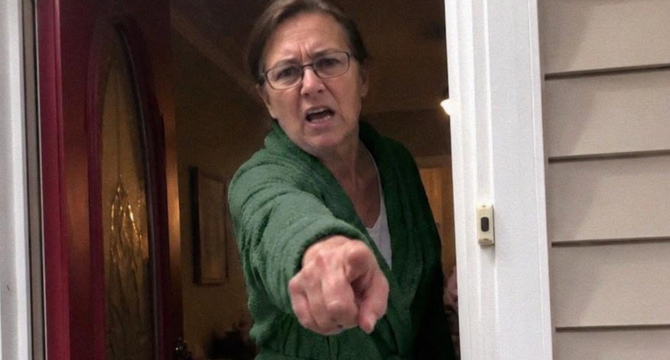
I was in the kitchen, making tea in Dad’s favorite mug because I missed him so badly I could hardly breathe. Linda entered wearing a pale blue robe and that same careful smile.
“This is my house now,” she said coldly. “I think it’s time you moved on with your life.”
I stared at her in disbelief.
“My father wanted me to live here.”
“Well, your father isn’t here anymore,” she replied.
The words landed harder than I expected. I gripped the counter because my knees felt weak.
“Linda, he’s been gone barely ten days.”
“And life does not stop because people die. You’re a grown woman, Nicole. You need to act like one.”
I wanted to scream that being grown did not mean being thrown out of the only home I had ever known. Instead, I whispered, “This is cruel.”
“No,” she answered. “This is practical.”
The next morning, my belongings were sitting in boxes on the front lawn.
At first, I thought there had been a mistake. I had gone to buy milk and returned to find cardboard boxes lined across the grass like some ugly yard sale.
My clothes were folded badly inside them. My framed photos were wrapped in towels. Dad’s old watch sat on top of a box labeled “Nicole” in Linda’s sharp handwriting.
I remember standing there holding a suitcase while she watched from the porch with a satisfied smile.
The neighbors’ curtains shifted. A dog barked somewhere down the street. I stood in the same driveway where Dad had taught me to ride a bike, and suddenly I was not his little girl anymore. I was a woman with no mother, no father, and no key to the front door.
I was heartbroken, angry, and completely lost.
The house I had grown up in was suddenly gone.
With nowhere else to turn, I called my father’s attorney.
My fingers shook so badly I had to dial twice. When Mr. Alden answered, his voice was calm and familiar.
“Nicole? Are you all right?”
“No,” I said, and that one word nearly broke me.
I explained everything.
I told him how Linda had thrown me out only days after inheriting it. I expected him to be shocked. I expected outrage, or at least a sharp intake of breath.
Instead, there was silence.
Then I heard something unexpected.
He started laughing.
Not a nervous laugh.
A genuine laugh.
For several seconds, he couldn’t stop.
I pulled the phone away and stared at it, stunned.
“Mr. Alden?”
He breathed out, still amused. “I’m sorry. I’m so sorry, Nicole.”
“Why are you laughing?”
Finally, he took a deep breath and said, “Your stepmother actually did it?”
“What do you mean?” I asked.
The attorney laughed again.
“That,” he said, “is exactly what your father planned.”
My heart started racing.
“What are you talking about?”
“I’ll explain everything when I get there,” he replied.
Then his voice turned serious.
“Don’t go anywhere. I’m coming right now.”
I stood frozen on the lawn, my phone still pressed to my ear even after Mr. Alden ended the call.
The sun was too bright. The boxes looked too ordinary. My whole life was sitting in cardboard on the grass, and somehow, somewhere in all of it, my father had planned this.
Linda folded her arms from the porch.
“Still here?” she called. “I told you, Nicole. I want those things gone before evening.”
I looked up at her, and for the first time since Dad’s funeral, I did not feel small.
“Mr. Alden is coming.”
Her smile slipped. “Why?”
“He said he needs to explain something.”
Linda’s eyes narrowed. “The will has already been read. The house is mine.”
“I know what you heard.”
“What does that mean?”
Before I could answer, a dark sedan turned onto the street and pulled up behind my car. Mr. Alden stepped out in a gray suit, carrying a leather folder under one arm. He was older than I remembered, with tired eyes and a mouth that looked like it had held too many family secrets.
He glanced at the boxes, then at Linda.
“Well,” he said quietly, “I suppose your father knew her better than either of us wanted to admit.”
Linda came down the steps with quick, sharp movements.
“What is going on?” she demanded. “Why are you here?”
Mr. Alden opened his folder. “I am here because your late husband left instructions for this exact situation.”
Her face tightened. “Instructions?”
He nodded. “He was worried that once the house was transferred to you, Nicole would be forced out. He hoped he was wrong.”
Linda scoffed. “This is ridiculous. The house belongs to me.”
“Yes,” Mr. Alden replied. “Conditionally.”
The word hung in the air.
I stared at him. “Conditionally?”
He turned to me, his expression softening. “Your father left Linda the house with a residency clause. She had the right to live here and manage the property, but only if she allowed you to remain in your family home for as long as you wished.”
Linda’s lips parted. “That was not in the will.”
“It was in the trust documents attached to the estate,” he corrected. “You signed an acknowledgment of them at the office.”
“I did not read every page,” she snapped.
“Well… that is unfortunate.”
My breath caught. I looked at the house, then at the boxes, then back at Mr. Alden. “So what happens now?”
He pulled out another document. “If Linda attempted to remove you, deny access to the home, dispose of your belongings, or change the locks, she would be considered in violation of the terms. At that point, her interest in the house would terminate.”
Linda went pale.
“No,” she whispered.
Mr. Alden’s voice remained calm. “Yes.”
She pointed at me with a shaking finger. “She is lying. She wanted out. She packed those boxes herself.”
I almost laughed, but it came out as a broken breath. “Linda, you put my underwear in a box on the lawn.”
Mr. Alden looked at the porch, where my suitcase had scraped marks from being dragged outside.
He took out his phone and snapped a few photos.
“Nicole,” he said, “did she tell you to leave?”
I swallowed. “Yes.”
“Did she say, ‘This is my house now. I think it’s time you moved on with your life?'”
My eyes filled with tears. “Yes.”
His gaze shifted to Linda. “Then the clause is active.”
Linda backed up one step, as if the house itself had turned against her. “You cannot do this to me. I was his wife.”
“And Nicole was his daughter,” Mr. Alden said. “He wanted both of you protected. You made that impossible.”
For a moment, no one spoke.
Then Linda’s anger broke through her fear.
“He always chose her,” she cried. “Even when he married me, everything was still Nicole. Nicole’s memories. Nicole’s mother. Nicole’s room. Nicole’s future.”
My chest tightened. I had imagined Linda as cold for so long that seeing pain on her face startled me.
“I never tried to take him from you,” I said softly.
“You did not have to,” she replied. “You were already there.”
Her words hurt, but they did not crush me the way they once might have. For the first time, I saw her clearly. She had not been powerful. She had been bitter. And she had let that bitterness turn her cruel.
Mr. Alden handed me a sealed envelope.
My name was written on it in Dad’s familiar handwriting.
“He asked me to give you this only if Linda made you leave.”
My fingers trembled as I opened it.
“My sweet Nicole,
If you are reading this, then I was right, and I am sorry. I wanted to believe Linda would do the kind thing when I was gone. But I also knew you needed proof that my love for you did not leave with me.
This house was never meant to be taken from you. Your mother planted those roses. I marked your height in the pantry. I heard your first laugh in the living room.
A home is not just walls.
It is the people who were loved there.
Be brave, baby girl. Do not let grief make you smaller. This house is yours now.
Love,
Dad.”
By the time I finished, tears were dripping onto the paper.
Linda sat on the porch steps, suddenly looking older than she had that morning. She covered her face with both hands, but I could not tell if she was crying from regret or loss.
Mr. Alden touched my shoulder. “The property transfers to you. Linda will have 30 days to vacate, unless you choose otherwise.”
I looked at Linda.
Part of me wanted to send her away before sunset. Another part of me remembered Dad’s tired voice asking me to trust him.
“You can stay for two weeks,” I said. “But not because you deserve it. Because I will not become cruel just because you were.”
Linda looked up, stunned.
I picked up Dad’s watch from the box and held it against my chest.
That evening, I carried my belongings back inside one by one. The house smelled like dust, grief, and something close to hope. In the pantry, I ran my fingers over the old marks Dad had carved into the wood.
Nicole, age seven.
Nicole, age 12.
Nicole, age 17.
I smiled through my tears.
Linda had thought she was throwing me out.
But Dad had known the truth all along. Sometimes, love does not shout. Sometimes, it waits quietly in legal papers, sealed letters, and the home that was always meant to be yours.
