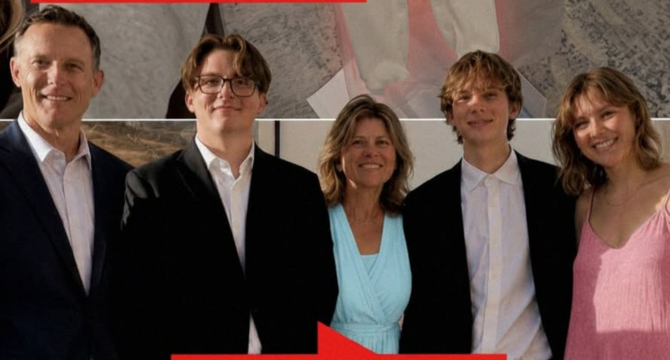
For 25 years, our house had been filled with noise.
Three children, endless schedules, sports practices, school projects, late-night conversations, and the constant feeling that somebody always needed something. Then suddenly, it was gone.
The bedrooms were clean. The kitchen stayed tidy. The laundry basket remained half-empty. I told myself I was adjusting well, but the truth was I kept finding reasons to stay busy because I wasn’t quite ready to sit in the silence.
That’s how I ended up reorganizing my husband Graham’s dresser on a Tuesday afternoon. I was looking for something to do.
Instead, I found something that nearly destroyed my marriage.
The outfit was hidden beneath a stack of winter sweaters he hadn’t worn in years.
At first, I thought it was a pair of socks. Then I pulled it free and stared at the tiny infant romper unfolding in my hands. It looked brand new, pristine, and small enough to fit a newborn.
I stared at it for several seconds, waiting for my brain to make sense of what I was seeing.
It didn’t.
Our youngest child was 20. There were no babies in our lives, no pregnant relatives, and no grandchildren. Nothing explained why my husband had a newborn outfit hidden in the back of his dresser.
My hands started shaking.
I checked the tag. Still attached.
I checked the size.
Newborn.
I sat down on the bedroom floor. For a moment, I couldn’t breathe.
Once the questions started, they came fast. A hidden baby outfit. Brand new. Secret. My mind immediately went somewhere dark, another woman, another family, another life. The kind of story you read about online and always assume could never happen to you.
Graham and I had been married for 25 years.
Twenty-five.
You don’t spend a quarter of a century with someone and expect to discover evidence of an entirely different life tucked beneath their sweaters.
Yet there I was, holding proof that something didn’t make sense.
I don’t know how long I sat there.
An hour, maybe.
Possibly more.
By the time I heard the garage door opening, I’d already imagined a hundred terrible explanations. And none of them ended well.
I carried the romper downstairs and waited.
The front door opened.
Graham stepped inside, carrying a grocery bag. He looked tired, ordinary, exactly like he had every day for the last two plus decades.
Then he saw my face.
And the romper in my hands.
Everything changed.
The grocery bag slipped from his fingers, and an orange rolled across the hardwood floor. For one awful second, neither of us moved. All the color drained from his face.
Not surprise.
Not confusion.
Recognition.
My stomach dropped. He knew exactly what it was.
“Graham?”
His knees buckled. He collapsed onto the hallway bench and buried his face in his hands.
I had spent the entire afternoon preparing myself for denial, excuses, and lies, but I wasn’t prepared for this.
My voice came out barely above a whisper.
“Tell me the truth.”
His shoulders began shaking.
The sight terrified me.
In 25 years, I had seen this man lose jobs, bury parents, survive surgeries, and sit through every hardship life could invent. I had never seen him look like this.
Not once.
Finally, he lifted his head, and his eyes were bloodshot. Desperate, terrified.
And when he spoke, it wasn’t the confession I expected.
It wasn’t even close.
“Please,” he said, his voice cracking. “Just come with me.”
Every hair on my arms stood up.
“What?”
He swallowed hard.
“Please.”
Fear flooded his expression.
The kind that comes when someone is already living through their worst nightmare.
“There’s not enough time to explain everything.”
I stared at him.
The romper felt impossibly small in my hands.
“What are you talking about?”
A tear slipped down his face.
Then another.
And suddenly I realized something that made my blood run cold. This wasn’t the face of a man afraid of being caught; it was the face of a man afraid of losing someone.
“Marianne,” he whispered. “My daughter is in critical condition.”
For a moment, I honestly thought I’d misheard him.
The words didn’t fit. Not with the baby outfit, not with the panic on his face, and definitely not with the 25 years we’d spent building a life together.
“Your daughter?”
His eyes closed as a fresh wave of tears slipped down his cheeks. Somehow, that terrified me more than anything else. Graham wasn’t correcting me. He wasn’t even saying I’d misunderstood.
He was confirming it.
I stared at him.
“What daughter?”
For several seconds, he couldn’t seem to speak.
Then he took a shaky breath.
“When I was seventeen, my girlfriend got pregnant.”
The room tilted.
I sank onto the stairs behind me.
Every terrible theory I’d spent the afternoon inventing vanished instantly, replaced by something I had never considered.
Graham rubbed both hands across his face.
“It happened before I met you. Years before.”
His voice sounded hollow.
Broken.
“We were kids. Her parents wanted the baby adopted. Mine didn’t know what to do. Everybody kept telling us what was best.”
I couldn’t look away.
Twenty-five years of marriage, three children, and thousands of conversations.
And somehow I’d never heard any of this.
“I wanted to be involved,” he continued quietly. “I wanted to know her. I wanted…” His voice cracked. “A lot of things.”
The silence stretched between us.
“What happened?”
“The adoption went through.”
His eyes drifted toward the floor.
“After that, she was gone.”
Gone.
The word felt too small, too simple. A child, his child, just gone.
“I never saw her again.”
I stared at him.
“Why didn’t you tell me?”
The question escaped before I could stop it.
I was not angry, just stunned.
His face crumpled. “Because after a while it felt impossible.”
I wanted to argue.
I wanted to tell him that he had had plenty of time, that there had been countless opportunities to loop me in. But one look at him stopped me.
Because whatever this secret was, it clearly wasn’t something he’d hidden comfortably.
It looked more like something he’d spent decades carrying alone.
“A few months ago,” he said, “I got a message.”
My pulse quickened.
He swallowed hard.
“She found me.”
The room went completely still.
His daughter.
After all those years, she found him.
“I didn’t believe it at first. Then we did a DNA test.”
His voice broke again.
“Marianne, she’s my daughter.”
I couldn’t even imagine what that must have felt like to spend decades wondering, then suddenly have an answer.
“Her name is Delaney.”
The name hung in the air between us.
A real name.
A real person.
Not a secret anymore, not a mistake from the past.
A daughter. I looked down at the tiny romper still resting in my lap.
“And the baby?”
For the first time, Graham’s expression shifted.
The grief deepened.
“She’s my grandson.”
I closed my eyes.
Of course. Everything suddenly made sense.
And somehow, none of it did.
“Delaney was pregnant when she found me,” he said softly. “We’d only known each other a few months.”
His voice shook.
“She said she spent years looking.”
“Then why now?” I asked.
Graham looked away.
“That’s what I wanted to know, too.”
His voice grew quieter.
“She found me almost two years ago.”
I stared at him.
“What?”
“She found me. Then disappeared again.”
The room went still.
“Why?”
He swallowed hard.
“She said she wasn’t ready.”
A sad smile flickered across his face.
“She spent her whole life wondering who I was. Then, when she finally had the answer, she didn’t know what to do with it.”
“What changed?”
His eyes dropped to the romper.
“She got pregnant.”
The answer landed softly.
“She told me she looked at her son on an ultrasound and realized she couldn’t let him grow up with the same questions she had.”
The tears returned.
“Then three days ago she went into labor.”
I felt my stomach tighten.
“How early?”
“Thirty weeks.”
The answer came instantly.
Like he’d repeated it to himself a thousand times.
“Complications followed. The baby survived.”
His eyes filled again.
“But Delaney…”
He couldn’t finish, but I understood.
The room seemed impossibly quiet. The grandfather clock ticked softly in the living room. A car passed outside. Ordinary sounds, yet nothing about this felt ordinary.
I looked at my husband, the man I’d loved for more than half my life, the man I thought I knew completely, and suddenly saw something I hadn’t seen before.
Decades of grief colliding with a brand-new fear.
So much fear.
“Why is the outfit here?” I asked gently.
His hand trembled.
“I bought it.” The answer surprised me. “I found out I was going to be a grandfather.” A sad smile flickered across his face. “The first thing I ever bought for him.”
My throat tightened.
“He was supposed to wear it when he came home.”
Neither of us spoke. We both knew what he wasn’t saying.
Graham looked at me, and for the first time since he’d walked through the door, I saw complete helplessness.
“I should’ve told you sooner.”
I nodded.
“Yes.”
After a moment, he whispered the thing he’d clearly been trying not to say.
“She’s in the ICU.”
My heart sank.
“Marianne… the doctors don’t know if she’s going to make it.”
The words hit harder than everything else combined. Suddenly, this wasn’t about secrets anymore. It wasn’t even about our marriage.
I still had questions.
Hundreds of them.
Questions about the adoption. About the years he’d stayed silent, about why he hadn’t told me when Delaney found him.
They just didn’t matter as much as the woman fighting for her life.
Somewhere across town, a woman who had spent her entire life searching for her father was lying in a hospital bed, her future hanging in the balance.
And somewhere in that same hospital was a newborn baby who had entered the world surrounded by fear.
Graham stood slowly.
His hands were shaking.
“I know this is a lot.”
That might have been the understatement of the century.
“But please.”
His voice cracked again.
“Come with me.”
This time, I didn’t hesitate.
I grabbed my purse.
And twenty minutes later, we were driving toward a hospital where I was about to meet a daughter I never knew existed.
The drive felt strangely unreal, traffic lights changed, cars passed, and people walked along sidewalks carrying coffee cups and grocery bags. The entire world continued exactly as it always had.
Meanwhile, everything I thought I knew about my life had been turned upside down in less than an hour.
Neither of us spoke much. Not because there was nothing to say, but because there was too much.
I kept glancing at Graham.
His hands gripped the steering wheel so tightly that his knuckles had turned white.
Every few minutes, his jaw tightened, then relaxed, then tightened again. The closer we got to the hospital, the worse he seemed.
Not guilty, terrified.
That distinction mattered more than I expected.
By the time we pulled into the parking garage, I had stopped thinking about the secret. I was thinking about Delaney, a woman I’d never met, a woman who had spent her entire life wondering who her father was. A woman who had finally found him, only to end up fighting for her life a few months later.
The unfairness of it made my chest ache.
We entered through the intensive care wing.
The smell hit me first. Wafts of disinfectant and coffee clung to the air, blending into that faint hospital scent that somehow manages to smell exactly the same everywhere.
A nurse greeted Graham immediately, and the recognition in her face told me he’d been spending a lot of time there.
“Graham.”
He nodded.
“Any change?”
Her expression softened.
Not a good sign.
“She’s stable.”
Stable. The kind of word hospitals use when they don’t want to promise anything.
The nurse glanced toward me, and for a second, I wondered what she’d been told about me.
Then she simply smiled.
“You must be Marianne.”
I nodded.
“Delaney’s been asking about you.”
That stopped me cold.
Asking about me?
The woman she’d never met.
The nurse led us down a long hallway, and each step felt heavier than the last. When she finally stopped outside a room, Graham froze with his hand on the door handle. For several seconds, he couldn’t move.
I realized then that this wasn’t just difficult for him. It was almost impossible. Twenty-five years of wondering, a few months of knowing, and now this.
Without thinking, I reached for his hand. He squeezed mine once, then pushed the door open.
The woman lying in the hospital bed looked younger than I expected, not because she was young, but because illness had a way of making people seem smaller and more fragile. Machines surrounded her.
Monitors blinked softly, an IV disappeared beneath a blanket, and her skin looked pale against the white pillow.
But even before she opened her eyes, I saw Graham in her.
Not all of him, just pieces: the shape of her mouth, the curve of her jaw, the way one eyebrow sat slightly higher than the other. Tiny details, but enough to leave no doubt.
This was his daughter.
Then she opened her eyes. For a moment, confusion crossed her face. Then she saw Graham, and a smile appeared instantly.
Weak, tired, but real.
“Dad.”
For a second, neither of them spoke.
Then Delaney smiled through tears.
“I’ve been practicing that for months.”
Graham’s face crumpled.
“Practicing what?”
“Saying Dad.”
The words broke something inside him.
I watched as years of unanswered questions collapsed into a single moment.
Graham crossed the room so quickly he nearly tripped over a chair and took her hand. Neither of them spoke. Neither of them needed to. Some emotions are simply too large for language.
Finally, Delaney looked past him and toward me. A flicker of nervousness crossed her face.
“I know this is weird.”
Her voice was barely above a whisper.
I laughed softly.
“Weird isn’t the word I’d use.”
To my surprise, she smiled. A real smile this time, though it vanished quickly when the effort seemed to cause her pain.
“I was scared to meet you.”
The confession caught me off guard.
“Why?”
A nervous laugh escaped her.
“Because if I found out my husband had a secret daughter, I don’t think I’d be thrilled.”
Despite everything, I smiled.
“Fair.”
Her gaze dropped to the blanket.
“I kept thinking you would look at me and see a problem. Or a mistake.”
The words hit harder than she probably realized.
“You aren’t either of those things.”
Her eyes lifted.
“You really mean that?”
I glanced at Graham, then back at her.
“You didn’t create the secret. You survived it.”
A tear slipped down her cheek.
Her gaze drifted toward the window. “I spent my whole life wondering where I came from.”
When she looked back at us, fresh tears filled her eyes.
“I don’t want that for him.”
Then she whispered something so quietly I almost missed it. “What happens to him?”
The room went still. I knew immediately who she meant. Not Graham. The baby. Her son. The fear in her voice was unlike anything I’d heard before. It wasn’t fear for herself. It was fear for him.
Graham lowered his head.
The answer was obvious. Nobody knew. And that uncertainty terrified her more than any diagnosis.
For several seconds, nobody spoke, then I heard my own voice.
“He won’t be alone.”
Both of them looked at me.
I swallowed hard and repeated it.
“He won’t be alone.”
Delaney started crying. Graham wasn’t far behind.
Standing beside that hospital bed, I realized something unexpected. I hadn’t come to meet a stranger. I’d come to meet family.
I met my grandson an hour later.
The neonatal intensive care unit was quieter than the rest of the hospital. Not silent, just softer. Monitors beeped gently, nurses moved carefully between incubators, and every conversation seemed to happen in hushed voices, as though everyone understood how fragile the tiny lives in those rooms were.
A nurse led us toward a clear incubator near the back. Graham slowed almost immediately. I could tell he’d been here before, not often, not enough, but enough to know what waited for him.
The baby looked impossibly small.
Smaller than either of our children had been and smaller than I thought a newborn could be. Tiny fingers. Tiny feet. A tiny chest rising and falling beneath a nest of blankets.
For several seconds, neither of us spoke.
Then Graham smiled.
The first genuine smile I’d seen all day.
“That’s him.”
His voice cracked.
I looked at the baby, then at Graham, and back again. The resemblance wasn’t obvious. How could it be? Oliver had only been alive a few days.
But the look on Graham’s face told me everything.
He already loved him.
Completely.
The nurse adjusted something on the incubator.
“He’s doing remarkably well.”
For the first time all day, I heard genuine optimism in someone’s voice.
“Really?”
She nodded.
“He’s a fighter.”
Graham smiled.
“She named him Oliver.”
The nurse looked surprised.
“You didn’t tell her?”
He shook his head.
I frowned.
“Tell me what?”
A genuine smile spread across his face.
“His middle name is James.”
It took me a second.
James.
Graham’s father’s name.
The man Delaney had never met, only heard about through stories.
My throat tightened.
“She gave him your father’s name?”
Graham nodded.
“I missed 25 years of her life, and somehow she still made room for us.”
Something about that answer made him laugh softly.
“She’s always been better than I deserve.”
The nurse smiled and moved on.
We stood beside the incubator for a while, watching Oliver sleep. Eventually, Graham rubbed his eyes.
“I spent years wondering if my daughter was happy. Now I finally know her, and I might lose her.”
His gaze remained fixed on the incubator.
“I keep thinking about everything I missed.”
He didn’t need to list the moments. We both knew them, the birthdays, the graduations, the ordinary days that never seem important until they’re gone.
The grief wasn’t new.
It had simply changed shape.
A nurse approached us later that afternoon. This one wore the kind of warm expression nurses reserve for conversations that aren’t entirely medical.
“She’s asking for you.”
Graham was already standing before she finished the sentence.
The nurse smiled.
“Both of you.”
Delaney looked stronger when we returned to her room. Not healthy. Not even close. But stronger. Some color had returned to her cheeks, and her eyes seemed clearer, more present.
She smiled when she saw us, then immediately looked embarrassed.
“I think I cried on everybody today.”
I laughed.
“I’ve had days like that.”
A weak smile tugged at her lips before her expression turned serious.
“I need to ask something.”
Every muscle in Graham’s body tensed.
The room suddenly felt very small.
“What happens if…”
The words caught in her throat.
Nobody needed her to finish.
We knew.
The silence stretched until Graham crossed the room and took her hand.
“Nothing is happening.”
His voice sounded firm. Certain. The voice of a father.
“You’re going to get better.”
Tears filled Delaney’s eyes.
“So that’s the plan.”
She laughed through them, a shaky, exhausted laugh.
Then she looked at me. Fear still lingered there, the kind that doesn’t disappear because someone offers reassurance.
I reached for her other hand.
For the first time since meeting her, I stopped thinking about what she represented. The secret. The surprise. The missing chapter.
I just saw a frightened young woman who loved her baby.
“Listen to me,” I said softly.
She met my eyes.
“If you need time to recover, we’ll help. If you need support, we’ll help.”
Fresh tears spilled down her cheeks.
“And if you need someone to love that little boy while you get back on your feet…”
My throat tightened.
“So do we.”
Delaney broke down completely.
So did Graham.
And honestly, I wasn’t doing much better.
Because something extraordinary had happened in less than 24 hours. I had started the day believing my husband was hiding another family. Instead, I discovered my family was bigger than I ever imagined.
The next few weeks were difficult, but Delaney kept fighting.
By the end of the month, she was walking short distances. A few weeks later, doctors finally approved her discharge. Nothing was perfect, but she was alive, and suddenly that felt like enough.
A month later, Delaney stood in our living room holding her son while our three children surrounded her, each eager for a turn to hold their new nephew.
The house wasn’t quiet anymore.
There were baby bottles on the counter, tiny socks in the laundry, a portable crib in the guest room, and more noise than we’d heard in years.
One evening, I stood in the kitchen watching everyone together: our daughters, our son, Delaney, the baby, Graham.
The family I had known forever, and the family I had only just met.
Graham slipped an arm around my shoulders.
“Remember when you were worried about the empty nest?”
I laughed. A real laugh. The kind that comes from somewhere deep.
“Yes.”
His eyes drifted toward the living room where Oliver had just started crying.
“Looks like we solved that problem.”
I looked around the crowded house, the toys, the laughter, the chaos, the life.
My eyes drifted toward the living room. The tiny blue romper sat folded over the back of a chair. A few months earlier, finding it had nearly convinced me my marriage was built on lies. Now it was stained with formula and missing one snap.
Oliver had already outgrown it.
I smiled.
Funny how quickly something can change from evidence to memory.
Graham followed my gaze and laughed.
“Looks like we got our answer.”
I slipped my hand into his.
“Looks like we did.”
Sometimes the things that look like the end of your life as you know it turn out to be the beginning of something you never saw coming.

 admin
admin