A few days before prom, our homeroom teacher, Mrs. Aldridge, announced that we’d be doing a group photoshoot in class. Everyone was supposed to come dressed in their prom outfits ahead of time so we could get the pictures done together.
The room buzzed immediately — girls started whispering about dresses and whether to do their hair up or down, and the boys complained loudly about having to wear ties two days in a row.
I smiled along and said nothing.
That evening I stood in front of my closet at home for a long time. My mom was working double night shifts at the hospital laundry, and there were weeks that month when dinner was pasta with whatever we had in the cupboard and two cups of tea between us.
A prom dress was not something that existed in our budget. It wasn’t even something I had let myself think about too seriously, because thinking about it too seriously hurt in a way I had learned to avoid.
I called my mom on her break that night.
I could hear the noise of the facility behind her voice when she picked up.
“Honey, I’m so sorry,” she said, and I could tell she genuinely was, which made it worse somehow. “If I’d known sooner, maybe we could have figured something out. Can you borrow something from one of your friends?”
I told her it was fine. I told her not to worry about it.
When I hung up, I sat on my bed for a while and decided I would just go in my uniform. It was still school, after all. Nobody could say anything about a school uniform at school.
I really believed that.
On the morning of the photoshoot, I walked into the classroom, and the difference was immediate. The girls had curled hair and carefully done makeup, dressed in gowns that ranged from blush pink to deep emerald. The boys wore dark suits with pocket squares. The room smelled like hairspray and somebody’s expensive cologne.
A professional photographer was already setting up a backdrop near the windows.
I stood in the doorway in my regular uniform and felt every single cell in my body want to turn around and leave.
My best friend, Jenna, spotted me first and waved me over with a warm smile, which helped. I made my way to the back of the group, hoping to stay near the edges, hoping the photographer would just get on with it and nobody would make a thing of it.
Mrs. Aldridge was directing everyone into position, moving people left and right with the brisk efficiency she applied to everything. Then she turned, and her eyes landed on me, and her expression shifted in a way I recognized — not quite surprise, more like irritation.
“Are you seriously planning to take the photo wearing that?” she said.
The room went quiet so fast it felt like someone had turned off a switch.
I felt my face go hot.
“I’m sorry,” I said quietly. “I don’t have anything else.”
She made a short sighing sound, the kind that carries more contempt than any word could, and then she said it louder, like she wanted to make absolutely sure the room heard her.
“Then you should step out of the frame. You’re ruining the whole picture.”
I stopped breathing for a moment. I genuinely felt it — the air just left me.
I don’t remember exactly what my face did. I remember the floor, because I looked at it. I remember Jenna saying my name very softly somewhere to my left. I remember stepping backward and finding a chair against the wall and sitting in it, and the photoshoot continuing around me like I was a piece of furniture that had been moved out of the way.
Nobody stopped it.
I understood why — what do you do in that moment, at 17, when an adult has already made her decision in front of everyone? But the silence of the room sat on me like a weight for the rest of that class period.
I went home and cried for most of the night. The kind of crying that wears you out completely, that leaves your eyes swollen and your whole face feeling thick and strange.
My mom didn’t know. She was at work.
The next morning I almost didn’t go in.
I sat at the kitchen table for 20 minutes after I was already dressed, just staring at the wall, trying to figure out whether the humiliation of yesterday or the humiliation of staying home was worse.
Eventually, I picked up my bag and left, because not going felt like letting Mrs. Aldridge win something, and I wasn’t ready to do that.
The walk to school was cold and entirely miserable.
Mrs. Aldridge was in the hallway when I arrived, standing near the lockers with a coffee cup in her hand. She saw me coming, and something moved across her face — not quite guilt, but something adjacent to it. She looked away and said nothing, which in its own way told me everything.
I was almost at the classroom door when I heard it.
Voices, hushed and urgent, just on the other side. “Quiet! I think she’s coming!” And then another one, “Is everything ready?!”
I stopped walking.
Mrs. Aldridge, who had been trailing a few steps behind me, frowned at the door. She reached past me and pushed it open, stepping inside first.
I walked in behind her.
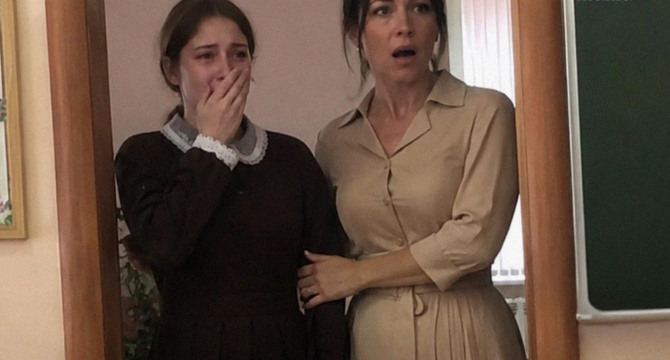
And then I covered my mouth with both hands because I genuinely could not help it.
The classroom had been completely transformed.
Balloons covered the ceiling, fairy lights were strung along the windows, and someone had set up a proper backdrop in the corner with a ring light standing next to it. Music was playing from a Bluetooth speaker on the teacher’s desk. And my entire class was standing there in their prom outfits — every single one of them, dressed up again, just like yesterday, watching the door with enormous grins on their faces.
Jenna stepped forward first, holding a large garment bag with both hands and crying already, which made me start crying before she even said a word.
“We took a vote last night,” she said, her voice wobbling. “Like, an actual vote in the group chat. It was unanimous. And then Marcus’s mom drove four of us to the mall.”
She unzipped the garment bag.
The dress inside was deep navy blue with a fitted bodice and a skirt that caught the light when it moved. Next to it, in a smaller bag, was a pair of silver shoes in my size — Jenna had texted my mom the night before to find out, which was why my mom had been so quiet that morning when I left.
“We all chipped in,” said Marcus from somewhere in the back. “Don’t make it weird.”
Everybody laughed, and I laughed through my tears, and then the girls descended on me all at once with makeup and jewelry and curling irons, and someone cleared the teacher’s desk so I’d have a mirror, and for the next forty minutes my classroom became the best version of itself I had ever seen.
Mrs. Aldridge stood near the doorway the entire time.
She had gone very pale when she first walked in, and she stayed pale. She didn’t say a word. She didn’t move to stop it or redirect it or reclaim her authority over the room.
She just stood there looking at what her cruelty had accidentally started, and eventually she turned and left, and nobody called after her.
We took the new group photo with me right in the center, in my navy dress with my hair done and Jenna’s gold earrings in my ears, and when the photographer — a classmate’s older sister who’d driven over on her lunch break — showed us the shot on her camera screen, the whole room erupted.
The story got out the way things always do in a small school.
By the end of that day, parents were calling the principal’s office. By the end of the week, there had been a formal meeting, and then another one, and Mrs. Aldridge was gone before the month was over. I heard later that it wasn’t the first complaint about her, just the one that finally had enough voices behind it.
Prom itself was two weeks later.
I wore the navy dress.
Jenna did my hair again in her bathroom while her mom made us both eat something before we left, because that’s the kind of mother she is. We walked into that gymnasium together, and I felt, for the first time in a long time, like I was exactly where I was supposed to be.
I don’t think anyone was more surprised than me when they called my name for prom queen. I stood there blinking at Jenna, and she was already screaming before I had fully processed what had happened.
I’ve thought about that moment a lot since then.
About how the worst night of my junior year turned into something that my whole class decided, without being asked, to fix together. Nobody organized it from the top down. Nobody assigned roles or sent a formal plan.
They just decided, in a group chat the night I went home and cried, that what had happened wasn’t acceptable and that they could do something about it.
That’s the part I keep coming back to. Not the dress, not even the crown. Just 17-year-olds in a group chat, deciding that one of their own deserved better.
They were right.

 admin
admin