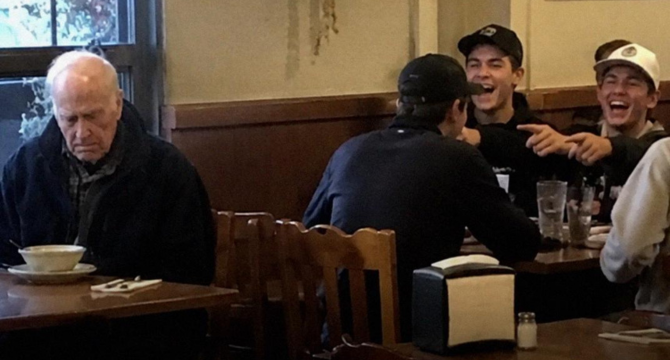
I still remember the sound of the spoon hitting the bowl.
It was this tiny, harmless sound, barely louder than the clink of dishes and low dinner chatter in the restaurant. But for some reason, that was the moment I looked over.
Not when the group of college-age customers came in laughing too loudly or when they started making jokes at the old man’s expense.
It was the spoon.
A small metallic tremor in a ceramic bowl, caused by the old man’s shaking hand.
That was the sound that made me turn fully toward the window table and see what was happening.
I was 27, working nights as a waitress at Bellamy’s, a family restaurant that stayed busy mostly because the prices were low and the portions were big.
It wasn’t glamorous work, but it paid my rent, and most days I didn’t mind it. I knew how to smile through rude comments, how to carry four plates at once, and how to calm down angry customers before Mr. Bellamy had to step in.
But that night felt different from the start.
The old man had come in just after six.
He was alone, dressed in an old brown jacket that had been brushed clean so carefully it looked almost formal.
His gray hair was neat. His shoes were polished, though worn at the edges. He sat by the window, folded his hands over the menu, and asked me in the gentlest voice if the vegetable soup was still part of the early dinner special.
“It is,” I told him.
He gave me this polite little nod. “Then I’d like that, please. And just water.”
There was something about him that made me slow down. Most people barely looked at me when they ordered. He did. Not in a strange way. Just like I was a person in front of him, not part of the furniture.
When I brought the soup, he smiled and said, “Thank you, Emily.”
I blinked. “You remembered my name?”
He glanced at my tag and smiled again. “I make an effort.”
I laughed. “Well, I appreciate it.”
At the time, I thought that was all it was. A sweet older man eating alone.
Then the group came in.
There were five of them. Early twenties, maybe. Loud, dressed like they wanted everyone in the room to know they had money and didn’t care what anyone thought.
One girl had this sharp, mean laugh that kept cutting through the room.
Two of the guys were the type who acted like being rude was a personality. I seated them at the next table because it was the only open one.
At first, it was little things. One of them imitated the old man’s unsteady hands. Another said, not quietly at all, “Damn, he looks like he wandered in from 1952.”
The others laughed.
I looked over at the man by the window. He kept his eyes on his soup. His expression did not change, but something in his face seemed to close.
I walked over to the younger table with my order pad.
“Can I get you started with drinks?” I asked.
One of the guys smirked at me. “Yeah. Can you get Grandpa over there a bib?”
The table erupted.
I felt heat crawl up my neck. “What can I get you to drink?” I repeated.
He rolled his eyes and ordered a beer.
I put their order in and tried to focus on the rest of my shift, but I kept hearing them. Every time the old man lifted his spoon and his hand trembled, one of them had something to say.
“Careful, sir, don’t break a hip.”
“Looks like he saved up all month for that dinner.”
“Maybe someone should cut up his food for him.”
I had dealt with nasty people before, but this wasn’t ordinary rudeness. It was deliberate. They had found someone defenseless and decided to make a sport of humiliating him.
I caught the old man’s eye once while refilling his water. I lowered my voice and asked, “Are you all right, sir?”
He gave me a faint smile. “I’m fine. Please don’t trouble yourself.”
That somehow made it worse.
He wasn’t angry or complaining.
A few minutes later, I was carrying a tray past their table when one of the guys leaned back in his chair and said, louder than before, “Hey, old-timer, maybe order dessert. Who knows how many chances you’ve got left?”
The girl with the sharp laugh nearly choked laughing.
I stopped walking.
“Enough,” I said.
They looked at me.
The same guy shrugged. “What? We’re joking.”
“Then joke among yourselves,” I snapped. “Leave him alone.”
He gave me this cocky little grin. “Or what?”
Before I could answer, the old man reached for his glass.
That was when the blond guy at the end of the table stretched one leg out and shoved the old man’s table.
It happened in one awful second.
The bowl tipped.
Soup spilled straight into the old man’s lap and across his jacket.
And then the whole table burst into laughter.
The old man jerked back in shock. His face went red, then pale. He tried to stand too quickly and almost lost his balance. Soup dripped from the edge of the table onto the floor.
Something in me snapped.
I slammed my tray onto the empty counter by the kitchen and walked straight to their table.
“You need to leave,” I said.
The laughter faded.
One of the girls blinked at me. “Excuse me?”
“You heard me. Get out. Right now.”
The blond guy scoffed. “You can’t kick us out.”
“I can, and I am.”
The first guy stood up halfway, puffing himself up. “We didn’t do anything.”
“You assaulted an elderly customer and turned it into entertainment,” I said. “So yes. You’re done here.”
He opened his mouth, but before he could start shouting, Mr. Bellamy came out from behind the register. He was in his 60s, broad-shouldered, with the kind of face that could end an argument before it started.
“Is there a problem?” he asked.
I didn’t take my eyes off the group. “Yes. They’re leaving.”
Mr. Bellamy took one look at the spilled soup, the old man’s soaked jacket, and the guilty expression on exactly none of their faces.
Then he said, “You heard her.”
The guy turned to him. “This is ridiculous.”
Mr. Bellamy stepped closer. “Out. Now. Before I call the police.”
That finally did it.
They started complaining all the way to the door.
“This place is trash anyway.”
“We were just joking.”
“Hope you enjoy losing customers.”
The girl with the laugh muttered, “Psycho waitress.”
I held the door open for them and said, “Goodnight.”
When they were gone, the restaurant felt strangely quiet.
I turned back toward the old man. He was standing beside his chair, trying to blot soup from his jacket with a paper napkin that had already fallen apart in his hands.
“Oh, sir,” I said softly, hurrying over. “I’m so sorry.”
He looked embarrassed, which made me hate those people even more.
“You don’t need to apologize,” he said. “None of that was your doing.”
“Still.” I grabbed clean towels from the service station. “Please, let me help.”
I helped clean the table and brought him a fresh bowl of soup and a new basket of bread on the house. Mr. Bellamy sent out a slice of pie, too, pretending it was no big deal.
The old man dabbed at his jacket and gave me this thoughtful look.
“You stood up for me,” he said quietly.
I shrugged, suddenly awkward. “Anyone should have.”
He kept looking at me. “But you did.”
I did not know what to say to that.
When he finished eating, he came to the register to pay. Mr. Bellamy tried to refuse, but the man insisted.
Before he left, he turned to me.
“What did you say your name was?”
I smiled a little. “Emily.”
He nodded slowly, as if committing it to memory. “Thank you, Emily.”
Then he walked out into the night.
That should have been the end of it.
For a week, I barely thought about him. Life was too busy.
The following Thursday, I got home after a double shift with sore feet and a headache so sharp it felt like a nail behind my eyes.
I was digging through my bag for my keys when I saw the car.
A long black luxury sedan sat at the curb in front of my house like it had taken a wrong turn into the wrong neighborhood.
The driver’s window rolled down.
A man in a dark suit leaned slightly toward me. “Are you Emily?”
Every bad possibility hit me at once.
I gripped my bag strap. “Who’s asking?”
“Mr. Blackwood would like to see you.”
I frowned. “Who?”
Without a word, the driver reached across and handed me a photograph.
I took it.
It showed the old man from the restaurant.
Except he didn’t look like the man from the restaurant.
He was standing in an elegant black suit beside two men I recognized from local news and a woman I knew was a senator. Behind them was a banner for some charity gala. He looked older, yes, but powerful.
At the bottom of the photo was a printed caption from a newspaper clipping:
Mr. Blackwood, philanthropist and chairman of the Blackwood Foundation.
My stomach dropped.
I looked from the photo to the driver. “This is a joke.”
“It is not,” the driver said.
I stared at the car again. “Why does he want to see me?”
“Mr. Blackwood said he would prefer to explain that himself.”
Every warning bell in my head was going off.
Instead, I heard myself ask, “Where is he?”
“At his residence.”
That sounded even more insane.
I crossed my arms. “I’m not just getting into a random car because a stranger asked.”
The driver gave a short nod like he respected that. Then he held out a business card, embossed in heavy cream paper. Mr. Blackwood. Blackwood Foundation. An address in the wealthiest part of the county.
“You may verify it if you like,” he said.
I did. With shaking hands, I searched the name on my phone right there on the sidewalk.
It was all real, so I got into the car, and the ride took almost an hour.
We drove farther and farther from my neighborhood, through parts of town I had only seen in magazines or from bus windows. Big houses turned into gated properties. Streetlights became softer. Trees lined the road like something out of a movie.
My heart pounded harder the whole way.
Finally, the car turned through iron gates taller than my house.
I looked out the window and actually whispered, “Oh my God.”
The place wasn’t a house. It was a mansion.
It had a stone exterior, a long curved driveway, fountains, and the lights from the front entrance spilled across the gravel in warm gold. Two security guards stood near the doors.
The driver came around to open my door.
My legs felt weak when I stepped out.
Inside, everything was polished wood, high ceilings, portraits, and the kind of silence that only exists in very expensive places.
A woman in a navy suit approached me. “Emily? This way, please.”
I followed her through a hallway longer than my apartment building.
Then she opened double doors.
Mr. Blackwood stood by a fireplace.
For one wild second, I thought they’d brought me to the wrong room, because the man in front of me looked nothing like the lonely customer from Bellamy’s.
He still had the same face, of course. But now he wore a beautifully cut charcoal suit. His hair was trimmed. His posture was straighter. There were assistants near the wall with tablets in hand, and a security guard by the door.
He turned when I entered.
“Emily,” he said warmly. “Thank you for coming.”
I just stared at him. “You’re kidding.”
A faint smile touched his mouth. “No.”
I looked around the room, then back at him. “You were eating soup at my restaurant.”
“Yes.”
“Wearing that old jacket.”
“Yes.”
“And now this?” I gestured helplessly at everything. “What is this?”
He motioned toward a sitting area near the fire. “Please. Sit.”
I stayed standing for another second, then sat on the edge of a cream-colored chair that probably cost more than my car.
Mr. Blackwood sat across from me, folding his hands over a cane I hadn’t noticed before.
“I owe you an explanation,” he said.
“Yeah,” I said breathlessly. “You really do.”
He nodded once.
Then he told me.
His late wife, Eileen, had founded the Blackwood Foundation nearly 30 years earlier. She had grown up watching her grandmother age in isolation and poverty, and she made it her mission to change the way elderly people were treated.
The foundation paid for housing, medical care, in-home aides, transportation, social programs, legal help, and community centers for seniors who had no family or support.
When Eileen died five years ago, Mr. Blackwood said, something in him cracked.
“I kept the foundation running,” he said, staring into the fire. “But I stopped believing in the spirit behind it. The paperwork, money, and galas continued. Yet I found myself wondering whether kindness itself had become performative. Whether people only cared when cameras were present.”
I listened in complete silence.
“So,” he continued, “I began going out alone. Without staff, announcements, or any sign of who I was.”
I blinked. “You tested people?”
His mouth curved slightly. “That does sound terrible when you say it that way.”
“Because it is a little terrible.”
He chuckled, which somehow made him seem suddenly more human.
“I suppose it is,” he admitted. “But I wanted to see people as they were. I visited diners, buses, parks, clinics, and waiting rooms. I wanted to know if decency still existed when there was nothing to gain.”
I thought of the restaurant. The group that was laughing, and the spilled soup.
His expression darkened a little. “I have seen enough cruelty these past years to understand how lonely old age can become. But I have also seen flashes of grace.”
He looked directly at me.
“And then I met you.”
My face got hot. “I just kicked out some jerks.”
“No,” he said gently. “You defended someone with no power in that room. You did it without knowing who I was. You did it at some risk to yourself. I noticed not only what you did, but how you did it.”
I looked down at my hands. Nobody talked about me like that. Not in my life.
He went on. “Afterward, I asked around. Quietly. Your employer spoke highly of you. I also learned about your circumstances.”
I stiffened. “What circumstances?”
He did not flinch. “You support your mother when you can. You have delayed college to help your family. You work hard. And you have a record of volunteering at the senior center on your one free Sunday each month.”
I stared at him. “How do you know that?”
He gave me a direct, unapologetic look. “Because before making the offer I intend to make, I needed to be certain.”
My pulse jumped. “Offer?”
Mr. Blackwood leaned back in his chair.
“My wife used to say that institutions fail when they lose their moral center. Money helps people, yes, but leadership decides what kind of help survives. For years, I have been searching for someone honest enough, strong enough, and compassionate enough to carry Eileen’s work forward.”
I laughed once, short and disbelieving. “You don’t know me.”
“I know enough to begin.”
He let that sit there for a moment.
Then he said, “Emily, I want to pay for your education in full. Tuition, housing, living expenses, all of it. I want you to study nonprofit leadership, public policy, social work, or whatever path best prepares you. I would also like to bring you into the Blackwood Foundation in a junior leadership role while you train. You would have mentors, support, and a place here. If, over time, you prove to be what I believe you are, I want you to help lead this organization.”
I literally forgot how to breathe.
My first reaction was not gratitude. It was a suspicion.
“Why me?” I asked.
“Because you did the right thing when nobody was watching.”
“That can’t be enough.”
“It is where enough begins.”
I stood up and paced two steps, then stopped. “This is insane.”
“Perhaps.”
“You are offering a stranger a life.”
He was quiet for a moment.
Then he said, “My wife spent her life believing that one decent person, placed in the right position, can change the course of thousands of other lives. I used to agree with her without effort. After she died, I agreed with her only on paper. You reminded me of what she meant.”
I swallowed hard.
“No one has ever looked at me like I could become more than what I already am,” I said before I could stop myself.
Mr. Blackwood’s expression softened.
“Then shame on them,” he said.
That almost broke me.
I sat down again because suddenly I wasn’t sure my legs would hold me.
He did not pressure me. He simply explained the terms. Everything would be legal, documented, and transparent. I could have my own lawyer review it. I could say no. I could take time.
Before I left, he said one last thing.
“When Eileen interviewed staff for the foundation, she used to ask them a question.” He paused. “She would say, ‘How do you treat someone who can do nothing for you?’ Most people never realized that was the only interview question that mattered.”
I was driven back home in a daze.
The next week felt unreal. It involved lawyers, meetings, documents, and orientation packets thicker than my winter coat. I kept waiting for the trick, for the catch, for someone to laugh and tell me I’d been stupid.
It never happened.
Instead, I found myself in classrooms I never thought I could afford, sitting in meetings with policy directors and elder care advocates, learning how housing grants were allocated, how caregiver shortages destroyed lives, how isolation increased mortality, and how many seniors died each year with no one to claim them.
I learned fast because I wanted to. Because every new fact felt personal. Because once you really see loneliness, you cannot unsee it.
Mr. Blackwood kept his distance at first, watching more than speaking.
But over time, he became something I had not expected.
A mentor.
Years passed.
Through it all, there was work in every inch of it, long nights, mistakes, self-doubt, classes, reports, training trips, and difficult conversations.
Some people at the foundation resented me at first. They thought I was a charity case. Or Mr. Blackwood’s sentimental project. So I worked harder.
I visited assisted living homes that smelled like bleach and silence. I sat with women who had not had a visitor in six months.
I listened to old men pretend they did not mind being forgotten. I helped build outreach programs for seniors being pushed out of housing. I fought for better funding for caregivers.
I learned how to listen before trying to fix things.
And slowly, people stopped seeing me as the waitress Mr. Blackwood had chosen and started seeing me as the person who belonged there.
Mr. Blackwood lived long enough to watch that happen.
On the day he officially stepped down as chairman, he called me into his office. He was thinner then. Frailer. But his mind was still sharp as glass.
He slid a folder across the desk.
Inside was the board resolution naming me executive director of the Blackwood Foundation.
I looked up at him, stunned. “Mr. Blackwood.”
He gave me a small smile. “Eileen would have liked you very much.”
I cried right there in his office, which was not the composed leadership moment I had imagined for myself.
He pretended not to notice and said, “Try not to ruin the place.”
I laughed through tears. “I’ll do my best.”
He nodded. “I know.”
Mr. Blackwood died nine months later.
It has been 15 years since the night at Bellamy’s.
I still think about it sometimes.
But today, I lead a foundation that funds housing, medical care, legal support, mental health services, and community centers for thousands of elderly people across the country.
And every time I walk into one of our centers and see an old woman laughing over cards, or a former widower teaching woodworking to teenagers, or a man with trembling hands eating a hot meal without shame, I think about how close I came to living and dying in a completely different story.
Even now, on hard days, I still hear Mr. Blackwood’s voice.
You did the right thing when nobody was watching.
That was the night I thought I was protecting a lonely old man in a stained jacket.
I had no idea he was the one about to hand me a future.
And if there is one thing this life has taught me, it is this:
You never really know who is sitting quietly at the next table.
Or how much can begin with the simple choice to say, “Enough. Leave him alone.”

 admin
admin