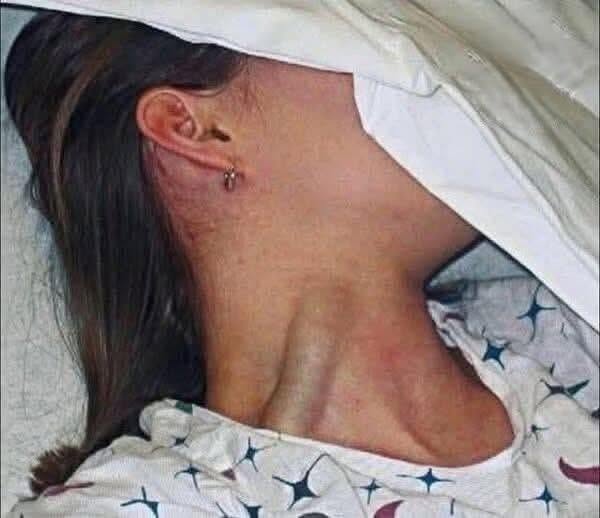
At first, the woman thought the prominent vein on the side of her neck was nothing to worry about.
She had noticed it becoming more visible in the mirror, particularly when she was sitting upright. There was no obvious injury, and she initially assumed it was simply a change in her appearance.
But over the following days, she began experiencing other symptoms.
She felt increasingly tired and occasionally became short of breath. Her family noticed that she was not herself, but she insisted that she would make an appointment with her doctor if things did not improve.
She never got that chance.
The Warning Sign She Didn’t Recognize
A visibly swollen or prominent neck vein can have many possible explanations. In some circumstances, however, it can be a sign of increased pressure in the veins returning blood to the heart.
Doctors refer to this clinical finding as jugular venous distention, or JVD.
JVD is not itself a disease. Instead, it can be a clue that something else may be affecting the heart or circulation.
In this woman’s case, the visible change in her neck was accompanied by symptoms that should have prompted urgent medical evaluation.
Her Condition Suddenly Became Worse
One evening, her family noticed that she was struggling to breathe.
She appeared exhausted and complained of feeling extremely unwell. Within a short period of time, her condition deteriorated rapidly.
Emergency medical personnel were called, but despite efforts to stabilize her, she could not be saved.
Her sudden death left her family devastated and struggling to understand how someone who had seemed relatively well could become critically ill so quickly.
Doctors Explained What the Sign Could Mean
After her death, the family learned more about the possible significance of the symptoms she had experienced.
A prominent jugular vein can sometimes be associated with serious conditions affecting the heart, lungs, or circulation.
Heart failure, particularly problems affecting the right side of the heart, can increase pressure in the venous system and make the jugular veins more noticeable.
Other serious conditions can also cause elevated pressure around the heart or within the pulmonary circulation.
The exact cause of a person’s symptoms can only be determined through a proper medical evaluation.
Why Symptoms Shouldn’t Be Ignored
The woman’s story highlights how easy it can be to dismiss a physical change when it does not initially seem painful or dangerous.
A person may notice a swollen vein, unusual fatigue, mild breathing difficulties, or swelling in the legs and assume the symptoms are simply related to aging, stress, or exhaustion.
But when several unusual symptoms appear together, they deserve attention.
Shortness of breath, chest discomfort, fainting, significant swelling, severe weakness, or rapidly worsening symptoms should never be ignored.
What Doctors Look For
When a healthcare professional suspects elevated venous pressure, they may examine the neck while the patient is positioned at an appropriate angle.
The examination may be followed by tests designed to identify the underlying problem.
Depending on the circumstances, doctors may use an electrocardiogram, blood tests, chest imaging, or an echocardiogram to evaluate the heart and circulation.
The treatment depends entirely on the cause.
Some conditions can be managed with medication, while others require urgent procedures or hospital treatment.
Her Family Wishes She Had Sought Help Earlier
After losing her, the woman’s family began reflecting on the symptoms she had experienced.
They wished they had understood that something as seemingly simple as a visibly swollen neck vein could sometimes warrant medical attention—particularly when accompanied by other concerning symptoms.
They also recognized an important truth: not every prominent vein is a medical emergency, and not every person with a visible neck vein has a serious illness.
But unusual changes combined with worsening symptoms should be evaluated rather than dismissed.
A Reminder About Listening to Your Body
The tragedy left her loved ones with a painful message they hoped others would hear.
People often become accustomed to minor changes in their bodies. They may tell themselves that they are simply getting older or that a symptom will disappear on its own.
Sometimes it does.
Sometimes, however, a seemingly small change can be an important clue to an underlying condition.
Paying attention does not mean assuming the worst. It means giving yourself the opportunity to find out what is really happening.
The Warning Signs Worth Knowing
A new or persistent prominent neck vein should be discussed with a healthcare professional, particularly if it appears alongside:
- Shortness of breath
- Chest pain or pressure
- Fainting or severe dizziness
- Unusual or worsening fatigue
- Swelling in the legs or abdomen
- Difficulty breathing while lying down
- A rapid or irregular heartbeat
- A sudden deterioration in health
If severe symptoms develop suddenly, urgent medical attention is important.
Her Story Became a Reminder for Others
The woman could not have known exactly what was happening inside her body simply by looking in the mirror.
Her family later hoped that sharing the lesson from her experience would encourage others not to dismiss significant changes or wait too long when symptoms become worse.
Her death was a heartbreaking reminder that the body can sometimes provide warning signs before a serious medical problem becomes obvious.
A visible change does not automatically mean something is seriously wrong—but when a new symptom is persistent or accompanied by other concerning symptoms, getting checked can make all the difference.
This story is fictionalized for health-awareness purposes. A photograph of a prominent neck vein cannot establish a diagnosis, and anyone experiencing concerning or worsening symptoms should seek advice from a qualified healthcare professional.
