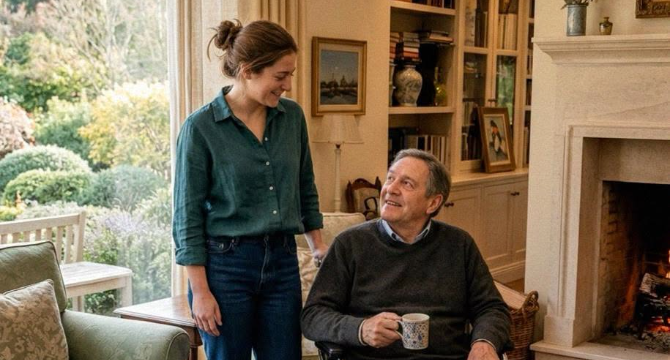
When I learned my dying uncle was rich, I made sure he remembered me. I called more, stayed longer, and secretly imagined what he’d leave me. After his funeral, his lawyer handed me a small package. What Isaac left inside made me ashamed I’d ever wanted his money.
For as long as I could remember, my family had been three people: Mom, Dad, and me.
No grandparents who called on Sundays.
No cousins at Thanksgiving.
No aunts who sent birthday cards with too much glitter.
I used to think that was just how some families were.
I was twenty-six when I learned that wasn’t the whole truth.
For as long as I could remember, my family had been three people.
“I have a brother,” Mom said one evening, staring at her coffee instead of me. “Isaac. He’s sick. The hospital called me because I’m still listed as next of kin.”
I set down my fork.
“You have a brother?”
“Had. Have. I don’t know anymore.”
“The hospital called me because I’m still listed as next of kin.”
She pressed her lips together in the way she did when a conversation was over before it started.
“Why didn’t you ever tell me?”
“Because it doesn’t matter,” she said. “He’s not part of our lives.”
“But he’s sick. Dying, maybe?”
“Why didn’t you ever tell me?”
She didn’t answer.
She just got up and started washing a dish that was already clean.
But the strangest part wasn’t that Mom had hidden a brother from me.
It was how scared she seemed of telling me why.
“What happened between you two?” I asked.
She didn’t answer.
Mom sighed.
“It was a long time ago, and I don’t want to talk about it.”
I stared at her.
And then I made a decision that would later change my life.
“Can I meet him? You don’t have to go if you don’t want to, but I’d like to see him at least once before it’s too late.”
I made a decision that would later change my life.
She looked at me for a long moment.
I thought she might forbid it.
Then she just said, “Do what you want. You always do.”
That stung.
But it also didn’t stop me.
“Do what you want. You always do.”
I thought meeting Isaac might finally explain Mom’s silence.
Instead, my first visit gave me another reason to wonder what she wasn’t telling me.
Isaac lived in a house that looked like it belonged in a magazine — stone facade, a circular driveway, a housekeeper who answered the door before I could knock twice.
He was thinner than I expected, sitting up in a leather chair with a blanket over his legs.
I thought meeting Isaac might finally explain Mom’s silence.
But his eyes were sharp and amused when he saw me.
“You must be Renee’s kid,” he said. “You’ve got her chin.”
I nodded.
He gestured at the chair across from him.
“Sit. Tell me about yourself.”
“You must be Renee’s kid,”
He was easy to talk to — funnier than I expected, curious about my job, my apartment, the dog I didn’t have but wanted.
But every time I steered the conversation toward Mom, he’d smile and change the subject like a man swatting a fly.
“Why did you two stop speaking?” I asked, the third visit in.
He was easy to talk to
“Ask your mother.”
“She won’t tell me.”
“Then maybe it’s not mine to tell either.”
He said it kindly, but it was a wall all the same.
Now they were both hiding the same story from me — and I couldn’t understand who they were protecting.
“She won’t tell me.”
I kept visiting anyway.
Partly because I liked him.
He had this dry, unbothered way of talking about the world.
I found that comforting.
But somewhere around the fourth or fifth visit, I noticed something that changed the reason I kept coming back.
I kept visiting anyway.
The cars in his driveway.
The art on his walls.
The way his housekeeper mentioned “the second property” like it was nothing.
I did the math a person does without meaning to.
An estranged, dying, wealthy uncle.
No other family that I knew of.
I told myself I was still visiting because I liked him.
That was even mostly true.
But underneath it, quietly, I started making sure I called more, stayed longer, laughed harder at his jokes.
I started being careful.
I told myself I was still visiting because I liked him.
Agreeable.
The kind of person a wealthy man might remember kindly when it counted.
I didn’t say any of this out loud.
Not even to myself, not really.
But I felt it, the way you feel a stone in your shoe you’ve decided not to stop and remove.
I thought I was being subtle enough that nobody would notice.
I was wrong.
The kind of person a wealthy man might remember kindly when it counted.
Isaac died two months later.
The funeral was small.
A handful of business associates attended.
Mom sat rigid in the second row with her hands folded so tightly her knuckles went white.
She didn’t cry.
Isaac died two months later.
She barely spoke.
Afterward, his lawyer, a tired-looking man named Mr. Alvarez, found me by the parking lot.
He pressed a small package into my hands.
“He wanted you to have this,” he said. “He’d been waiting for this day to finally reveal the truth.”
“What truth?”
He pressed a small package into my hands.
“Read the letter first,” Alvarez said.
He walked away before I could ask anything else.
I stared at the package.
The truth… that phrase seemed to point to only one thing.
I expected something about Mom and why they stopped talking.
I wasn’t prepared to find something about myself.
That phrase seemed to point to only one thing.
I opened the package that night, alone in my apartment.
Inside, I found a letter.
If you’re reading this, I’m gone.
You need to know why your mother stopped speaking to me. It’s the only way the rest of it will make sense.
Inside, I found a letter.
Our parents left us a property together — a house on Miller Lake. It was supposed to be split evenly.
So that was why Mom had cut him off.
But it didn’t explain why Isaac had left this confession to me.
Or what he expected me to do about it.
It didn’t explain why Isaac had left this confession to me.
I was older, I handled the paperwork, and I made sure it ended up entirely in my name.
I told myself I deserved it more.
I told myself Renee didn’t need it as much as I did. I was wrong on both counts, and I knew I was wrong the whole time.
She found out.
I was wrong on both counts, and I knew I was wrong the whole time.
She confronted me.
I defended myself, badly, the way people do when they know they’re guilty.
Later I tried to make it right by writing her a check, and she threw it back at me. She wasn’t going to let me buy my way out of what I’d done.
I didn’t understand that then.
I understand it now.
Then I reached the part of the letter that made my stomach drop.
I didn’t understand that then.
I want to tell you something else.
I need you to hear it without flinching, because I didn’t flinch when I saw it in myself, either.
I noticed exactly when your visits changed.
Not dramatically — you’re not a dramatic person. But I know what greed looks like from the inside.
I saw myself in you, and it scared me more than the diagnosis did.
I want to tell you something else.
I didn’t say anything, because I wanted to see what you’d do with it.
I wanted to see if you were only that, or if there was more underneath.
I still don’t fully know.
But I hope, by the time you’re reading this, you do.
My face was burning.
But Uncle Isaac had one more surprise for me
I didn’t say anything, because I wanted to see what you’d do with it.
Mom called the next morning.
“Alvarez phoned me,” she said.
Her voice was strange — careful, like she was walking on ice.
“He wants us both at the reading of the will,” she finished. “Isaac insisted we both had to be there.”
“Do you think he left us something?”
Mom called the next morning.
Mom sighed.
“I don’t know. I’m not sure I want anything from him.”
I didn’t reply.
I was terrified of what that will reading would reveal.
But I couldn’t stay away.
I was terrified of what that will reading would reveal.
The reading of the will took place in Alvarez’s office.
A handful of relatives I barely recognized were sitting in stiff chairs along the wall.
I sat beside Mom, who kept her eyes on her hands.
I won’t pretend I didn’t still hope.
Some small, embarrassing part of me had spent the drive over doing math again.
I won’t pretend I didn’t still hope.
I’d imagined what a fortune like Isaac’s might mean for me.
I hated that part of myself.
It didn’t stop me from feeling it.
Alvarez cleared his throat and began reading through the smaller bequests — donations to a hospital, a sum to his housekeeper, the cousin getting a set of watches.
Then he reached my name.
I hated that part of myself.
“I leave to you a package, already delivered, a sum of fifteen thousand dollars, and the fishing rod that belonged to my father, which I hope you’ll use better than I ever did.”
Fifteen thousand dollars.
A fishing rod.
That was it.
I felt the heat rise in my face again, but this time it wasn’t shame at being caught.
“I hope you’ll use better than I ever did.”
It was shame at how much smaller I felt in that moment.
I had let myself want more, despite the guilt that wanting had caused me.
I had let myself count on it.
Alvarez continued before I could fully sit with that feeling.
“The remainder of the estate,” he said, “including the Miller Lake property, its accumulated value, and all associated holdings, is to be transferred in full to my sister, Renee.”
Alvarez continued before I could fully sit with that feeling.
Mom’s hands had gone still in her lap.
“This should be considered restitution for the share that was always rightfully hers, along with the appreciation and income it would have generated across the years I withheld it.”
The room went quiet.
Someone near the back murmured a number under their breath — a big one.
“I don’t want it,” Mom said, so quietly I almost missed it.
The room went quiet.
Alvarez looked at her gently.
“Mrs. Calloway, I understand your hesitation. But I want to be clear about what this is. This is restitution. It was always yours. He simply held it for thirty years without your permission.”
“He offered me money once before,” Mom said. “I turned it down.”
“I know,” Alvarez said. “He told me. He also told me this was different, and I believe him.”
What he said next stunned me.
“He told me. He also told me this was different, and I believe him.”
“Isaac began the paperwork for this transfer eight months before your son ever visited him,” Alvarez continued. “This isn’t something he did because he got caught being sentimental at the end. He was already trying to fix it.”
That detail landed on me harder than almost anything else in the room.
That meant Isaac’s last decision wasn’t about rewarding me or punishing me.
He’d been trying to correct something much older.
Isaac’s last decision wasn’t about rewarding me or punishing me.
Whatever had shifted in Isaac, it hadn’t started with me.
Meeting me had just made the shift feel urgent — a mirror he hadn’t asked to look into.
Mom was quiet for a long moment.
Then she said, “He should have done this fifteen years ago.”
“You’re right,” Alvarez said. “He knew that too.”
Whatever had shifted in Isaac, it hadn’t started with me.
“The money doesn’t undo what we lost. The years we didn’t speak.”
“No,” Alvarez agreed. “It can’t undo that.”
Mom nodded slowly, like she was settling something inside herself.
“But he stopped asking me to forgive him for it. That’s different than before.”
She looked down at the folder in front of her.
“It can’t undo that.”
“I’ll accept it. Not because it makes things right. Because it’s mine.”
I thought Isaac’s will had settled everything.
A few weeks later, Mom put me in the same position Isaac had faced years ago.
We didn’t speak much on the drive home.
When we got to her house, she made tea, and we sat at her kitchen table the way we had a hundred times before, except everything about the room felt different now.
I thought Isaac’s will had settled everything.
“I’m sorry,” I said. “I did like him, but honestly, I kept visiting him for all the wrong reasons.”
“You were curious first,” she said. “You liked him first. That’s not nothing.”
“It doesn’t feel like enough of a defense.”
She almost smiled.
“No. It probably isn’t.”
A few weeks later, after the transfer had gone through and the number in her account had become real and enormous, Mom sat me down again.
“I kept visiting him for all the wrong reasons.”
“I want to split some of this with you,” she said. “You’re my son.”
I thought about the letter.
About Isaac watching me change, quietly, from a distance, recognizing something he used to be.
I thought about how easy it would be to say yes.
To let this become the ending where the money finally found its way to me anyway, just through a different door.
I thought about how easy it would be to say yes.
“No,” I said. “This was always yours.”
She studied me for a second, like she was checking whether I meant it.
I think she saw that I did.
“He kept a fishing rod for thirty years and never used it once,” she said finally. “Maybe you’ll do better with it than either of us did with anything else he touched.”
She was checking whether I meant it.
I still have that rod.
I haven’t caught much with it yet.
But some mornings I take it out to the lake house Isaac stole from Mom and then returned.
I sit there and think about a man who spent most of his life taking what wasn’t his, and the last months of it quietly trying, imperfectly, to give it back.
I still have that rod.
It isn’t a happy ending, exactly.
Mom still carries the years she lost.
I still carry the shame of what I almost became.
But we’re both a little more honest now than we were before Isaac died.
I think that might be the only kind of inheritance that was ever really worth having.

 admin
admin