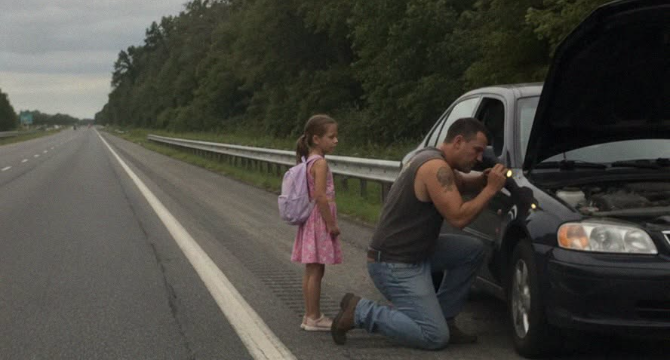
I almost drove past the man stranded beside a broken-down car. Then he turned toward me, and I recognized the father who had abandoned me ten years earlier.
“Ellie?”
My father’s hand dropped from the window.
For a moment, neither of us moved.
Cars rushed past, throwing hot wind across the shoulder. Behind him, the little girl shifted on the suitcase.
I stared at the man who had walked out of my life ten years earlier.
His face had changed.
His eyes had not.
“Your car broke down?” I asked.
It was a ridiculous question, but it was the only one I could manage.
He nodded.
“Overheated, I think.”
His voice was rougher than I remembered.
I looked at the girl.
She was about nine, with dark hair in two uneven braids. She wore a yellow T-shirt and held a water bottle against her chest.
My father followed my gaze.
“This is Sophie.”
Then she stood.
She had his eyes too.
“Is she your daughter?”
He did not answer quickly enough.
The old pain returned so fast that it almost felt familiar.
“You left us for another family.”
“No.”
“Don’t.”
“Ellie, it isn’t what you think.”
“That is what people say when it is exactly what you think.”
Sophie looked between us.
“Dad?”
The word hit me like a fist.
He turned toward her.
“It’s okay.”
“No, it isn’t,” I said.
His shoulders dropped.
“I know.”
I almost drove away.
Instead, I looked at Sophie standing beside the broken car while traffic flew past.
“Get her into my car.”
My father blinked.
“What?”
“She is not staying on the shoulder.”
“Thank you.”
“This is not for you.”
“I know.”
He helped Sophie into the back seat, then sat beside me.
The car immediately felt too small.
I turned on the air-conditioning.
Sophie leaned toward the vent.
“Thank you,” she whispered.
“You’re welcome.”
I looked at my father.
“Who is she?”
He folded his hands.
“My daughter.”
There it was.
Ten years of silence reduced to two words.
“How old?”
“Nine.”
He had left when I was13.
The dates did not require much imagination.
“Was her mother the reason you left?”
“No.”
“Did you know she was pregnant?”
“No.”
“Did you know her before you left?”
He closed his eyes.
“Yes.”
I gripped the steering wheel.
“Get out.”
“Ellie—”
“Get out of my car.”
Sophie made a small sound behind us.
My father glanced back at her.
“Please let me explain somewhere safer.”
I hated that he was right.
I called roadside assistance, then drove us to a gas station twelve miles away.
No one spoke.
Sophie stared out the window.
My father kept his hands folded in his lap.
At the station, I parked beside a shaded picnic table.
Sophie went inside.
The moment the door closed, I turned on him.
“You have three minutes.”
He nodded.
“Her mother was named Rachel.”
“Was?”
“She died last year.”
That stopped me for half a second.
Then my anger returned.
“How did you know her?”
“She worked with me.”
My father had sold appliances and traveled often. He used to bring me hotel soaps from his trips.
I collected them in a basket.
“Did you have an affair?”
“Yes.”
The directness hurt more than an excuse.
“How long?”
“Six months.”
“Did Mom know?”
“No.”
“Then why did you leave?”
He looked toward the gas station.
“I was going to tell her.”
“But you didn’t.”
“No.”
The affair had already ended when he packed his clothes. Rachel had moved to another state, and he told her he would not leave his family.
Then a doctor called.
My father had inherited a serious heart condition from his own father, who died at forty-six. Without surgery, he might have only a few years.
“What does that have to do with leaving us?”
“At first, nothing.”
He was terrified.
He had betrayed my mother, faced dangerous surgery, and accumulated medical debt.
“So you disappeared.”
“I convinced myself you would recover faster if you hated me.”
I stared at him.
“Do you hear how arrogant that sounds?”
“Every day.”
“You decided what pain we could survive.”
“Yes.”
“You let Mom think she had done something wrong.”
His face tightened.
“I know.”
“No, you don’t.”
My mother spent years replaying their marriage.
She blamed the arguments about money.
The weight she gained.
The nights she fell asleep before he came home.
When I was fifteen, I found her crying with their wedding photograph in her lap.
She looked at me and said, “I wish I knew what I did.”
She had done nothing.
My father had found silence easier than confession.
“Why didn’t you ever call me?”
“At first, shame.”
“And later?”
“The longer I waited, the harder it became.”
“That is always the excuse.”
“I know.”
“You knew where we lived.”
“Yes.”
“You knew my birthday.”
“Yes.”
“You knew Mom worked two jobs.”
His eyes lifted.
“How did you know that?”
“Do not change the subject.”
His silence answered.
A new suspicion settled over me.
“Did you watch us?”
“Online. Through people I knew.”
“Who?”
He named my aunt Linda.
I felt sick.
Aunt Linda had brought groceries after he vanished. She paid our electricity bill once and held Mom while she cried.
“She knew where you were?”
“Not at first.”
“When?”
“Three years later.”
I stood so quickly that the bench scraped the pavement.
“She kept your secret for seven years?”
“She did not approve.”
“But she did it.”
“I asked her to.”
“You always ask other people to carry your cowardice.”
He flinched.
Good.
Sophie came outside carrying three bottles of water.
She stopped when she saw us.
My father stood.
“Everything is okay.”
“No, it isn’t,” she said.
Her voice was stronger now.
“You lied to her too.”
I looked at Sophie.
“What did he tell you?”
She looked at him.
He said nothing.
“He said you didn’t want to know us.”
My anger went cold.
I turned toward him.
“You told her that?”
“I said you had your own life.”
“You said Ellie knew about me,” Sophie replied.
He closed his eyes.
I faced her.
“I did not know you existed.”
Her expression changed.
The hope she had carried onto the roadside disappeared.
“Then why did you never visit?” she asked.
My throat tightened.
“I would have.”
The answer came immediately.
“If I had known, I would have wanted to meet you.”
She looked at my father.
“You said she blamed me.”
“Sophie—”
“Did she?”
I shook my head.
“No. None of this is your fault.”
She began crying and wiped her face quickly.
“Mom said that too.”
My father sat down heavily.
I stared at him.
“Rachel knew about me?”
“Yes.”
Rachel contacted him when Sophie was four months old. A paternity test confirmed she was his daughter.
By then, he had undergone heart surgery and survived.
He could have returned.
He did not.
He moved near Rachel and helped raise Sophie.
The truth was worse than the affair.
He had not vanished into sickness.
He survived and chose to remain gone.
“You built another family.”
“Not at first.”
“But eventually.”
“Yes.”
“Did you love Rachel?”
He hesitated.
“Yes.”
“You said she was not why you left.”
“She wasn’t.”
“But she was why you stayed.”
His face collapsed.
“Partly.”
The tow truck arrived.
My father left to speak with the driver.
Sophie sat beside me.
For a while, neither of us spoke.
Then she opened her backpack and handed me a photograph.
It showed my father on a couch with Sophie and a red-haired woman who had to be Rachel.
On the wall behind them was a picture of me at my high school graduation.
I stared at it.
“Where did he get that?”
“Aunt Linda sent it.”
Sophie pointed toward my face.
“I always knew what you looked like.”
She had grown up with my picture in her home while I did not know her name.
“Did you ask to meet me?”
“Every year.”
“What did he say?”
“That you weren’t ready.”
My father had turned my ignorance into rejection.
To me, he was absent.
To Sophie, I was unwilling.
He stayed protected between two lies.
When he returned, the driver said the car could not be repaired until morning. A motel stood across the road.
I asked Sophie, “Where were you going?”
She looked at my father.
He answered.
“To see you.”
I stared at him.
“What?”
Rachel had left a letter before she died of ovarian cancer.
She told him he had already taken enough choices from his daughters and made him promise to introduce us.
It took him 11 months.
“Why?”
“I was afraid.”
“Of what?”
“That you would hate me.”
“This is not about whether I hate you.”
“It is for me.”
“That is your problem.”
Sophie pulled an envelope from her backpack.
My name was written across the front.
ELLIE.
“Mom wrote one for you too.”
I hesitated before opening it.
Rachel had known my father was married when their relationship began. She wrote that she told herself his marriage was already failing because it made her choices easier to justify.
When she learned he had left us, she told him to return.
He refused.
For years, she allowed him to claim he was protecting everyone because she feared that if he faced what he had done, he might leave Sophie too.
Near the end, she wrote:
Sophie has wanted a sister her entire life. You owe her nothing, but please do not let our choices make you believe she wanted any part of your pain.
Then came one final sentence.
Your father loves both of you. Unfortunately, love has never been the same as courage for him.
I folded the letter.
Sophie watched me.
“Was she sorry?”
“Yes.”
She nodded as if that mattered.
Maybe it did.
My father asked, “What happens now?”
“You do not get to ask me that.”
He lowered his head.
I turned to Sophie.
“Do you want dinner?”
Her eyes widened.
“With you?”
“Yes.”
She nodded.
My father reached for his wallet.
“Not you,” I said.
His hand stopped.
“Sophie can come with me. You can stay here and think about how you lied to both your daughters at once.”
For once, he did not argue that he had been protecting someone.
Sophie and I ate at a diner nearby.
At first, we talked about safe things.
School. Books. Music.
She loved drawing.
I hated it.
She hated tomatoes.
So did I.
When the waiter brought lemon sodas, Sophie smiled.
“Dad likes those too.”
I almost corrected her.
Then I stopped.
He was her dad.
That did not mean he was still mine.
Before we left, she asked, “Will I see you again?”
“Yes.”
The answer came easily.
She was a child who had lost her mother and discovered the sister she thought rejected her had never been given a choice.
I drove her back to the motel.
She hugged me before running inside.
My father stayed beside my car.
“Thank you.”
“Do not thank me for cleaning up damage you caused.”
He nodded.
“Will you speak to me again?”
“Not tonight.”
“Eventually?”
I looked at the man who had left me barefoot in a driveway.
Part of me wanted to make him wait ten years for an answer.
But I was tired of silence being our family’s inheritance.
“I will speak to you,” I said. “That does not mean I forgive you.”
“I understand.”
“No. You understand the sentence. The rest will take time.”
He looked toward Sophie’s room.
“I don’t deserve either of you.”
“Stop saying that.”
He seemed startled.
“It sounds like guilt, but it is still about you. Whether you deserve us is not the question.”
“What is?”
“Whether you can finally tell the truth when it costs you something.”
I drove home alone.
The next morning, I called my mother.
There was a long silence after I told her.
Then she asked, “Is the little girl all right?”
That was my mother.
Even after learning her husband had another child, her first concern was Sophie.
Mom cried because my father had survived his surgery and never told us.
“He was alive,” she whispered.
“Yes.”
“All those years, he was alive.”
I went to her apartment and stayed until evening.
Aunt Linda arrived after I called her.
Mom asked her to leave before she finished apologizing.
They did not speak for six months.
My father stayed in town for two weeks.
He signed the divorce papers Mom had never been able to serve because no one knew where he lived. He paid part of the unpaid support immediately and arranged a legal plan for the rest.
Money repaired nothing.
But avoiding it would have continued the same pattern.
I met him twice during those weeks.
Sophie came both times.
He admitted he attended my graduation from across the street.
I hated him for that.
He had been close enough to see me and still chose silence.
He did not call it love.
He called it fear.
That was more honest.
A year has passed.
Sophie and I talk almost every day. She visits during school breaks.
My mother has met her.
Their first meeting was awkward until Sophie asked Mom to teach her the cinnamon rolls I always talked about.
They spent three hours in the kitchen.
My father and I are not close.
We may never be.
He calls every Sunday.
Sometimes I answer.
Sometimes I do not.
When I do, he tells the truth.
Not edited truth designed to make him look less selfish.
The whole thing.
I do not comfort him.
That is not my job.
Last week, Sophie asked whether I remembered the day we met.
“The highway?”
She nodded.
“Would you have stopped if I wasn’t there?”
I thought about lying.
Then I remembered what lies had already cost us.
“No.”
She considered that.
Then she smiled.
“Good thing I was there.”
“Yes.”
It was.
I almost left my father stranded on the side of the road.
Some days, I wish I had kept driving.
It would have been easier.
I would still believe he disappeared because he never loved us.
Mom would still believe she had done something wrong.
Sophie would still believe I knew about her and chose not to care.
The truth did not give me my father back.
It gave me a sister.
Maybe that is enough.
For now, it has to be.

 admin
admin