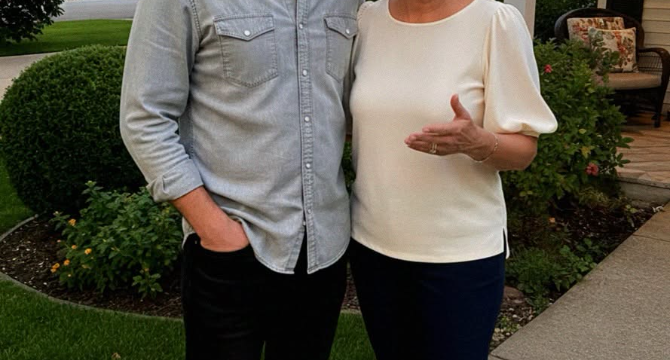
I hid across the street when I saw my widowed mother laughing with the last man I ever expected. What I uncovered that Thursday shattered everything I thought I knew.
I hadn’t seen my mother laugh like that in three years, and the man making her laugh wasn’t my father’s ghost. It was Patrick, my childhood friend from four houses down.
I was crouched low in the driver’s seat of my own car, watching from across the street, and my hands would not let go of the wheel.
I had not failed Dad.
The house on Willow Lane used to hum. My father, Thomas, filled every room with old records and burnt coffee and the sound of his laugh, and my mother, Eleanor, moved through it all like she was part of the music. Three years after we buried him, the house had gone quiet in a way I could feel in my teeth.
I visited every week. I brought casseroles she barely touched, photographs she barely looked at, invitations she never accepted.
Somewhere along the way, checking on her had stopped being something I did and become the way I proved I had not failed Dad. If she needed something, I was supposed to know before she asked.
“Come to Sunday dinner, Mom. Daniel is grilling.”
“I’m not keeping score.”
“Maybe another time, sweetheart.”
The garden she once babied had gone to seed. The piano stayed closed under a thin gray film of dust. Her smiles arrived on time and left too quickly, like a guest who did not really want to be there.
My childhood friend Patrick still came around. He’d grown up four houses down, and at thirty-six he was still the boy who used to steal cookies off our counter, only taller and quieter now. He mowed her lawn. He fixed the porch light. He sat with her.
“You don’t have to do all this, Patrick,” I told him once.
She was laughing.
“Your parents fed me half my childhood, Rachel. I’m not keeping score.”
I loved him for it. I told myself he was the reason she had not disappeared entirely.
Then came the Thursday I stopped by without calling.
The driveway was empty. The house looked dark. I was halfway out of my car, keys in hand, when headlights swept the street behind me. Instinct — or something darker — sent me back into the driver’s seat.
A car I recognized pulled into the driveway, and my mother was in the passenger seat.
‘I haven’t seen her smile like that since Dad died.’
She was laughing. Not the polite little exhale she gave me when I told a joke. A real laugh, head tipped back, one hand pressed to her collarbone. She was wearing the blue dress she used to save for anniversaries.
Patrick came around to her door and offered his hand. She took it and stepped out still smiling, and I watched her thank him with a warmth I had not seen on her face in three years.
He walked her to the porch. He did not touch her again, and he did not linger. He waited until she was inside, then went back to his car and pulled away without ever glancing toward the curb.
I stayed where I was, low in the seat, both hands on the wheel of a car I had not remembered to turn off.
It no longer felt like coincidence.
I whispered it to the windshield, to no one.
‘I haven’t seen her smile like that since Dad died.’
And I knew, right then, I needed to find out why.
Over the next two Thursdays, I found excuses to drive past the house just before six. Every time, Patrick arrived right on schedule. Every time, my mother greeted him wearing one of the dresses she’d packed away after Dad died. Every time, she smiled in a way she never smiled with me anymore.
By the third week, it no longer felt like coincidence. It felt like a secret.
“It’s become our little tradition.”
When she came home that night, I was waiting in her kitchen with two mugs of tea.
“Mom. Where do you and Patrick go on Thursdays?”
She hung her coat with slow, careful movements.
“He takes me dancing in the park,” she said. “It’s become our little tradition.”
“I’d rather it just stay the two of us.”
“Dancing?” I repeated.
“Dancing.”
I smiled the way you smile at something fragile.
“I’d love to come watch you sometime. Just once.”
She turned, and the light in her face went out.
“It’s dancing. It’s harmless.”
“No,” she said, too quickly. “I’d rather it just stay the two of us.”
I drove home with that no ringing in my ears. My husband Daniel was already in bed when I climbed in beside him and told him everything.
“Rach,” he murmured into the dark, “you’re spiraling. It’s dancing. It’s harmless.”
“She wouldn’t let me watch, Daniel.”
Mom is going out every Thursday, dressed up.
“Because it’s hers. Not everything is a secret. Some things are just private.”
Sleep never came. Daniel called it private. I couldn’t stop hearing the word secret.
I called my brother, Marcus, the next morning.
“You’re telling me Mom is going out every Thursday, dressed up, with Patrick, and won’t let you come?”
“That’s what I’m telling you.”
“Don’t say that out loud again.”
He laughed, sharp and short.
“Rachel, come on. This is Patrick. We grew up with him.”
“He’s thirty-six, Marcus. He’s not married. He’s at her house all the time.”
There was a long, ugly pause on the line.
“Don’t say that out loud again,” my brother said. “Not until you know something.”
He stood on the porch a moment.
But he did not laugh again before he hung up, and that silence told me everything about what he was also thinking.
After that, I couldn’t stop connecting moments I’d ignored for years – Patrick lingering after Dad’s funeral, the spare key to Mom’s house, the way her Thursdays had slowly become the brightest part of her week.
The following Thursday, I was back across from my mother’s house, watching the light change and rehearsing words I never said out loud.
Just after dark, Patrick’s car turned back onto the street. He parked in the driveway, got out, and walked my mother to her door. She went inside. He stood on the porch a moment, then came back down the walk toward his car.
“We don’t dance.”
I stepped into the street with my arms crossed, and Patrick hit the brakes before he could pull away.
He rolled down the window, startled.
“Rachel? What are you doing?”
“So why do you take my mom dancing every Thursday?”
His smile slid off his face. He stared at the steering wheel for a long moment, his knuckles pale against the leather.
“You’ve been picking her up for months.”
“Patrick. Answer me.”
“We don’t dance.”
The porch step caught the back of my knees before I realized I had stumbled toward it.
“What do you mean you don’t dance? You’ve been picking her up for months.”
“I know.”
“Is she sick, Patrick?”
“Then what are you doing with my mother every Thursday for hours?”
He looked at me with something that felt like regret.
“Your mom asked me not to tell anyone. Especially not you.”
The world tilted a little.
“I can’t. I gave her my word.”
“Is she sick, Patrick?”
“No.”
“Then what? Because I swear to God, Patrick.”
He rubbed a hand across his jaw.
“I can’t. I gave her my word.”
“Are you sleeping with my mother?”
I stood up, my voice shaking.
“Patrick, you’ve known me since we were seven years old. She is a widow. She is grieving. And you show up every Thursday in a clean shirt and take her away where none of us can see, and now you won’t tell me why?”
“Rachel, don’t.”
“Are you sleeping with my mother?”
His face crumpled like I’d slapped him.
He drove away.
“God. No. Rachel, it’s not that. It’s not that.”
“Then what is it?”
“I can’t.”
He put the car in drive.
“Patrick, if you leave right now, I don’t know how I come back from thinking what I’m thinking.”
They all felt like pieces of the same puzzle.
“I’m sorry.”
And he drove away.
I stood in the street until the taillights disappeared, my whole body shaking.
That night I replayed every word Patrick had said. The flour on Mom’s counters, the covered dishes, the whispered conversations — they all felt like pieces of the same puzzle.
Patrick knew something about my mother.
Once, as I came through the kitchen door, I heard Patrick say, ‘She isn’t ready for the family to know.’ My mother saw me, and they both went silent.
By the next Thursday, I had told myself a dozen times that Daniel was right and I should leave it alone. But Dad had trusted me to look after her, and now Patrick knew something about my mother that I did not.
At five thirty, I parked two houses down, angled for a clear view of her front walk, and waited.
At six, Patrick’s car pulled in. My mother stepped out onto the porch in a soft blue dress I’d never seen her wear. She was carrying the same small tin, wrapped in a cloth, that I’d watched her fuss over all week.
I couldn’t breathe.
I followed them across town, three cars back, my hands slick on the wheel.
Instead, they stopped outside a small blue house. An elderly woman opened the door, and my mother walked straight into her arms.
I sat in my car and watched them hold each other on the porch of a stranger’s house, and I couldn’t breathe.
Then I got out.
She had my mother’s eyes.
I walked up the path with my keys still clenched in my fist. Patrick saw me first. His face went white.
“Rachel.”
The old woman looked up.
I froze. I had never seen that face before, but I knew it instantly. She had my mother’s eyes.
“I think it’s time you knew.”
My mother turned, her face draining of color.
“Sweetheart.”
“Mom.” My voice barely made it out. “Who is this?”
The elderly woman steadied herself on her cane and did not look away from me.
“Rachel. Come inside. Please. I think it’s time you knew.”
“I lied because it wasn’t my secret.”
Inside Margaret’s small living room the air felt thin. I turned on Patrick first, my voice shaking.
“You let me think the worst. You let me stand there accusing you of things.”
He didn’t flinch. He just met my eyes and said quietly, “I didn’t lie to you for my own sake, Rachel. I lied because it wasn’t my secret.”
I turned to my mother.
“My biological mother.”
“Why the dancing story?”
Her hands trembled around the teacup.
“Because I was ashamed, sweetheart. Sixty-three years old, and I discovered the woman who raised me had kept the truth from me all my life.”
“What? None of this makes any sense,” I said.
“I didn’t know if Margaret would want me.”
“A few months ago, while I was sorting through your grandmother’s things, I found an old letter addressed to me. It was from Margaret — the woman you see sitting beside me. My biological mother.”
She swallowed.
“She had written years earlier after finally finding me, but my adoptive mother hid the letter before I ever saw it.”
“Mom…”
“I didn’t know if Margaret would want me after all this time,” she whispered. “I couldn’t bear the thought of you watching me lose a mother for the second time.”
I was trying to sort out her estate.
Margaret spoke then, her voice paper-thin.
“I was seventeen. I had no choice. I prayed every year on her birthday.”
My mother looked at Patrick before answering me.
“After your grandmother died, I was trying to sort out her estate. Patrick helped me go through years of old files and boxes in the attic. We were looking for bank papers and the deed to the house when we found Margaret’s letter tucked inside an old folder.”
“I’m your granddaughter.”
Margaret met my eyes.
“These Thursdays gave me a reason to open the curtains again.”
Something inside me cracked open.
I knelt beside Margaret’s chair. My knees hit the rug harder than I meant them to.
“I’m Rachel,” I said. “I’m your granddaughter.”
I stopped on the porch.
Her hand found mine, warm and small and shaking.
I looked up at Patrick.
“I’m sorry.”
He just nodded, the way he’d nodded at me since we were seven.
The next Thursday, I pulled into my mother’s driveway just before five, but this time I stopped on the porch instead of letting myself in.
“I was hoping you’d ask.”
When Mom opened the door, I held up the covered dish I’d brought.
“I wasn’t sure if you wanted company,” I said.
She looked at me for a long moment.
Then she smiled.
“I was hoping you’d ask.”
“I thought Margaret should have this.”
Relief washed through me.
I stepped inside.
I went back to my car and returned with a worn blue photo album.
“I thought Margaret should have this,” I said.
Mom’s eyes filled before she nodded.
Together they reached for the keys.
When Patrick’s car pulled in, I climbed into the back seat with my casserole balanced on my knees, and no one said a word about how strange or ordinary that was.
I placed the photo album on Margaret’s coffee table. She rested both hands on it.
My mom smiled.
“Open it.”
At Margaret’s, the piano stood open against the wall. My mother sat beside Margaret, and together they reached for the keys.
The house was humming again.
They played something slow and uneven, four hands feeling for the same song. Margaret laughed when she missed a note. Mom laughed back, that same real laugh, head tipped, hand at her collarbone.
I stood in the doorway with a lemon cake going warm in my hands, and I finally understood what I had been listening for on Willow Lane for three years.
My phone buzzed in my pocket.
Marcus: How’s Mom?
I looked at my mother beside Margaret, smiling through tears.
I slipped the phone back into my pocket. This was Mom’s story to tell.
The truth had come late. But the house was humming again.

 admin
admin