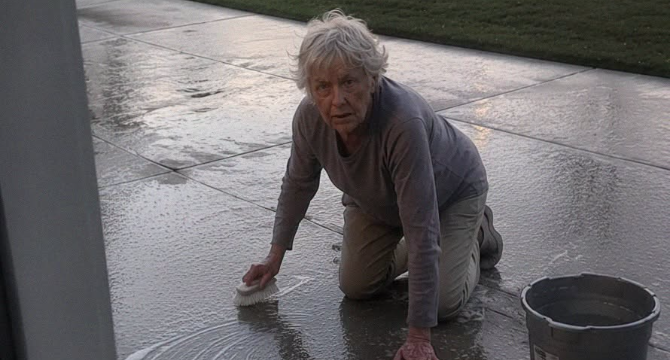
My mother moved across the world after my father died. Three weeks later, I found her outside before sunrise, trying to hide a message someone had left for her.
The two words were still visible under the water.
“GO HOME.”
My mother lowered her head.
“I was almost finished.”
Her voice broke on the last word.
I stared at the chalk.
White letters stretched across the center of our driveway, large enough to be seen from the street.
My 72-year-old mother had been on her knees trying to erase them before I woke up.
“Who did this?”
She gripped the kitchen brush.
“It doesn’t matter.”
“It matters to me.”
“Leila, please. Go inside.”
Her hands were shaking.
Mom had moved from Lebanon to live with us three weeks earlier, after my father died. She had left behind the apartment they shared for 46 years, the grocery store where everyone knew her name, and the balcony where she grew mint in chipped clay pots.
She had already lost her husband.
Now someone had told her she did not belong here either.
I crouched beside her.
“Did someone say something to you?”
“No.”
“Has this happened before?”
She looked away.
That was my answer.
I took the brush from her hand.
Her palms were raw.
“Inside,” I said.
“I can finish.”
“No.”
“The children will see.”
My daughters were eight and eleven. Their bedrooms faced the driveway.
“They should not have to see this,” Mom whispered.
“Neither should you.”
I helped her stand.
As we walked toward the house, the porch light next door came on. Our neighbor, Greg, stepped outside wearing sweatpants and a gray sweatshirt.
He looked at the wet driveway.
Then at Mom.
“Everything all right?”
His concern sounded rehearsed.
Greg had lived next door for six years.
He was 50, broad-shouldered, and always smiling when other people were watching.
He organized the block party.
Collected money for holiday decorations.
Complained if anyone’s lawn grew half an inch too high.
I had never liked him.
But until that morning, I had never been afraid of him.
“Someone wrote on our driveway,” I said.
Greg leaned forward as if he could not read the letters from ten feet away.
“That’s terrible.”
Mom’s fingers closed around my wrist.
I felt her warning.
Do not argue.
Do not make this worse.
Greg shook his head.
“Kids, probably.”
“At four in the morning?”
“Teenagers do stupid things.”
“Do you have cameras?”
His eyes moved toward his garage.
“No.”
That was a lie.
A black security camera hung under his gutter, pointed directly toward the street.
I had noticed it when he installed it the previous summer.
Greg followed my gaze.
“It hasn’t worked in months.”
“Convenient.”
His smile thinned.
“Excuse me?”
Mom pulled gently on my arm.
“Leila, inside.”
Greg looked at her.
“Your mother should be careful walking around at night.”
I stopped.
“What does that mean?”
“Nothing.”
“She wasn’t walking around. She was cleaning my driveway.”
“I meant in general.”
He stepped back toward his door.
“This neighborhood is different from where she’s from.”
Mom’s grip tightened.
I understood then.
Not the whole truth.
But enough.
Greg knew exactly who the message was for.
I took Mom inside and locked the door.
My husband, Samir, came downstairs while I washed the chalk from her hands.
He saw the redness and went still.
“What happened?”
Mom answered before I could.
“I spilled bleach.”
I looked at her.
She shook her head once.
Even then, she was trying to protect us.
From anger.
From conflict.
From the feeling that bringing her into our home had brought trouble with her.
I told Samir everything.
He walked outside without putting on a coat.
By the time I followed, Greg was already in his driveway.
“You wrote it,” Samir said.
Greg laughed.
“Are you serious?”
“Did you?”
“Of course not.”
“Then show us your camera footage.”
“I told your wife the camera is broken.”
Samir looked at the small green light blinking under it.
Greg noticed too.
His face changed.
Only slightly.
But I saw it.
“So it came back on,” he said.
“Then show us.”
“No.”
“Why not?”
“Because my property is not your business.”
I took out my phone.
“I’m calling the police.”
Greg’s smile returned.
“For chalk?”
“For harassment.”
He folded his arms.
“Good luck proving that.”
Behind me, Mom opened our front door.
“Leila.”
I turned.
She looked frightened.
Not of Greg.
Of what I might discover.
“Please come inside,” she said.
That was when I realized the chalk was not the first thing he had done.
I followed her.
Samir stayed outside long enough to photograph the driveway before the water erased the last of the words.
At the kitchen table, Mom held a cup of tea she did not drink.
“Tell me,” I said.
She stared at the steam.
“Last week, he asked me to sign something.”
My stomach tightened.
“What?”
“A paper.”
“What kind of paper?”
“I don’t know all the words.”
“Why would Greg ask you to sign anything?”
“He said it was permission.”
“For what?”
She pointed toward the backyard.
“The fence.”
Our properties were divided by an old cedar fence. Greg had been talking for months about replacing it with a stone wall.
Samir and I told him we were not interested.
The fence was ugly, but it was functional.
More importantly, the survey from when we bought the house showed that the property line ran nearly two feet inside what Greg considered his yard.
Replacing the fence would reopen that dispute.
“What did the paper say?” I asked.
Mom disappeared upstairs.
She returned with a folded copy.
Greg had called it a permission form.
It was not.
It was a boundary acknowledgment.
By signing, we would have agreed that the current fence stood entirely on Greg’s property and that we had no claim to the narrow strip of land beside it.
The same strip where our storm drain ran.
My father had been a mechanic. My mother had spent 38 years as a civil engineer for the municipal government.
Most people saw an elderly woman with an accent and assumed she understood less than they did.
Greg had made the same mistake.
“You knew what this was,” I said.
Mom nodded.
“Not every word. Enough.”
“What did you tell him?”
“That the measurements were wrong.”
Samir looked at her.
“You checked them?”
“I walked the line.”
Of course she had.
Mom had spent her career reviewing roads, drainage plans, and building permits.
She could look at a slope and tell you where water would collect before the first drop of rain.
“What happened after you refused?” I asked.
“He said I was confused.”
My jaw tightened.
“Then?”
“He came back the next day.”
This time, he carried a second document.
A translated version.
Except the translation did not match the English text.
The English version surrendered our boundary claim.
The Arabic version described temporary access for fence repairs.
“He thought I would sign the Arabic one,” Mom said.
“Did you keep it?”
She reached into the pocket of her robe.
A photograph appeared on her phone.
Both documents lay side by side.
Clear enough to read.
My mother had photographed them before Greg took them back.
Samir stared at her.
“Why didn’t you tell us?”
“You have work. The girls. The mortgage.”
“Mom—”
“You brought me here because I had nowhere else to go.”
Her eyes filled.
“I did not want to become another problem in your house.”
The sentence hurt more than the chalk.
“You are not a problem.”
“Maybe not to you.”
She glanced toward the window facing Greg’s house.
I took her phone.
There were more photographs.
The documents.
The fence.
A measuring tape stretched between two survey stakes.
Then a picture of the storm drain.
The concrete around it had cracked.
“Mom, what is this?”
She hesitated.
“His wall will block the drainage.”
“What wall?”
She zoomed in on the photograph.
Beyond the fence, Greg had already excavated a shallow trench.
He had not been waiting for permission.
He had started construction.
“If he builds there,” Mom said, “rainwater will collect beside your foundation.”
Samir frowned.
“How bad?”
She looked at him.
“Bad enough that he needs your signature before the city sees the plan.”
That changed everything.
Greg was not simply trying to steal two feet of land.
He was trying to make us legally accept responsibility for drainage damage his wall could cause.
The chalk message was not random hatred.
It was pressure.
He wanted Mom frightened enough to stay quiet.
I called the police.
Then I called the city.
The officer who arrived took photographs and spoke to Greg.
Greg denied everything.
He claimed Mom had misunderstood a friendly conversation about the fence.
He said the documents were preliminary.
He said the Arabic translation must have been created by someone else.
Then the officer asked about the security footage.
Greg said the camera was broken.
Again.
That might have ended it.
Except Mom had noticed something else.
“The doorbell camera,” she said.
I looked at her.
“We don’t have one.”
She pointed across the street.
Mrs. Jenkins did.
Her camera faced our driveway.
Mrs. Jenkins invited us inside in her bathrobe and orthopedic slippers.
The recording was clear.
At 3:41 a.m., Greg walked across the street carrying a bucket.
He looked toward our windows.
Then he wrote GO HOME in white construction chalk.
Before leaving, he placed something near our storm drain.
The officer paused the video.
“What is that?”
We returned to the driveway.
Beside the drain, half-hidden under wet leaves, was a small plastic bottle.
The label had been removed.
Inside was blue liquid.
Mom smelled it from several feet away and stepped back.
“Do not open.”
The fire department tested it.
Concrete sealant mixed with industrial dye.
If poured into the drain, it would have stained the pipe and surrounding soil.
Greg had planned to report that we were dumping chemicals into the stormwater system.
The city fine alone could have reached thousands of dollars.
More importantly, it could have complicated any future dispute over drainage damage.
The officer returned to Greg’s house.
This time, Greg did not smile.
He was arrested before breakfast.
Not for the chalk.
For attempted evidence fabrication, harassment, and possession of materials intended for unlawful dumping.
The city inspector arrived later that morning.
He examined Greg’s trench.
Then our survey.
Then the false documents.
By noon, a stop-work order was taped to Greg’s front door.
But that was not the worst part for him.
The inspector recognized his company name on the paperwork.
Wallace Outdoor Design.
Greg was a licensed contractor.
If he had falsified boundary documents for us, the city needed to know whether he had done it elsewhere.
He had.
Three former clients came forward within two weeks.
One elderly couple had signed away access to a shared alley without understanding the document.
Another family discovered Greg had redirected runoff toward their basement.
A widow had paid him to correct a retaining wall he had built incorrectly in the first place.
He used confusion as a business model.
Older clients.
Immigrants.
Anyone he believed would be too embarrassed to admit they did not understand the paperwork.
My mother was simply the first person who understood it better than he did.
Greg’s contractor’s license was suspended.
His company closed before the investigation ended.
He sold the house six months later to help cover legal fees and restitution.
The morning the moving truck arrived, Mom stood at our kitchen window.
She watched without satisfaction.
I expected relief.
Instead, she said, “He has children.”
“So do we.”
“I know.”
“He tried to frame you.”
“I know.”
I looked at her.
“Why are you sad for him?”
She folded the dish towel in her hands.
“Because a man can ruin his life one small wrong choice at a time.”
Then she looked at me.
“Your father used to say the same about engines. One sound ignored becomes a broken machine.”
That was Mom.
Even after what Greg did, she looked for the human damage under the anger.
I was not there yet.
Maybe I never would be.
The girls learned what happened.
Not every detail.
Enough.
My oldest asked why Greg had written GO HOME.
I told her some people believe belonging is something they can grant or remove.
“Can they?” she asked.
Mom answered before I could.
“No.”
Her voice was firm.
“You belong where you build your life.”
A month after Greg moved, the city repaired the storm drain.
Mom stood outside with the crew and pointed out a slope the first inspector had missed.
At first, the foreman smiled politely.
Then he checked.
She was right.
By the end of the morning, he was asking her questions about the entire street.
Word spread.
Soon, neighbors began knocking on our door.
Could she look at a cracked walkway?
Did the water near their garage seem normal?
Was the retaining wall leaning?
Mom always said the same thing.
“I am retired.”
Then she put on her shoes.
Last week, Mrs. Jenkins brought her a small wooden sign.
She had painted it herself.
It read:
ENGINEER ON DUTY.
Mom laughed so hard she cried.
We hung it beside the front door.
Not because she works for anyone now.
Because she spent weeks believing she had entered our home as a burden.
I wanted her to see what the rest of us had finally learned.
She had not brought trouble into our house.
She had recognized it.
At four in the morning, I thought I had found my elderly mother erasing two cruel words from our driveway.
What I did not understand was that Greg had written them because he needed her to feel small.
Foreign. Confused. Temporary.
He thought shame would keep her quiet.
Instead, the woman he told to go home exposed every lie he had built next door.
Mom still wakes early.
Jet lag became habit.
Most mornings, I find her on the porch with tea, watching the street brighten.
Sometimes I sit beside her.
A few days ago, she looked at the driveway and said, “You can still see the letters when the concrete is wet.”
I looked.
She was right.
Faint white lines remained inside the pavement.
“Do you want me to have it pressure-washed?”
Mom shook her head.
“No.”
“Why?”
She smiled.
“So I remember.”
“The message?”
“No.”
She touched my hand.
“That I did not leave.”

 admin
admin