Grief has a strange way of uncovering things you never knew were hidden. In my case, it started with an old phone, hundreds of forgotten videos, and a realization that changed the way I looked at my own family.
When my mother-in-law died, my husband and I spent three days inside her house.
We sorted through the remains of a life no one knew how to divide.
Norah had lived there for 41 years.
Every room carried some trace of her.
There was a cardigan draped over the back of a chair and grocery lists held to the refrigerator by a chipped magnet.
Her husband Micah’s old slippers were still waiting beside the bed even though he had died the year before.
Silas moved through the house quietly.
He was Norah’s only child, and after Micah died, he had called her every evening.
Still, I could see how much he had not known about her.
Neither of us had.
On the third afternoon, I found an old phone beneath a stack of recipe cards.
I stumbled on it while emptying a kitchen drawer filled with batteries, takeout menus, rubber bands, and pens that no longer worked.
“Are we keeping that?” Silas asked as he went to sort other things across the hall.
“I don’t know. Let me see what’s on it first.”
The screen stayed black, so I found a charger and plugged it into the wall.
A few minutes later, the phone turned on.
There was no password.
I opened the Photos app expecting family pictures and screenshots.
Instead, I found hundreds of videos.
The thumbnails looked almost identical.
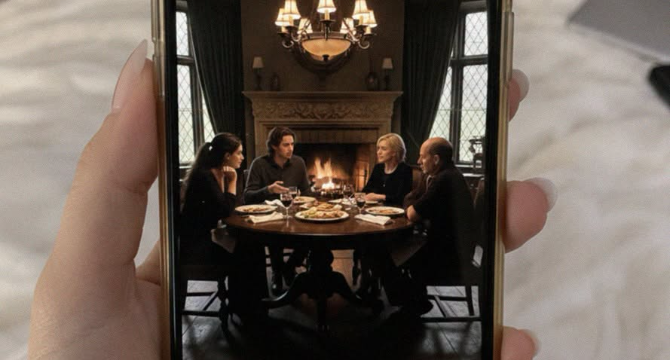
A table, plates, faces, and our family.
I pressed the first one.
There we were around Norah’s dining table nearly six years earlier.
My son Caleb looked about 11 while his brother Charles was nine.
Silas was laughing at something Micah had said.
Norah sat at the end of the table with a soft smile on her face.
The phone had been propped against a drinking glass.
I remembered Norah saying the same thing at almost every dinner.
“Don’t move my phone, sweetheart.”
I had always assumed she did not want anyone knocking it onto the floor.
None of us ever questioned it.
Why would we?
I opened another video.
Then another.
Birthdays, Sunday dinners, and Thanksgiving meals at our place.
Ordinary Wednesday evenings when Norah had invited us over because she had made too much stew.
Every video started from the same angle.
At first, I wondered whether she had simply forgotten to stop recording.
Maybe she had been trying to capture the grandchildren and never learned how the camera worked.
After nearly two hours, I opened a video from the previous Christmas.
Same dining room and same angle.
I dragged the timeline back and watched again.
Then I opened another and another.
“No,” I whispered as it dawned on me.
“It can’t be.”
The camera was not pointed at the whole table.
It was not capturing the family.
The center of every recording was me.
“What have you been watching?” Silas called from the hallway.
I locked the phone without thinking.
“Nothing.”
The word came out too quickly.
But it was a lie.
Because at that moment, I finally understood exactly what Norah had been watching for.
I unlocked the screen and replayed the Christmas video.
Five minutes in, Charles asked me to get more gravy.
I stood.
Before I sat down again, Caleb needed a clean fork.
Then Silas asked whether there was more bread.
Micah wanted his pills from the kitchen counter.
Norah told me I could sit, but I laughed and said, “It’s fine.”
I refilled drinks.
I found napkins.
I warmed someone’s plate.
When dessert came, everyone had pie except me.
I was clearing dishes while the others ate.
No one asked whether I wanted any.
I had not even finished the food I had served.
I opened a video from Thanksgiving three years earlier.
I spent the first 10 minutes serving food.
Then Caleb spilled juice.
Charles complained that his potatoes were touching the vegetables.
Silas asked whether I had brought the cranberry sauce.
Micah needed help opening a jar.
By the time I sat down, everyone else was halfway finished.
Before I took three bites, someone asked me for something else.
It happened in every recording.
“Mom, where’s the salt?”
“Lakisha, did you bring the rolls?”
“Can you get me another drink?”
“Mom, Caleb took my chair.”
“Mom, tell Charles to stop.”
“Did you pack the leftovers?”
“Do we have ice cream?”
“Can you help me with my history assignment when we get home?”
I watched myself move in and out of the frame like a server in a restaurant where I was also expected to be a guest.
Sometimes Norah offered to help.
Sometimes she told me to sit down.
I always said the same thing.
“I’m fine.”
I had said it so many times that I believed it.
Then I noticed something else happening when the camera was not focused on me.
Norah was not watching the table in most of the videos.
She was watching me.
Her expression changed whenever I stood.
At first, she looked concerned.
In later recordings, she looked sad.
In the most recent ones, she looked almost angry.
Not at me.
At everyone else.
Including her son.
Silas stepped into the kitchen.
“You’re still looking at that thing?”
I locked the phone again.
“We should finish the bedroom before it gets late.”
He sighed and returned to the hallway.
I slipped the phone into my purse.
On the drive home, Silas talked about the lawyer, the funeral bills, and whether we should sell Norah’s furniture or donate it.
I barely heard him.
I kept seeing myself on that screen.
Standing, reaching, cleaning, and disappearing.
At home, Caleb and Charles were sprawled across the living room sofa.
At 15 and 17, they were both old enough to prepare food, wash clothes, and clean a bathroom.
Instead, Caleb looked up from his phone and asked, “What’s for dinner?”
Silas set down the box he was carrying.
“I don’t know. Ask your mother.”
Charles opened the refrigerator.
“There’s nothing ready.”
There was food.
What he meant was that there was nothing he could eat without putting in effort.
Normally, I would have walked into the kitchen, opened cabinets, and created a meal while everyone else rested.
That evening, I looked at all three of them.
“My head hurts,” I said. “I think I’m getting sick.”
Silas frowned.
“What are we going to eat?”
“I don’t know. All I know is I’m going to lie down until I feel better.”
Caleb glanced toward the kitchen.
“What about dinner?”
That was everyone’s first question.
Not, “Are you okay?”
Not, “Do you need anything?”
“What about dinner?”
I thought of Norah’s videos.
“You’ll have to figure it out.”
Charles stared at me.
“Like order something?”
“Like feed yourselves.”
I went upstairs and closed the bedroom door.
I was not proud of lying.
But for the first time in years, I wanted to know what would happen if I stopped holding everything together.
They ordered pizza.
No one brought me a slice.
The next morning, I stayed in bed.
Silas stood in the doorway wearing one sock.
“Have you seen my blue tie?”
“No.”
“It’s not in the closet.”
“Then wear another one.”
He hesitated.
For one hopeful second, I thought he might ask whether I was still feeling unwell.
Then he said, “It doesn’t really match with the vibe I’m going for.”
“Oh, that’s too bad,” I replied.
He immediately went on to ask about something else: “Did you wash my white shirts?”
“Check for them in your closet or laundry basket.”
He went to work in a wrinkled blue one.
Caleb and Charles argued downstairs because neither had packed lunch.
They had money in their accounts, but they were used to finding sandwiches, fruit, snacks, and water bottles lined up on the counter.
Charles came upstairs.
“Mom, there’s no clean gym shirt.”
“Then wash one.”
“I’ll be late.”
“Then wear a dirty one.”
He looked offended, as if I had created the problem.
By the second day, the kitchen sink was full.
By the third, takeout containers covered the counter.
The trash can overflowed, but instead of replacing the bag, someone balanced an empty soda bottle on top.
Laundry spread across the hallway.
The downstairs bathroom smelled unpleasant because no one had cleaned the toilet.
Silas came home each evening, looked around, and told the boys to “figure things out.”
Neither of them understood what that meant.
I was still upstairs, supposedly sick.
They waited for instructions that never came.
On Wednesday, Silas asked, “How long do you think this is going to last?”
I looked at him.
“My illness?”
He realized how the question sounded.
“I mean, should we call a doctor?”
“No. I simply need rest.”
He nodded, then glanced toward the laundry basket.
“Caleb needs his school uniform tomorrow.”
“Then Caleb should wash it.”
Silas lowered his voice.
“They’re just children.”
“They’re 15 and 17; they should know how to take care of themselves.”
“They have homework and school.”
“And I have a job, a house, a marriage, two sons, and a body that gets tired.”
He looked at me for a long moment.
Then he went downstairs.
He did not start the washing machine.
By Friday, both boys had worn dirty clothes to school.
They had eaten cereal from mugs because every bowl was in the sink.
Silas had ordered dinner four nights in a row and complained twice about the cost.
No one had checked my temperature.
No one had made soup.
No one had carried a glass of water upstairs unless I asked.
What hurt most was not that the house became messy.
It was how quickly they accepted my sickness as an inconvenience.
Saturday morning, I got dressed and told them to meet me in the living room.
They gathered slowly.
Caleb carried his phone.
Charles looked annoyed.
Silas seemed worried.
“I need to tell you something,” I said. “I wasn’t sick.”
All three stared at me.
Charles spoke first.
“You lied?”
“Yes.”
“Why?”
I looked around the room.
Pizza boxes sat beneath the coffee table.
Two glasses stood on the windowsill.
A basket of unfolded laundry had been pushed behind a chair.
“Because I needed to know what would happen if I stopped babying all of you.”
Silas crossed his arms.
“You were testing us. You could have just asked for help.”
“I have, even though it should have been obvious.”
“When did you ask for help?”
“Every time I said I was tired. Every time I asked someone to take out the trash. Every time I asked you to put your plate in the sink instead of leaving it on the table. Every time I said, ‘Can somebody else handle dinner tonight?'”
Caleb looked down.
I continued.
“You all hear requests and do nothing. You do not see this house as something you are responsible for. You see it as my job, and anything you do is helping me.”
“That’s not true,” Silas said.
I picked up Norah’s old phone.
“Your mother thought it was.”
His expression changed.
I connected the phone to the television and opened one of the dinner recordings.
They watched themselves laughing, eating, and talking while I moved around them.
In one video, I sat for less than four minutes during an hour-long meal.
In another, I never finished my plate.
In another, Charles asked for dessert while I was still carrying dirty dishes into the kitchen.
No one thanked me.
No one noticed I had not eaten.
Caleb shifted uncomfortably.
“Why was Grandma recording us?”
“She wasn’t recording all of us.”
I paused the video.
“She was recording me.”
The room became silent.
I played clip after clip.
My family watched years of themselves depending on me without seeing me.
Finally, Charles whispered, “I didn’t know.”
“I don’t think any of you cared; otherwise, you would have seen me.”
He wiped his eyes quickly.
Silas sat forward with his hands clasped.
“I thought you liked taking care of us.”
“I do. But you’ve all been taking advantage of the love and care I give you.”
“I never meant to make you feel invisible.”
“You still did, and you haven’t done anything about it.”
Caleb put down his phone.
“Did Grandma ever say anything?”
“Not directly.”
I looked at the frozen image of Norah watching me leave the table.
“But I think she was trying to.”
That afternoon, we cleaned the house together.
Not because I handed out jobs.
Because I told them the house belonged to all of us.
Caleb washed dishes.
Charles gathered trash and started laundry.
Silas cleaned the bathrooms.
They did not do everything correctly.
Charles used too much detergent.
Caleb loaded the dishwasher so badly that half the plates came out dirty.
Silas asked where we kept the toilet cleaner even though it had been beneath the sink for years.
Normally, I would have taken over.
I did not.
When Caleb complained that there was nothing for lunch, I told him to make something.
He found bread, eggs, and cheese.
When Charles needed his uniform, he checked the washing machine himself.
When Silas asked whether I knew where his keys were, I said, “No.”
He found them in his jacket.
A few days later, we returned to Norah’s house for the reading of her will.
Her attorney, Brennan, sat with us in the living room.
Norah had left most of her estate to Silas, with education funds set aside for Caleb and Charles.
Then Brennan looked at me.
“Norah left a separate gift for Lakisha.”
Silas turned toward me.
Brennan handed me an envelope.
Inside was a letter written in Norah’s careful handwriting.
“Lakisha,”
“I wanted you to notice how often you disappear while everyone else keeps eating.”
“I saw it because I did the same thing.”
“For most of my life, I was Silas’s mother and Micah’s wife before I was Norah.”
“I loved them both. That is what made it so easy to convince myself I needed nothing else.”
“After Micah died, I realized I had spent years waiting for a quieter season that never came.”
“I kept thinking I would rest later, travel later, paint again later, and choose myself later.”
“Later arrived when I was too tired to enjoy it.”
“You are more than a wife and mother.”
“Please do not realize that as late as I did.”
Norah had left me $20,000.
The instructions said I was not to use it for household bills, school expenses, repairs, or anyone else’s emergency.
“Use some of it to pamper yourself occasionally,” she had written. “You deserve to experience your own life, not only make everyone else’s easier.”
I cried before I reached the end.
Silas cried too.
“I didn’t know she felt that way,” he said.
“Maybe she didn’t know how to say it.”
The recordings had been her way of showing me the life she recognized.
Not because she thought I was weak.
Because she knew exactly how a woman could vanish while standing in plain sight.
Our home did not become perfect.
Caleb still forgot to take out the trash.
Charles occasionally left wet towels on the floor.
Silas sometimes waited too long before noticing what needed to be done.
But I stopped doing everything for them as I used to.
If Caleb forgot to wash his uniform, he handled it.
If Charles did not pack lunch, he bought food at school with his own money.
If Silas wanted dinner and no one had planned it, he cooked.
We made a weekly schedule.
Everyone cleaned.
Everyone shopped.
Everyone learned the difference between helping me and carrying their own share.
I also began taking Saturday mornings for myself.
At first, I sat in a cafe alone because I had forgotten what I enjoyed.
Then I remembered that I used to paint.
I bought brushes, canvases, and more colors than I needed.
The first painting was terrible.
The second was better.
By the fourth, I stopped caring whether they were good.
I cared that they were mine.
Months later, we had dinner together on a Sunday evening.
Silas served the food.
Caleb filled the glasses.
Charles carried the empty dishes into the kitchen without being asked.
I remained seated.
Halfway through the meal, Silas looked at my plate.
“You haven’t eaten much. Is everything okay?”
It was a small question.
But it made me think of Norah.
For years, she had watched me disappear one request at a time.
That evening, I noticed that my family had started seeing me as more than a mother and a wife.

 admin
admin