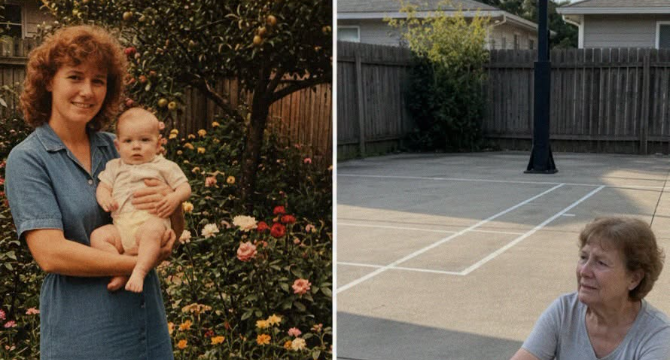
My children destroyed the garden I’d spent forty years building while I was on vacation. Then my husband saw the missing apple tree and asked a question that changed everything.
I knew something was wrong the second we turned into our driveway.
One section of our fence was missing.
Deep tire tracks scarred the front lawn.
Three of my clay flowerpots lay shattered beside the garage.
For a moment, I convinced myself a contractor must have made some terrible mistake.
My husband, Robert, stayed behind to unload our suitcases while I hurried toward the backyard.
I honestly wish I hadn’t.
I stopped so suddenly I almost lost my balance.
My garden was gone.
Nearly the entire backyard had disappeared beneath a smooth slab of fresh concrete.
Bright white lines stretched across it.
A brand-new basketball hoop stood exactly where my apple tree had been.
I couldn’t breathe.
Forty years.
Forty years of planting, pruning, weeding, watering, harvesting.
Gone.
The raised beds Robert had built from scrap lumber.
The strawberries my children always picked too early.
The climbing roses my mother gave me before she passed away.
The herbs I dried every autumn.
The tomatoes that somehow tasted better because we’d grown them ourselves.
Everything.
Buried beneath concrete.
I spun in a slow circle.
The herb garden was gone.
The raspberry bushes were gone.
Even the little wooden bench where Robert and I drank coffee every morning had disappeared.
It was as if someone had decided 40 years of our lives needed to be erased.
I walked onto the court in a daze.
The concrete was still pale enough to smell new.
Someone had poured it only days earlier.
My shoe brushed against a tiny green leaf trapped near one edge.
One of my bean plants.
It was pressed into the concrete forever.
I bent down and touched it.
My hands began to shake.
I planted that garden the summer Robert and I bought the house.
We were both 26, with more hope than money.
The backyard was nothing but hard dirt and weeds.
Robert found discarded lumber behind a construction site, asked permission to take it, and spent every evening building raised beds by hand.
I planted vegetables because grocery money was tight.
By the second summer, we hardly bought produce at all.
The garden had fed us before it became beautiful.
Our children grew up there.
Daniel used to sneak tomatoes straight off the vine.
Rebecca insisted every sunflower had a name.
Every birthday ended with muddy shoes and grass stains. Every Christmas, we’d decorate the apple tree with strings of popcorn for the birds. Even after the kids moved away, they still came every summer carrying empty coolers.
They always left with fresh vegetables, homemade jam, and enough tomatoes to last a week.
Just two weeks earlier, Robert and I had started talking about retirement.
Talking.
Nothing more.
We’d toured a retirement community after a friend’s recommendation.
That was it.
No contracts.
No realtor.
No moving boxes.
No decision.
Before we left for our ten-day vacation, Daniel offered to check on the house.
“I’ll water Mom’s garden,” he’d said.
I looked him right in the eye.
“Every other evening. The tomatoes are almost ready.”
He smiled.
“I’ve got it.”
Now there wasn’t a single tomato plant left.
A basketball bounced behind me.
I turned.
Daniel stood near the free-throw line while his son chased the ball across the fresh concrete.
Rebecca leaned against the new hoop with a smile that vanished the moment she saw my face.
“Surprise!” she said.
I stared at them.
“What happened to my garden?”
Neither of them answered immediately.
Daniel finally spread his arms.
“We wanted to do something nice.”
I looked around again, hoping I was somehow seeing someone else’s yard.
“You call this nice?”
Rebecca sighed.
“Mom, don’t start.”
“Don’t start?”
Daniel stepped closer.
“We’ve been talking about this for months.”
“No, you have.”
He frowned.
“You and Dad were moving.”
“We never said that.”
“You said you were looking at retirement communities.”
“We were looking.”
Rebecca folded her arms.
“What’s the difference?”
“The difference is we never decided.”
Silence settled over the yard.
Then Daniel pointed toward the basketball hoop.
“The grandkids will actually use this. You’ll thank us once you get used to it. Besides, nobody wants to look at rows of vegetables.”
I stared at him.
“My garden fed this family for 40 years.”
“It was just a garden.”
The words hit harder than I expected.
“Just a garden?”
They knew what that garden meant to me.
Or at least I thought they did.
Rebecca stepped forward.
“Mom, half those plants were dying anyway.”
“They were getting ready for fall.”
“You weren’t going to take them with you.”
I felt as though I was talking to strangers.
“You cut down my apple tree.”
Daniel shrugged.
“It was old.”
“It was healthy.”
“It would’ve had to come down eventually.”
“Who told you that?”
Neither answered.
Instead, Rebecca smiled at her daughter.
“Go shoot another basket, sweetie.”
The little girl happily dribbled away, completely unaware of the silence surrounding the adults.
I looked back at the empty corner where the apple tree had stood.
Every birthday photograph.
Every family barbecue.
Every anniversary picnic.
That tree had been in the background.
Now there wasn’t even a stump.
They’d ground it out completely.
Whoever had done this hadn’t worked around my garden.
They had erased it.
Every raised bed.
Every stepping stone.
Every rose bush.
Every tomato cage Robert had built by hand.
Every flower border.
Someone had spent days making sure nothing remained.
Not one piece had been left behind.
I turned slowly toward Daniel.
“How long did this take?”
He hesitated.
“A few days.”
“So this wasn’t some spur-of-the-moment surprise.”
Rebecca looked uncomfortable.
“We hired professionals.”
My heart sank.
“You hired contractors?”
Daniel nodded.
“They had to remove the tree first.”
I felt sick.
“You planned this.”
“We planned something the whole family could enjoy.”
“The whole family already enjoyed the garden.”
“You and Dad did.”
“The grandchildren like basketball.”
“They also liked picking strawberries.”
Daniel laughed.
“They’ll survive.”
Before I could answer, I heard footsteps behind me.
Robert came through the gate carrying two grocery bags.
He smiled until he looked past me.
The bags slipped from his hands.
Groceries spilled across the concrete.
He didn’t seem to notice.
His eyes locked on the empty space where the apple tree had stood.
The color drained from his face.
For several long seconds, he couldn’t speak.
Then he whispered, almost to himself, “Oh, God.”
He looked at Daniel.
Then at Rebecca.
His voice shook.
“Please tell me you didn’t find the box I buried under the apple tree.”
Neither of them answered.
Daniel glanced at Rebecca.
Rebecca looked down at the concrete.
My stomach dropped.
“What box?”
Robert looked at me with a fear I’d never seen in 42 years of marriage.
“The one I prayed nobody would ever dig up.”
Robert never took his eyes off Daniel.
“Did you find it?”
Daniel shifted uncomfortably.
“We found a metal box.”
“I figured it was something Grandpa forgot about.”
My husband’s shoulders sagged.
Rebecca spoke before either of us could.
“It was rusted almost all the way through. We figured it was just old junk.”
I looked from one of them to the other.
“What did you do with it?”
Daniel rubbed the back of his neck.
“We opened it.”
Robert closed his eyes.
“And?”
“There were papers.”
Rebecca shrugged.
“There were pictures, letters, notebooks… things like that.”
Daniel shrugged.
“We figured if they’d been buried for 40 years, they obviously weren’t important anymore.”
A cold knot formed in my stomach. “Where are they?”
Neither answered.
“Daniel.”
He finally looked at me.
“We asked them to throw it away.”
He swallowed.
“We thought it was just trash.”
For a moment, the world went completely silent.
Robert lowered himself onto the edge of the concrete as though his legs had given out.
“You threw it away.”
Daniel frowned.
“We didn’t know it mattered.”
Robert laughed once.
It wasn’t a happy laugh.
“It mattered?”
He looked up at both of them.
“Everything that mattered was in that box.”
Rebecca crossed her arms.
“It was buried underground. How were we supposed to know?”
“You were supposed to ask.”
Neither of them had an answer.
Robert rested his elbows on his knees.
“I buried it the day we planted that apple tree.”
I sat beside him.
“What was inside?”
He looked at me sadly.
“You remember how we used to measure the kids against the garage wall?”
I nodded.
“You made me copy every measurement into a notebook in case we ever repainted.”
I stared at him.
“That notebook was in the box.”
He looked toward Daniel.
“Every birthday photograph.”
Toward Rebecca.
“Every Mother’s Day card.”
“The tiny hospital bracelet Daniel wore the day he was born.”
“Rebecca’s first pair of baby shoes.”
His voice cracked.
“The letters your mother wrote to each of you before your first day of school.”
I covered my mouth.
I’d forgotten those letters.
I’d written one every September, hoping they’d read them someday after I was gone.
Robert continued quietly.
“The journal Margaret kept about the garden.”
Daniel frowned.
“What journal?”
“The one where she wrote down what she planted every spring.”
I looked at him.
“You saved that?”
He smiled sadly.
“I saved everything because I thought one day they’d want to remember.”
“We didn’t know.”
Robert nodded.
“I know.”
His next words landed even harder.
“The original deed to the house.”
Daniel blinked.
“What?”
“The deed.”
Rebecca frowned.
“Why would that be buried?”
“For safekeeping.”
Daniel laughed nervously.
“You can get another copy.”
“Yes.”
Robert’s voice stayed calm.
“But not everything else.”
Nobody spoke.
Rebecca finally whispered, “I’m sorry.”
I looked at her.
“No.”
She blinked.
“No?”
“You aren’t sorry you did it.”
I stood.
“You’re sorry it upset us.”
Daniel’s jaw tightened.
“We were trying to improve the place.”
“For who?”
“For the family.”
I looked around the empty yard.
“You’re still trying to convince us we should be grateful.”
He threw up his hands.
“You weren’t going to stay here forever.”
He shook his head.
“You always knew we’d end up with this house.”
The words hung in the air.
Robert slowly stood.
“So that’s what this was.”
Daniel looked confused.
“What?”
“You thought it was already yours.”
Rebecca spoke softly.
“Dad…”
“No.”
He held up a hand.
“I want to hear him.”
Daniel sighed.
“We just thought…”
“What?”
“That it made sense.”
“What made sense?”
“Fixing the place up before it became a problem.”
“My garden was a problem?”
“No. The yard.”
“It wasn’t your yard.”
Silence.
Then Daniel said the words neither of us would ever forget.
“We’re your children.”
Robert nodded.
“You are.”
“So eventually…”
He didn’t finish.
He didn’t have to.
Robert understood.
So did I.
“You thought inheritance meant ownership.”
Neither child argued.
Because it was true.
Daniel finally broke the silence.
“So you’re really this upset over a garden?”
Robert looked at him for a long moment.
“That’s the difference.”
Daniel frowned.
“What difference?”
“To you, it was just a garden.”
He looked across the empty concrete.
“To us, it was 40 years.”
His voice stayed calm.
“Forty years of building a life. Forty years of raising you. Forty years of memories you threw away without asking.”
He looked back at Daniel.
“Somewhere along the way, you stopped seeing us as your parents and started seeing us as an obstacle between you and this house.”
Daniel opened his mouth.
Robert raised a hand.
“Go home.”
“Dad…”
“Go home.”
Daniel looked at Rebecca.
She quietly turned toward her car.
Neither of them said goodbye.
The following Monday, Robert and I met with an attorney.
We changed everything.
The house would be sold after we were both gone.
Part of the proceeds would establish a community garden in the town park.
Each grandchild would receive a college trust.
Daniel and Rebecca would each receive a modest fixed inheritance.
Nothing more.
The attorney looked up from his notes.
“Would you like to include an explanation?”
Robert looked at me.
I nodded.
He wrote one sentence.
“A home belongs to the people who care for it while they’re living in it.”
Weeks passed.
Then one Saturday morning, there was a knock at the door.
Rebecca stood there alone.
Her eyes were red.
“I went back.”
I frowned.
“Where?”
“The landfill.”
She held up a dirty cardboard box.
“I went back because I couldn’t stop thinking about what Dad said.”
She looked down at the muddy box.
“Then I saw your handwriting on one of the notebooks.”
“I knew I couldn’t leave it there. I should have known what it meant before I ever let them throw it away.”
Inside were muddy notebooks.
Water-damaged photographs.
Several letters sealed in plastic.
One small tin journal.
Not everything had survived.
But some of it had.
Tears filled Robert’s eyes as he carefully opened the journal.
My gardening journal.
The first page read: “Year One.”
“We can’t afford much.”
“But one day this garden will feed our family.”
Rebecca started crying.
“I didn’t understand.”
“No,” I said quietly.
“You didn’t.”
She wiped her eyes.
“I do now.”
That spring, I planted another apple tree.
Not where the old one had stood.
Nothing could replace that.
Instead, I planted it beside the basketball court.
The concrete remained.
So did the hoop.
But the little tree stretched toward the sun anyway.
One afternoon, my youngest granddaughter wandered into the yard carrying a tiny watering can.
She looked up at me.
“Grandma?”
“Yes?”
“Can I help you take care of it?”
I smiled and handed her the hose.
“I’d like that.”
Together, we watered the little tree.
Some things can never be replaced.
But they can be remembered.
And sometimes, if you’re lucky, they’re honored by the next generation.

 admin
admin