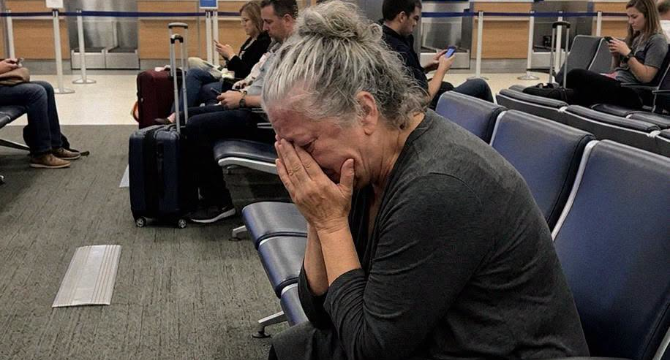
The day I buried my husband, my children left me alone at the airport. Instead of begging them to care, I decided to make one call they would never forget.
“Mom, take a cab. We’re busy.”
Jason’s voice cut through the terminal noise before I could even tell him I had landed. Three sleepless nights pressed down on my shoulders like wet wool, and forty years of marriage had just ended with Henry lowered into the earth of the village where he was born.
“Jason, I haven’t slept in three days.”
“Stop making everyone responsible for your grief.”
He exhaled hard into the receiver. In the background, my grandson’s laugh rang out, then a shout.
“Tell Melissa I claimed Grandpa’s truck!”
My throat closed. I gripped the phone tighter.
“Dad is gone, Mom. Stop making everyone responsible for your grief.”
The line went dead before I could answer.
“You can get home by yourself.”
The airport smelled of stale coffee and rain-soaked coats. I stood by the empty baggage carousel long after the last suitcase had gone, phone still warm in my hand.
A young clerk behind the counter finally looked up from her screen.
“Ma’am, I’m sorry. Your suitcase didn’t make the transfer in Zurich. We’ll deliver it when it turns up.”
“Thank you,” I whispered, though I hardly heard my own voice.
I sat on a bench near the doors and watched families reunite around me. Then I scrolled to Melissa’s number.
“They’re still our children.”
“You knew Dad was sick, Mom. This wasn’t exactly unexpected. You can get home by yourself.”
I set the phone in my lap. Rain streaked the tall glass windows.
I thought of Henry, who every morning of our married life slipped a small sealed envelope into the inside pocket of his coat before he left for work.
“Bills,” he would say, patting the pocket. “I’ll drop them at the post office.”
I never asked. In forty years, I never once asked.
Henry saw. I chose not to see.
He had been a quiet man who kept his hands folded when he prayed and never raised his voice. Not even the last time he told me what he thought of our children.
“They take us for granted, Eleanor.”
“They’re still our children,” I had said.
He had only nodded. He never argued with me, not once.
I remembered how the birthdays had thinned over the years, how the phone rang only when Jason needed the down payment or Melissa needed a sitter. Henry saw. I chose not to see.
Then I remembered the call.
A taxi driver tapped on the glass and pointed at my empty hands.
“No bag, ma’am?”
“No bag.”
I climbed in and gave him the address of the house Henry and I had built together. As the city slid past, my phone stayed silent.
Then I remembered the call. A week before Henry died, a soft voice on the line, a young woman named Claire Bennett from the local news station, asking gently if the family might speak on camera about him.
I stood in my own driveway.
“He was a very private man,” I had told her. “I’m sorry.”
She had said she understood. She had left her number.
I scrolled back through my calls until I found it. My thumb hovered a long moment above her name.
But I couldn’t press it. Not yet.
The taxi pulled away, and I stood in my own driveway staring at the house I had lived in for thirty-two years.
“You finally made it?”
The porch light was on. The curtains glowed. Inside, I could already hear my grandchildren laughing.
I opened the front door and stopped in the entry.
Small sticky labels. On the rocking chair. On Henry’s toolbox by the entry closet. On the glass front of my jewelry cabinet.
“MELISSA.”
“JASON.”
“SOPHIE.”
Names in blue marker on strips of masking tape, stuck to forty years of my life.
“Fine. Ignore me.”
Melissa came out of the kitchen with a dish towel over her shoulder. She looked me up and down.
“You finally made it? What took you so long? We had to make dinner ourselves.”
I did not answer.
“Mom, don’t be like that. We’re all tired.”
I picked up my carry-on and walked past her toward the stairs.
“Fine. Ignore me. That’s mature.”
“Your husband paid for my mother’s surgery.”
Upstairs, I closed the bedroom door behind me and sat on the edge of the bed I had shared with Henry for four decades. His flannel shirt was still folded on his pillow where I had left it before the flight to Switzerland.
I lifted it to my face and breathed him in.
Then I remembered Marcus. The young man at the graveside in Zurich, in a suit two sizes too large, waiting until the others had drifted away.
“Eleanor,” he had said quietly. “Your husband paid for my mother’s surgery. Ten years ago. She’s still alive because of him.”
“You said you wanted to tell Henry’s story.”
I had not known what to say. I still did not.
I pulled my phone from my bag and scrolled to Claire Bennett’s number.
She answered on the second ring.
“Eleanor. I’m so sorry. I heard.”
“Claire,” I said. My voice was steadier than I expected. “You called me last week. You said you wanted to tell Henry’s story.”
“I’ll come to you.”
There was a pause on the line.
“Yes. I did.”
“Is the offer still open?”
“It is. It was always going to be.”
Something in the way she said it made me sit up straighter.
“I’ll come to you,” I said. “Six o’clock. I’ll bring Henry’s records. He kept everything in the study. I have the key.”
“Then don’t hide anything.”
“I’ll send a car for you. And Eleanor, I’d like to send a small crew by the house separately in the morning for exterior shots. If the curtains are open, they’ll film only what can be seen from the sidewalk. They won’t knock. They won’t disturb anyone.”
Claire hesitated.
“Eleanor… if we tell this story, people will see everything.”
I looked toward the kitchen where Jason and Melissa were laughing downstairs.
For forty years, I had protected them from every consequence.
“He asked me to wait until you called me.”
“Then don’t hide anything,” I said quietly. “Show them exactly what Henry wanted people to see.”
Claire was quiet for a moment.
“Eleanor… your husband came to see me a few months ago.”
My hand tightened around the phone.
“Henry?”
I did not go down for dinner.
“He asked me to wait until you called me.”
“What did he want?”
“I’m sorry. He insisted I explain everything in person.”
I stared at the rain.
“Six o’clock,” I whispered.
“I’ll be there.”
I would never know the man I’d spent my life.
I hung up and stared at the flannel shirt in my lap.
I did not go down for dinner.
Before dawn, I dressed quietly, took the key from Henry’s nightstand, and slipped into his study with only the desk lamp for light. The bottom drawer held a leather folder I had never seen.
For forty years, I would have closed the drawer and walked away. Henry’s private things had always been exactly that — private. But if I turned away again, I would never know the man I’d spent my life beside.
‘Jason’s canceled debt.’
Inside lay a bank ledger in Henry’s neat hand.
One line stopped my breathing. March, three years ago. Twenty-two thousand dollars, wired to a children’s hospital in Denver.
In the margin, in the same steady script, three words: ‘Jason’s canceled debt.’
I stared at it a long time. My son had told me that year that he had “handled” his bankruptcy on his own.
I closed the folder, tucked it under my arm, and slipped out the back door.
“We should sell the cabin.”
I did the one thing I had promised Claire. I walked through the silent house, pulling back every curtain until the first gray light could reach every room.
No one noticed I was gone.
The living room smelled of pot roast and impatience. My family had assembled around the television for the six o’clock news, plates balanced on knees, voices tangled over the anchor’s introduction.
Jason leaned back in Henry’s recliner. He had already claimed it with a strip of blue painter’s tape stuck to the armrest.
“She’ll come around.”
“Once we settle the truck situation, we should sell the cabin,” Jason said.
“Fine by me,” Melissa replied. “As long as I get my share.”
I ate slowly, saying nothing.
“Mom, say something.”
“I’m listening.”
Jason shrugged. “She’ll come around.”
It was me, seated in Claire’s studio.
Sophie, my granddaughter, glanced at me from the couch. Only fifteen, and yet the only one whose eyes softened.
“Grandma, do you want more water?”
“No, sweetheart. Thank you.”
The anchor’s voice shifted into the lead segment. A photograph filled the screen. It was me, seated in Claire’s studio that morning, hands folded in my lap.
Sophie’s fork clattered.
“Grandma?”
Henry funded the cancer treatment of six local children.
Jason lurched upright.
“What the hell is this?”
On screen, my voice was quiet. I spoke about a man who mailed letters every morning of his life. I spoke about envelopes I had never opened.
Then Claire’s voice took over, gentle and deliberate.
“For more than thirty years, Henry quietly funded the cancer treatment of six local children. He put four veterans through trade school. He paid off the mortgage of a widowed neighbor. He endowed a scholarship at the community college under a name that was not his own.”
“Denver. Three years ago.”
Melissa’s mouth fell open, her fork hovering midair.
A woman appeared on screen, wiping her eyes. “I never knew who paid. I only found out last week, at the funeral home, when the director handed me a letter.”
Another face. A young man in a mechanic’s uniform. “Henry saved my daughter’s life. I thought he was a stranger passing through.”
“Jason,” I said quietly. “Denver. Three years ago.”
His face changed.
“Was there a will amendment?”
“What did you say?”
“Twenty-two thousand dollars,” I said quietly.
Jason’s face drained of color.
Melissa frowned. “What twenty-two thousand dollars?”
Jason never answered. He already knew exactly what that entry meant.
“I said turn it off.”
“Was there a will amendment?” Melissa asked, her voice climbing. “Mom. Was there an amendment?”
I did not answer. I turned back to the screen.
Marcus appeared on the broadcast next, the young man from the funeral in Switzerland. He spoke about his mother. He spoke about a check that had arrived without a return address in 2013.
“Turn it off,” Jason snapped.
Nobody moved.
“I said turn it off.”
“There is one more part to Henry’s story.”
I reached across the couch and touched her wrist.
Claire’s voice returned, softer than before, threading through the room like a warning bell.
“But there is one more part to Henry’s story. A request he made, months before he died. A request about the person he loved most.”
The whole family went still. And I set my plate on the side table, because I knew what was coming next.
The whole town was watching.
On the screen, Claire’s voice softened.
“Months before his death, Henry walked into our station with a single condition. Whatever we aired about his life, we would air only when his wife was ready. He asked us to stand between her and anyone who would try to take from her when he was gone.”
The footage cut sharply. There was our living room, filmed that morning through the front window. Labels on the rocking chair. Jason’s handwriting stuck to my jewelry box.
The whole town was watching.
“I am the sole trustee.”
Jason shot up from the couch.
“How could you do this to us? Do you know what people will say?”
Melissa was crying, but not the kind of crying I recognized.
“My children’s inheritance, Mom. You just threw it away on television.”
For the first time in three days, my voice did not shake.
“Henry left everything to a foundation in his name. It was finalized the day of his burial. I am the sole trustee.”
“I only wanted a ride from the airport.”
Jason stared at me.
“You planned this.”
“No,” I answered quietly. “I only wanted a ride from the airport.”
“We didn’t know you needed us that badly,” Jason said.
“Henry was afraid of what might happen after he was gone. He prayed he was wrong.”
Jason glanced toward Melissa.
“He didn’t hesitate.”
“What is that supposed to mean?”
“It means he knew you might start dividing his life before I even made it home.”
“We weren’t dividing anything,” Jason said quickly. “We were only trying to sort things out.”
I opened the ledger I had carried with me all day.
“Three years ago, when you went to him asking for help, he didn’t hesitate.”
“Never made you feel guilty.”
Jason froze.
“He paid the twenty-two thousand dollars you owed without asking for anything in return.”
No one spoke.
“A few months later, there was a new truck in your driveway.”
“That has nothing to do with this,” Jason muttered.
“You were still his son.”
“He never mentioned the money again. Never reminded you. Never made you feel guilty.”
Melissa stared at her brother. “You never told us.”
“Because no matter what kind of son you were… you were still his son.”
My voice broke for the first time.
“And instead of thanking your father after he died, you came into this house to put labels on his furniture, argue over his truck, and divide everything he spent a lifetime building.”
“Neither of you even came to your father’s funeral.”
I looked from Jason to Melissa.
“Neither of you even came to your father’s funeral.”
I looked back at Jason.
“He simply made sure I would never have to face today alone.”
For the first time since Switzerland, I slept.
Sophie was the only one who looked at me instead of the television.
“Grandma, I’m sorry.”
I touched her cheek and walked past the rest of them, up the stairs and into the room where forty years of marriage still lived in the closet. I peeled Jason’s label off the rocking chair. I sat down.
For the first time since Switzerland, I slept.
Henry had spent his protecting strangers.
Weeks later, I sat in Henry’s old desk chair at the foundation office, a folder of scholarship applications open on my lap. Claire brought me coffee without asking how I took it. She already knew.
My phone lit up on the desk. Sophie’s name, and beneath it, a single question. Could she come for the weekend?
I poured a second cup of coffee, the way Henry had every morning for forty years, and set it across from mine.
Then I picked up the phone and wrote back one word: Yes.
For forty years, I had spent my life protecting the people I loved from the consequences of their choices.
Henry had spent his protecting strangers from circumstances they had never chosen.
Only after losing him did I finally understand which kind of kindness changes the world. I couldn’t bring my husband back. But I could make sure his kindness never died with him.

 admin
admin