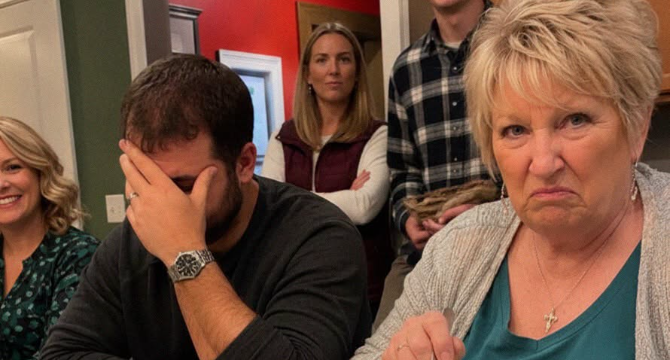
My mother-in-law took one bite of the dinner I’d spent hours preparing, spat it back onto her plate, and loudly declared that no human being could eat my cooking. She thought she was exposing me as a terrible wife. Instead, what followed next had her walking out the door, head bowed in shame.
“No wonder my son looks like he’s starving. No one could eat this.”
That was what my mother-in-law, Sally, said during Sunday dinner.
Then she spat my cooking back onto her plate.
There were 13 people crowded around our dining table when it happened.
For one long second, the only sound in the room was the stew sliding from her mouth with an ugly splat.
My husband’s cousins stared at their bowls.
His sister covered her mouth.
Our 10-year-old daughter, Ellie, looked at me as though she was waiting to see whether she should be frightened.
Sally dabbed her lips with a napkin and pushed her plate away.
“This is so bland and bitter that it is barely food,” she announced. “Is this how you feed Mark every day?”
A few people gave nervous laughs.
My cheeks burned.
Beside me, my husband had gone completely still.
Sally looked around the table, encouraged by the attention.
“I am serious. Look at him. He has lost weight, and he looks exhausted. No wonder. The poor man probably comes home to meals like this every night.”
I gripped the serving spoon so tightly that my fingers hurt.
She had no idea why Mark had lost weight.
She did not know why there was no salt in the stew.
Why I had used lemon, garlic, turmeric, parsley, and a slightly bitter herb blend instead of the seasoning packets she preferred.
She did not know why Mark’s portion had been measured.
Or why I had spent three hours checking labels, calculating sodium, and making sure every ingredient was the match needed.
She did not know why I had done all these, because Mark had begged me not to tell her.
And for six months, I had kept his secret.
Sally leaned toward him.
That was when Mark stood.
His chair scraped sharply against the floor.
Everyone looked at him.
His face was pale, but not from embarrassment.
“Enough,” he said.
Sally blinked in surprise.
“What? Are you defending her?”
“I said enough.”
I had been married to Mark for 12 years.
I had heard him angry, frustrated, and exhausted.
I had never heard him speak to his mother like that.
Sally laughed uncertainly.
“Oh, don’t be dramatic. I am only saying what everyone else is thinking.”
“No,” Mark said. “You are saying what you always say. You criticize my wife, embarrass her, and call it concern for me.”
Sally’s smile disappeared.
“Mark, I am your mother. You cannot talk to me like that.”
“And Claire is my wife. You can no longer talk to her like that.”
The room went quiet again.
Mark placed both hands on the table, steadying himself.
“She is only following my doctor’s instructions. The food is low in sodium because I have heart failure.”
Ellie’s spoon hit her bowl.
Our seven-year-old son, Ben, looked up.
“What does that mean?”
My stomach dropped.
This was exactly why Mark had not wanted the family told.
He had wanted more time before explaining it to the children.
He had wanted to get through the next round of medication first.
Sally stared at him.
“No, you don’t. You’re just making excuses for her.”
“I do. And now, you’ve forced me to blurt it out in front of the children.”
“Stop. This is not funny.”
“I am not joking.”
He pointed toward the bowl she had insulted.
“Claire has made that meal according to the plan from my cardiologist and dietitian.”
The news started sinking in as everyone at the table stopped eating.
“The bitterness you are complaining about comes from the salt-free seasoning blend they approved,” Mark said, his voice heavy with anger.
Sally’s face drained of color.
“Claire has spent months changing everything we eat because too much sodium makes my body retain fluid and puts more strain on my heart.”
His voice cracked.
“I take medication every morning and every night. I weigh myself daily to check for fluid retention. I have blood tests, scans, and appointments you know nothing about.”
Nothing was funny anymore.
Everyone’s faces looked like they had received the worst news.
“And Claire has been carrying all of it with me.”
I wanted him to stop.
Not because Sally did not deserve the truth, but because Ellie had started crying.
“Is Daddy going to die?” she asked.
Every adult at the table froze.
Mark turned immediately.
“No, sweetheart.”
He crouched beside her chair.
“I am sick, but my doctors are treating me. The medicine and food are helping. I should have explained it to you before now.”
She threw her arms around his neck.
Ben began crying too.
I moved around the table and pulled him against me.
Sally sat motionless.
Her spoon remained beside the food she had spat out.
The family had gathered at our house every Sunday for years.
It started after Mark’s father died.
Sally said the dinners helped keep everyone close. At first, I loved them.
Then the comments began.
Sally criticized how I set the table.
She said my curtains made the room look dark.
She rearranged my kitchen cabinets without asking.
When Ellie was a baby, she accused me of holding her too much.
When Ben was born, she said I did not hold him enough.
Nothing I did was correct.
Cooking became her favorite target.
If I made pasta, the sauce was too thin.
If I roasted chicken, it was dry.
If Mark praised a meal, she would smile and say, “You always were easy to please.”
I used to laugh awkwardly.
Mark would squeeze my knee under the table and whisper, “Ignore her.”
Afterward, he would apologize.
“She is just like that,” he would say.
I began to hate those words.
Sally was not “just like that.”
She behaved that way because everyone allowed her to.
Six months earlier, Mark had nearly collapsed while carrying laundry upstairs.
He had been tired for weeks, but we blamed work.
Then his ankles started swelling, and he became breathless walking from the bedroom to the kitchen.
I drove him to urgent care.
They sent us straight to the hospital.
Tests showed that his heart was not pumping as strongly as it should.
The cardiologist diagnosed cardiomyopathy with reduced heart function.
Mark was 37.
He exercised.
He rarely drank.
He had never smoked.
The doctor said viral illness, genetics, and other causes could damage the heart even in people who seemed healthy.
More testing was needed.
I remember sitting beside Mark’s hospital bed while he stared at the wall.
“My dad died at 58,” he said.
“That does not mean you will.”
“What do we tell the kids? They will hear ‘heart failure’ and think I am dying.”
“We explain it carefully.”
“Not yet. Let’s find out my prognosis before we do.”
We agreed not to tell anyone until the doctors knew more.
Especially Sally. Mark’s dad had died so abruptly, and since then she had become worried when anyone had health issues, even minor ones.
“She will panic,” he said. “She will call me every hour. She will tell the whole family. I cannot handle that while I am trying to figure this out.”
I agreed.
At first, keeping the secret seemed possible.
Then Mark’s dietitian recommended nutritional changes.
The low-sodium diet changed our meals.
He lost weight because his body stopped holding excess fluid and because he was eating more carefully.
Sally noticed everything.
She just interpreted it cruelly.
“Claire is shrinking you,” she joked one Sunday.
Another time, she brought a salty casserole and insisted Mark eat two servings.
I told her we would have it the next day.
We didn’t. I had to dispose of it.
Later, I asked Mark if it was time we told his mother.
“Not yet,” he said.
“She will keep pushing you to eat these foods that the dietitian has asked you not to.”
“She will become even more pestering. I cannot manage this illness and her.”
He looked exhausted.
“Please, Claire. I don’t need every conversation to be about my heart. You know that’s how it will be.”
So I kept cooking the meals the dietitian recommended.
I kept smiling.
I kept absorbing Sally’s insults because I knew the truth was not mine to reveal.
But sitting at that table while my children cried, I realized silence had protected no one.
Mark held Ellie and looked at his mother.
“You need to leave.”
Sally stared at him.
“Mark, I did not know.”
“That is not the point.”
“Of course it is. If you had told me, I never would have said those things.”
“You said them because you thought Claire was an acceptable person to humiliate.”
Sally recoiled.
“I was concerned about what she’s feeding you.”
“No. You were using me as an excuse to attack my wife.”
She looked around the table, perhaps expecting someone to defend her.
No one did.
Mark’s sister, Diane, lowered her eyes.
Sally turned back to him.
“I am your mother. I have a right to be concerned about how you are treated.”
“I am treated with more care in this house than you seem capable of recognizing.”
His breathing had become shallow.
I touched his arm.
“Sit down.”
He shook his head.
“For six months, Claire has tracked my medication. She has driven me to appointments.”
His eyes filled.
“She wakes up when I cough because she is afraid I cannot breathe. She learned an entirely new way to cook so I could still enjoy meals with my family.”
He turned towards me, holding my gaze.
“And while she was doing all of that, you came into our home every Sunday and made her feel small.”
Sally began crying.
“I am sorry.”
“You are sorry because now you know I am sick. You are not sorry for how you’ve treated my wife.”
“No, that is not fair.”
“It is exactly fair.”
Ben tugged on my sleeve.
“Is Dad really going to be okay?”
I knelt beside him.
“His heart needs help, but the doctors are helping it. The medicine, the food, and the appointments are all part of that.”
“Did Mommy make the bad-tasting food to help him?”
A cousin coughed to hide a laugh.
Despite everything, Mark smiled.
“Yes. Mommy made the bad-tasting food to help me.”
“It does not taste bad,” Ellie said through tears.
Sally flinched.
Mark looked at his mother again.
“The children should not have learned this as carelessly as they have because you decided to shame their mother at dinner.”
“I said I was sorry.”
“And I said you need to leave.”
Sally stood slowly.
No one helped her with her coat.
At the doorway, she looked back at me.
For once, she had no criticism ready.
Then she walked out.
The rest of dinner was awkward.
Mark explained his condition to the children in simple terms.
He promised that if anything important changed, we would tell them.
Diane apologized to me before leaving.
“I should have said something years ago,” she admitted. “We all let her do it because it was easier than becoming her next target.”
One cousin apologized for laughing.
Another quietly took Sally’s untouched plate to the kitchen and scraped it into the trash.
That night, after the children finally fell asleep, Mark and I sat in bed.
“I am sorry,” he said.
I waited.
“For all of it.”
He looked down at his hands.
“I kept saying I was protecting my privacy. But I also knew that as long as you could not explain the food, Mom would keep blaming you.”
I had not expected him to admit that.
“I should have told her to stop treating you badly long before I got sick,” he continued. “I made you endure it because confronting her made me uncomfortable.”
“Yes, you did,” I said.
He looked at me, surprised by the bluntness.
“I love you,” I said. “But yes. You did.”
He nodded.
“I thought apologizing for her afterward was enough.”
“It was easier for you to comfort me in private than defend me in public.”
The truth hurt him.
I could see it.
But he did not argue.
“I will not do that again,” he said.
The next morning, someone knocked on the door at eight.
Sally stood outside holding a covered dish.
My first thought was that she had brought more of her tasty food.
Then she looked at the container and seemed to realize how it appeared.
“This is not for Mark,” she said quickly. “It is just fruit.”
I did not invite her inside.
Her eyes were swollen.
“I came to apologize.”
“Mark is resting.”
“I need to apologize to you first.”
She held the dish against her chest.
“After I left, Diane called me. Then Michael called. Then two of the cousins.”
I raised an eyebrow.
“They all told me that if I did not give you a sincere apology, they would not be speaking to me anymore.”
“So you are apologizing because they threatened to stop speaking to you?”
“No.”
She looked down.
“I came because I am sincerely sorry.”
I said nothing.
Sally’s voice shook.
“I have told myself for years that I was teasing you. I said I was protecting my son. But Mark was right. I was mocking you.”
She wiped her cheek.
“I did not know he was sick, but I knew I was hurting you. I saw your face every Sunday. I simply believed being his mother gave me the right to say whatever I wanted.”
That was the first apology she had ever given me without adding “but.”
“I am sorry for spitting out your food,” she continued. “I am sorry for insulting you in front of your children. I am sorry for acting as though Mark’s home belongs to me more than it belongs to you.”
Mark appeared behind me.
Sally’s face crumpled when she saw him.
“I am sorry I forced you to reveal something you were not ready to share.”
Mark leaned against the hallway wall.
“We need boundaries.”
She nodded immediately.
“No criticizing Claire’s cooking, parenting, home, or marriage. No rearranging things. No showing up without calling. And no sharing my diagnosis with anyone.”
“I understand.”
“If you break those boundaries, you will not be invited back.”
She pressed her lips together.
Then she nodded again.
“I understand.”
Forgiving her did not happen at the doorway.
We allowed her inside for a few minutes.
She apologized to the children for frightening them.
She left when Mark said he needed rest.
For several weeks, Sunday dinners stopped.
When they eventually resumed, they were way better.
Sally asked before bringing food.
Our relationship did not become perfect.
But we could be in the same room and be cordial and respectful to each other.
Mark’s treatment continued.
His next scan showed modest improvement in his heart function.
The cardiologist warned us that recovery could be slow and uncertain, but the medication and diet were helping.
The children adjusted too.
Ellie began checking food labels with me.
Ben told everyone that Daddy’s heart was “getting stronger because Mommy makes serious soup.”
A month after that terrible dinner, Sally came early and asked if she could help me cook.
I almost said no.
Instead, I handed her a cutting board.
She chopped vegetables while I measured spices.
After several quiet minutes, she said, “I spent years believing no one could care for him as well as I could.”
I looked at her.
“The truth is, I was not paying enough attention to see that you already were.”
Her comments did not erase what she had done.
But it was a beginning.
For years, Sally claimed her cruel treatment of me came from loving her son.
Mark claimed his silence came from protecting our peace.
Both of them were avoiding accountability.
The night Sally spat my food onto her plate, she finally exposed the truth about our entire family.
I had been carrying too much alone.
Mark had been allowing it.
And Sally had mistaken access to our lives for control over it.
Her apology mattered.
Mark’s defense mattered more.
Not because he humiliated his mother or made her walk out.
Because for the first time, he made it clear that respecting me was not optional.
And once he finally said it aloud, no one at that table could treat me disrespectfully again.

 admin
admin