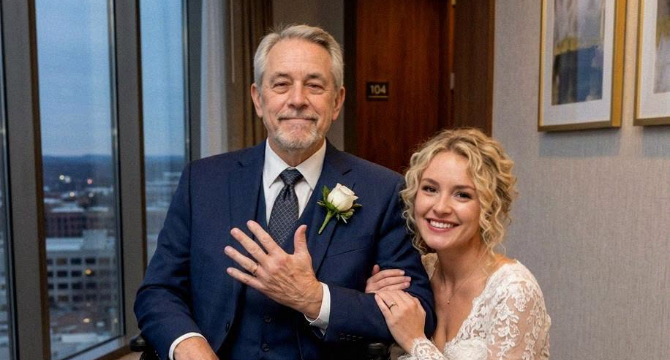
I tried to ignore the uneasy feeling I got whenever I looked at my father’s new wife, telling myself it was only jealousy. Little did I know that the truth would hit home closer than I anticipated.
Most people assumed I’d grown up lonely, being raised by parents who were already 53 when I arrived. They were wrong. My childhood was the softest, happiest, and brightest thing I owned. I still measure every good day against the ones I’d spent under my parents’ roof.
Penny, my mom, used to laugh with her whole body, throwing her head back. Ben, my dad, was quieter. He was a man who read the newspaper aloud at breakfast and pretended not to notice when I stole the crossword.
They were wrong.
They joked that other kids had young parents, but I had two people who’d already lived long enough to answer any question I’d ever ask.
Three years ago, a truck ran a red light.
Mom died before the ambulance reached the hospital. Dad survived, but the accident left him in a wheelchair he couldn’t seem to make peace with.
A truck ran a red light.
He stopped reading the paper, stopped going out, and was no longer the man I’d grown up beside.
At 14, I tried everything.
I bought him puzzles, audiobooks, and his favorite chocolate cake from the local bakery.
“You don’t have to sit with me all evening, sweetheart,” he’d say.
“I know I don’t.”
“Then go and be a kid.”
He’d smile, but it didn’t reach anywhere important, and I’d pretend I hadn’t noticed.
I tried everything.
The last person I expected to pull him back was my English teacher.
Ms. Emily was 32, smart, warm, quick with a joke — the kind of teacher students adored.
I’d invited Dad to the school’s annual Family Appreciation Night on a whim, sure he’d refuse, and was stunned when he agreed.
I watched Ms. Emily cross the auditorium and sit down beside my dad’s wheelchair as if she’d been looking for him all evening.
The kind of teacher students adored.
“‘Your daughter says you used to teach history,'” he later told me she’d said.
“A long time ago.”
“Then you owe me a debate. I’ve been losing arguments with my students about the Roman Republic all week.”
He laughed. I saw my dad actually laugh! It was the first real sound I’d heard from him in weeks!
My teacher spent nearly half an hour talking to him while parents and teachers mingled in the auditorium. I assumed she was being kind to a lonely widower.
“Then you owe me a debate.”
A few weeks later, Ms. Emily “happened” to bump into my dad at the public library.
Then came the recommended novels, invitations to community lectures, and coffee dates that stretched into whole afternoons. Before I realized what was happening, they were inseparable.
Eight months later, they quickly got married in the backyard under Mom’s old dogwood tree.
By then, Dad was 67, marrying someone over half his age.
He was beaming for the first time since Mom’s death!
They were inseparable.
I stood at the reception, and I tried to be happy for him.
“You okay?” Cousin Cynthia asked mischievously.
“Of course.”
“You sure? You look like you’re solving a math problem.”
I laughed because that was easier than answering.
“You okay?”
Across the room, Emily caught my eye.
She smiled, but there was something underneath it, something careful, as if she were studying me for a test only she knew about.
My teacher could have built a future with almost anyone. Instead, she chose a man old enough to be her father, who depended on a wheelchair to get around.
I told myself that the feeling in my stomach was nothing.
There was something underneath it.
The wedding photos went up on the hallway wall within a week: Dad in his chair, Emily leaning down beside him, both of them laughing at something the photographer had said.
I passed those pictures every morning and tried to smile back at them.
My stepmother moved into the house as if she’d always belonged there. She rearranged the spice rack, learned exactly how Dad took his tea, and started reading to him at night.
I passed those pictures every morning.
Emily was warm with me, too. Almost careful.
“I made too much soup again,” she’d say, sliding a bowl across the counter. “Sit. Eat something before you go to bed.”
“You don’t have to feed me, Emily.”
“I know I don’t have to.”
She’d smile as if the sentence meant more than it said, then turn back to the stove.
“I know I don’t have to.”
Dad now laughed at Emily’s terrible puns, at the way she pretended not to understand the news, and at nothing at all! I should’ve been grateful. I wanted to believe he’d found love again.
Instead, I started noticing things.
The top drawer of Emily’s nightstand was always locked. She took her phone into the laundry room to answer certain calls. When we ate dinner together, she’d ask me questions that felt, at the moment, ordinary, and only later, a little too personal.
I started noticing things.
“What was your favorite book in fourth grade?”
“Did your mother sing to you when you were small?”
“Did your mom ever tell you stories about the day you came home?”
“Why are you asking me that?” I said one night, setting my fork down.
My stepmother blinked, then softened her face. “I’m just trying to know you better. Is that wrong?”
“It’s a weird question.”
“Why are you asking me that?”
“I’m sorry. Forget I asked.”
But she didn’t forget. She wrote things down. I caught her once, closing a small notebook when I walked into the kitchen too quietly.
I told myself I was being paranoid.
Then, one night, I couldn’t sleep.
The house was quiet, the way old houses get after midnight. I went downstairs for water and stopped in the hallway because a strip of light glowed under the living room door.
I was being paranoid.
Emily was on the phone. Her voice was low, careful, and shaking.
“He has no idea. Neither does she.”
I didn’t move.
“I’ve been planning this for years. Getting close to this family was never an accident.”
I froze. My hand found the wall.
She was quiet for a long time, listening.
Then she spoke again, softer.
“He has no idea.”
“I know. I know. But she’s my daughter, and she deserves the truth.”
I clamped my hand over my mouth so hard that I tasted copper.
Daughter? The word hit me like a slap.
I backed down the hallway one silent step at a time, made it to the stairs, and climbed them without breathing. In my bedroom, I sank against the door and stared at nothing.
I tasted copper.
Emily had a daughter.
She’d married my dad, my grieving, wheelchair-bound dad, and moved into our house carrying a secret I couldn’t begin to understand.
I thought of every question she’d asked me. Every careful smile.
“You will not touch him,” I whispered into the dark. “You will not take one more thing from us.”
My hands were still shaking. I didn’t cry.
I made a list instead, in my head, of everything I needed to find out.
“You will not touch him.”
The locked drawer.
The phone calls.
Wherever Emily went on Thursday afternoons when she said she was grading papers at a coffee shop.
I would find out who my stepmother really was. I owed my mom that much. I owed my dad everything.
The morning after the phone call, I became someone I didn’t recognize. A teenage girl who waited for the front door to close, listened for the car to pull away, and then snuck to her stepmother’s bedroom with a pounding pulse.
I owed my mom that much.
Emily kept her side of the closet meticulous.
Her blouses were arranged by color. Her shoes were lined up like soldiers.
The drawer that was usually locked was open that day. Inside was a small wooden box. Locked. Heavy.
I shook it once and heard something soft shift inside. Whatever she was hiding, it lived in this box.
I put it back exactly where I’d found it and went to work on the rest of the room.
I shook it once.
My stepmother’s nightstand held nothing but a book of poetry and a hand cream. Her other drawers were unremarkable. That, somehow, felt worse.
That afternoon, I sat in Cynthia’s car two blocks from school and watched Emily leave. She didn’t drive home but went downtown.
My stepmother parked outside a squat brick building and disappeared through a glass door. The sign read Family Counseling Center.
She didn’t drive home.
An hour later, Emily came out and walked three doors down to a records office.
I sat in the passenger seat while my co-conspirator gripped the steering wheel.
The following day, Cynthia and I followed Emily again.
This time, she met an older woman at a corner cafe. Both of them ordered the same tea and sat as if they’d done it a hundred times before.
Cynthia and I followed Emily.
We parked across the street and took photographs with my phone. Then I snuck closer, and I caught pieces of their conversation.
“After all this time,” the older woman was saying. “You’re sure now is the right time?”
“I couldn’t be sure until the DNA test confirmed what my heart already suspected,” Emily answered. “Now that I know for certain, I can’t keep pretending. I really can’t.”
I snuck closer.
I called Uncle David that night.
He’d been Dad’s lawyer since before I was born. I got his number from my dad’s phone while he was in the bathroom.
“Uncle David, I know this might sound strange, but I need a background check.”
He went quiet, but thankfully didn’t ask why.
Two days later, Uncle David called me back.
I called Uncle David that night.
“There’s nothing criminal. She has a clean credit history and a clean record. The only unusual thing is old. She filed adoption paperwork at 18. She relinquished a child.”
“A child?”
“Yeah, that’s it. Do I need to be worried, Holly?”
“No, Uncle. I’m just curious about her. Please don’t mention this to Dad.”
He promised not to, but told me to be careful.
“There’s nothing criminal.”
I went back for the box.
I told myself I’d only look and would put everything back the way I found it.
I pried the lock with a hairpin. I used a butter knife on the box until the latch gave.
Inside, folded in tissue paper, lay a faded hospital bracelet. Beneath it, a knit hat no bigger than an apple. A photograph of a newborn with dark hair and unfocused eyes.
There was a letter, sealed in an envelope yellowed at the edges, titled, “To my daughter, whoever you become.”
I went back for the box.
And underneath the letter, a relinquishment record on agency letterhead, and clipped to it a recent DNA results summary and disclosure paperwork, dated just weeks after she married Dad, confirming a parent-child match and authorizing the release of my adoptive family’s identity.
The room seemed to tip sideways.
Behind me, wheels rolled softly on the hardwood floor.
The room seemed to tip sideways.
I turned. My dad sat in the doorway, one hand still resting on the wheel, his face gone gray.
“Sweetheart,” he said quietly.
I held up the relinquishment record. The paper shook hard.
“Dad.” My voice came out small, the voice of a broken child. “Who am I?”
Dad asked me to sit on their bed.
The paper shook hard.
“We adopted you a few months after you were born,” he said quietly. “Your mother and I planned to tell you at 18. We were terrified that telling you sooner would make you believe your whole life had been a lie.”
I stared at the letter, still trembling in my hand.
“There’s more, my angel,” he added. “And I hope you won’t hate me for this next part.”
“We adopted you.”
I steeled myself.
“Emily told me the truth a few weeks before the wedding. I’ve known since then. She wanted to tell you as soon as the DNA results confirmed what she’d suspected, but I asked her to wait until we could tell you together. I was afraid you’d think we were both lying to you, and I couldn’t bear losing you on top of losing your mother. That was my mistake, not hers.”
Right then, Emily stepped into the doorway, tears already sliding down her cheeks.
I steeled myself.
“I was a teenager,” my stepmother whispered. “I wanted you to have a real life. I became a teacher to be near children, because being away from you hurt too much.”
“So you tracked me down?”
“No. You happened to walk into my classroom. Something about you felt familiar, but I told myself it couldn’t be true. I buried the thought for years. After I met your parents and saw no resemblance, I couldn’t ignore it anymore. I searched the records, and the DNA test confirmed what I suspected.”
“So you tracked me down?”
“And you said nothing?”
“How could I? Your parents had given you everything I couldn’t. I wasn’t going to tear that down.”
“Then why marry my dad?”
Emily’s voice broke.
“Because I meant it. I fell in love with him. Caring for him felt like the only way I could ever thank the two people who raised my daughter.”
“Why marry my dad?”
“And the phone call?”
“My mother. Your grandmother. She’s been telling me for years that if I ever learned the truth, I owed it to you to tell you.”
I couldn’t breathe. So I walked out.
When I returned, I went to my room.
I came back carrying a shoebox under my arm, packed with report cards, crayon drawings, and photographs of a small girl on a swing.
I couldn’t breathe.
I set it on the kitchen table in front of Emily.
“You missed a lot,” I said. “I thought maybe you’d want to see.”
My biological mother’s hand covered her mouth.
Dad wheeled himself between us and reached for both our hands, holding on as if he’d been waiting his whole life to do it.
Outside, the porch light flickered on, steady against the coming dark.
