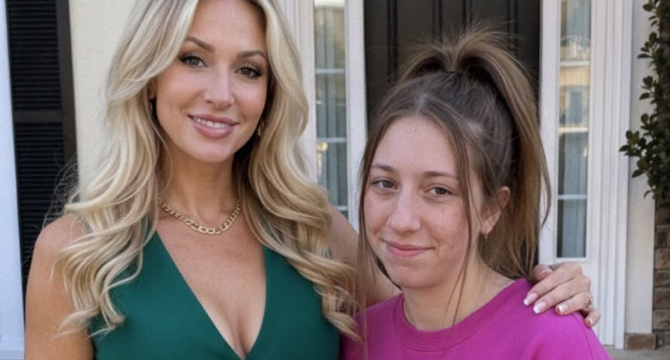
My mother spent my entire childhood reminding me that I should be grateful she had “chosen” me. I believed her until one forgotten discovery after my grandmother’s death made me question everything I thought I knew.
The first time my mother reminded me that she “didn’t have to keep me,” I was seven years old.
I cannot even remember what caused it now.
What I remember clearly is the way she leaned down until her beautiful face was level with mine.
“Your real mother didn’t want you,” she said. “You should be grateful I did.”
I stopped crying immediately.
At seven, I did not understand adoption, abandonment, or what it meant for a mother to give away her child.
I only understood that somewhere in the world was a woman who had looked at me and decided she did not want me.
That sentence followed me for the rest of my childhood.
My mother, Celeste, never sat me down for one big conversation.
There were no papers spread across the dining room table, no gentle explanations, and no promises that being adopted did not make me less loved.
It was simply something I had always “known.”
Whenever I asked where I came from, she gave me the same story.
My biological mother had been too young, too poor, and too troubled to raise me.
“You were headed for a terrible life,” she once told me while brushing her long hair in front of the bedroom mirror. “I rescued you from that.”
I was ten at the time.
“Did she ever ask about me?” I asked.
“No.”
The answer came so quickly that I felt embarrassed for asking.
Growing up, I constantly felt like an outsider.
Whenever Celeste and I argued, she reminded me that she had not been obligated to take me in.
“You have no idea where you would be without me,” she would say.
Sometimes, she said it in anger.
Other times, she delivered it calmly, as though she were reminding me to turn off the lights before leaving a room.
“I gave you opportunities your real mother never could have provided,” she replied. “A beautiful home, good schools, vacations, and clothes. Most girls in your position would be grateful.”
My position.
That was how she described my place in the family.
Colin had married Celeste when I was five.
He was wealthy, polished, and careful about appearances.
He owned several commercial properties and seemed to know everyone worth knowing in our city.
He was not cruel to me, but he was never especially warm, either.
Celeste had told him the same story she told everyone else.
She claimed she had adopted me because she could not bear to see an unwanted child suffer.
People praised her for it.
The worst part was that I looked nothing like her.
Celeste was gorgeous.
She had long, thick hair, a delicate nose, full lips, perfect teeth, and eyelashes that looked fake even without makeup.
Her skin always seemed smooth, and every dress she wore fit as though it had been made for her.
Whenever we stood together, people stared at her and then looked at me with confusion.
I noticed it everywhere.
I always felt like the ugly duckling beside her.
My nose was wider.
My chin was softer.
My teeth had needed braces for three years.
My hair was dull brown, and no amount of styling ever made it fall neatly over my shoulders.
Celeste never directly called me ugly, but she did not need to.
She bought me skin creams before I had acne.
She suggested that I keep my mouth closed in photographs because my smile was “awkward.”
Before my high school graduation, she made me sit through two makeup appointments because the first artist had not done enough to “balance” my features.
For years, I wondered what my biological mother looked like.
Did I have her eyes? Her nose? Her awkward smile?
Maybe she hated photographs, too.
Maybe her hair curled at the ends when it rained.
Maybe she tilted her head whenever she was nervous, the same way I did.
I invented different versions of her as I grew older.
By the time I became an adult, I had stopped asking Celeste questions.
I learned that every conversation about my past ended the same way.
She became defensive, I became emotional, and she reminded me that I owed her everything.
Then my grandmother, Miriam, died.
She never mentioned my adoption unless I brought it up, and she never used it to make me feel indebted.
Her death left me with a grief that felt strangely physical.
For days, my chest ached whenever I remembered that I would never hear her voice again.
A week after the funeral, Celeste and I went to clean out Miriam’s house.
Colin was supposed to join us, but a business meeting kept him away.
Celeste seemed relieved.
The house still smelled like Miriam’s lavender hand cream.
For several minutes, neither of us spoke.
Then, Celeste headed toward the kitchen while I climbed the stairs to the bedroom.
I began with the dresser.
Most of the drawers were filled with neatly folded scarves, old receipts, buttons, and birthday cards Miriam had saved for years.
The bottom drawer stuck halfway open.
I pulled harder, and something scraped behind it.
After several attempts, I managed to lift the drawer from its track.
A yellowed envelope had slipped behind it and fallen against the back of the dresser.
There was no name on the front.
I opened it, expecting another stack of photographs.
Instead, I found a certified copy of my original birth certificate.
For a moment, I did not understand what I was looking at.
Then I saw my name.
Angelica.
My date of birth.
The hospital where I had been born.
My eyes moved lower.
Under the word “MOTHER,” Celeste’s full legal name was printed clearly across the page.
I stared at it until the words blurred.
She had not adopted me.
She had given birth to me.
My knees weakened, and I sat heavily on the edge of Miriam’s bed.
I read the certificate again.
Then I read it a third time.
There had to be another explanation.
Perhaps the document had been altered.
Perhaps Celeste’s name appeared there because of some legal process I did not understand.
However, I knew what a birth certificate was.
I also knew Celeste’s date of birth.
She had been 17 when I was born.
My eyes filled with tears.
Why would she lie?
Why had she spent my entire life making me believe another woman had abandoned me?
Why had she forced me to feel grateful for being tolerated when she was the person who had brought me into the world?
Why did I look nothing like her?
My head spun with so many questions that I could barely breathe.
Celeste was downstairs, cleaning out Miriam’s kitchen drawers, while I was having a full-blown panic attack upstairs.
From below, I heard a cabinet shut.
“Angelica?” Celeste called. “Did you find anything worth keeping?”
I looked down at the dusty certificate in my hands.
On shaky legs, I made my way to the first floor.
Celeste stood at the kitchen counter, sorting utensils into cardboard boxes.
Her hair was tied back with a silk scarf, and even in an old sweater and jeans, she looked elegant.
The second she looked at me, I raised the certificate in my trembling hand.
“Why?”
Her eyes landed on the paper.
All the color drained from her face.
“Where did you get that?”
“You gave birth to me.”
She stared at me without answering.
“You are my biological mother,” I continued. “You spent my whole life telling me I was abandoned. You made me believe I should be grateful that you tolerated me. Why would you do that?”
Celeste glanced toward the front door, as though she was afraid Colin might walk in at any moment.
“You don’t understand,” she whispered.
“Then explain it.”
She pressed both hands against the counter.
I could see her searching for an excuse, but I was not going to let her escape this time.
“And why don’t I look like you?” I demanded. “Not even a little?”
Something changed in her expression.
For the first time, she looked genuinely frightened.
She slowly reached for her iPhone and unlocked it.
“What are you doing?” I asked.
She did not answer.
Her finger hovered over the screen before she finally selected an old photograph.
“One photo can explain everything,” she said.
Then, she turned the phone toward me.
My heart pounded so hard that I could hear it in my ears.
Celeste held the phone with trembling hands.
“Look,” she whispered.
I looked.
The woman staring back at me was not the mother I had grown up with.
She could not have been more than 17.
Her hair was the same dull brown as mine.
It was frizzy and unruly.
She had my nose.
She had my chin.
She had my eyebrows.
Even her awkward half-smile looked exactly like the one I had spent years trying to hide in photographs.
I stared at the picture, unable to process what I was seeing.
“No,” I breathed.
“That is me,” Celeste said quietly.
I looked from the photograph to the woman standing in front of me, then back to the phone.
It did not seem possible.
The glamorous woman I had spent my life comparing myself to looked nothing like the frightened teenager in that photograph.
“I don’t understand.”
She lowered herself into one of Miriam’s kitchen chairs, as though her legs had given out.
“I knew you wouldn’t.”
I remained standing.
After everything she had done to me, I was not about to comfort her.
She rubbed her temples before speaking again.
“I was 17 when I got pregnant with you.”
I said nothing.
“My parents barely had enough money to keep the lights on. College was supposed to be my way out. I had saved every dollar I earned while working after school.”
She laughed bitterly.
“Then I got pregnant.”
“What happened to my father?” I asked.
“He left as soon as I told him.”
The answer came without hesitation.
“He said he wasn’t ready to be a parent. Two weeks later, he moved away. I never saw him again.”
She swallowed hard.
“I had you, and I loved you the second I held you. However, I also looked in the mirror every day and saw someone I hated.”
I frowned.
“What does that have to do with lying to me?”
“Everything.”
She unlocked the phone again.
Instead of showing me one photograph, she began scrolling through dozens.
There were pictures of the same young woman sitting in dental offices.
There were photographs of her with swollen cheeks and bandages wrapped around her face.
Other images showed her hair wrapped in foils at expensive salons.
There were receipts, appointment records, and before-and-after photographs.
“I spent almost every dollar I had saved for college on changing the way I looked.”
I stared at the screen.
“I had cosmetic procedures, dental work, hair treatments, and skin treatments. I paid for everything I thought would make me beautiful.”
My stomach tightened.
“You chose changing your appearance over college?”
“I chose survival.”
I laughed in disbelief.
“No. You chose vanity.”
Her face crumpled.
“You don’t understand what my life was like.”
“Then tell me.”
She looked toward the front window before lowering her voice.
“People treated me differently after I changed.”
I folded my arms.
“Different how?”
“They noticed me.”
I could not believe what I was hearing.
“So, you erased the old version of yourself.”
“Yes.”
“And I reminded you of her.”
She closed her eyes.
“Yes.”
The single word hit me harder than any scream could have.
For years, I had believed that something was wrong with me.
The truth was that I simply looked like the person my mother had spent her entire adult life trying to erase.
“I met Colin several years later, when you were still little,” she continued.
“He thought I was adopted?”
“I told him I had adopted a little girl because I wanted to give her a home.”
“You lied before you even married him?”
She nodded slowly.
“I told him I came from a respectable family. I never mentioned getting pregnant at 17. I never mentioned leaving school. I never mentioned changing my appearance.”
I felt physically sick.
“So, every time someone called you generous, you accepted the praise?”
“I let them believe it.”
“Every time people praised you for adopting me, you said thank you?”
“Yes.”
“You built your entire marriage on a lie.”
“I know.”
“You built my childhood on one, too.”
Silence settled over the kitchen.
Finally, I asked the question that had haunted me for years.
“Did you ever love me?”
Her head snapped up.
“Every day.”
“No.”
“I do love you.”
“You don’t tell your child that she wasn’t wanted if you love her.”
“You don’t spend years making her feel like a burden.”
“You don’t destroy her confidence because she has the face you were born with.”
She covered her mouth.
“I know.”
“I spent my entire childhood hating myself.”
Tears rolled down my face.
“I looked in mirrors and wished I looked like you.”
She began crying openly.
“I imagined another woman somewhere who looked exactly like me.”
My voice broke.
“It never occurred to me that she was standing right in front of me the whole time.”
The kitchen became painfully quiet.
Then, the front door handle rattled.
A second later, Colin walked inside, carrying a folder beneath one arm.
“I finished earlier than expected,” he said.
He stopped when he saw our faces.
“What is going on?”
Neither of us answered.
His eyes moved to the birth certificate lying on the counter.
“Angelica?”
I picked it up before Celeste could.
“You should probably read this.”
He frowned.
“What is it?”
“My birth certificate.”
He accepted it, still looking confused.
As he read, I watched his expression change.
His eyes lifted slowly toward Celeste.
“You gave birth to her?”
She nodded once.
“You told me she was adopted.”
“I know.”
He looked back at the document.
“Why would you lie about something like this?”
She opened her mouth, but nothing came out.
I reached for her phone.
Without asking permission, I opened the hidden folder and handed it to him.
“Keep looking.”
He scrolled through the photographs, including the before-and-after images, receipts, appointment records, and old teenage pictures.
His face lost every trace of color.
“So,” he whispered, “that is what you used to look like?”
Celeste looked down at the floor.
“Yes.”
“You have lied to me for more than 20 years.”
“I was scared.”
“You let me believe you were some kind of hero.”
“I know.”
“You let me believe this little girl had been abandoned.”
“I know.”
She began sobbing.
“I thought that, if anyone saw my old face in hers, everything would fall apart.”
“And instead,” he replied quietly, “you destroyed your own daughter.”
His words hung in the air.
The story she had carefully protected for decades had collapsed in less than an hour.
Colin set the phone down.
“I need some air.”
He walked out the back door without another word.
Celeste reached for me.
I stepped back.
“Don’t.”
“Angelica, please.”
“I spent years believing my own mother didn’t want me.”
“I wanted you.”
“No.”
I shook my head.
“You wanted a life in which I didn’t look like proof of who you used to be.”
She buried her face in her hands.
“I can never fix this.”
“No,” I said honestly. “You can’t.”
For the first time in my life, I was not afraid of disappointing her.
I walked toward the front door.
“Angelica.”
I stopped, but I did not turn around.
“I am sorry.”
I closed my eyes.
Those words were something I had waited my entire childhood to hear.
They had simply come too late.
Since the confrontation, I stopped comparing my reflection to hers.
For the first time in my life, I realized there had never been anything wrong with my face.
The problem had never been how I looked.
The problem was that the one person who should have loved that face had spent years teaching me not to.

 admin
admin