Real compassion isn’t a feeling that disappears in hard times — it’s the force that helps the heart keep going. Even when life feels heavy and happiness feels far away, real human connection survives in the smallest gestures of compassion and empathy.
Psychology has the receipts: research highlighted by the University of Chicago found that everyday acts of kindness measurably boost happiness, resilience, and optimism — while reducing anxiety and loneliness.
The people in these quiet moments of love and light prove it better than any study could: when everything else got hard, their kindness was the thing that didn’t stop.
1.
My grandmother passed away at ninety-one. She’d lived alone for a decade after my grandfather passed.
At her service, a young woman we didn’t recognize came in, sat in the back, and cried. We later learned she was a checkout girl at the grocery store down the street. My grandmother had been her only customer who ever asked her name.
“She asked me on a Tuesday in 2019. She used it every single visit after that for six years. I was invisible to everyone. She made me a name. I came today because somebody who made me a name should not be laid to rest by strangers.”
She comes to my grandmother’s tombstone every birthday. She brings flowers. She says her own name out loud when she gets there. Just so somebody is still saying it.
2.
I worked at a coffee shop in college. One regular, a quiet older man, came in every morning and always paid in exact change.
One day his hands shook so badly he couldn’t count it. He started crying at the counter, embarrassed. I quietly waved him off and told him the coffee was on the house.
He came back the next day with cash he’d carefully counted at home. I waved him off again. We did this dance for a year.
When he finally passed, his daughter brought me an envelope. Inside was every coffee he’d “owed” me, calculated to the penny, plus a note: “He knew. He let you let him. He said it was the only kindness he could accept.”
3.
Last spring, we lost our baby at twenty-three weeks. We named her. We held her for two hours. We left the hospital with empty arms.
The week after, my wife wouldn’t get out of bed. I was scared. Our elderly neighbor — a woman we’d barely spoken to in five years — knocked on our door one morning. She didn’t ask how we were.
She just said, “I lost two babies in the 1970s. Nobody talked about it then. I don’t know what you need. I brought soup. I’ll come back Tuesday with more. You don’t have to invite me in. Leave the bowl on the porch.”
She brought soup every Tuesday for nine months. Different soup each week. She never asked us how we were doing. She just kept feeding us.
We have a son now. He’s almost a year old. She holds him sometimes. She calls him “the soup baby.”
4.
My grandmother kept a small dish of butterscotch candies on her kitchen table for fifty years. She never ate them. They were always there.
After she passed away, I asked my mother. My grandmother had grown up so poor that candy had been a once-a-year luxury. “She kept them out so any child who walked into her kitchen would never have to ask. She said she wanted to be the kind of grandmother who already knew the answer.”
I have a dish of butterscotch on my table now. My nephew empties it every visit. I keep refilling it. That’s the whole job.
5.
I work as a hospice nurse. Last fall I had a patient — an elderly man, no family, completely alone. The hospice was dim and quiet. He wouldn’t speak. Wouldn’t eat. Wouldn’t acknowledge anyone.
On day five I sat by his bed during my break and started reading the newspaper out loud. Just headlines, weather, sports scores. I did it for forty minutes. He didn’t react. The next day I did it again. By day eight he was looking at me.
By day twelve he was correcting my pronunciation. By day twenty he was telling me about his life — he’d been a postal worker, he’d loved a woman who’d married someone else, he’d never had children because he hadn’t wanted to disappoint anyone.
He passed on day thirty-one holding my hand. The last thing he said to me was, “You read me the news for a month. Nobody had read to me since I was eight. Thank you for noticing I was hungry for it.”
I read to every patient now. Out loud. Even the ones who don’t seem to be listening. They are.
6.
My six-year-old asked me last fall why the woman two houses down “always looked sad.” I told her the woman had lost her husband. My daughter went quiet.
The next day she walked over to the woman’s house with a drawing of a heart and rang the doorbell. She handed it over and said, “I heard you lost a person. I made you a heart so you have something extra in case yours got smaller.” The woman cried.
My daughter has drawn her a new heart every Sunday for two years. The woman’s fridge is now completely covered. She told me last month, “I didn’t know I needed eighty-seven hearts. But I did.”
7.
I dropped a bag of groceries in the parking lot last winter — eggs everywhere, oranges rolling under cars. I started crying for reasons that had nothing to do with eggs.
A teenage boy walked over, helped me pick everything up, and then walked into the store and came back with a new carton of eggs. He paid for them himself. He handed them to me and said, “My mom drops things when she’s having a hard week. I figured it wasn’t really about the eggs.”
I have never seen him again. I buy eggs for crying women now. I’m up to four.
8.
My husband and I separated for nine months when our marriage was at its worst. He moved into a small apartment across town.
During those nine months, every Sunday morning, my mother-in-law dropped off a casserole at his apartment without telling me. And every Sunday afternoon, she dropped off the exact same casserole at our house, where I lived alone with our kids. She didn’t tell either of us.
Years later — after we reconciled — she finally admitted it. She said, “I refused to take a side. You were both my children. I figured if you were both eating my food on the same day, you were still on the same family. I wasn’t picking. I was waiting.”
We’ve been remarried for five years. She still drops off two casseroles. She says it’s a habit now.
9.
My husband passed away two years ago. The morning after the service, our mailman — a man I’d waved at for fifteen years but never really known — left a small note in my box.
It said, “I noticed the black wreath. I am sorry. I will keep delivering quietly. If the mail piles up for more than two days, I will knock to make sure you are okay. You don’t have to answer. I just need to know.”
He retired last spring. The new mail carrier doesn’t know to knock. I miss him for that one reason most of all.
10.
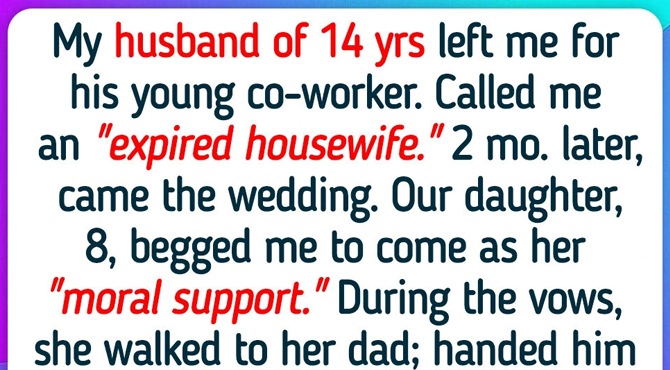
My husband of 14 years left me for his young co-worker. Called me an “expired housewife.”
2 months later, came the wedding. Our daughter, 8, begged me to come as her “moral support.” During the vows, she walked to her dad; handed him something. He went pale.
Turns out she’d handed him a folded piece of paper—one I knew nothing about. It was a note in his own handwriting, from 8 years ago. Our daughter had found it while helping me pack his things: a promise he’d written the night she was born and tucked into her baby album.
“I, your dad, promise to be a man you’ll be proud of. I promise to treat your mother like a queen, so you’ll know how you deserve to be treated one day.”
Below it, in pencil, in her careful eight-year-old letters, she had added: “You can still keep the first promise, Daddy. It’s okay.”
He stood there at the altar, pale, hands shaking—not because he was exposed, but because he was remembered. To his credit, the wedding went on; that was his path now. But something in him broke open that day.
The man who’d called me an “expired housewife” showed up at my door a week later—not to come back, but to apologize, properly, for the words and the way he left. He restarted every missed payment, never skipped a pickup again, and started speaking to me with respect, especially in front of our daughter.
I didn’t raise her to sabotage a wedding. I raised her to be kind, and kindness turned out to be the loudest voice in that room.
My marriage expired. My dignity didn’t. And my daughter, at eight, taught a grown man that you don’t have to stay married to someone to keep your promises to their child.

 Editor1