When the lawyer handed me my husband’s journal after his funeral, I finally learned why the love of my life disappeared 56 years earlier. The truth made me wish I’d never spent a single day hating him.
When I was 19, I thought Michael and I would grow old together.
We had already chosen the little white church where we wanted to get married.
On Sunday afternoons, we’d walk past empty lots, pretending we could already see the future.
“That’s where the vegetable garden goes,” Michael would say.
“And the porch swing?”
“I’ll build it myself.”
“You’ve never built anything.”
“I’ve got 50 years to learn.”
I believed him.
Back then, I believed everything he said.
We had plans for children, a tiny house, and growing old side by side. Neither of us imagined that the future could disappear overnight.
Then one cold October morning, Michael was gone.
His apartment was empty.
The landlord said he’d packed before sunrise. No forwarding address. And no explanation. Just a folded note tucked beneath the blue scarf I’d left at his apartment the week before.
“Emily,”
“I have to leave.”
“Please don’t look for me.”
“You’ll have a happier life if you forget me.”
“I’m sorry.”
“—Michael”
I read those sentences until the paper nearly came apart in my hands.
For weeks, I searched everywhere.
Hospitals.
Train stations.
His friends.
Even places he’d once mentioned wanting to visit.
No one had seen him.
Eventually, grief turned into anger.
If he wanted to disappear, then I would let him.
Life has a cruel way of continuing, even when yours feels as though it has stopped.
Three years later, I met Thomas.
He was gentle in all the ways heartbreak requires.
He never asked me to stop loving my past.
He simply gave me a future worth choosing.
We married.
Raised two wonderful children.
Welcomed grandchildren.
Shared 50 years that were quiet, ordinary, and happier than I ever thought possible.
When cancer took Thomas, I mourned the man who had faithfully stood beside me for half a century.
After his funeral, the house became painfully quiet.
The children visited often.
The grandchildren filled Sundays with laughter.
But evenings belonged to memories.
Sometimes I wondered what had become of Michael.
Not because I wanted him back. Only because unanswered questions have a way of growing louder with age.
Then one rainy Tuesday afternoon, my phone rang.
The number was unfamiliar.
“Hello?”
There was a long silence.
Then a voice I hadn’t heard in 56 years.
“Emily?”
The room seemed to tilt beneath me.
Only one person had ever said my name that way.
“Michael?”
“I wasn’t sure you’d recognize me.”
“I almost didn’t.”
He let out a tired laugh.
“I suppose that’s fair.”
Neither of us spoke for several seconds.
Finally, he broke the silence.
“I don’t have much time.”
Something in his voice made my stomach tighten.
“My doctor says I should stop pretending otherwise.”
I leaned against the kitchen counter.
“What do you want, Michael?”
“I was hoping you’d see me.”
I closed my eyes.
After 56 years.
After one note.
After a lifetime of questions.
He wanted to see me.
“I don’t know if that’s a good idea.”
“It probably isn’t.”
His honesty caught me off guard.
“But I’d still like to ask.”
I looked out the rain-covered window.
Every sensible thought told me to hang up.
Instead, I heard myself ask, “Where are you?”
The hospice sat on a quiet hill overlooking a small lake.
Autumn leaves drifted across the water as I walked toward the entrance.
I almost turned around twice.
A nurse smiled gently when I gave Michael’s name.
“He’s been waiting all morning.”
She knocked softly before opening the door.
“You have a visitor.”
Michael was sitting beside the window instead of lying in bed.
He looked thinner than I remembered.
His once-dark hair had turned completely silver.
Deep lines framed his face.
But when he looked up, his eyes were unmistakably his.
He smiled.
“You came.”
“I almost didn’t.”
“I wouldn’t have blamed you.”
For a long moment, neither of us moved.
Fifty-six years is too much life to cross in a single step.
Finally, I pulled out the chair beside his bed.
“You look terrible.”
He laughed.
“That’s probably the nicest thing anyone’s said to me all week.”
Despite myself, I smiled.
“I’ve missed that laugh.”
“I’ve missed making you smile.”
The words hung awkwardly between us.
He noticed my wedding ring was gone.
“I’m sorry about Thomas.”
“You knew?”
“I kept up with the local paper.”
“You read about him?”
“I read about you.”
I didn’t know what to do with that.
“You had children.”
“Two.”
“And grandchildren.”
“Five.”
“They’re beautiful.”
I stared at him.
“How do you know that?”
He nodded toward the framed photograph sitting on the table beside his bed.
It was a newspaper clipping from my granddaughter’s high school graduation.
“I saved a few things over the years.”
Something inside me shifted.
Not forgiveness.
Not yet.
Just confusion.
“You left me.”
He lowered his eyes.
“You never wrote.”
“No.”
“You never explained.”
“No.”
The room fell silent again.
Finally, I asked the question I’d carried for more than half a century.
“Why?”
He looked toward the lake.
The answer didn’t come.
Instead, he whispered, “I can’t tell you.”
I felt every wall I’d lowered begin rising again.
“You called me here after 56 years, and you still can’t tell me?”
“No.”
“Or you won’t?”
“I gave someone my word.”
I stared at him in disbelief.
“A promise?”
“Yes.”
“You destroyed both our lives because of a promise?”
His eyes filled with tears.
“I know how it looks.”
“Then help me understand.”
“I wish I could.”
“You can.”
He slowly shook his head.
“I can’t break it.”
I stood.
“Then I don’t know why you called me.”
“I called because I couldn’t bear to die without seeing you one last time.”
I picked up my purse. “You’ve had 56 years.”
He closed his eyes.
“You don’t get to ask for my understanding while refusing to give me yours.”
“You’re right.”
I turned toward the door.
Behind me, his voice was barely more than a whisper.
“I never stopped loving you, Emily.”
I closed my eyes but didn’t turn around.
“I don’t know what to do with that.”
“You don’t have to do anything.”
I rested my hand on the doorknob.
“For years, I wondered where you went,” I said. “I don’t anymore.”
He didn’t answer.
As I walked out of the room, I realized the question that had haunted me for more than half my life had finally changed.
I no longer wanted to know where Michael had gone.
I wanted to know who had been worth losing everything for.
I stayed away for nearly a week.
Every morning, I told myself I had already wasted enough years thinking about Michael.
Every evening, I found myself wondering whether each visit I skipped might be his last.
On the sixth day, my daughter, Sarah, arrived with a casserole.
“You’ve been distracted.”
“I’ve just been tired.”
She studied me.
“Mum… has something happened?”
I almost lied. Instead, I quietly said, “Michael called.”
The spoon slipped from her hand.
“The Michael?”
I nodded.
“I thought he died years ago.”
“So did I.”
She sat across from me.
“What did he want?”
“To see me.”
“And?”
“I went.”
Sarah stared at me in disbelief.
“Why?”
“I honestly don’t know.”
I told her about the hospice.
About his illness.
About the promise he refused to break.
I left out one thing.
The way my heart still recognized his smile.
She reached across the table and squeezed my hand.
“Whatever happened back then, don’t let him hurt you again.”
“I won’t.”
At least, I hoped I wouldn’t.
The next afternoon, my phone rang.
“I wasn’t sure you’d answer,” Michael said.
“I’m still not sure why I did.”
“I wanted to thank you for coming.”
“You already did.”
“I know.”
Silence settled between us.
“I’ve started writing again,” he said.
“Haven’t you always written?”
He chuckled.
“You remember.”
“You used to carry a notebook everywhere.”
“I still do.”
I pictured the old leather notebook he’d filled with plans for our impossible future.
“What are you writing now?”
He rested his hand on the notebook.
“The truth.”
“For who?”
He smiled sadly.
“For you.”
Something about the way he answered stayed with me long after we ended the call.
Two days later, I found myself driving back to the hospice. This time, he was waiting outside beneath a blanket, watching ducks cross the lake.
“I was hoping you’d come.”
“I haven’t forgiven you.”
“I know.”
“But I was tired of wondering what I would’ve said if I hadn’t.”
He smiled.
“That’s enough for today.”
Over the next two weeks, our visits became routine.
We never talked about the promise for long.
Every time I asked, he gently shook his head.
“I can’t.”
Instead, we talked about everything else.
He asked about my children.
My grandchildren.
My garden.
I learned he’d spent 37 years teaching high school history.
He’d retired quietly.
Never married.
Never had children.
“You always wanted a big family,” I said one afternoon.
“I did have a family.”
I looked at him.
“What do you mean?”
A shadow crossed his face.
“I can’t explain that yet.”
Again, the promise.
Again, the wall.
One afternoon, I noticed the worn leather journal resting beside his chair.
Its edges were softened from years of use.
I smiled.
“You still buy the same notebooks.”
“They’re reliable.”
“What do you write?”
“My life.”
“Is it worth reading?”
He smiled.
“I hope one day you’ll think so.”
He quickly changed the subject.
I didn’t ask again.
Despite everything, we laughed more than I thought possible.
We argued about baseball, teased each other about our gray hair, and complained about aching knees.
Somehow, 56 years slowly became 56 conversations we never had.
One afternoon, he looked out across the lake and quietly said, “I’ve been thinking about that porch swing.”
I laughed.
“You still owe me one.”
“I know.”
“I don’t suppose you’re finally planning to build it.”
“I’d need a little more time.”
The smile faded from both our faces.
Time.
That was the one thing neither of us had.
As October turned to November, Michael grew noticeably weaker.
Some days, he struggled to finish a sentence.
The nurses visited more often.
His hands trembled when he held a cup.
I knew what was coming.
Neither of us spoke about it.
Then one afternoon, he asked, “Would you do something for me?”
“It depends.”
“Will you come tomorrow?”
“I’m already planning to.”
“No.”
He smiled gently.
“I mean dressed nicely.”
I frowned.
“What are you talking about?”
“I’ve made arrangements.”
“For what?”
“You’ll see.”
The next morning, I almost didn’t wear the blue dress.
It felt foolish dressing up to visit a hospice.
When I arrived, one of the nurses greeted me with an unexpected smile.
“He’s been very excited.”
She led me past Michael’s room.
Then, she opened the small chapel at the end of the hallway.
I stopped in the doorway.
The room had been decorated with fresh white flowers.
Sunlight poured through stained-glass windows.
A minister stood quietly near the front.
A few nurses waited along the back wall, smiling through tears.
Michael was sitting in a wheelchair wearing the only suit I’d ever seen him own.
He looked impossibly frail.
But he was smiling exactly the way he had at 19.
I turned toward the nurse.
“What is this?”
She squeezed my hand.
“You should ask him.”
Michael motioned for me to come closer.
“I know I don’t deserve another chance,” he said softly. “I know I have no right to ask anything of you.”
He reached into his jacket pocket and pulled out a small velvet box.
Inside was the same engagement ring I’d given back the week he disappeared.
“I kept it,” he whispered.
“I never stopped hoping I’d have one more chance to ask.”
My heart broke all over again.
“Michael…”
“I can’t give you 56 years.”
His voice shook.
“I can’t explain everything yet.”
“I may never deserve your forgiveness.”
He looked down at the ring before meeting my eyes again.
“But I don’t want to leave this world with everyone believing you were only my first love.”
He took a slow, painful breath.
“You’ve always been the love of my life.”
Tears blurred my vision.
“I don’t want money. I don’t want sympathy. I don’t even need you to forgive me.”
He held out the ring.
“I lost decades because of one promise. Please don’t let me lose my final days too.”
The room was completely silent.
I looked around.
The nurses were crying openly.
Even the minister had lowered his eyes.
Then I looked back at the man I’d loved, hated, mourned, and somehow never completely forgotten.
Fifty-six years had stolen almost everything from us.
But not this moment.
I slipped the ring onto my finger.
“Yes.”
His shoulders sagged with relief.
The chapel erupted into quiet applause.
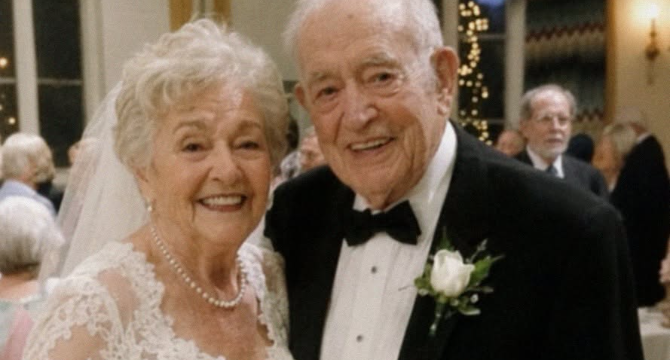
At 75, I married my first love.
Everyone thought I’d lost my mind.
My children worried I was making an emotional mistake. Michael’s relatives whispered that I wanted his money.
None of them knew the truth.
Our marriage lasted 12 days.
On the 13th morning, the phone rang before sunrise.
I knew before I answered.
At Michael’s funeral, I stood quietly in the last row as they lowered him into the ground.
I told myself the questions I’d carried for five decades would be buried with him.
I was wrong.
As the cemetery slowly emptied, a man in a dark suit approached me.
“Mrs. Emily?”
I nodded.
“I’m Michael’s attorney. “He made me promise this would be the first thing you received after the service.”
He handed me a thick envelope sealed with dark blue wax.
My fingers trembled as I accepted it.
“It contains a letter,” he said. “And his journal.”
I looked down at my name written in Michael’s unmistakable handwriting.
For the first time since I was 19, I realized the answers I’d waited a lifetime to hear were finally within reach.
“My dearest Emily,”
“If you’re reading this, then I’ve finally kept every promise I ever made.”
“Except the one I wanted most.”
“Please read my journal.”
“It contains the truth I couldn’t tell you while I was alive.”
The first page was dated 56 years earlier.
“Today I buried my best friend.”
“Before he died, Daniel asked me to choose between keeping my promise to him… and keeping my promise to Emily.”
“He made me promise to raise the little girl everyone believed was his daughter.”
“She wasn’t.”
“She was his teenage sister’s child after a man forced himself on her. He begged me never to tell anyone the truth. He believed exposing it would destroy what remained of his family.”
“I promised.”
The pages that followed introduced me to the man Michael had been without me.
Michael left town with a frightened little girl who believed he was her uncle.
He worked two jobs.
Moved whenever questions became dangerous.
Cheered at school plays, graduations, and birthdays.
He never married.
My name appeared on almost every page.
Near the end of the journal, his handwriting became unsteady.
“I told myself I stayed away to protect the promise.”
“That was true at first.”
“But after I learned you’d married Thomas, I became a coward.”
“You deserved an explanation.”
“Instead, I let silence become easier than asking your forgiveness.”
The final entry was dated three days before he called me.
“Today she looked at me and said, ‘You kept your promise. You’re free now.'”
“I only have one promise left to keep.”
“I’m going to find Emily.”
By the time I reached the final page, I could barely see the words through my tears.
A week later, I met the woman Michael had raised.
“He gave up everything for me,” she whispered. “And he never let me feel guilty for it.”
She handed me a small wooden plaque wrapped in brown paper.
Inside was a carved board that read, “PORCH SWING”
On the back, in Michael’s handwriting, were six words.
“I finally learned how to build one.”
That spring, my son hung the finished porch swing on my front porch.
Some evenings, I sit there and watch the sunset. I think about Thomas, who gave me 50 beautiful years. And I think about Michael, who gave up 56 of his own to keep one impossible promise.
He kept his promise.
And after 56 years, he finally came home to me.

 admin
admin