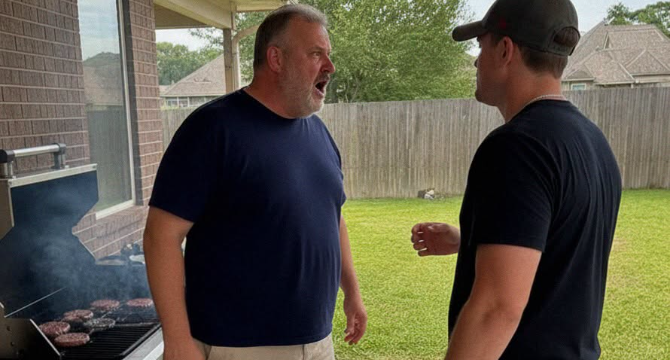
I was the daughter-in-law who did everything — the cooking, the cleaning, the paying. For four years, I played my part. Then I realized the only way to break the cycle was to let him be the host.
Friday evening light spilled through the laundry room window as I folded the last of my daughter’s tiny shirts. The house smelled faintly of the lavender detergent I splurged on, and somewhere down the hall, my two kids were arguing over a crayon. This was the moment of the week I loved most, the quiet before the storm.
Then my phone buzzed on top of the dryer.
“Meghan, sweetheart, it’s Richard.”
I already knew. His voice always came in like he was doing me a favor by dialing.
“Hi, Richard. Everything okay?”
“Better than okay. I’m bringing a couple of friends from the club tomorrow. Nothing fancy. Just make sure the backyard looks presentable.”
I closed my eyes.
“How many is a couple?”
“Three, maybe four. You know how it goes. They love your setup.”
They loved my setup. My patio. My grill. My groceries.
“Richard, I already shopped for this weekend. That’s a lot of extra.”
He laughed, that warm chuckle he used when he wanted to politely steamroll me.
“Meghan, you’re the best hostess this family has. Don’t overthink it. See you Saturday.”
The line went dead.
I stood there holding a folded onesie, staring at nothing.
Mark walked in a minute later, tie loosened, briefcase still in hand. He saw my face and stopped in the doorway.
“Dad called, didn’t he?”
“Three more people. Maybe four.”
He exhaled, that slow, guilty exhale I had come to hate.
“I’ll talk to him.”
“You said that last week. And the week before.”
“Meghan.”
“Mark, I’m not doing it to fight. I’m doing it because our grocery bill last weekend was over 400 dollars.”
He set the briefcase down and wouldn’t look at me.
“I just don’t know how to tell him.”
“You’re 41 years old.”
“I know how old I am.”
There was a beat, the kind where you can hear the refrigerator humming and your kids laughing in another room and your marriage quietly deciding what it wants to be.
I softened. I always did.
“Just help me tomorrow, okay? Grill duty. That’s all I ask.”
“I promise.”
He kissed the top of my head and went to change out of his suit. I loved him. I did. But I had been loving him alone at these BBQs for four years now.
I walked to the kitchen and picked up last Sunday’s receipt off the counter where I had left it as a small, silent protest no one had noticed. Four hundred and eleven dollars. Prime cuts, imported cheese, and two bottles of wine Richard had specifically requested by name. Not a thank-you. Not a dish was washed. Not a single grocery bag was carried in.
When I married Mark, he had described these weekends like something out of a magazine. A close family. Kids running through sprinklers.
Cousins and grandparents and Sunday laughter.
I had believed him. I wanted it for our children more than for myself.
But somewhere between the first BBQ and the 200th, I had stopped being a daughter-in-law and become a caterer with no salary and no clock-out.
I heard my son shriek with laughter in the backyard. My daughter followed, her small feet pounding across the deck.
I looked at the receipt in my hand.
Then I looked at Richard’s voicemail notification still glowing on my screen, that cheerful little announcement about “a couple more friends,” and I quietly wondered how long I had been paying for a family that had never once said thank you.
Saturday morning arrived with the ping of my phone on the kitchen counter. Richard’s name lit up the screen before I had even poured my coffee.
I answered on the third ring, already bracing.
“Meghan, sweetheart, change of plans,” he said, cheerful as ever. “Forget today’s little cookout. I’m moving it to tomorrow and making it bigger. Six of the boys from the club. Premium steak night. Prime ribeyes, the good kind, not that grocery-store nonsense.”
I gripped the edge of the counter.
“Six people, Richard? That’s on top of you and Linda.”
“Well, of course. Pick up some nice sides, too. Roasted asparagus, maybe those little potatoes you do. And make it look nice, would you? These are important men.”
I closed my eyes.
“Richard, that’s a lot of money and a lot of work on short notice.”
“Oh, don’t be dramatic. You’ll figure it out. You always do.”
The line clicked dead before I could answer.
I stood there holding the phone, staring at the screen until it went dark. Mark walked in wearing his weekend flannel, saw my face, and stopped in the doorway.
“That was him, wasn’t it?”
“He bumped today to tomorrow. Six friends now. Premium ribeyes.”
Mark set his mug down slowly, as if the ceramic might shatter if he moved wrong.
“Meghan, I’ll talk to him. I will.”
“You’ve said that for four years.”
“I know.”
“Four years, Mark. Do you know what I’ve spent on his weekend theater? I ran the numbers last night. It’s over 800,000 dollars this year alone.”
He sank into a kitchen chair and put his face in his hands.
“You don’t understand what he was like when I was a kid. If I said no to him, if I made him look small in front of anyone, he’d.”
He stopped. He didn’t finish.
“He’d what?”
“He’d make me feel like I wasn’t his son anymore. For weeks sometimes. My mother would beg me to just apologize, just fix it. So I learned to never make him look small.”
Something in me softened and hardened all at once. I sat down across from him and took his hand.
“Mark. I love you. But I am not asking you to make him look small. I am asking you to stop letting him make me invisible.”
His eyes filled. He nodded, but I already knew.
“You can’t do it, can you?”
“I want to.”
“I know you do.”
I looked out the window. Our two kids were on the swing set, our daughter pushing our son, both of them laughing about nothing. I thought about what they were learning by watching me smile and pay and smile and pay.
“Okay,” I said quietly.
“Okay what?”
“Okay. I won’t wait for you anymore. And I won’t scream at him either. I’m just going to let him play his own game, all the way to the end.”
Mark lifted his head.
“Meghan, what are you going to do?”
“Nothing you have to defend. Nothing you have to explain to him. I promise.”
He searched my face, and whatever he saw there made him nod once, slowly.
That night, after the kids were asleep and Mark was snoring softly beside me, I carried my laptop into the living room. I searched for luxury caterers within 30 miles. I found one with white-glove service, gold-embossed menus, and a lead coordinator named Diane who answered emails at ten p.m.
I booked the full premium steak package for Sunday evening.
Six guests plus host and family.
I listed Richard as the host of record, phone number and all.
I closed the laptop and whispered into the dark, “We’ll make sure it’s an unforgettable night.”
Tomorrow would break Richard, or it would break my marriage, and I no longer knew which one I feared more.
Richard arrived at three sharp, a full two hours before his guests, wearing a crisp navy polo like he was about to host a magazine spread. He walked past me without a greeting and inspected the backyard with his hands on his hips.
“Meghan, set the table properly this time. These are important men. Use the real linens, not the cheap ones you pulled out last month.”
I smiled and folded a dish towel over my arm.
“Of course, Richard. I want tonight to be exactly what you deserve.”
He nodded, satisfied, and disappeared inside to change his shoes.
Mark caught my eye from the kitchen window, worry etched across his face. I gave him the smallest nod.
By five, six luxury sedans lined our quiet street. The men spilled out laughing, clapping Richard on the back like he was a returning war hero.
“Rich, you old dog, another private dinner? You spoil us.”
“Only the best for my friends,” Richard boomed, arm sweeping across our backyard as if he had built it himself.
I stood at the patio door, hands folded, and said nothing.
Then the white van pulled into the driveway. Richard’s head snapped toward the sound.
His smile flickered.
Three uniformed staff members climbed out and began unloading chafing dishes, a portable bar, and long tables draped in white linen. A woman in a black blazer stepped forward with a leather folder tucked under her arm.
“Good evening, sir. I’m Daniela with Belmont Catering. We’re ready to begin setup for your event.”
Richard’s mouth opened, then closed.
One of his friends whistled low.
“Belmont? Rich, you didn’t say you brought in Belmont. That’s the top shelf.”
“I . . . yes,” Richard managed, his voice thinner than I had ever heard it. “Only the best.”
Daniela stepped closer to him, opening the folder with practiced grace.
“Before we begin service, sir, we do require the host signature and payment on file. Standard procedure for premium events. The total comes to 1,800 dollars.”
She held out the invoice, his name printed in bold at the top.
The backyard fell silent. Six men in expensive golf shirts turned as one, watching him.
Richard’s hand hovered over the folder. His face had gone pale beneath his tan.
“Rich? Everything alright, buddy?”
“Fine,” Richard said quickly, forcing a chuckle that came out cracked. “Just reviewing the details.”
He glanced at me then. A long, searching look, waiting for me to step in and save him the way I always had.
I looked back at him steadily. I did not move.
“Well?” one of his friends prompted, amused. “You gonna feed us or what?”
Richard laughed, high and strained, and reached into his back pocket. His hand shook as he pulled out his card.
“Of course. Just making sure everything’s in order.”
Daniela took the card with a polite nod and produced a small reader.
The machine beeped once. Declined. Richard’s face went gray beneath the tan.
“Try this one,” he said quickly, fumbling a second card from his wallet with trembling fingers.
The reader beeped again. Approved.
Richard exhaled like a man who had held his breath underwater for a mile.
“Excellent, sir. We’ll begin service in 15 minutes.”
The staff sprang into motion. Richard stumbled back to his friends and forced a hearty laugh, throwing his arm around the nearest one, redirecting them toward the bar.
Mark appeared at my side, wide-eyed.
“Meghan. What did you just do?”
“I let him choose,” I whispered.
I watched Richard raise a glass across the yard, playing the generous host, his knuckles white around the stem.
Whatever came next, the mask was already cracking.
The dinner unfolded like something out of a magazine spread. Candles flickered on white linen. The caterers moved like ghosts between the guests, refilling glasses before anyone had to ask.
Richard performed. He laughed too loudly at every joke, waving his wine glass around like a conductor.
“You know me, gentlemen. Only the best for the best.”
His friends chuckled. One clapped him on the shoulder.
“Richard, you’ve outdone yourself again.”
I watched from the patio door with Mark beside me. His hand found mine and squeezed it tight.
“You did this,” he whispered.
“We did this,” I answered.
The guests left just after ten, thanking Richard profusely, promising to return the favor at the club. He waved from the driveway until the last taillight disappeared. Then his shoulders dropped like someone had cut a string.
He didn’t leave. He walked back into the yard and sank into a patio chair, staring at his hands. Linda joined him quietly, and Mark and I followed.
Nobody spoke for a long moment.
Then Richard cleared his throat.
“I have to tell you something. All of you.”
His voice cracked on the last word. I sat down slowly across from him.
“I can’t afford it,” he said. “The club. The dinners. Any of it.”
Linda’s head snapped up.
“Richard, what are you saying?”
“I’ve been using this house for months,” he continued, staring at the flagstone. “Every BBQ. Every ‘private dinner.’ I told them I hosted. I let them believe I paid. But it was always you two.”
Mark leaned forward.
“Dad.”
“I couldn’t stand the thought of them knowing,” Richard whispered. “Those men have summer homes. Yachts. And I’m barely covering the membership dues. Pretending to be generous was the only respect I had left.”
Linda covered her mouth. Tears slipped down her cheeks.
“I suspected,” she said, voice breaking. “I saw the credit card statements. I never asked. I’m so sorry, Meghan.”
I looked at Richard, this man who had bulldozed through my home for years, now smaller than I had ever seen him. I didn’t feel triumphant. I felt tired and strangely tender.
“Richard,” I said gently. “Why didn’t you just tell us?”
“Because I was ashamed,” he answered. “And because you never complained. I told myself you didn’t mind.”
Mark’s hands trembled. He looked at his father the way a boy looks at someone he once thought was made of stone.
“Dad,” Mark said quietly. “Respect was never something you had to buy from us. You just had to ask.”
Richard’s shoulders shook. Linda reached over and covered his hand with hers.
I stood slowly, my legs unsteady beneath me.
“We’re a family,” I said. “Families ask. Families help. But families don’t lie to each other.”
Nobody argued. Nobody defended anything.
For the first time in four years, the four of us sat in honest silence.
Weeks later, the BBQs still happened. Smaller now. Honest now. Linda brought potato salad in a chipped Tupperware container. Richard grilled without lecturing anyone, his voice softer, his laughter real. Mark stood beside his father at the grill and cracked jokes without flinching.
I watched from the porch with my kids tucked against me, sipping iced tea, feeling the summer air move through the yard.
I didn’t just end the free meals. I ended a lie the whole family had been feeding. And in giving up the peace I’d been protecting, I finally found the peace I’d been missing all along.

 admin
admin