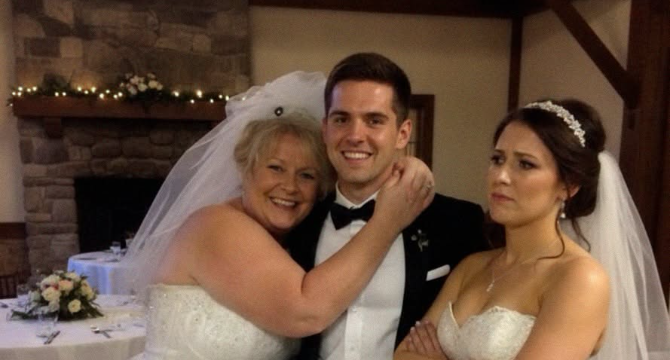
I thought walking toward the altar would be the hardest part of my wedding day — until the church doors opened and I saw someone else wearing white where I was supposed to stand.
The bridal suite was so quiet I could hear the soft hum of the air conditioner and the whisper of silk as I smoothed my dress against my hips. Sunlight fell across the veil draped on the chair, turning the lace into something almost holy. On the vanity sat a small folded square of paper, yellowed at the edges, that James still carried in his wallet after twelve years.
“Meet me behind the bleachers.”
I had slipped that note into his chemistry book when we were seventeen, and he had never let it go.
“You waited a long time for today.”
Twelve years. Two apartments, three moves, one layoff that emptied our savings, and a thousand nights when he reached for my hand in the dark.
“He’s a good one,” my maid of honor whispered, pinning a curl behind my ear. “You waited a long time for today.”
“I waited for him,” I said. “The rest of it, I just survived.”
She knew what I meant. Everyone in that suite knew.
Diane had spent twelve years making sure I understood I was damaged goods.
She had invited James’s ex-girlfriend to Thanksgiving three years running, seating her directly across from me. My name had never appeared on a single Christmas card. Once, at a family dinner, she had lifted my hand toward the lamp and studied my engagement ring with.
“She’ll finally understand you’re my family.”
“He settles when he’s tired,” she had murmured, loud enough for the aunts to hear.
His father never argued with her. He would usually lower his eyes, offer me a quiet, apologetic smile, and let Diane have the last word. James always said his dad had spent thirty years keeping the peace by saying almost nothing.
I had cried in the car that night, and James had gripped the steering wheel until his knuckles went pale.
“After the wedding,” he had promised, his voice low and certain, “she’ll finally understand you’re my family.”
He said it so many times it became a lullaby. On bad nights. On birthdays she skipped. On the morning I found my name misspelled on the shower invitation she had approved.
“It’s time.”
“After the wedding,” he would whisper into my hair, “she’ll understand.”
A soft knock broke my thoughts, and Dad stepped inside in his gray suit, his eyes already glossy.
Across the sanctuary, I noticed James’s father already seated in the front pew. He gave me a small nod, the same quiet kindness he’d shown me for years whenever Diane wasn’t looking.
“Sweetheart,” he said. “It’s time.”
He crossed the room slowly, as if he did not want to rush a single second of it. His hand cupped my cheek, warm and familiar, and he pressed a kiss to my forehead the way he had every school morning of my childhood.
“You are the best thing your mother and I ever did,” he whispered.
The sound I had waited twelve years to hear never came.
“Don’t make me cry before I get out there, Dad.”
“Then let’s move.” He offered his arm, steady as oak. “Your groom is waiting.”
I took a breath. I whispered a small, private prayer that today, of all days, Diane would let me have him without a fight.
Then the double doors of the sanctuary began to open, and my hand tightened on my father’s sleeve.
The doors kept opening, and the sound I had waited twelve years to hear never came.
No organ. No hush of gowns rising in the pews. Only whispers, thin and sharp, running down the aisle like a draft.
Diane stood at the altar beside James.
My aunt covered her mouth. The pianist froze, her hands suspended above the keys as if the music itself had been forbidden.
Then I saw her.
Diane stood at the altar beside James in a full white lace bridal gown. Pearl-trimmed veil. A long train spread across the space where mine was supposed to lie.
She held a bouquet.
My fingers went numb against Dad’s sleeve. He stopped walking. He tightened his grip, steadying me as he had since I was small.
“Do you want to turn around, sweetheart?” he murmured. “Say the word and we go. Right now.”
“I want to see this through.”
I stared down that aisle at the woman who had spent twelve years trying to erase me, and I felt something harden behind my ribs.
Then I looked at James, and that was what stopped me. His face wasn’t the face of a man ambushed. He was still, too still, the way a man goes still when something he has already prepared for finally arrives. He wasn’t surprised. He was braced.
Something small and stubborn flickered under my sternum.
“No,” I said. “I want to see this through.”
He studied me for one long second. Then he nodded, once, and we started walking again.
“James deserves one beautiful wedding photo.”
I could not breathe. I could only walk, because stopping now meant something different than it had a moment ago.
Halfway down the aisle, my maid of honor rushed up beside me.
“She must have been in the vestry for an hour, dressed and waiting,” she whispered. “She came out through the side door the moment we lined up. None of us saw her until she was already at the altar.”
I found my voice.
“Diane,” I called. My voice splintered on her name. “Explain this.”
She turned toward me slowly, the satisfied smile of someone unwrapping a gift she had wrapped for herself.
Diane laughed.
“James deserves one beautiful wedding photo,” she said. “Today, he finally gets one.”
A gasp moved through the pews behind me.
I looked at James, waiting for him to send her away.
He didn’t move.
“James,” I whispered. “Tell her to sit down.”
He met my eyes, wearing an expression I’d never seen before.
“Sweetheart,” he said quietly. “I need a minute.”
Diane laughed. She reached for his arm the way a bride reaches for a groom.
“James, don’t do this to me.”
James stepped aside.
Her fingers closed on empty air, and for the first time that morning her smile faltered.
He lifted the microphone.
“Family,” he said. “Friends. Before we go any further, I need to speak to the two women I love most.”
The air went out of the church.
Diane recovered quickly, her smile stretching into something almost radiant. She lifted her chin as though she had been waiting her entire life for those words. She looked out at the pews, at her sister, at her cousins, at the people she had spent twelve years convincing that I was a phase.
“James, don’t do this to me,” I whispered. “Not here.”
“You need to sit down first.”
He did not look away from me. His eyes were steady, but the resolve in them was cold, and for a single terrible second he looked like a stranger.
“My love,” he said. “You need to sit down first.”
“I’m not sitting down.”
“Please.”
“No.”
His hand disappeared inside his jacket. When it came back out, he was holding a plain white envelope, thick enough to catch the light.
Diane’s smile finally slipped. Her eyes locked onto that envelope, and something small and animal crossed her face.
That sounded like the beginning of a storm.
She had seen it before. I was certain of it.
For the first time that morning, I saw James’s father sit a little straighter. His eyes never left the envelope. It was as if he’d been waiting for this moment too.
James turned back to me, the microphone still lifted, the envelope steady in his hand.
“Because when everyone hears what’s inside,” he said, “you may not be able to stand.”
And somewhere behind me, my father let out a breath that sounded like the beginning of a storm.
Someone has to protect James from a decision he’ll regret.
I did not sit.
My knees shook, but my feet stayed planted on the runner Dad had walked me down. James lowered the envelope halfway, watching me.
“I said sit down,” he repeated, softer this time.
“No,” I answered. “Whatever is in that envelope, I will hear it standing.”
She turned toward the pews with, her white train sweeping the marble.
“Thank you all for coming,” she announced. “I know the flowers turned out lovely. I chose the lilies myself.”
A cousin in the third row shifted uncomfortably.
Her smile tightened.
Advertisement
“Diane,” I said, and my voice carried farther than I expected. “Stop.”
She kept smiling.
“I know this is a shock, dear. But someone has to protect James from a decision he’ll regret.”
“Protect him?” I repeated. “The way you protected him by inviting his ex to Thanksgiving?”
Her smile tightened.
“By leaving my name off every Christmas card for twelve years? By calling me a phase in my own engagement photos?”
You can marry her in that dress.
“I was being honest,” Diane said. “A mother is allowed to be honest.”
“You examined my ring,” I said, “and told the room he settles when he’s tired. That isn’t honesty. That’s a campaign.”
The whispers in the pews changed pitch. My aunt lowered her hand from her mouth. Diane’s serene mask stayed intact, but her knuckles whitened around the bouquet.
“I am his mother,” she said. “I know what he needs.”
“Say something. Now. Or I walk out that door and you can marry her in that dress.”
He met my eyes. The cold resolve I had mistaken for a stranger’s face was still there, but it was not aimed at me. It was aimed past my shoulder.
“You used me as bait.”
He opened the envelope.
“This,” he said, holding up a bound report, “is a private investigator’s file my mother commissioned two years ago. To find something disqualifying about you. There was nothing. She kept paying him anyway.”
Diane’s bouquet lowered an inch.
“And these,” James continued, fanning out three folded receipts, “are what she paid Rebecca to sit across from us at Thanksgiving. Rebecca sent me copies last month. She said she was done being used.”
Someone in the second row said, “Oh my God.”
“And this,” James said, lifting a single sheet of stationery I recognized as Diane’s, “is the letter she sent me one week ago. Cancel the wedding, or lose my inheritance.”
You let her walk down that aisle in white.
The bouquet slipped. Petals scattered across the marble.
I looked at James, and everything reordered itself.
“You used me as bait,” I said.
James closed his eyes for a moment, as though he’d been waiting for those words all morning.
“I know.”
“You let her walk down that aisle in white toward me.”
“I saw the dress twenty minutes ago, through the vestry door.”
“You knew?” My voice barely sounded like mine.
I chose exposing her over protecting you.
He nodded once. “I ran to your bridal suite. You’d already left. By the time I got here, she was already at the altar.”
Diane didn’t say a word.
“If I’d stopped her then, she’d have destroyed every piece of evidence we’d spent weeks gathering.”
A sharp gasp echoed through the church. Even my father stared at James in disbelief.
He closed his eyes for a second. “I made the worst decision of my life. I chose exposing her over protecting you.”
I held his eyes for a long breath. Then I nodded, once, because I chose to, not because the hurt was gone.
My mother spent years trying to destroy the woman I love.
Diane’s mouth opened, then closed. Her sister, seated in the front pew, stared at the receipts in James’s hand as though seeing her for the first time.
James turned the microphone slowly toward his mother.
“Now you sit down, Mom. And listen.”
James lowered the letter and pulled the remaining documents from the envelope.
“The investigator’s report, the payment records, and these bank documents all tell the same story,” he said. “My mother spent years trying to destroy the woman I love while forging my father’s signature to keep control of a trust that was never hers.”
You lost your son by trying to own him
James’s father rose slowly. “Everything he said is true,” he said quietly. “I only learned the full extent of it three days ago.”
James looked back at Diane. “You were never choosing between me and an inheritance. You were choosing control. And today, you lost both.”
Diane’s mouth opened, but nothing came out. Her sister quietly stood and slipped down the side aisle.
The pew behind Diane emptied one person at a time until she stood at the altar in her bridal gown, alone, her bouquet trembling.
I could have screamed. I could have had someone escort her out. Instead, slow and steady, past every stunned face.
The wedding photos captured smiles.
I reached her and gently lifted the bouquet from her shaking hands.
“You wanted a photo,” I said softly, setting the flowers on a pew. “You’ll have one. Of the day you lost your son by trying to own him.”
She said nothing. There was nothing left to say.
I turned to James, my dad still at my side, and I nodded to the pianist.
“Now, please. Begin.”
The first notes lifted into the rafters, and the ceremony began.
The wedding photos captured smiles and laughter. They didn’t capture what came afterward.
I failed to protect you.
For weeks, James apologized whenever the memory surfaced.
“I protected the truth,” he told me one evening. “But I failed to protect you. If I ever have to choose again, I’ll choose you first.”
He blocked Diane’s number, returned every letter unopened, and made one thing clear to anyone who called on her behalf.
“Until she respects our boundaries, we’re done.”
Months later, Diane did not come to our small housewarming dinner. James’s father did, bringing wine and stories I had never been allowed to hear.
The chemistry-book note sat framed on the mantel, the ink faded but the words still visible.
Then I understood something twelve years had tried to teach me.
Love was never the thing that needed defending.
Boundaries were.

 admin
admin