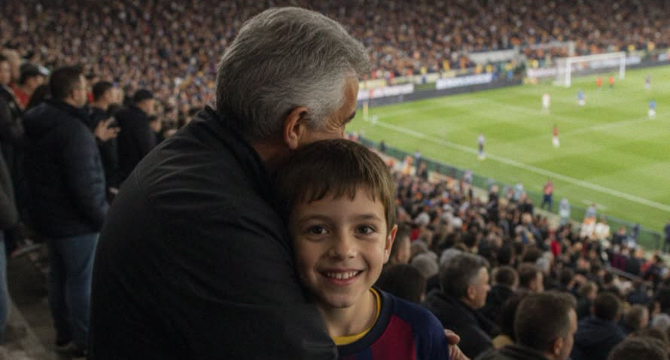
My eight-year-old grandson disappeared at a football match three days before heart surgery. When I found him, he told me he had been planning for the possibility that he might die.
Three days before my grandson’s heart surgery, he asked me for one thing.
He wanted to watch his favorite football team play.
“Just once,” Arnold said. “In the real stadium. With you.”
He was eight years old, thin from months of tests and medication, with a heart that had never worked the way it should.
He had been born with a malformed valve, and over the past year, the strain on his body had grown worse.
He would get tired easily. His lips sometimes lost their color.
He had started taking breaks halfway up the stairs, though he always pretended he had stopped because he had forgotten something.
The surgery was supposed to repair the valve before the damage became permanent.
His doctor called it necessary.
He also called it high-risk.
I had raised Arnold since he was two.
My daughter, Grace, died in a car accident, and Arnold’s father had disappeared before he was born.
From the day I brought that grieving little boy into my house, it had been the two of us.
I was his grandmother, legal guardian, emergency contact, cook, driver, nurse, and the person who checked five times each night to make sure he was still breathing.
I wanted to say no to the match.
Thirty thousand people, long lines, noise, stairs, and germs.
Too many ways for something to go wrong so close to surgery.
But Arnold looked at me with those serious brown eyes and said, “I don’t want my last good memory before the hospital to be boring.”
So, I gave in.
The morning of the match, sunlight came through the kitchen window in soft yellow bands.
I had laid his blue jersey across a chair the night before, but Arnold came downstairs already wearing it.
He held the tickets against his chest like they were official documents.
“Grandma, we need to leave.”
He stared at me.
“The match starts in four hours, and there could be traffic.”
He was being very impatient, and I let him.
“What if we lose the tickets?”
“They are on my phone.”
“What if your phone breaks?”
“I printed copies.”
He stared at me.
I lifted an envelope from the counter.
“And I printed copies of the copies.”
That finally made him smile.
I stirred his oatmeal while he sat at the table, tapping one foot beneath his chair.
“Eat slowly,” I said. “Your doctor said today is not the day to upset your stomach.”
“Tuesday is the big day. Today is just about football.”
“Every day with you is a big day.”
He rolled his eyes, but the corner of his mouth lifted.
We left just after noon. During the drive, Arnold recited the starting lineup, predicted the score, and explained why the manager’s latest formation was “a complete tactical disaster.”
“You’re eight,” I said. “How do you know the word tactical?”
“Because I study the sport.”
“You watch men shout on television.”
“That is studying.”
He talked almost the entire way. I let him.
Sick children often become experts in worlds where their bodies do not limit them.
Arnold knew every player, every injury, and every goal from the past three seasons.
When he spoke about football, he did not sound like a boy waiting for surgery.
He sounded like someone with years ahead of him.
We parked in the accessible lot and moved slowly toward the stadium.
I kept one hand on his shoulder through the crowd.
Just before the security gates, Arnold stopped.
He slipped his hand into mine, the way he used to when he was small.
“Grandma?”
“What is it?”
“If you can’t find me right away today, don’t panic.”
I looked down at him.
The joy had vanished from his face.
“What did you say?”
“Nothing.”
“Arnold.”
“It was a joke.”
“That was not a joke.”
He squeezed my hand. “I just mean it’s crowded. People get separated.”
“We are not getting separated.”
“I know.”
“Are you feeling dizzy?”
“No.”
“Chest pain?”
“No.”
“Do I need to call your doctor?”
He groaned. “Grandma, I am fine.”
I knelt in front of him.
“Then promise me you will stay beside me.”
He hesitated.
It lasted less than a second, but I felt it.
“Promise.”
“I promise,” he said.
I should have pressed harder.
Instead, I let the crowd carry us through the gates.
For the first half of the match, Arnold was happier than I had seen him in months.
He shouted chants with strangers. He complained about the referee.
He stood for a goal even though I kept a hand behind his back in case his legs gave way.
When our team scored, he threw both arms around me.
“They heard you,” I said.
“Who?”
“The players. I told you they would behave if your grandmother were watching.”
“That is not how football works.”
“They scored, didn’t they?”
He shrugged, and we continued watching the game.
Just before the halftime whistle blew, the team my grandson was supporting scored a goal.
However, even before we could celebrate, the referee disallowed the goal, claiming it was offside.
Chaos broke out, the whistle was blown, people started arguing, and left the stands.
I reached out for Arnold’s hand so we could grab some drinks before the game refused and he wasn’t beside me.
Arnold was gone.
At first, I did not understand what I was seeing.
There was an empty space where he had been.
“Arnold?”
I started walking away from the stands.
Blue jerseys moved in every direction.
“Arnold!”
There was no answer.
I pushed toward the concession stand, searching for his small head among hundreds of adults.
My heart began to pound.
I checked beside the counter, the restroom entrance, and the stairwell.
He was nowhere to be seen.
I approached an usher, grabbed his hands, but no words seemed to come out of my mouth.
“Ma’am, are you all right?”
“My grandson is missing.”
He took out a radio. “How old?”
“Eight. He is in a blue jersey and has brown hair. He has a heart condition, looks fragile, and walks slowly.”
The usher’s expression changed.
“Stay here.”
“I am not staying anywhere.”
Another staff member arrived. They asked for Arnold’s full name, his height, and what he was wearing.
I answered while moving, looking over their shoulders, and calling his name.
The crowd noise pressed against me.
Music blasted through the stadium.
People laughed and carried food back to their seats while my entire life disappeared inside a building with lots of exits.
His words at the gate returned to me.
If you can’t find me right away today, don’t panic.
He had planned this.
That realization frightened me more than the crowd.
Minutes passed as we searched.
Maybe it was five. Maybe it was fifteen. I could not tell.
Time became one long, sickening moment.
I searched every face.
Then a security guard near the far end of the concourse raised his hand.
“Rose?”
I ran.
He pointed toward a quieter seating area near the first-aid station.
Arnold was sitting on a bench.
A young woman sat beside him.
Her hand rested near his shoulder, not touching him, but close enough that my fear turned instantly into fury.
“Arnold!”
He jumped up.
I reached him and pulled him against me so hard he gasped.
“Grandma, I can explain.”
“What were you thinking?” I gripped his shoulders. “Do you understand what you did? I thought you had collapsed. I thought someone had taken you.”
“I’m sorry.”
“Who is she?”
The young woman stood. She looked about 30, with dark hair pulled into a loose knot and a canvas bag tucked beneath one arm.
She appeared frightened.
Good, I thought. She should be.
“Rose,” she began, “I believed you knew I was coming.”
“You know my name?”
Arnold caught my sleeve.
“Grandma, please.”
I looked down at him. His eyes were wet.
“Please don’t blame her,” he whispered.
The anger left me so quickly that I almost lost my balance.
“Blame her for what?”
He looked toward the woman.
“Her name is Miriam.”
“How do you know her?”
“From the hospital.”
My stomach tightened.
Arnold lowered his voice.
“She’s my pen pal.”
I stared at him.
The hospital offered several support programs for children waiting for surgery.
Months earlier, I had signed a stack of forms while half-listening to a coordinator explain art groups, supervised letter exchanges, and family counseling.
I remembered Arnold bringing home colorful envelopes.
I had assumed he was writing to another child.
I looked at Miriam.
“You’re an adult.”
“Yes.”
“And you’ve been writing to my grandson?”
“Every letter went through Nurse Deborah,” she said. “They were read and approved before either of us received them.”
“Did the hospital tell you he was eight?”
“Of course.”
“Do they know that you are here for a private meeting?”
Her face changed.
“Arnold wrote that you knew.”
I turned to him.
He looked down.
“Did you tell her I knew?”
He nodded once.
“Why?”
“Because she wouldn’t come otherwise.”
Miriam stepped back. “The moment I realized you weren’t expecting me, I told him we needed to find security.”
“Then why was he sitting here?”
“He became short of breath. I took him to the first-aid station.”
I looked at Arnold’s face. His cheeks were pale.
Fear replaced anger.
“Are you having pain?”
“No. I ran.”
“You ran?”
“Only a little.”
I crouched in front of him and pressed my palm to his cheek.
“Why would you do this?”
His chin trembled.
“Because I needed you to meet her before Tuesday.”
“Why?”
He looked at Miriam again.
She closed her eyes as if she already knew what he was going to say.
Arnold took both my hands.
“Because if I don’t wake up after surgery, I don’t want you sitting by yourself.”
For a moment, the stadium disappeared.
There was no crowd. No music. No match.
Only my grandson’s small hands, gripping mine.
“Arnold,” I whispered.
“Miriam knows what it’s like.”
I looked up at her.
Her face had gone pale.
“What does that mean?”
She swallowed.
“My son, Danny, had the same heart condition.”
The answer came quietly.
“He died during surgery three years ago.”
I sat beside Arnold because my legs would no longer hold me.
He leaned against my arm.
“I wrote to her because Nurse Deborah said she helps kids who are scared,” he said. “But then she told me about Danny, and I thought she could help you too.”
“You are not supposed to arrange help for me.”
“You never ask anyone for help.”
“I am the adult.”
“Adults can feel alone and scared, too.”
His voice cracked on the last word.
I covered my mouth.
All those nights I had stood outside his bedroom trying not to cry.
All those mornings I smiled over breakfast. All the appointments where I had told doctors, nurses, and Arnold that I was fine.
I thought I had hidden my fear.
Arnold had seen every piece of it.
Miriam spoke gently.
“I am sorry. I should have confirmed the meeting with you. I would never have agreed if I knew he was keeping it secret.”
I believed her, but I was not ready to forgive anyone yet.
I stood and took Arnold’s hand.
“We are going home.”
He did not argue.
We missed the second half of the match.
Neither of us spoke during the drive.
That evening, I called Nurse Deborah.
She listened without interrupting while I described the secret meeting, Arnold disappearing, and Miriam believing I had approved it.
When I finished, she let out a slow breath.
“Rose, I am very sorry. The letters were supervised, but the meeting was not arranged through us. Arnold mentioned wanting you and Miriam to meet. I told him it would need to happen with your permission.”
“He lied to her.”
“It appears so.”
“Why was an adult matched with him in the first place?”
“Our program includes former patients and bereaved parents. You signed consent for Arnold to exchange monitored letters with a family mentor. Miriam was selected because Danny had the same diagnosis.”
I remembered the forms.
I had signed them after a 10-hour hospital day, trusting that nothing important could hide beneath so much paper.
“Did you know he was afraid he might die?”
There was a pause.
“Yes.”
My throat tightened.
“Why didn’t you tell me?”
“We encouraged him to speak to you. He said you became frightened whenever he mentioned the possibility.”
I wanted to deny it.
Then I remembered every time Arnold had asked what would happen if the surgery failed.
I had always interrupted him.
“Don’t talk like that.”
“You’re going to be fine.”
“We are thinking positively.”
I had mistaken silence for comfort.
The next morning, I called Miriam.
We met at a coffee shop near the hospital. She was already there, both hands wrapped around a mug.
“I am sorry,” she said as soon as I sat down.
“I know Arnold misled you.”
“I still should have called the hospital and asked them to contact you.”
“Yes. You should have.”
She accepted that without defending herself.
I asked her about Danny.
Her face softened.
“He was six. Loud, stubborn, and completely uninterested in football. He loved dinosaurs and hated mashed potatoes.”
Then Miriam’s eyes filled.
“The surgery was meant to save him,” she said. “There were complications. Afterward, I spent months angry at everyone. The doctors, myself, and other parents whose children survived.”
“I am sorry.”
“So am I.”
I looked toward the window.
“Arnold said you know how to survive losing a child.”
Miriam was quiet.
“You don’t survive it all at once,” she said. “You survive breakfast. Then noon. Then the hour after that. Eventually, you realize you have lived through another day.”
My eyes burned.
“He should not know enough to worry about that.”
“No.”
“He should be thinking about school and football.”
“No child should have to plan for the people they might leave behind.”
I wiped my face.
“He asked you to come to the hospital?”
“Yes. I told him I would only come if you asked me.”
I looked at her.
“I am asking.”
On Tuesday morning, Miriam met us in the surgical waiting area.
Before the nurses took Arnold away, he looked at me.
“You won’t be alone?”
I took his face between my hands.
“I will not be alone. But you are coming back to me. Do you understand?”
He nodded.
“I love you, Grandma.”
“I love you more.”
The doors closed behind him.
The surgery lasted seven hours.
During the fourth hour, a nurse told us there had been a delay.
She would not explain more. I thought my body might break apart from fear.
Miriam sat beside me.
She did not tell me to calm down. She did not promise everything would be fine.
She simply held my hand.
When my grandson’s doctor finally entered the waiting room, his surgical cap was still on. His face looked exhausted.
I stood so fast that my chair fell backward.
“He’s alive,” he said.
Miriam and I hugged warmly.
“The repair was successful,” he continued. “There were complications, but he is stable. Recovery will be difficult, but right now, he is doing very well.”
I cried into Miriam’s shoulder.
She cried too.
Several weeks later, when Arnold was strong enough to walk outside for more than a few minutes, the three of us visited Danny’s grave.
Arnold placed his football scarf across the stone.
Miriam looked at me.
I took her hand.
My grandson had frightened 10 years off my life, lied to two adults, disappeared in a stadium, and nearly stopped my heart before his surgeons ever touched his own.
But he had also understood something I had refused to admit.
Strength was not the same as standing alone.
Sometimes love meant letting someone sit beside you in the waiting room.
And sometimes the bravest person in the family was an eight-year-old boy who knew exactly who his grandmother would need if he could not come home.

 admin
admin