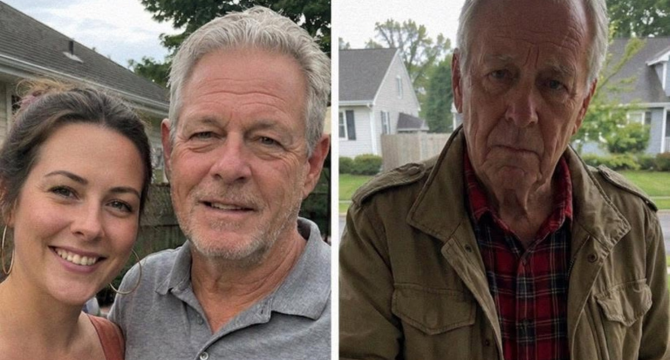
My earliest memory of my father isn’t something he said.
It’s waiting.
I was five years old, sitting on the front porch with a paper crown I’d made for Father’s Day. My teacher had helped me glue cotton balls around the edges because she said every king deserved a crown.
I wanted to give it to my dad.
My earliest memory of my father isn’t something he said.
Every few minutes, I asked my grandmother if his truck had turned onto our street.
She’d look through the curtains before answering.
“Not yet, sweetheart.”
The sun went down before I finally carried the crown inside. The next morning, I left it outside his bedroom door before school.
When I came home, it was gone. Dad never mentioned it.
“Not yet, sweetheart.”
My name is Emily. I’m 31 years old, and I spent most of my life believing I’d somehow been born difficult to love.
My father, Alex, never yelled at me. He never scolded me. His absence was quieter than that, which somehow hurt more.
He remembered my cousins’ birthdays. He mailed graduation checks. He paid toward their college tuition and displayed their photographs around his house.
There wasn’t a single picture of me.
His absence was quieter.
I kept telling myself the next birthday would be different. The next Christmas. The next school play. There was always a next time until one day there wasn’t.
When I graduated high school, I searched the crowd until almost every folding chair sat empty. Families hugged, flowers changed hands, and the seat I’d secretly hoped he’d occupy remained bare in the afternoon sun.
Still, I made excuses.
Maybe work ran late.
Maybe Dad forgot.
Maybe next time.
Maybe Dad forgot.
The breaking point came on my wedding day.
Six weeks before the ceremony, Dad called right after I texted him.
“I’ll be there.”
“You promise?”
“I promise.”
For the first time in years, I believed him.
“I’ll be there.”
On the morning of the wedding, I stood in the church vestibule with my bouquet trembling in my hands while the coordinator checked the parking lot twice. Finally, my uncle touched my shoulder.
“Sweetheart,” he said softly, “I can walk you down.”
Halfway down the aisle, I looked toward the church doors one last time.
They never opened.
“I can walk you down.”
A week later, the phone calls started.
“Emily,” my aunt said sharply, “how could you embarrass your father like that?”
I stared at the phone. “What are you talking about?”
“He said you asked him not to come.”
I laughed because the alternative was crying.
“He said you asked him not to come.”
According to my father, I’d chosen another man to walk me down the aisle because I no longer considered him part of my life.
That lie hurt more than his absence ever had.
I stopped calling him.
He never called me either.
Two years passed. My husband and I welcomed our daughter, Sophie. My father never met her.
I stopped calling him.
Then one afternoon, an elderly man knocked on our front door holding a worn leather journal against his chest.
“My name is Harold,” he said gently. “I knew your father.”
I almost closed the door.
“He asked me to bring this to you,” Harold continued, holding out the journal. “But only after you stopped waiting for him to apologize.”
“He asked me to bring this to you.”
Something inside me tightened.
“I don’t understand.”
“He said his words would mean more once you no longer needed them.”
I took the journal without thanking him.
After Harold left, I set it on the kitchen table and stared at it for nearly an hour. My husband found me there after work.
“I don’t understand.”
“You don’t have to read it today, Em.”
“I know.”
I opened it anyway.
The first page held only one sentence.
“If you’re reading this, then I’ve finally run out of excuses.”
I almost closed it.
Instead, I turned the page.
I almost closed it.
The next entry wasn’t about my late mother or the day I was born.
It was about my seventh birthday.
“You probably remember waiting for me that afternoon. I remember it too.”
My breath caught.
“You wore a yellow dress with white flowers. I knew because I drove past your grandmother’s house three times before work. You were standing on the porch holding a balloon almost as tall as you were.”
It was about my seventh birthday.
I frowned.
That couldn’t be right.
I remembered waiting. I remembered the balloon. I remembered staying with Grandma.
I did not remember seeing Dad.
“I bought you a music box with a tiny ballerina inside. It’s still wrapped in blue paper because I never found the courage to knock.”
I shut the journal.
“No.” The word slipped out before I could stop it.
That couldn’t be right.
My husband looked up from the living room. “You okay?”
“I don’t know.”
I carried the journal into the kitchen and made coffee out of habit, then forgot to drink it. If my father had been outside, why hadn’t he come in?
A folded receipt slipped onto the table when I opened the journal again.
Gift World. One musical jewelry box. Paid in cash.
The date matched my seventh birthday.
If my father had been outside, why hadn’t he come in?
I stared at it until the numbers blurred.
The next page held my high school graduation program. My name had been circled in faded blue ink.
“You searched the audience. I know because I watched you searching.”
A lump rose in my throat as I continued reading.
“I wasn’t sitting with the families. I stood behind the last row of maple trees near the football field.”
I could picture those trees instantly.
“I watched you searching.”
As a teenager, I’d looked toward them once before giving up and facing the stage.
Dad had been there.
Close enough to see me. Too far away for me to know.
Anger flared before sadness could catch it.
“If you were there,” I whispered, “why didn’t you come to me?”
The journal answered without really answering.
Dad had been there.
“Distance becomes easier the longer you practice it,” Dad wrote. “One missed birthday becomes two. Two become ten. Eventually you stop knowing how to walk toward the person you’ve spent years walking away from.”
I read those lines three times.
They explained something.
Not enough.
Harold returned two days later with blueberry muffins and the flimsiest excuse I’d ever heard.
We sat on the back patio while Sophie slept upstairs. For several minutes, neither of us mentioned my father.
They explained something.
Finally, I asked, “Did he ever talk about me?”
Harold smiled sadly.
“Dear,” he said, looking down at his coffee, “I don’t think I’ve ever met a lonelier father.”
“That doesn’t make sense.”
“It didn’t to me either.” He nodded toward the journal on the table. “Keep reading.”
“I don’t think I’ve ever met a lonelier father.”
That night, a pressed dandelion fell from the next section, fragile enough to crumble in my palm. A tiny note had been taped to the back.
Emily, age six. She picked this because she said yellow was Mommy’s favorite color.
I remembered that dandelion.
I’d handed it to my father after kindergarten. He had tucked it into his shirt pocket and walked away, and I had assumed he threw it out before reaching the driveway.
Instead, he had carried it for years.
I remembered that dandelion.
After that, the journal revealed a pattern I had never seen.
He came.
He watched.
He left.
On my first day of middle school, Dad parked across from the bus stop before sunrise. When I earned my nursing degree, he waited until everyone left the auditorium, then placed white lilies beside my car because my mother had loved them.
The journal revealed a pattern I had never seen.
No card.
No signature.
Only distance dressed up as restraint.
By the time I reached the section titled The Wedding, my hands were trembling.
A parking receipt slipped from between the pages.
St. Mark’s Church.
9:12 a.m.
The exact morning I married Daniel.
Beneath it was something folded into quarters.
A parking receipt slipped from between the pages.
I recognized the construction paper before I opened it.
A crooked yellow sun. Two stick figures holding hands. Across the top, in uneven childish handwriting, were the words: Me and Daddy Forever.
Tears splashed onto the page.
“I bought a navy-blue suit,” Dad wrote. “I practiced walking you down the aisle in my living room because I wanted to get every step right. I arrived before your guests.”
Tears splashed onto the page.
I pressed my fingers to my mouth.
“Then I sat in the parking lot holding your drawing. I watched people carrying flowers into the church. I watched your husband arrive. I watched your uncle.”
The next sentence shattered me.
“When the music began, I realized I still believed the greatest gift I could give you was one day untouched by the man who had already taken your mother away.”
I closed my eyes.
The next sentence shattered me.
No.
Please, no.
Dad had stayed in his truck until the ceremony ended.
Not because he didn’t love me.
Because he believed I deserved better than him.
Then came the page I had feared without realizing it.
“Relatives asked why I hadn’t been there. I couldn’t admit that fear had defeated me again, so I told one lie. I said you had asked me not to come.”
Then came the page I had feared.
The next line was darker.
“The greatest cowardice of my life was allowing my daughter to carry the blame for my own shame.”
I cried so hard I could barely see the ink.
But one question remained.
Why? Why had he spent 31 years believing he deserved to lose me?
The answer waited on the next page.
Why had he spent 31 years believing he deserved to lose me?
It began with six words.
“This is where I broke myself.”
Dad wrote about the morning my pregnant mother woke him before sunrise because something didn’t feel right. She was weeks early, frightened, and still apologizing for complaining while he helped her into his truck.
Halfway to the hospital, she began bleeding.
The highway would have been safer, but longer. In his panic, my father took the winding county road because he believed it would save precious minutes.
“This is where I broke myself.”
Rain had already started.
“I rounded a curve too fast,” he wrote. “The truck slid. I remember the sound before I remember the impact.”
There were no excuses in the pages that followed.
Only truth.
“You survived. Your mother lived long enough to tell me your name. She never came home.”
I closed the journal and pressed it against my chest.
“She never came home.”
My husband found me sitting on the bedroom floor almost an hour later. He didn’t ask what I’d read. He simply sat beside me until I finally whispered, “He never forgave himself.”
The next evening, I finished the journal.
“Everyone told me it wasn’t my fault,” Dad penned. “The police. The doctors. Your grandparents. Eventually even my pastor. I believed every one of them until I looked at you.”
My heart ached.
“Everyone told me it wasn’t my fault.”
“Every time you smiled, I saw the woman who should have been smiling beside you. Every birthday reminded me she never had another one.”
Then came the line that changed everything.
“You mistook my distance for the absence of love. The truth is, I never learned the difference.”
The final pages were confessions, not excuses.
Dad admitted that every Father’s Day card I slid beneath his bedroom door had been collected and stored inside an old cedar box. He couldn’t throw them away. He couldn’t bring himself to answer them either.
The final pages were confessions, not excuses.
Near the end, his handwriting weakened.
“Harold keeps telling me to call you. He’s right. I keep telling him tomorrow.”
Another page.
“Tomorrow has become 31 years.”
The last entry stood alone.
“Please don’t forgive me because I’m gone. Forgive me only if one day remembering me hurts a little less than missing the father I should have been.”
“Please don’t forgive me because I’m gone.”
And beneath that:
“I loved you every day of your life. I simply never believed I deserved to let you see it.”
For the first time in years, I wasn’t angry.
I was heartbroken.
A week later, I invited Harold and several relatives to dinner, including the aunt who had blamed me after my wedding. When someone quietly mentioned my father, I placed the journal on the table.
For the first time in years, I wasn’t angry.
“I want to read something.”
No one interrupted.
I found the page I’d marked and read aloud.
“The greatest cowardice of my life was allowing my daughter to carry the blame for my own shame.”
The room went silent.
“I want to read something.”
My aunt covered her mouth with trembling fingers.
My uncle whispered, “Emily… we were wrong.”
One by one, they apologized.
I didn’t defend my father. I didn’t condemn him either.
I simply closed the journal and said, “Guilt is a terrible place to build a family.”
No one argued.
One by one, they apologized.
A few days later, my husband drove me to the cemetery.
For the first time, I visited both of my parents together. My mother’s grave sat only a few steps from my father’s, fresh flowers resting between them.
I placed the journal on the grass.
“I spent my whole life believing you didn’t love me,” I whispered.
The trees moved softly above us.
“Now I know you loved me every day. You just never believed you deserved to.”
“I spent my whole life believing you didn’t love me.”
As we walked back to the car, my husband slipped his hand into mine.
For the first time since I was a little girl waiting on the porch with a paper crown, I no longer looked over my shoulder, hoping my father would finally arrive.
His apology came too late to change my childhood.
But it gave me the truth I had spent 31 years searching for.
I had never been difficult to love.
The man who loved me simply never learned how to forgive himself.

 admin
admin