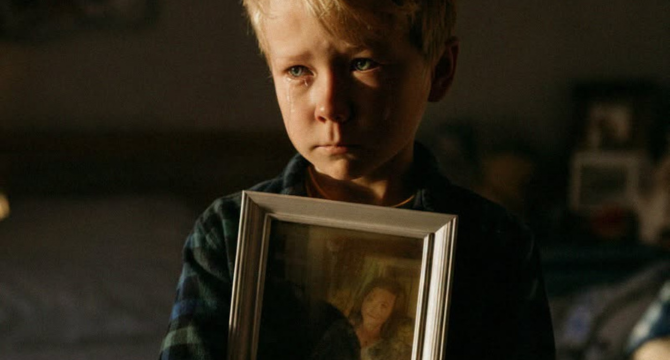
My mother died on a Thursday in February, three years before this story begins.
I was nine years old. I know the day of the week because I have thought about it many times since, the way you return to specific details when the larger thing is too big to hold all at once. Thursday. February. The smell of the hospital hallway. My dad’s hand around mine, squeezing too hard without seeming to realize it.
Her name was Diane.
She loved crossword puzzles, old movies, and making things with her hands — sewing, knitting, and small craft projects that covered the kitchen table on weekends and produced things that filled our home with a particular warmth.
She had been making quilts since before I was born.
There were several around the house, each one different, each one assembled from fabric she had chosen with specific care.
The one she made for me was the last thing she finished before she got too sick to sit at the table.
I was in the room when she completed it.
She had been working on it for weeks, during the period when she was still well enough to do things but tired more quickly than she used to.
It was blue and green with patches of yellow, and some of the fabric I recognized from old clothes, like a piece of a shirt I had loved and outgrown and a square from a dress she used to wear on summer evenings.
“This is yours,” she said, spreading it across my bed. “For keeping.”
“It’s really good, Mom,” I told her.
“I should hope so,” she said, smoothing the edges with both hands. “I put enough hours into it.”
She died six weeks later.
After that, the quilt was the thing I held onto most literally and most completely.
Every night, without exception, I slept under it.
It went with me when we visited my grandmother.
It came to the hospital twice when I had minor procedures and needed to stay overnight.
My dad never questioned it. He understood, I think, without either of us needing to say it, that the quilt was not a blanket in the conventional sense.
Meanwhile, my stepmother, Sandra, did not understand this.
Or she understood it and disagreed with the conclusion.
Sandra had been in our lives for about 18 months by the time this happened.
She and my dad had met through mutual friends and dated for a year before getting married. Honestly, she was not, in most ways, a bad person.
She was organized, and she genuinely tried to take care of the household in practical ways.
What she was not good at was the unscheduled work of caring for a grieving 12-year-old who kept his dead mother’s quilt on his bed.
She made comments about it early on.
There were small ones at first.
“That blanket is getting quite worn,” she said once, after she had done laundry and put it back on my bed. “The edges are fraying.”
“I know,” I nodded. “It’s fine.”
“I could get you a new one,” she offered. “Something warmer.”
“I don’t need a new one,” I said.
“It’s just a blanket, Noah,” Sandra said gently. “Your mom wouldn’t want you clinging to something that’s falling apart.”
“Maybe,” I replied. “But she made this one.”
Sandra folded her arms. “You can remember her without sleeping under the same quilt every night.”
“Maybe you can,” I said quietly. “I can’t.”
She looked at me for another second as though she wanted to argue, then simply sighed and walked away.
I talked to her very politely because my dad had asked me to try, and I was trying.
Another time, she came into my room while I was doing homework.
She looked at the quilt folded at the foot of my bed and said, “You know, it’s okay to move on, sweetheart. Holding onto things doesn’t always help.”
I looked at her for a moment and then looked back at my homework.
“Thanks,” I said, which was the most neutral thing I could find.
My dad was aware of the tension, but he hadn’t yet figured out how to address it.
He told me once, quietly, that Sandra meant well and was still figuring out how to be in our lives. I nodded and said I knew, which was not entirely true but felt like the right thing to say.
The quilt remained on my bed.
I assumed that was settled.
I came home from school on a Wednesday in October to a house that felt slightly different in a way I couldn’t immediately locate.
I went upstairs, dropped my bag, and turned toward my bed.
That’s when it hit me.
The quilt was gone.
I stood very still for a moment.
Then I looked around the room.
I thought maybe Sandra had washed it and it was drying somewhere.
I checked the hallway. I checked the linen closet. I checked the bathroom, the landing, and the spare room.
NOTHING.
Then, I went downstairs.
Sandra was in the kitchen, unloading the dishwasher, and she looked up when I came in, with what I can only describe as the expression of someone prepared for a reaction.
“Have you seen my quilt?” I asked.
She barely looked up.
“Oh, that old thing?” she said. “I threw it away.”
The kitchen went completely silent.
“You threw it away,” I repeated.
“It was falling apart,” she said. “The edges were fraying, and there was a tear along one side. I’ve been meaning to replace it for weeks. There’s a new blanket on your bed — I put it there this morning.”
“You knew that quilt was my mom’s,” I said.
“She made it for me,” I continued. “Before she died. That was the last thing she gave me. The last memory I have of her.”
“I know,” Sandra said, and her tone had the quality of someone who considered that information to have already been weighed and concluded. “And I know it meant a lot to you. But it was in bad condition, and at some point you have to—”
“Which trash?” I interrupted. “Where did you put it?”
“The collection was this morning,” she said. “It’s already gone.”
I couldn’t believe that.
I couldn’t believe my stepmother could do something like that.
I do not have a clear memory of getting from the kitchen to my dad’s home office, which is where he worked on Wednesday afternoons.
I know I ran. I know I was crying before I reached the door, which I pushed open without knocking.
He looked up from his screen, and his expression changed immediately. “Hey — what happened?”
“Sandra threw away Mom’s quilt,” I said.
He was already standing. “She what?”
“She threw it away. She said it was old and falling apart, and the trash already came.” I pressed the back of my hand against my mouth for a moment. “Dad, Mom hid it there.”
He stared at me. “What do you mean she hid it there?”
“Inside the quilt,” I said. “Mom put letters inside it. Before she died, she told me… she told me she had put things in there for me. For when I was older. For different things that would happen.” I was talking too fast, and I could hear it, but I couldn’t slow down. “Birthdays and graduations and… she said there were letters for all of it. She said when I needed her, I should look inside the quilt.”
My dad looked terrified. He sat back down in his chair very slowly, like his legs had made the decision independently.
“She told you this?” he asked.
“Right before she went back to the hospital the last time,” I said. “She made me promise not to tell anyone because she said it was between her and me. I never told you because I wasn’t ready to open them yet. I was saving them.” My voice broke on the last word. “I was saving them for when I really needed them.”
My dad put his face in his hands.
After a moment, he looked up. “How long ago did the truck come?”
“Sandra said this morning.”
He was already on his phone.
“Go get your coat,” he said. “We’re going to the depot.”
I will not make the next part of the story more dramatic than it was, because what it actually was — two people searching through a municipal waste depot for three hours on a Wednesday afternoon — was unglamorous and exhausting and smelled terrible and was also, in its own way, one of the most important things my father has ever done for me.
He called the waste management company before we left, explained the situation to three different people, and was eventually given the name of a supervisor who agreed to let us search the area where our street’s collection had been offloaded before processing.
We went in old clothes with gloves the supervisor gave us, and we went through bags in a systematic way that my dad organized quietly and efficiently.
I followed his lead because he was holding himself together in a way that I understood was for my benefit.
Every few minutes, Dad glanced at me.
“You doing okay?” he asked.
I nodded even though neither of us believed it.
“Your mom would’ve laughed if she’d seen us digging through garbage for one of her quilts,” he said with a tired smile.
“She would’ve told us exactly where to look,” I answered.
He smiled a little wider and kept searching.
We found it in the second hour.
It was at the bottom of a larger bag, wrapped around itself, the blue and green and yellow fabric recognizable even compressed and dirty.
My dad pulled it free, held it in both hands, and looked at it for a long moment without saying anything.
“Got it,” he said.
His voice was rough.
I just smiled at him.
We took it home and spread it on the kitchen table.
Then, we went through it carefully, opening the seam along the bottom edge where my mother had created a hidden interior pocket — something I had known about in the abstract but had never examined directly because I had been saving it.
Inside were envelopes, 15 of them, each one labeled in my mother’s handwriting.
“For your 13th birthday.”
“For when you graduate.”
“For when you fall in love for the first time.”
“For when someone breaks your heart.”
“For when you need to hear my voice.”
Several of them were water-damaged beyond reading.
My dad and I spread them out and went through them one by one.
We set aside what was lost and preserved what remained.
Eight survived in readable condition. Seven were gone.
My dad sat at the kitchen table and looked at the damaged envelopes for a long time.
“I’m so sorry,” he said. It was directed at me, but also, I think, at something larger than either of us.
“We got eight,” I said.
“We should have gotten 15,” he replied. “Fifteen.”
“Yeah,” I said. “But we still got eight.”
He spoke to Sandra that evening, after I had gone upstairs.
I was not in the room for that conversation, and he has never told me exactly what was said, which I respect.
What I know is that Sandra came to my room the following morning, knocked on the open door, and stood there.
“I didn’t know,” she said quietly. “About the letters. I didn’t know what I was throwing away.”
“I know you didn’t,” I replied.
She looked down at her hands before speaking again.
“I thought I was doing the right thing,” she said. “I kept telling myself that replacing the quilt would help you move forward. I convinced myself it was just an old blanket.”
I didn’t answer.
“I see now that it was never just a blanket,” she continued. “It was a part of your mom… a part of the life you had before I came here. I should have asked you before I touched it.”
“Yeah,” I said quietly. “You should have.”
Her eyes filled with regret.
“I’m sorry, Noah,” she said. “I’m genuinely sorry. If I could undo what I did, I would.”
I looked at her for a long moment. Part of me wanted to stay angry. Another part knew she hadn’t meant to destroy the last gift my mother had given me.
“Okay,” I said.
It wasn’t forgiveness exactly, not yet, but it was the beginning of the space where forgiveness might eventually grow, and I think she understood that.
I opened the first surviving letter that evening, sitting on my bed under the new blanket Sandra had left, with my dad beside me.
It was the one labeled “For when you need to hear my voice.”
My mother had written three pages in the small, slightly slanted handwriting I had not seen in three years.
She wrote about how much she loved me. She wrote about the things she hoped I would do and the person she believed I was becoming.
She wrote about the quilt and why she had made it and what she had meant by the letters inside — that she wanted to be present for the moments she knew she would miss, that she had thought about each one and written to the version of me who would be living it.
At the end, she wrote, “You will never be truly alone. I promise you that. Whatever room you are in, whatever year it is, whatever has happened — I am somewhere in the room with you. Look for me in the things that feel like home.”
My dad read it over my shoulder and didn’t say anything for a long time.
“She was something else,” he said finally.
“Yeah,” I said. “She really was.”
I folded the letter back into its envelope and put it with the others in the box my dad had found for them — a wooden box, properly sized, with a lid that closed securely.
He put it on my bookshelf where I could see it from my bed.
The quilt went back on the bed too, washed and dried, the fraying edges exactly as they had always been.
I pulled it up that night and lay under it in the dark, and I thought about my mother sitting at the kitchen table on a Sunday afternoon, smoothing the edges with both hands, knowing exactly what she was building into it.
“For keeping,” she had said.
She had meant it in more ways than I had known.

 admin
admin