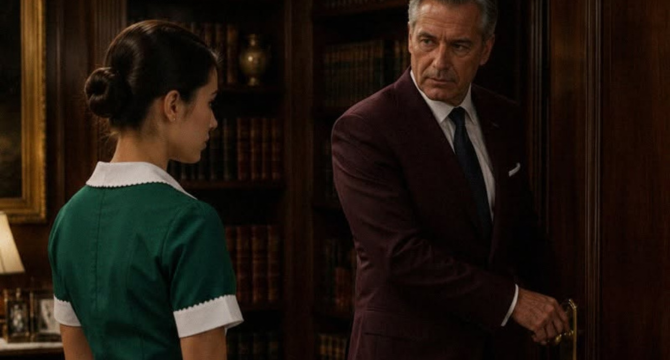
The first time the banker asked me to stay after everyone else had left, I thought I knew exactly what he wanted.
And I hated myself for it.
Not because I was naive.
I had stopped being naive long before I turned 18. You do not grow up in an orphanage, counting down the days until the system politely pushes you out, and still believe the world is gentle.
You learn to read faces. You learn to listen for tone. You learn which adults smile because they care and which ones smile because they want something.
So when Mr. Harrison’s assistant stopped me at the front door of the mansion that evening, my first thought was not that I had forgotten to clean something.
It was that I had been noticed.
I had been working as a cleaner in his mansion for almost three months. To me, it was just a job — one I desperately needed after aging out of the orphanage. The pay was good, the house was enormous, and most days I managed to stay invisible.
Invisible had always been safe.
In the orphanage, invisible meant no one blamed you when a window cracked or food went missing from the kitchen. Invisible meant no one picked you first when they wanted to mock someone. Invisible meant adults forgot to ask questions you did not want to answer.
At the mansion, invisible meant I could do my work, collect my pay, and leave without becoming part of anyone’s story.
That was all I wanted.
The Harrison estate sat at the end of a private road lined with tall iron lamps and trees that looked too perfectly trimmed to be real. The first time I saw it, I stood outside the gate for a full minute, wondering if I had misunderstood the address.
The house was not just large. It seemed built to remind everyone who entered that they were smaller than the people who lived there.
Marble floors.
Crystal lights.
Long hallways that swallowed sound.
Rooms no one seemed to use, full of furniture no one seemed allowed to touch.
I cleaned in silence and kept my head down. The other staff members taught me quickly.
“Never move anything on the banker’s desk,” one housekeeper warned me in my first week.
“Do not speak unless spoken to,” the cook added.
“And do not stare at the portraits,” the gardener said with a nervous laugh, though I did not understand why.
I followed every rule.
Mr. Harrison was rarely home during the day. He worked at one of the largest banks in the city, or so people said. When he was home, the house seemed to change around him. Staff straightened. Conversations faded. Even footsteps grew softer.
He was not cruel, exactly. At least, I had never seen him shout.
That almost made him more unsettling.
A loud man told you where danger was. A quiet man made you guess.
He wore tailored suits even at home, dark ones that made him look like he was always coming from a funeral or heading into a courtroom. His hair was silver at the temples, his posture straight, his voice calm enough to make people obey before they realized they had been ordered.
The first time he spoke to me, I was dusting the hallway outside the dining room.
“You’re new.”
I nearly dropped the cloth.
“Yes, sir.”
“What’s your name?”
“Hazel.”
His eyes stayed on my face longer than I liked.
“Hazel,” he repeated, as if testing the sound. “Who hired you?”
“Mrs. Nolan, sir. The staff manager.”
He nodded once. “Do your work carefully.”
“I will, sir.”
That was it.
A simple exchange.
Nothing strange enough to tell anyone about.
Still, I felt his gaze on my back long after I walked away.
But not to him.
More than once, I caught him watching me from across the room.
At first, I ignored it.
I told myself wealthy people watched staff the way customers watched waiters. Not with interest, but with expectation. Maybe he was checking whether I missed corners. Maybe he thought I was too young to be trusted around expensive things. Maybe he simply did not like strangers in his house.
That explanation worked for a while.
Then I started noticing other things.
He seemed to appear in rooms I had just entered.
The music room when I polished the piano.
The east sitting room when I wiped fingerprints from the glass shelves.
The second-floor corridor when I carried folded linens toward the guest rooms.
He never said anything inappropriate. That was the worst part. He did not corner me. He did not touch me. He did not even smile in a way I could point to and say, “There. That is the problem.”
He only watched.
And because he only watched, I kept questioning myself.
Maybe I was imagining it.
Maybe I was too sensitive because I had spent my childhood being moved from one room to another by adults who called it care.
Maybe I should just be grateful.
Grateful for steady work.
Grateful for meals in the staff kitchen.
Grateful that Mrs. Nolan had hired me even though my references were thin and my address was temporary.
The truth was, I needed the money too badly to run from shadows.
My tiny rented room above a laundromat cost more than it should have. My shoes had holes I covered with black marker. Every paycheck was divided before I even cashed it. Rent. Bus fare. Groceries. A little saved in an envelope under my mattress because I did not trust life to stay kind for long.
So I stayed.
I cleaned.
I avoided Mr. Harrison’s eyes whenever I could.
His wife, Mrs. Harrison, was rarely around. When she was, she floated through the house in pale clothes and expensive perfume, speaking to people without quite looking at them. She once asked me to polish a silver tray I had already polished twice.
“There are still marks,” she said.
I looked down at the tray and saw my tired face staring back at me.
“Yes, ma’am.”
She left before I finished answering.
That was how the house worked. The Harrisons gave instructions. The rest of us made sure their world stayed smooth.
By the end of my third month, I had built a routine I could survive.
Arrive before 8 a.m.
Change into my uniform.
Clean the downstairs rooms.
Eat quickly in the staff kitchen.
Avoid questions.
Avoid mistakes.
Avoid him.
Then came the evening that changed the shape of everything.
It had rained all afternoon, the kind of rain that made the windows look like they were crying. By 6 p.m., the sky outside had turned a heavy blue-gray, and most of the staff were eager to leave.
The cook wrapped leftovers in foil.
The gardener shook water from his jacket.
Mrs. Nolan checked the final list and reminded me to lock the supply closet before I left.
I was tying my coat belt at the door when Mr. Harrison’s assistant appeared.
His name was Calder. He was thin, sharp-faced, and always carried a leather folder pressed against his side like a shield. He looked at me, then past me, then back again.
One evening, after the rest of the staff had gone home, his assistant stopped me at the door.
“Mr. Harrison would like to speak with you in the library.”
For a second, I thought I had misheard him.
“The library?” I asked.
Calder’s expression did not change.
“Yes.”
“Did I do something wrong?”
“I was only asked to deliver the message.”
His voice had no warmth in it, but I thought I saw something flicker in his eyes. Pity, maybe. Or warning.
My stomach tightened immediately.
The house was empty. His wife was away. The servants had left.
And now the two of us were alone.
I looked toward the dark hallway that led to the library. I had cleaned that room dozens of times, but never at night. During the day, it was impressive. Shelves from floor to ceiling. A heavy desk. A fireplace large enough to warm a small chapel. A locked cabinet filled with old books and framed documents.
At night, it felt like a place where secrets went to breathe.
“I should go,” I said quietly. “My bus comes soon.”
Calder lowered his voice. “It would be better not to keep him waiting.”
That sentence settled over me like cold dust.
Not a threat.
Not exactly.
But close enough.
I thought about my rent. I thought about the envelope under my mattress. I thought about Mrs. Nolan telling me there were girls waiting for work who would gladly take my place.
Then I nodded.
“All right.”
Calder stepped aside.
Each step toward the library felt longer than the last. The hallway lamps glowed softly against the polished wood. My reflection moved beside me in the dark windowpanes, pale and frightened, and I hated that I looked so young.
At the library door, I paused.
My hand felt damp against the handle.
I told myself to breathe.
I told myself I was not a child anymore.
I told myself rich men could not just take whatever they wanted because the world had rules.
Then I remembered how often the world ignored its own rules.
I knocked once.
“Come in,” Mr. Harrison said from inside.
When I entered the library, he closed the door and stood there silently for several seconds.
The click of the latch sounded too loud.
He was standing near the fireplace, still dressed in his dark suit, one hand resting on the back of a leather chair. The room smelled faintly of smoke, paper, and rain. A lamp on the desk cast a warm circle of light, but the corners of the library stayed dim.
I kept my hands clasped in front of me.
“You wanted to speak with me, sir?”
He did not answer right away.
Instead, he studied me.
Not like a man looking at a cleaner.
Not like an employer about to discuss a broken vase or a missing key.
His expression was different. Strained. Almost afraid.
That frightened me more than anything else had.
Because powerful men were not supposed to look afraid.
“Hazel,” he said.
My name sounded heavier in his voice than it should have.
“Yes, sir?”
He took one step closer.
I forced myself not to move back.
His eyes searched my face, and for one terrible moment, I thought he was looking for permission.
Then he looked me straight in the eyes and whispered five words that made my knees go weak.
“I know who you are.”
The words did not land all at once.
They seemed to hang between us, quiet and impossible, as the rain tapped against the library windows. For a moment, I simply stared at him, waiting for my mind to make sense of them.
Then fear rushed in.
“What does that mean?” I asked.
Mr. Harrison’s face tightened. “Hazel, please sit down.”
“No.”
My voice came out sharper than I expected.
I stepped back, my hand searching for the door behind me. “You don’t get to close me in here and say something like that.”
He raised both hands slowly, like I was some frightened animal he did not want to scare.
“I’m not going to hurt you.”
I almost laughed. “That’s what people say right before they do.”
Pain crossed his face.
Real pain.
For the first time since I had started working in that house, he did not look like the banker everyone obeyed. He looked like an old man carrying something heavy.
“I deserved that,” he said quietly.
My fingers found the doorknob, but I did not turn it.
“Tell me what you mean.”
He looked toward the desk. On it sat a worn envelope, a small silver locket, and a photograph turned face down.
“I should have told you differently,” he admitted. “I have practiced this conversation a hundred times, and now that you’re here, I have made a mess of it.”
I swallowed hard. “What conversation?”
He picked up the photograph with trembling fingers and held it out.
I did not move.
“Please,” he said. “Just look.”
Every instinct told me to leave. But something in his voice stopped me. Not power. Not command.
Grief.
I took the photograph.
It was old and faded around the edges.
A young woman stood near a fountain, laughing at whoever held the camera. She had dark curls, a small chin, and eyes I knew because I saw them in the mirror every morning.
My breath caught.
“Who is she?”
Mr. Harrison’s voice broke slightly. “Her name was Serena.”
Was.
The word scraped through me.
“She’s dead?”
He nodded. “She passed away years ago.”
I stared at the photograph until the woman’s face blurred. “Why are you showing me this?”
“Because she was your mother.”
The room tilted.
“No.”
“Hazel.”
“No,” I repeated, louder this time. “You don’t get to say that. You don’t even know me.”
“I do.”
“You watched me for three months like I was some puzzle on your floor,” I snapped. “You scared me. You made me feel like I was doing something wrong just by being here.”
His eyes filled, but he did not look away.
“I know,” he murmured. “And I am ashamed of that.”
I gripped the photograph so tightly it bent in my hand.
“My mother left me at an orphanage,” I said. “That’s all I know. No name. No family. Nothing.”
“She didn’t leave you because she didn’t love you.”
The sentence struck something raw inside me.
“Don’t.”
“She loved you more than anything.”
“Stop.”
“She was young,” he continued, his voice soft but urgent. “We both were. Back then, we were struggling financially. I had no position, no family support, and no way to provide the kind of life you deserved. Serena tried. She tried harder than anyone I have ever known.”
My throat tightened despite myself.
“She had no choice,” he said. “She placed you in an orphanage in another city because she thought it was the only way you might be fed, clothed, and safe.”
Safe.
That word almost broke me.
“Safe? Really?” I whispered. “Do you know what safe looked like for me? Safe was sleeping with my shoes under my pillow so no one would steal them. Safe was hiding birthday cupcakes because older kids took them. Safe was learning not to cry too loudly because nobody came anyway.”
His hand covered his mouth.
I saw his shoulders shake once.
“I didn’t know,” he said.
“No,” I replied. “You didn’t.”
Silence stretched between us.
Then I looked at him again, and the question I had not wanted to ask forced its way out.
“And you? Where were you?”
He closed his eyes.
“I didn’t know at first.”
My laugh was bitter. “Of course.”
“She left before she told me. We had argued. I was proud, angry, and useless. By the time I found her again, you were gone, and she was sick.”
I looked down at the photograph.
Serena’s smile seemed too alive for someone I had never been allowed to know.
“Years later,” he went on, “when I was older and more stable, I tried to find my daughter. I hired investigators. I searched records. I visited offices that treated me like a nuisance. I followed leads that ended nowhere. Despite all my efforts, I was never able to track you down.”
“Then how did you find me now?”
His gaze moved to the locket on the desk.
“When Mrs. Nolan hired you, I saw your file. Your birthday. The city where you grew up. Then I saw you.” His voice thinned. “You have Serena’s eyes.”
I wanted to hate him.
It would have been easier if I could hate him cleanly. But he stood there with his perfect suit and broken expression, and I saw something I had not expected.
Regret.
Not the kind people perform when they want forgiveness.
The kind that has been living inside them for years.
I set the photograph on the desk.
“So what now?” I asked. “You tell me you’re my father, and I’m supposed to fall into your arms?”
“No,” he answered at once. “You owe me nothing.”
That made my chest ache.
“I don’t even know your first name.”
He blinked, then gave a sad little smile. “Adrian.”
“Adrian,” I repeated.
It felt strange. Too human for him.
He picked up the locket and placed it in my palm.
Inside was a tiny curl of dark hair and an engraving.
“For our little Hazel.”
My knees weakened again, but this time he did not move toward me. He waited.
I sank into the chair behind me and covered my mouth as tears finally came.
All my life, I had imagined my parents in pieces. A shadow. A mistake. A woman who walked away. A man who never existed.
Now one of them stood before me, real and flawed and too late.
“I’m angry,” I whispered.
“You should be.”
“I’m confused.”
“I know.”
“I don’t know how to be your daughter.”
His eyes shone. “Then we won’t start there.”
I looked up.
He sat across from me, leaving space between us.
“We can start with breakfast,” he said gently. “Or a walk. Or one honest conversation at a time. And if you decide you want nothing from me, I will respect that too.”
I held the locket against my chest.
For years, I had believed I came from abandonment. That I had been unwanted, misplaced, forgotten.
But maybe the truth was messier than that.
Maybe love had existed and still failed me.
Maybe regret could not erase pain, but it could stand beside it.
I wiped my cheeks and looked at the man I had feared for three months.
“Tell me about her,” I said.
Mr. Harrison’s face crumpled.
Then he smiled through his tears.
“Your mother laughed like she had never once been hurt,” he began.
And as the rain softened outside the library windows, I listened.
Not because everything was forgiven.
Not because the past suddenly stopped aching.
But because, for the first time in my life, someone was finally giving me the beginning of my own story.

 admin
admin