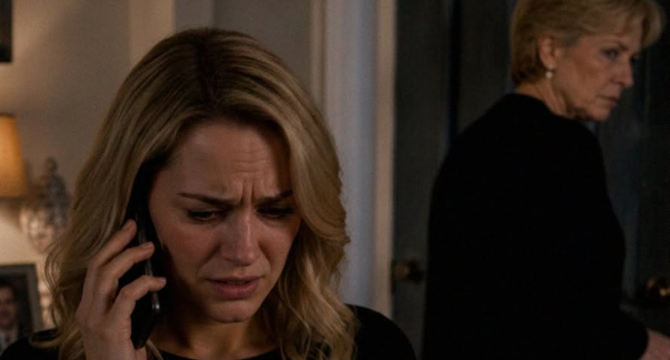
Three days after my husband died, I came home and found my key didn’t work.
At first, I thought I was using the wrong one.
My hands were shaking, and I hadn’t slept properly since the funeral, so grief had turned even simple tasks into challenges.
I stepped back, checked the house number, then tried again.
The key slid into the lock, but it just wouldn’t turn. I frowned and tried the spare key.
Same result.
A strange feeling settled in my stomach. I knocked. No answer. I knocked again, still nothing.
I pulled out my phone and called my mother-in-law.
Nova answered on the second ring.
“What?”
No hello. No greeting. Just that one word.
I swallowed. “My key isn’t working.”
Silence. Then, “I know.”
For a moment, I thought I’d misheard her.
“What?”
“The locks were changed yesterday.”
The world seemed to tilt beneath my feet. I stared at the front door.
“You changed the locks?”
“Yes.”
My grip tightened around the phone. “Why?”
Another pause. Then she said something I’ll never forget.
“Because you don’t live there anymore.”
I genuinely thought she was joking. The house belonged to Leon and me. We’d been married for 11 years.
We’d painted every room together, built the deck together, and planted the maple tree in the backyard together.
My winter coat was still hanging in the closet, my photographs were still on the walls, and everything I owned was inside. Somehow, this woman was telling me I didn’t live there anymore.
“Nova,” I said carefully, “my husband died three days ago.”
“I know.”
The coldness in her voice shocked me more than the words themselves.
“He was my son.”
I closed my eyes. Grief sat between us like a living thing, raw, heavy, impossible. But this wasn’t grief.
This was something else.
“I need to get my things.”
“No.”
I blinked.
“No?”
“The house belongs to Leon’s family.”
My chest tightened. “I am Leon’s family.”
“No,” she said quietly. “You were his wife.”
Were. Not are. Were.
The word hit harder than I expected, as though 11 years had been erased in a single sentence.
My voice shook. “All of my belongings are inside.”
“I’ll have them packed.”
“Packed?”
“Yes.”
I couldn’t believe what I was hearing.
Three days earlier, I’d stood beside her at a cemetery while we buried the same man. Now she was locking me out of my own home.
“Nova…”
“I’m done discussing this.”
Then she hung up. I stood frozen on the porch, the phone still pressed against my ear.
The wind stirred the maple tree Leon and I had planted during our second year of marriage. I remembered him kneeling in the dirt with a ridiculous amount of enthusiasm for a tree that was barely taller than his knee.
“One day it’ll be huge.”
I laughed through tears. Back then, we’d assumed we’d have decades to watch it grow. Instead, at 42 years old, Leon had suffered a massive aneurysm and died before the ambulance reached the hospital.
One moment, he was making coffee; the next, he was gone. No warning. No goodbye.
Just gone.
And now I was standing outside a locked house that still smelled like him, a house I suddenly wasn’t allowed to enter.
I wish I could tell you I fought harder.
That I called lawyers immediately, that I pounded on the door until Nova opened it. I didn’t. The thought of a legal battle felt impossible when I could barely get through a day, because grief does strange things to people.
Sometimes it makes you angry. Sometimes it makes you brave. And sometimes it leaves you so exhausted that survival becomes the only thing you can manage.
So I walked back to my car and drove away.
At the time, I thought losing my husband was the worst thing that would happen to me. I had no idea that six months later, a single phone call would make me question everything I thought I knew about why Nova had changed those locks.
Six months passed.
I moved into a small apartment and tried to rebuild my life. Nova and I never spoke again. The few belongings she returned arrived in neatly labeled cardboard boxes, but everything that had belonged to Leon stayed behind.
Those never came. Not his photographs, not his journals, not the old guitar he kept in the den, not even the coffee mug he’d used every morning.
Whenever I thought about it, anger would briefly cut through the grief. Then exhaustion would smother it again. I kept telling myself I would deal with it eventually. I just wasn’t ready yet.
Then one Tuesday afternoon, my phone rang. I almost ignored it.
The number wasn’t familiar, but something made me answer.
“Hello?”
A man cleared his throat. “Is this Willow?”
“Yes.”
“Sorry to bother you. My name is Greg. I’m calling because I think there may have been a mistake.”
“A mistake?”
“Yes.”
Papers shuffled on the other end of the line. I heard someone speaking in the background. Then, “I’m working at the Thompson property.”
I froze. The Thompson property. Nobody had called it that except contractors and tax assessors. To everyone else, it was simply my house. Or at least it had been.
“What about it?”
Another pause. “Your name is on about half the boxes up here.”
For a moment, I couldn’t process the sentence.
“What boxes?”
“The boxes in the upstairs office.”
I sat upright so quickly my coffee nearly spilled. The upstairs office. My stomach tightened. Leon had always kept an office above the garage, but I never thought much about it until that moment.
Now my heart was racing.
“What kind of boxes?”
“There are dozens of them.”
Dozens. I gripped the phone tighter.
“Why are you calling me?”
The man sounded confused. “Because your name is on them.”
I stood and began pacing. “What exactly is happening?”
“We were hired to clear out the room.”
Every muscle in my body went rigid.
“Clear it out?”
“Yes.” A pause, then, “The owner said everything was ready to be disposed of.”
Disposed of. The word hit me like a punch.
“What owner?” The question came out sharper than I intended.
The man hesitated, then answered carefully. “Your mother-in-law.”
I stopped walking.
Advertisement
For several seconds, I couldn’t speak. Disposed of. Dozens of boxes. My name. Leon’s office.
Nothing about any of it made sense.
Finally, I found my voice. “What exactly is in these boxes?”
The contractor laughed softly. “I honestly couldn’t tell you.”
“Why not?”
“Because they’re sealed.”
Sealed. A chill ran through me. “Every single one?”
“Pretty much.”
I leaned against the kitchen counter, my pulse hammering now. “What do the labels say?”
The man was silent for a moment, as though he was checking.
Then he read one aloud.
“For Willow.”
My breath caught. Another rustle of paper. Then, “Open on your 40th birthday.”
I closed my eyes. Leon had died three months before my 40th birthday.
The contractor continued. “There’s another one.”
My heart was pounding so hard it hurt.
“What does it say?”
“Open when you finally take that trip to Italy.”
I couldn’t breathe. Leon and I had talked about Italy for years. Nobody else knew that.
Nobody. Not even Nova.
The room suddenly felt too small. Too warm. Too loud, because in that moment, I understood two things. First, those boxes had been meant for me.
And second, Nova had known exactly who those boxes were for.
“Ma’am?” The contractor’s voice sounded distant. “Are you still there?”
“Yes.” My throat felt tight.
“Please tell me something.”
“Sure.”
I swallowed. “Has anything been thrown away yet?”
There was a brief pause. Then, “No.”
For the first time in six months, hope and anger arrived at exactly the same moment, and both of them had the same target.
Nova.
Because whatever was inside that room, whatever Leon had left behind, my mother-in-law had been trying very hard to make sure I never saw it.
I called Nova the moment I hung up.
She answered on the third ring.
“What do you want?”
“The contractor called me.”
Silence.
My grip tightened around the phone. “He says there are dozens of boxes in Leon’s office with my name on them.”
Another silence, longer this time. Then, “You should leave it alone.”
The words sent a chill through me.
“What exactly are you hiding?”
“I’m not hiding anything.”
“Then why were you having the room cleared out?”
No answer. I could hear her breathing. Slow. Uneven. Almost nervous. For the first time since Leon died, Nova didn’t sound angry.
She sounded afraid.
“Nova.”
Still nothing. Finally, she spoke.
“Some things are better left where they are.”
I laughed once, a sharp, humorless sound.
“You changed the locks three days after your son died.” Silence. “You threw me out of my own home.” Nothing. “And now I’m supposed to believe you’re protecting me?” My voice cracked.
“I lost my husband, Nova.”
The line went quiet. When she finally spoke, her voice sounded smaller than before. “I lost my son.”
For a moment, neither of us said anything. Then I took a breath.
“When can I see the room?”
“No.”
The answer came too suddenly, as though she’d been expecting the question.
My pulse quickened.
“Why?”
“You don’t understand.”
“Then explain it.”
“I can’t.”
That was the moment I knew. Whatever was inside that office wasn’t paperwork. It wasn’t junk. It wasn’t old tax records.
It mattered.
“Either you let me in,” I said quietly, “or I get a lawyer.”
The words hung between us. Nova didn’t answer right away. When she finally did, she sounded tired. Not angry or cruel.
Just exhausted.
“Tomorrow.”
I blinked. “What?”
“You can come tomorrow.” Her voice steadied. “Ten o’clock.”
Then she hung up.
The next morning, I stood in front of the house for the first time in six months. The maple tree swayed gently in the breeze. It was taller now. Leon would have loved that.
The sight hurt more than I expected.
I walked up the driveway.
Nova was waiting at the front door, and for a moment neither of us moved. The last time I’d stood here, she’d locked me out. Now she was holding the key.
She looked older. Much older. The six months hadn’t been kind to either of us.
Without a word, she stepped aside. I entered the house. Everything looked exactly the same. The photographs. The furniture. The faint smell of Leon’s coffee. It felt as though time had stopped the day he died.
Nova led me through the kitchen, past the living room, toward the stairs leading above the garage. My heart hammered harder with every step. At the top was a closed door.
The office.
The room Leon had spent so much time in.
Nova stopped. Her hand rested on the knob, and for several seconds she simply stared at it.
Then she whispered something so quietly I almost missed it.
“I’m sorry.”
Before I could respond, she opened the door.
And I forgot how to breathe.
The room wasn’t filled with junk or paperwork. It was filled with boxes. Dozens of them. Every one labeled in Leon’s handwriting.
“For Willow.”
And in the center of the room, resting on the desk, was a single envelope. One I somehow knew Leon had wanted me to find first.
My hands were shaking before I even touched it. I recognized Leon’s handwriting instantly. He had always written my name the same way. The W was too large, and the final w curled upward. Tiny details I never thought I’d miss. Now they felt priceless.
Slowly, I opened the envelope.
Inside was a single sheet of paper. The first line made me laugh and cry at the same time.
“If you’re reading this, then my timing was terrible.”
A sound escaped me. Half sob. Half laugh. Leon. Even after death, he still sounded exactly like himself. I sat down in his chair. Nova remained near the doorway, silent, watching. I kept reading.
“Before you panic, no, I wasn’t hiding a second family. I wasn’t secretly in debt. And I definitely wasn’t a spy.”
Despite everything, I smiled.
That was Leon, always trying to make people laugh when things got difficult. Then the letter changed.
“About a year ago, I received news that scared me more than I ever admitted.”
My stomach tightened.
“The doctors found something they weren’t sure about. They told me it might be nothing. Or it might be very serious.”
I looked up. “Doctors?”
Nova lowered her eyes. She already knew.
I turned back to the page.
“They eventually determined I was going to be fine. But for a few weeks, I honestly thought I might lose the future we’d planned.”
A lump formed in my throat. Italy. Retirement. The lake cabin we kept talking about.
Everything.
“Those weeks made me realize something.”
“We spend our lives assuming we’ll have time. Then one day, someone reminds us that time is never guaranteed.”
Tears blurred the words.
“So I started preparing something. Not because I expected to die, but because I realized I never wanted to leave important things unsaid.”
I slowly looked around the room. The boxes, the labels, the years of effort. Suddenly, I understood. Leon had built all of this because he thought he might not get the chance later.
My chest tightened, but I continued reading.
“Every box in this room is for you. Some are for birthdays. Some are for anniversaries. Some are for days when life feels impossible. A few are for days when life feels wonderful.”
I pressed a hand against my mouth.
“There’s even one for the trip to Italy that you’re absolutely going to take, whether you think you can afford it or not.”
A tear slipped down my cheek, then another, and another. For several seconds, I couldn’t read anymore, because suddenly I wasn’t looking at cardboard boxes. I was looking at the hundreds of hours Leon had spent loving me. Planning for me. Thinking about me.
Even after he was gone.
Then I noticed something. There was a second envelope beneath the first. Smaller. Thicker. The handwriting was different. Not addressed to me.
Addressed to Nova.
My eyes lifted. My mother-in-law had gone pale, and for the first time since entering the room, I saw genuine fear in her face.
Slowly, I picked up the envelope. The front read:
“Mom. “
“If Willow is holding this, please don’t make her wait too long.”
The room went completely silent, because suddenly I knew two things. Leon had expected Nova to find this room first. And whatever was inside that second letter explained why she had changed the locks.
For several seconds, neither of us moved. The envelope felt heavier than paper should have. Nova’s eyes never left it.
“Did you read this?” I asked quietly.
She closed her eyes, then nodded.
A strange ache settled in my chest. Of course, she had. Leon died six months ago. She had found the room long before I did.
Slowly, I opened the envelope. Inside were three pages. I recognized Leon’s handwriting immediately. The first line hit me like a punch.
“Mom, if Willow is reading this, it means you finally opened the door.”
The room went silent. I looked up. Nova stared at the floor.
I continued reading.
“If you’re angry with me for writing this, I’m sorry. But I know you. And I know what you’re going to do when I’m gone.”
A tear slipped down Nova’s cheek. She didn’t wipe it away.
“You’re going to try to carry me. You’re going to try to keep every piece of me. You’re going to tell yourself you’re protecting everyone else. But really, you’re protecting yourself.”
My throat tightened, because Leon wasn’t guessing. He had known. Somehow, he had known.
“So I’m asking you for one thing.”
“Don’t make Willow fight for me.”
I heard Nova inhale sharply.
The sound was almost painful.
“She lost me, too. Don’t punish her because you miss me.”
The words hung in the room, heavy and unavoidable.
I looked at Nova.
She was crying openly now, still saying nothing.
I turned back to the letter.
“Everything in this room belongs to her. Not because I love you less, but because she was supposed to share the rest of her life with me.”
My eyes blurred.
“You got 42 years. She only got eleven.”
A sob escaped Nova before she could stop it.
The sound broke something inside me, because for the first time in six months, I stopped seeing the woman who changed the locks.
And saw a mother who had buried her child.
Leon’s letter continued.
“I know this is unfair. Losing someone always is. But if you’re reading this, please do the hard thing. Let her have what’s left.”
The final line was short. Painfully simple.
“Mom, don’t make her grieve alone.”
I lowered the letter. The room felt impossibly quiet. Finally, Nova sank into the chair across from me. She looked exhausted. Not six months exhausted, lifetime exhausted.
“I tried,” she whispered. “Every day, I told myself I was going to give you everything.” Her eyes moved across the room. “But every time I came in here, I saw his handwriting.”
Tears filled her eyes. “One day, I opened a box and found a video. He was talking about you.” Her voice broke. “And all I could think was that if I gave these to you, he’d be gone again.”
Suddenly, the last six months made sense.
Not right, not acceptable, but understandable.
She had hidden the room because every box forced her to say goodbye, and she wasn’t ready.
“I know what I did was wrong,” she whispered.
“You should.”
She nodded. “I know.”
No excuses or arguments.
Just grief. Raw and ugly and human.
Then she reached into a drawer. For a moment, I didn’t understand what she was doing. Then she pulled out a small flash drive.
Her fingers trembled.
“He wanted you to watch this first.”
I stared at it. “What is it?”
A sad smile crossed her face.
“The last thing he recorded.”
And suddenly, after everything we’d discovered, after the letters and the boxes and the six months of silence, I found myself terrified to press play. Because some part of me knew that hearing Leon’s voice again would feel like losing him all over again.
My hands shook as I inserted the flash drive into Leon’s laptop. The screen flickered, and there he was. Smiling. Alive. Wearing the faded blue sweatshirt he refused to throw away.
My breath caught. For the first time in months, I was looking at my husband again.
“Hi, Willow.”
His voice shattered me. I bent forward and covered my mouth.
Tears came instantly.
Leon smiled. “Okay. If you’re crying already, this is going to be a rough video.”
Despite everything, I laughed. A broken little laugh through tears.
“First, if Mom is in the room, stop glaring at each other.”
I heard Nova make a sound somewhere behind me.
Half sob, half laugh.
Leon nodded. “Yeah, I figured.”
For a moment, he just looked into the camera, as though he could somehow see us.
Then his expression softened.
“I don’t know when you’re watching this.” His voice grew quieter. “But if you’re seeing it, then something happened, and I didn’t get the future I was planning.”
A lump formed in my throat.
Leon smiled sadly. “I hate that.”
I closed my eyes.
So did I.
“So here’s what I need from both of you.” He pointed directly at the camera, at us. “No competing over who loved me more.”
A tear rolled down my cheek.
“Mom loved me first.”
Nova started crying again.
Then Leon smiled. “And Willow taught me what home feels like.”
The room went completely still, because that was Leon. Always finding exactly the right thing to say.
“You’re both going to be hurting.” His smile faded. “And you’re both going to think nobody understands.” He paused.
“But the truth is, you’re the only two people who do.”
I looked over at Nova.
For the first time, she looked back. No anger. No resentment. Just grief.
The same grief, the same loss, the same man.
Leon leaned closer to the camera. “So take care of each other.” His eyes glistened. “Because if I know the two of you, you’re both going to try doing this alone.”
Another pause. Then his smile returned, the smile I had fallen in love with.
“And Willow?”
My chest tightened.
“Go to Italy.”
I laughed through tears. Of course.
“Seriously.” He pointed again. “I’m not kidding.”
Then he glanced down at something, probably his notes. “Okay. That’s enough wisdom. If this gets any more emotional, I’m going to start sounding like a greeting card.”
A grin spread across his face.
The screen froze for a second as he reached toward the camera. Then he stopped, looked directly into the lens, and said one final thing.
“I loved my life.”
A tear slid down my cheek.
“Because I got to share it with you.”
The screen went black.
Nobody spoke for a very long time. Finally, Nova reached across the desk, tentatively, as though she wasn’t sure I would accept it. She placed her hand over mine.
I looked down at it, then back at her. For six months, all I had seen was the woman who changed the locks. Now I finally understood why she had. And for the first time, she finally let go.
We sat there together in the room Leon had built for us, surrounded by the boxes he had spent a year preparing.
The locks had never been about the house.
They had been about grief.
And inside that room, surrounded by everything Leon left behind, two people who thought they were fighting over his memory finally realized they had been protecting the same thing all along.
The man they both loved.

 admin
admin