The airport that morning smelled of coffee and jet fuel, and the soft hum of rolling suitcases blended with announcements I barely registered. Julie walked beside me with red-rimmed eyes, one hand gripping mine, the other clutching the strap of a carry-on that held 30 years of her life.
Her parents waited near the check-in counter, exactly where they had said they would be. Margaret wore her best coat, the navy one she saved for special occasions. David stood half a step behind her, hands buried in his pockets.
“There’s my girl,” Margaret said, opening her arms.
Julie folded into them, and I noticed Margaret’s fingers trembling against her daughter’s back. Not the gentle tremor of emotion. Something sharper.
“Mom, please don’t cry yet,” Julie whispered. “If you cry, I’ll never get on that plane.”
“I’m not crying,” Margaret said, even as her voice cracked. “I’m proud. That’s all.”
David stepped forward and squeezed my shoulder.
“You take care of her, Kelvin. You hear me?”
“I will, sir. I promise.”
He nodded, but his eyes never quite met Julie’s. They drifted past her shoulder, fixed on some imaginary point near the departure board. I told myself it was a father’s grief at letting go.
We checked the bags in and drank one last cup of bitter airport coffee at a small table near the windows. Margaret kept reaching across to touch Julie’s wrist, as if to confirm she was still there.
“You know,” Julie said quietly, turning to me, “I keep thinking I’m a horrible person.”
“You’re not.”
“They gave me everything, Kelvin. Every single thing I have. And I’m just… leaving.”
“You’re not leaving them. You’re starting something.”
“It feels like the same thing.” She pressed her thumb against the rim of her cup. “Like I’m walking out on the only two people who ever really loved me.”
I reached for her hand. “They want this for you. Look at them. They’re glowing.”
She glanced over her shoulder at Margaret and David, heads bent low, speaking in a hush I couldn’t quite catch.
“Did you send it?” I heard Margaret whisper.
“It’s done,” David murmured back. “Stop asking.”
But then I remembered Margaret had been muttering for weeks about a package she wanted waiting for us when we landed, some framed photograph or the recipe book she’d been threatening to finish, one of those sentimental surprises parents arrange when they can’t be there in person.
Of course, it was done. Of course, she’d badgered David into shipping it before we boarded. I felt a flicker of tenderness for them both and let the moment slip past, swallowed by the next boarding announcement.
We stood. The four of us walked together toward passport control, the way families do when they’re stretching the last minute as thin as it will go.
Margaret hugged me first.
“Whatever you hear, remember she’s a good girl. She’s always been a good girl.”
I pulled back, not quite sure what to make of it. She only smiled — a smile that didn’t reach her eyes, and turned to her daughter.
“Julie. Sweetheart. Come here.”
She drew Julie aside, just a few steps away, and I watched them speak in low voices I couldn’t hear. Margaret cupped Julie’s cheek. Julie nodded, wiping her face with the heel of her hand.
Then Margaret leaned in close, her lips near Julie’s ear, and I saw her whisper something that made Julie’s eyebrows knit together.
“What was that?” I asked when Julie returned.
“She said she sent me a voice message.” Julie sniffled and tried to laugh. “She wants me to listen to it once we’re already in the air. Not before. She made me promise.”
“That’s sweet.”
We walked through the terminal in silence, the weight of the goodbye hanging heavy between us. I waved at Margaret and David through the glass of the passport gate. They waved back, smiling, their figures growing smaller as we moved away.
And somewhere beneath my ribs, a small, unnamed unease began to hum — one I couldn’t quite shake as we stepped through the gate and toward the plane that would carry us home.
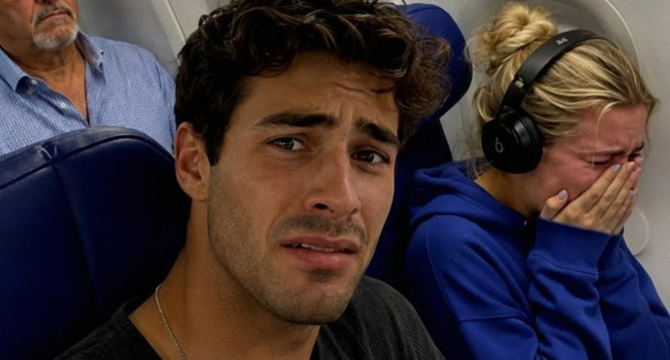
The cabin lights dimmed as the plane leveled out, and I watched Julie slip the headphones over her ears. She gave me a small smile, the kind that said she was bracing for something sweet.
I leaned back, expecting nothing more than a mother’s blessing.
Her smile held for the first few seconds. Then it began to slip, slowly, the corners of her mouth pulling down as if something heavy had been tied to them.
“Love?” I asked.
She didn’t look at me. Her gaze was fixed on the screen, but her eyes weren’t moving.
“Julie, what is it?”
A tear rolled down her face, and then another, and then her shoulders started to shake without sound.
I touched her wrist.
“Talk to me.”
Her hand clutched the armrest tightly. I reached over and carefully lifted one earbud from her ear, slipping it into my own. Margaret’s voice was already playing, low and trembling, nothing like the bright woman who had hugged me at the gate.
“Julie, sweetheart, by the time you hear this, you’ll be in the sky, and that’s the only way I could do this. I’m so sorry. I’ve been a coward for 30 years.”
I glanced at Julie. She wouldn’t meet my eyes.
My stomach went cold.
“The wedding… the one you think we had… the photographs in the hallway. None of it happened the way we said. Your father and I… we are not. We were never —”
Her voice broke on the last word, and for a long moment, there was only the sound of her trying to breathe.
“I can’t. Not like this. Julie, please, just call me when you land. I’ll tell you everything. I promise.”
The recording ended with a soft click, leaving a ringing silence in my ear.
I pulled the earbud out, my heart hammering against my ribs.
“What did she say?” Julie whispered.
“She said to call her when we land.”
“Kelvin, what did she say before that?”
I looked at her, and for a moment I didn’t recognize the shape of what I was supposed to tell her. The words felt like stones in my mouth.
“She said —” I started, and my throat caught.
“Tell me.”
“She said your sister Rebecca. And something about hospital papers. And. She said she and your dad weren’t. She couldn’t finish.”
Julie stared straight ahead. Her tears had stopped, but only because something deeper had taken their place, something blank and very far away.
“Weren’t what?” she said quietly.
“I don’t know.”
“Weren’t married? Weren’t my parents? Weren’t real?”
“I don’t know, love.”
She pressed her palms flat against her thighs, as if the only way to stay in her seat was to hold herself down.
“Kelvin, my whole goodbye. Two hours ago. The crying at the gate. The pictures Mom took. Was any of that real?”
“I don’t know.”
“Why would she wait until I was on a plane?”
“Because she didn’t want to look at your face when you heard it.”
The truth of it landed between us, and Julie flinched. She turned to the window and pressed her forehead against the cold plastic.
“I want to call her,” she said.
“We can’t, not yet.”
“I want to call her the second we land.”
“Okay.”
“And if she doesn’t answer, I’m getting on another plane.”
I held her hand. I stared at the seatback screen, watching our tiny plane icon crawl across the vast blue ocean, and realized the woman crying beside me no longer knew who her own mother was.
The wheels touched down. Julie didn’t wait for the seatbelt sign to dim. She was already dialing before we cleared the runway, her hands shaking so hard she dropped the phone twice.
“Mom. Pick up. Pick up.”
Margaret answered on the second ring. I could hear her breathing, slow and afraid, even from where I sat.
“Tell me what you meant,” Julie said. “Tell me right now. No more pieces. All of it.”
“Sweetheart, not like this. Not over a phone. When you come home,”
“I’m not coming home. Say it.”
“Julie, please. There are truths I should have told you in person, years ago, and I—”
“You didn’t. You chose a recording. So you don’t get the in-person version now. Say it.”
A long silence. I heard Margaret swallow.
“When you were very small, we —”
“We who?”
“Your father and I made some decisions.”
“Decisions about what?”
“About how to raise you. About what was best.”
“Mom.” Julie’s voice flattened into something I’d never heard from her. “Say the word. Whatever word you’re walking around. Say it.”
Another silence. Then Margaret’s voice was smaller than I had ever heard it.
“I’m not your mother, sweetheart. I’m your grandmother.”
Julie made a sound I would never forget. Not a scream. Something quieter and worse.
“Rebecca,” Julie said. “Rebecca is —”
“Your mother. Your sister. She was 16 when you were born. We told everyone she had gone to study abroad. We adopted you legally, properly, so no one would ever know.”
“No one would ever know,” Julie repeated, her voice hollow and metallic.
I gripped her free hand. She didn’t seem to feel it.
“Why now?” she whispered. “Why on the plane? Why not look me in the eye?”
“Because I couldn’t,” Margaret said. “Because the bank is taking the house next month. Because your father lost everything two years ago and we hid it. Because if you had known before you boarded, you would have stayed. You would have canceled the wedding, postponed your life, tried to fix what can’t be fixed. I couldn’t watch you do that.”
“So you shipped me off,” Julie said. “You used my wedding. You used Kelvin.”
“I saved you from us.”
“You discarded me.”
“Was there ever a sister who ran away?” Julie asked. “Or did Rebecca leave because you took me from her?”
Margaret started crying. Real crying, the kind that breaks a voice in half.
“She wanted to keep you. We told her she couldn’t. She left when you were two. She never stopped writing.”
“What letters?”
“Letters. Every birthday. Every Christmas. For 30 years. She sent them to our house. She always knew where you were — she just couldn’t reach you.”
“And you?”
“I burned them. All of them. I called her after you boarded. I told her what I’d done. I gave her your email. She deserved that much, after everything. I’m so sorry, Julie. I’m so sorry.”
Julie went very still. The kind of still that scared me more than the screaming.
“You let me grow up thinking she didn’t want me,” she said. “You let me feel guilty for leaving you. You let me cry at the gate apologizing to the wrong woman.”
“I thought distance would make it easier.”
“Easier for whom?”
Margaret had no answer. Only the sound of static and sobbing remained.
“Don’t call me,” Julie said. “Don’t write. Don’t send anything. I need to not know you for a while.”
“Julie, please.”
“I said the goodbye at the airport already. I just didn’t know what I was saying goodbye to.”
She hung up. The phone slid out of her fingers onto her lap. Around us, passengers were still pulling bags from overhead bins.
“Kelvin,” she said, “I don’t know whose daughter I am anymore.”
I pulled her against my chest. I didn’t have words for that. I’m not sure anyone does.
“You’re still you,” I tried. “Whatever else changed, that didn’t.”
“I don’t even know what that means.”
We sat there until the cabin was empty. The flight attendants pretended not to notice. I helped her stand, helped her walk, helped her carry a life that had quadrupled in weight somewhere over the Atlantic.
In the taxi, her phone lit up, a new email, from an address neither of us recognized. The name attached to it was Rebecca. Julie stared at the screen for a long time before she said anything at all.
Our new apartment smelled of fresh paint, and a sealed box marked KITCHEN sat in the middle of the living room because neither of us had the heart to open it.
For the next few days, Julie sat on the floor by the window most mornings, knees pulled to her chest.
I brought her tea, but she didn’t drink it. The same mug sat on the sill, reheated three times, gone cold three times, ringed with a faint brown line where the tea had receded. I sat beside her when she wanted, and I left the room when she needed the silence to swallow her whole.
On the fifth morning, her laptop chimed.
“It’s her,” Julie whispered.
I sat down beside her, one hand resting on her shoulder. The email was three lines long. Rebecca was asking, gently, if Julie would speak to her. Even once. Even just on a screen.
“I don’t know if I can,” Julie said.
“You don’t owe anyone an answer today,” I told her.
She turned her face toward mine, and I could see how little she had slept.
“But what do I owe myself, Kelvin?”
“The truth. Whatever shape it takes.”
Her fingers hovered over the trackpad for a long time. Then she clicked.
The video connected, and Rebecca appeared, hair tied back, lips trembling before she even spoke.
“Julie,” Rebecca said, and broke into a sob.
Julie pressed a hand to her mouth.
“I’m sorry,” Rebecca whispered. “I’m so sorry. I wrote you. Every birthday. Every Christmas. I never stopped.”
“I never got them,” Julie said.
“I know that now.”
For a moment, neither of them spoke. I felt Julie’s shoulders shake under my palm.
“I was 16,” Rebecca said. “They told me you’d hate me if you knew. They told me leaving you was the kindest thing I could do. I believed them because I needed to believe them.”
“Did you ever want me?” Julie asked.
“Every single day.”
Julie cried then — a sound low in her throat, one I had never heard from her in three years together; something between a gasp and a word that wouldn’t form. Her hand opened and closed against her knee, slowly, as if she were trying to catch hold of something only she could see.
“I don’t know what to call you,” she said at last.
“You don’t have to call me anything yet,” Rebecca answered. “Just don’t disappear. Please.”
“I won’t.”
When the call ended, Julie closed the laptop and stared at her own reflection in the dark screen.
“I don’t know who that woman is,” she said.
“Which one?”
“Me.”
I took her hand and pulled her to her feet. “Then we get to find out together,” I said.
She leaned her forehead against mine. “I’m not theirs, but I don’t know who I am yet.”
“No,” I said. “But you are still yours. And you always were.”
She nodded, slowly, as if the words had to climb a long way before they reached her. That evening, she walked to the mailbox downstairs and slid a small white card into the slot beside our door. Her name, written in her own hand. Just her first name. No surname yet. She said she wasn’t ready to choose one.
I watched her from the doorway and understood that the hardest goodbye hadn’t been at the airport. It had been here, in a quiet hallway, with a name half-written and a future yet to be claimed.

 admin
admin