My name is Lily. I’m twenty-nine, a single mom of three, and most days my life feels like pure chaos—school runs, late-night diner shifts, and bills stacked on the kitchen table like tiny towers waiting to fall. I thought I had seen just about everything life could throw at me. Then last Thursday happened.
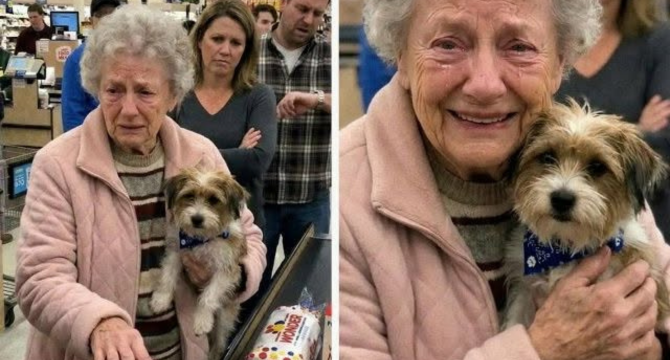
That morning started as a complete disaster. The kids were yelling over cereal, my phone wouldn’t stop buzzing, and we were somehow out of both bread and milk. I rushed into the grocery store to grab the basics before heading to work. At the checkout line, I noticed an elderly woman standing at the register. She was hunched over, wearing a coat that looked like it had been patched a dozen times. Her hands trembled as she tried to pull a few wrinkled bills from her wallet. On the conveyor belt were only two things: a loaf of bread and a carton of milk.
The people behind her in line weren’t exactly kind about it. One woman sighed loudly and said, “Seriously? She can’t even pay for that?” Another voice snapped, “Move along! No shame!” A man muttered the word “pathetic” under his breath, loud enough for everyone to hear. The whole line felt thick with judgment. The old woman looked terrified, glancing nervously between the cashier and the irritated faces behind her.
Without really thinking about it, I stepped forward and put my card on the counter. “Let me cover it,” I said. Immediately a few people scoffed. “You’re wasting your money,” someone said. Another voice added, “She probably does this all the time.” The elderly woman turned to look at me, her eyes watery but surprisingly sharp. “No,” she said softly. “You have your own family.”
“You’re not taking,” I replied gently. “I’m giving.”
“You have children,” she insisted. “Keep your money.”
I shook my head and smiled. “I want my kids to grow up in a world where this is normal. Please.”
She stood there for a moment before finally accepting the groceries. She held them carefully, almost like they were something precious. Her voice broke as she spoke. “No one has ever done this for me.” People behind us rolled their eyes, annoyed that the line had taken longer, but I didn’t care. Before she left, she told me her name was Mrs. Hargrove. Then she slowly walked out of the store.
I didn’t think much about it afterward. Life kept moving the way it always does. Work, kids, homework, exhaustion. Three days later, someone knocked hard on my front door. My youngest, Emma, ran over and grabbed my leg while I went to answer it. When I opened the door, the male clerk from the grocery store was standing there. His face looked pale and serious, and he was holding a thick envelope.
“Lily?” he asked quietly.
“Yes?”
He took a slow breath and handed me the envelope. “I’m here on behalf of Mrs. Hargrove’s last request.” My heart skipped. “Last request?” I repeated. He nodded. “She passed away yesterday morning.”
The words hit me harder than I expected. I had only known the woman for a few minutes, but something about the thought of her dying alone made my chest tighten. “She left instructions for us to find you,” the clerk explained. “The manager checked the receipt from that day. Your name was attached to the card payment.”
I opened the envelope slowly. Inside was a letter written in shaky but careful handwriting.
“Dear Lily,” it began, “three days ago you showed me a kindness I had never experienced in my life. I have lived eighty-two years, and most of them were lonely ones. When people saw me, they usually saw a burden. But you saw a person.”
My eyes blurred as I kept reading. “I do not have children or family left. The small house I lived in will be sold. The money is not much by the world’s standards, but it is everything I have. Please accept it. Use it for your children. Use it to build the kind of world you told me you wanted them to grow up in.”
At the bottom of the letter was her signature: Mrs. Hargrove.
I lowered the page slowly, trying to process what I had just read. The clerk cleared his throat gently. “She left you her savings,” he said. “It’s a little over eighty thousand dollars.”
For a moment, I couldn’t even speak. Eighty thousand dollars could erase every bill sitting on my kitchen table. It could mean a safer home, better opportunities for my kids, and maybe even fewer exhausting night shifts at the diner. All because of bread and milk.
I looked back down at the letter and whispered softly, “Thank you, Mrs. Hargrove.” And for the first time in years, it felt like kindness had finally come full circle.

 admin
admin