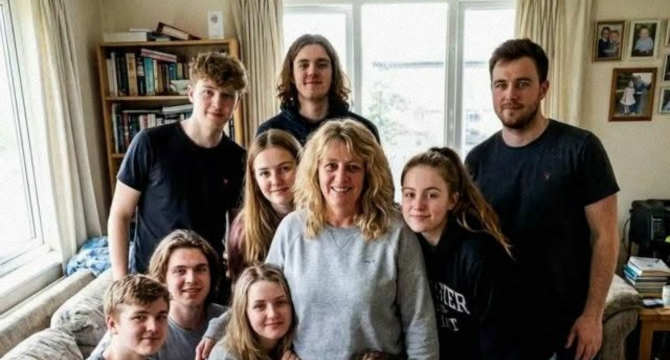
I was fifteen when my father destroyed our family. He gathered all of us in the church basement after Sunday service, my mother sitting beside him eight months pregnant with baby number ten, and announced that God was “calling him elsewhere.” Ten children. Ten mouths to feed. Ten lives built around a man who preached family, sacrifice, and faith every Sunday. The truth came out a few days later: God wasn’t calling him anywhere. A twenty-two-year-old choir soprano named Rachel was. He packed his bags and left that same week.
The years after that were brutal. We lost the house and squeezed into a smaller rental. Some of my siblings shared beds, and my mother took every job she could find, cleaning office floors after midnight, scrubbing bathrooms before dawn, doing whatever kept food on the table. She never once said a cruel word about him. Not one. Whenever one of us complained, she’d just smooth my hair back and say, “Your father made mistakes. That’s between him and God.” But I watched her come home exhausted with cracked hands and a smile she wore like armor, and I never forgot the man who walked away from ten children and a pregnant wife because he wanted something younger, prettier, and easier.
Ten years passed. The youngest child he abandoned was now in fifth grade when, out of nowhere, Dad called. Apparently Rachel had left him. According to relatives, she’d gotten tired of nursing a man with back problems, medical bills, and a retirement account that wasn’t nearly as impressive as he’d once pretended. Suddenly family mattered again. Suddenly he missed us. Suddenly he wanted a second chance. I heard Mom take the call in silence, and afterward she sat at the kitchen table twisting the phone cord around her fingers. “I think people deserve forgiveness,” she whispered. I stared at her, stunned, because after everything he’d done, she still sounded soft. Still sounded like the woman who had spent ten years carrying all of us with her bare hands.
So I made a plan.
Using Mom’s phone, I texted him back: “I’ve thought about what you said. Come to a family reunion dinner Sunday at seven. All the children will be there. Wear your best suit.” He replied almost immediately. “Thank you, dear. I can’t wait to become a family again.” I smiled at the screen because he had no idea what was waiting for him. On Sunday evening, Dad pulled into the parking lot wearing a navy suit and a smug little grin. Then he looked up and the grin vanished. The building wasn’t our house. It wasn’t a restaurant. It was a ceremony hall. “What is this?” he muttered. I was waiting near the entrance. “Where’s your mother?” he asked, already irritated. “Inside,” I said. “This isn’t a family dinner.” “No,” I answered calmly. “It isn’t.” He turned toward his car. “I’m leaving.” I stepped in front of him. “No. Not this time.”
He reluctantly followed me inside, and the second he saw the room, the color drained from his face. The hall was full of people—my siblings, their spouses, grandchildren, neighbors, church members, and friends. At the front stood a stage decorated with flowers and framed photographs of our mother. A giant banner hung behind the podium. It read: CELEBRATING MARGARET’S TEN YEARS OF STRENGTH. Dad stopped dead. “This is for your mother?” he asked in a voice that suddenly sounded small. I nodded. “Sit down.” For the next hour, people took turns speaking. My oldest brother told the room how Mom worked double shifts while helping him study for college entrance exams. My sister talked about the dresses Mom sewed by hand because she couldn’t afford new ones. A former neighbor described how Mom shoveled snow from three driveways before going to work because she needed every extra dollar she could get. A church elder spoke about how she quietly paid utility bills for families who were struggling, even when she barely had enough for our own lights to stay on.
Dad sat there in silence, hearing story after story about the life he’d chosen not to witness. Then it was my turn. I stepped up to the microphone and looked directly at him. “You know something interesting about abandonment?” I said. “The people who leave think they’re punishing the ones they abandon.” The room went completely still. “But that isn’t what happens. The abandoned people learn how strong they are.” I pointed to our mother sitting in the front row. “For ten years, she did the work of two parents. Every school event. Every graduation. Every birthday. Every emergency room visit. Every heartbreak. Every success. You missed all of it. And the funny thing is, none of us are here because of you.” I let that sink in. “The doctors, teachers, parents, mechanics, college graduates, and business owners sitting in this room weren’t raised by a man who walked away. They were raised by her.”
By then Mom was crying, and so was I. Then I reached into my jacket pocket and pulled out a framed deed. Dad frowned. “What is that?” he asked. I held it up. “The reason you’re here.” I handed it to him, and his hands shook as he read the words. It was a house deed. A beautiful one. A house we had all bought together, each of Mom’s ten children contributing what we could. At the bottom, in bold letters, it said: PAID FOR BY THE TEN CHILDREN YOU NEVER GAVE UP ON. Dad stared at the paper, then at Mom, then back at the paper. His eyes filled with tears, but he still didn’t speak. He had spent ten years thinking we needed him. That night he learned we had built something beautiful without him.
Mom stood and walked slowly toward him. The whole room held its breath. She took the deed from his hands and said quietly, “I forgive you.” He broke down immediately. But she wasn’t finished. “That doesn’t mean you get your old life back.” The room went silent. She held the deed against her chest and looked him right in the eye. “You left this family. We survived anyway.” Then she added, still calm, still steady, “You’re welcome to build new relationships with your children if they’re willing. But this family isn’t waiting for someone to save it anymore.” For the first time in my life, I saw my father with nothing left to say. And that was the lesson waiting for him all along: he didn’t return to reclaim a family that needed him. He arrived just in time to learn that the woman he abandoned had become the strongest person in the room.

 admin
admin