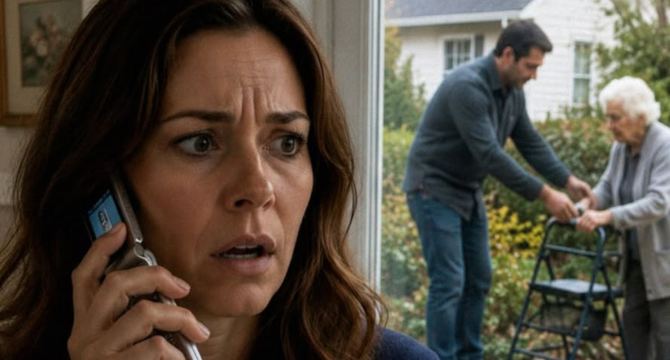
For the past three months, my husband disappeared every Friday evening to take the same phone call.
At first, I barely noticed.
Gregory had always been the kind of man who answered calls away from noise. If the television was on, he stepped into the hallway. If I was washing dishes, he moved toward the back porch.
He said he hated repeating himself, and after 15 years of marriage, I knew his habits well enough not to question every little thing.
But habits have a way of changing shape when they start keeping secrets.
The first time it happened, I was folding laundry in our bedroom. Gregory’s phone buzzed on the dresser at exactly 7 p.m. He glanced at the screen, and something in his face tightened so quickly I almost missed it.
“Everything okay?” I asked, holding one of his work shirts against my chest.
He smiled, but it was too fast. “Yeah. Just an old friend.”
Then he walked out of the room.
A few minutes later, I heard the guest room door close.
Not loudly. Not like he was hiding. Just carefully, as if he didn’t want the click of the latch to draw my attention.
I stood there with his shirt in my hands and told myself I was being silly.
Gregory and I had been through almost everything two people could survive together. Job losses. My mother’s illness. His father’s funeral. The years when money felt like a locked door we kept pushing against with our shoulders.
We had not built a perfect marriage, but we had built a steady one.
Trust becomes a habit after 15 years of marriage.
At least, that was what I told myself that first Friday.
The second Friday, I noticed the time.
7 p.m.
His phone rang while we were halfway through dinner. I had made chicken stew, the kind he liked with extra carrots and a little too much black pepper. He checked the screen, set down his spoon, and rose from the table.
“Again?” I asked before I could soften my tone.
He looked back at me. “What do you mean?”
“The old friend?”
His shoulders relaxed, but his eyes did not. “Yeah. Just an old friend.”
“What old friend calls every Friday night?”
He gave a short laugh. “Adrianna, it’s not a big deal.”
“I didn’t say it was.”
“No, but you’re looking at me like I committed a crime.”
I looked down at my bowl. “I’m looking at you like my husband just left dinner to whisper in another room.”
He came around the table and kissed the top of my head. “I’ll be ten minutes.”
And he was.
Exactly ten minutes.
Not nine. Not 11. Just ten.
When he returned, he sat down and ate as if nothing had happened. He told me the stew was good. He asked whether I had remembered to call the insurance office. He complained about the loose handle on the garage door.
Normal things. Married things.
But I could not stop watching his hands.
They were steady.
Mine were not.
By the fifth Friday, the calls had become part of the house. The way the pipes groaned at night. The way Gregory hung his keys on the wrong hook even though I had asked him a hundred times not to. The way the kitchen light flickered when it rained.
Every Friday evening, his phone rang.
Every Friday evening, he left the room.
He closed the door. Lowered his voice. And talked for exactly ten minutes.
Once, I asked for a name.
Gregory was standing at the sink, rinsing coffee from his mug. Morning light fell across his face, making him look softer than he had the night before.
“You never told me who this friend is.”
He kept rinsing the mug long after it was clean. “Someone from years ago.”
“Do I know them?”
“No.”
“Man or woman?”
He turned off the water. “Does it matter?”
I hated how quickly that question stung.
“It matters if you’re hiding it,” I replied.
He set the mug down gently. “I’m not hiding anything.”
“Then tell me.”
For a second, I thought he would. His mouth opened, and something passed across his face that looked almost like grief.
Then it was gone.
“It’s complicated.”
I folded my arms. “That’s worse.”
He stepped toward me, but I stepped back.
“Adrianna.”
“No. Don’t say my name like I’m the unreasonable one.”
He looked tired then.
Not annoyed. Not defensive. Just tired in a way I had not seen before.
“I promise you,” he said quietly, “it has nothing to do with us.”
But when someone says a secret has nothing to do with you, all you hear is that there is still a secret.
That afternoon, while looking for a spare charger, I opened the drawer of the small table near the guest room bed. It was empty except for old receipts and a dried-out pen.
I checked the closet next, then Gregory’s desk, then the cabinet in the hallway where we kept batteries, tape, and things neither of us wanted to sort.
Nothing.
Finally, I went into the room Gregory used when he worked from home. His desk had three drawers on the left and two on the right. I had been in those drawers before. Paper clips. Tax folders. Manuals for appliances we no longer owned.
But underneath the bottom right drawer, tucked behind a hanging file box, I saw a small metal handle I did not recognize.
I knelt down.
There was a locked drawer I’d never seen before.
My heart began to beat so loudly that I paused, listening as if the house itself might hear me.
The key was not on his key ring.
I knew because I checked with trembling fingers when he was in the shower that evening. I told myself I would leave it alone. I told myself good wives did not go digging for trouble.
But suspicion changes the meaning of every silence.
On Friday afternoon, Gregory went outside to help our elderly neighbor, Mrs. Bellamy, with a broken garden trellis. I watched him through the kitchen window. He was patient with her, as always, holding the wooden frame steady while she pointed and talked.
That was the thing about Gregory. He was kind. He was the man who carried groceries for strangers, remembered birthdays, and warmed my side of the bed with his hand on cold nights.
That made everything worse.
Because if he could lie with that same gentle face, then what else had I missed?
I found the drawer key taped beneath the back edge of his desk.
For several seconds, I only stared at it.
Then I unlocked the drawer.
Inside was an old flip phone.
No photos. No messages. No contacts.
Just one incoming call.
Every Friday.
From the same number.
My mouth went dry.
I held the phone in my palm, staring at the call log until the numbers blurred. Three months of Fridays. The same time. The same number. The same ten minutes Gregory had carved out of our life and hidden behind a closed door.
Then the phone started ringing.
I nearly dropped it.
Outside, Gregory was still helping Mrs. Bellamy. I could see his back through the window, his sleeves rolled up, his hands busy with the trellis.
Same time.
Same number.
For the first time in months, he wasn’t there to answer it.
So I did.
I pressed the button and lifted the phone to my ear.
For one breath, there was only static.
Then an elderly woman’s voice whispered, “Michael? Is that really you?”
But my husband’s name isn’t Michael.
For a moment, I forgot how to breathe.
The old flip phone felt warm against my ear, though I knew that was impossible. My fingers tightened around it until the hard plastic edges pressed into my palm.
“Who is this?”
There was a sharp inhale on the other end.
Not fear, exactly.
Hope.
“Michael?” the elderly woman whispered again. “Please. I don’t have much time tonight.”
My eyes moved to the window. Gregory was still outside with Mrs. Bellamy, one hand braced against the trellis, his head bent as she spoke to him. He looked so normal. So familiar. Like the man who kissed my forehead when I worried too much and reached for my hand in grocery stores.
“My husband’s name is Gregory,” I said, though my voice did not sound like mine. “Who are you calling?”
Then the woman said, “Oh, no.”
Those two words landed heavier than an accusation.
“Tell me who you are,” I demanded, but my voice cracked on the last word.
“I shouldn’t have called. I shouldn’t have pushed him.”
“Pushed who?”
She did not answer.
I turned away from the window because I could not stand looking at Gregory while another woman trembled through his secret phone.
“My name is Adrianna. I’m his wife. We’ve been married for 15 years. So please do not hang up and leave me standing here with this.”
The woman began to cry.
It was soft at first, a fragile sound that made me think of thin paper tearing. I hated myself for feeling pity, because fear was already ripping through me.
“I’m Ruth,” she said at last.
The name meant nothing to me.
“Why did you call him Michael?”
“Because that was his name when I knew him.”
I sat down on the edge of Gregory’s desk chair. The room seemed to tilt a little.
“No,” I said.
“I’m sorry.”
“No,” I repeated, louder this time. “You have the wrong person.”
“I wish I did.”
My throat burned. “My husband is Gregory. He grew up in Ohio. His father’s name was Dennis. His mother’s name was Carol.”
Ruth’s breath shook. “That is what he told you?”
A coldness spread through my chest.
Outside, Gregory laughed at something Mrs. Bellamy said. The sound came through the window, muffled but real, and it almost broke me.
“What is going on?” I asked.
Ruth was quiet so long I thought she might have hung up. Then she spoke in a low, careful voice.
“Thirty-two years ago, my daughter had a son. His name was Michael. He was seven when he disappeared.”
I closed my eyes.
“Stop.”
“He was taken by his father after a custody hearing. We searched for years. My daughter never recovered. She died still believing she would hear his voice again.”
My stomach twisted. “Why are you telling me this?”
“Because three months ago, I received a letter. No return address. Just a note and this number. It said, ‘Call on Fridays at seven. Ten minutes only. Do not ask where I live.'”
I pressed my hand to my mouth.
Ruth continued, her voice breaking. “The first time he answered, I knew. A grandmother knows. He did not admit it right away, but I knew his voice. He has my daughter’s laugh.”
The desk chair creaked beneath me as I leaned forward. My body felt too small for what I was hearing.
“And Gregory knew?” I asked.
“He said he had only found out recently. He found documents after the man who raised him died. Birth records. Old newspaper clippings. A photo of my daughter holding him in a blue blanket.”
Dennis had died four months ago.
I remembered Gregory flying back alone to clear out the house.
I remembered the boxes he brought home, how he left some in the garage for weeks. I remembered him sitting in the dark one night, staring at nothing, telling me he was just tired.
I had believed him because trust was a habit.
“Why didn’t he tell me?” I whispered.
Ruth’s answer came gently. “He said he was afraid.”
“Of me?”
“Of becoming someone else in your eyes.”
The front door opened.
I froze.
Gregory’s voice drifted from the hallway. “Adrianna?”
The flip phone was still to my ear. Ruth heard him too.
“Tell him I’m sorry,” she whispered.
Then the line went dead.
I sat there with the phone in my hand as Gregory appeared in the doorway. His smile faded the second he saw me.
His eyes dropped to the phone.
Every bit of color left his face.
“Adrianna,” he said.
I stood slowly. “Michael?”
He flinched.
That small movement told me everything Ruth’s story had not.
He reached for the doorframe as if he needed it to stay upright. “How much did she tell you?”
“Enough.”
He swallowed. “I was going to tell you.”
“When? After another three months? After another year?”
“I didn’t know how.”
I laughed once, but there was no humor in it. “You didn’t know how to tell your wife your name?”
His eyes filled. Gregory rarely cried. In 15 years, I had seen it only twice: once at his father’s funeral and once when we lost a pregnancy so early the doctor called it common, and I called it my baby.
“My name is Gregory,” he said, his voice rough. “It has been for most of my life. But before that, I was Michael.”
I sank back against the desk.
He stepped closer, then stopped when I held up my hand.
“No. You talk from there.”
He nodded, wiping at his face. “After Dad died, I found a locked metal box in his closet. There were papers inside. Court documents. My original birth certificate. Articles about a missing boy. Me.”
“Your father took you?”
“The man I called my father did.” His mouth trembled. “He told me my mother abandoned us. He told me her family was dangerous and that he saved me.”
“And you believed him?”
“I was seven, Adrianna. Then I was 17. Then I was 30. By the time I was old enough to question it, the lie had roots.”
The anger in me faltered, not because I forgave him yet, but because I could see the boy inside the man, frightened and trained to survive a story he never chose.
“Why ten minutes?” I asked.
Gregory looked down. “Ruth is in a care home. She has limited private phone access, and I panicked the first time she called. I told her ten minutes. I thought if I kept it contained, I could handle it.”
“And the locked drawer?”
“I was ashamed.”
“Of her?”
“Of myself,” he said quickly. “Of not knowing who I was. Of loving the man who stole me. Of missing him even after I learned what he did.”
His voice broke fully then.
I wanted to stay angry.
Part of me needed to. Secrets had sat at our dinner table for three months. They had slept beside me. They had made me feel foolish in my own marriage.
But this was not an affair. It was not betrayal in the way I had feared.
It was grief with a false name.
I crossed the room and placed the flip phone on the desk between us.
“You should have trusted me with this.”
“I know.”
“I would have held it with you.”
His face crumpled. “I know that now.”
“No,” I said softly. “You always knew. You were just scared.”
He nodded, and the shame in his eyes made him look older than his years.
I took a breath. “Call her back.”
He stared at me. “What?”
“Ruth. Call her back.”
“Adrianna, you don’t have to do that.”
“I’m not doing it because I have to.” I picked up the phone and held it out. “I’m doing it because you don’t get to lose more family to fear.”
His hand shook when he took it.
He dialed, and when Ruth answered, Gregory closed his eyes.
“Grandma?”
The word shattered something in the room.
I turned away, wiping my cheeks, while he listened to the woman who had waited 32 years to hear that one word again.
Later, we sat together on the floor beneath his desk, surrounded by papers, old clippings, and a faded photo of a young woman with Gregory’s eyes.
He told me everything he knew.
I told him how deeply he had hurt me.
He did not defend himself.
That was the first step back.
By midnight, we had made a plan. We would visit Ruth together. We would find out who Michael had been, without losing the man Gregory had become. We would begin counseling, because love could survive secrets, but not if they stayed buried.
When we finally went to bed, he reached for my hand in the dark.
I let him hold it.
Not because everything was fixed.
It wasn’t.
But because the man beside me had not been hiding another woman.
He had been hiding a lost boy.
And now that I knew his name, I could help him find his way home.

 admin
admin