I hadn’t spoken to my father in almost 15 years when I got the call that he was dead.
At first, I thought the woman on the other end had the wrong number. Her voice was soft and careful, the kind people use when they already know they are about to ruin your day.
“Is this Abigail?” she asked.
“Yes,” I said, pressing the phone tighter against my ear.
“I’m calling from St. Catherine’s Hospital. I’m sorry to inform you that your father passed away early this morning.”
For a few seconds, I heard nothing. Not her breathing. Not the hum of my refrigerator. Not even my own.
My father.
The man I had spent years pretending didn’t exist. The man whose name I avoided at family weddings, in old photo albums, and in the quiet moments when grief crept in anyway.
“He’s dead?” I whispered.
“Yes. I’m very sorry.”
I did not cry. That surprised me more than the news itself. I sat on the edge of my bed in my small apartment and stared at the chipped polish on my thumbnail, waiting for some wave to crash over me. Anger, sorrow, relief. Anything.
But all I felt was hollow.
The funeral was small. Cold. Awkward.
There were fewer people than I expected.
Then again, maybe I had expected too much from a man who had turned bitterness into a full-time occupation.
A few old business associates stood near the back, speaking in low voices. Mrs. Delaney from the church brought flowers and avoided my eyes. The priest said kind things that sounded like they had been written for someone else.
I stood by the casket in a black dress I had bought that morning, and somehow, I still felt like a little girl again, standing inside that enormous mansion everyone in town envied.
That house had always looked like it belonged in a storybook from the outside. Tall stone walls, iron gates, wide windows, and a driveway that curved through maple trees. People in town used to slow their cars when they passed it.
They called it beautiful.
I remembered it differently.
I remembered my mother’s laughter floating through the halls before she died. I remembered my father’s voice becoming colder after the funeral. I remembered doors closing, meals eaten in silence, and the way he looked at me as if I had taken something from him just by surviving.
After my mother died, everything between us cracked. I was young, confused, and angry. He was distant, sharp, and impossible to reach. We fought until there was nothing left to say. Then I left.
For almost 15 years, we barely spoke.
A birthday card here. A cold, formal email there. Once, a short phone call that ended with him saying, “You made your choice, Abigail.”
I had hung up with shaking hands and promised myself I would never call again.
After the burial, I expected to go back to my apartment, back to my ordinary job, back to the life I had built far away from that house. But the lawyer asked me to come to his office.
His name was Mr. Calder, a thin man with tired eyes and a voice that never rose above a murmur. He sat behind a mahogany desk and opened a folder that looked too thick for one dead man’s final wishes.
I sat across from him with my hands folded in my lap.
“There are a few matters regarding your father’s estate,” he said.
“I’m not expecting anything,” I replied, almost too quickly.
He looked up at me.
After the lawyer finished reading the will, he looked directly at me and said, “Your father left everything to you.”
I blinked. “Everything?”
“The house. The land. The money. Everything.”
Which made no sense.
Because my father and I barely spoke after my mother died.
I honestly thought he hated me.
“There must be a mistake.”
“There is no mistake,” Mr. Calder answered. “Your father was very clear.”
Clear. My father had never been clear about anything that mattered. He had hidden grief behind anger, love behind rules, and pain behind locked doors.
Still, three days later, I moved into the mansion alone.
I told myself it was practical. The place needed sorting. There were papers to go through, rooms to inspect, decisions to make. I could sell it later. I could walk away later.
But the moment I stepped inside with my suitcase, the old air wrapped around me like a memory I had not agreed to revisit.
The mansion smelled of dust, wood polish, and something faintly metallic. The furniture sat beneath white sheets in some rooms, while others looked untouched, as if my father had just stepped out for a walk and would return at any moment to tell me I was standing in the wrong place.
The place felt wrong at night.
Too quiet. Too many locked rooms.
There were doors along the second-floor hallway that I could not open. I found keys in drawers, boxes, and coat pockets, but none fit those locks.
My father’s study was sealed. So was the room at the end of the west corridor, the one my mother used to call the sunroom, though I could not remember sunlight ever reaching it.
Sometimes I swore I heard footsteps upstairs, even though I was the only person there.
The first time, I froze in the kitchen with a cup of tea halfway to my mouth. The sound was soft but steady, like someone crossing the floor above me.
“Old house,” I said aloud.
My voice sounded thin.
By the fourth night, I had stopped sleeping properly. I kept the lights on in the hallway. I slept with my phone on the pillow beside me. Every creak made my heart slam against my ribs.
Then on the fourth night, around 2 a.m., I heard the front door unlock.
Not someone breaking in.
A key.
I froze in bed as footsteps echoed through the hallway below me.
Slow.
Calm.
Like whoever entered belonged there.
My mouth went dry. I reached for my phone, but my fingers were shaking so badly I dropped it between the bed and the wall. The footsteps moved deeper into the house.
I grabbed the fireplace poker from beside the hearth in my bedroom and walked downstairs, shaking.
Each step felt louder than the last. The mansion seemed to hold its breath with me.
At the bottom of the stairs, I saw a faint light glowing from the kitchen.
I tightened my grip on the poker and moved toward it.
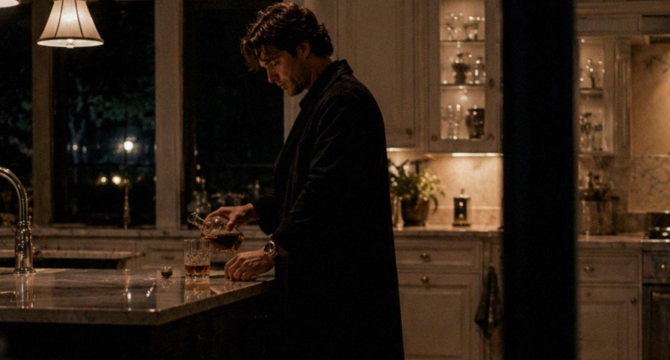
And there, standing in my father’s kitchen pouring himself a drink, was a man I had never seen before.
Maybe mid-30s.
Dark coat. Messy hair. Completely relaxed.
Like I was the intruder.
But the strangest part?
He was wearing my father’s old watch. The one my father never took off for 30 years.
My chest burned. Fear and fury tangled so tightly inside me that my voice came out as a scream.
“Who are you?!”
The man did not flinch.
He looked at the fireplace poker in my hand, then at my face, and set the glass down with a soft click.
“My name is Adrian,” he said.
I kept the poker raised. “That does not answer my question.”
He had tired gray eyes, sharp cheekbones, and dark hair that looked as if he had run both hands through it too many times. His coat was expensive, but worn at the cuffs. Nothing about him looked panicked.
He glanced toward the ceiling. “You should lower your voice.”
That only made my heart pound harder.
“You unlocked my door at 2 a.m. and walked into my kitchen. I’ll scream as much as I want.”
His jaw tightened. “This was never just your kitchen.”
I stared at him.
Then he lifted his wrist, and my father’s watch caught the light.
“Take that off,” I breathed.
His expression changed.
Not guilt. Pain.
“Your father gave it to me,” he said. “Before he died.”
“My father?” I laughed once, but it cracked in my throat. “You don’t get to say that.”
Adrian’s eyes held mine. “Your father told me this house would be mine one day, too.”
The room seemed to tilt.
For a moment, all I could hear was my own breathing and the old pipes groaning inside the walls. I thought of the locked rooms upstairs, the cameras in corners, the staff who never lasted long, and the rumors people whispered after my mother died.
Screaming arguments at night. Strange cars at the back gate. My father turning the mansion into a fortress.
“You’re a liar,” I said.
Adrian reached into his coat pocket and placed a key ring on the table.
There were more than a dozen keys.
I followed him upstairs because fear had become less powerful than rage. He opened my father’s study first, the room I had not been able to enter. Inside, dust covered the desk, but not the floor near the bookshelves. Someone had been there recently.
Adrian pressed a hidden latch behind a framed hunting print. A narrow closet opened.
Inside were clothes that did not belong to my father. Coats, shoes, shirts, all neatly arranged. There were old photographs in a box on the top shelf.
I picked one up with trembling fingers.
A little boy stood in the garden behind the mansion, squinting in the sun. Beside him was a young woman in a maid’s uniform. Behind them, half hidden by roses, was my father.
And in another photo, my mother knelt beside that same boy, smiling at him as she tied his shoelace.
My knees nearly gave out.
“My mother,” I whispered.
Adrian’s voice softened. “She was kind to me.”
I turned on him.
“No. Don’t you dare.”
“She knew,” he said quietly. “Not at first. But she found out. My mother worked here. Your father kept us hidden because he cared more about his reputation than anyone’s life.”
My fingers closed around the photograph. “My mother would have hated this.”
“She hated what he did,” Adrian replied. “But she never hated me.”
The words struck me harder than his arrival.
My mother had died when I was 13. She had been warm, elegant, and loved by nearly everyone in town. I remembered her perfume, her laugh, her hand smoothing my hair when I cried. She had been everything my father was not.
“She paid for my school,” Adrian continued. “Secretly. She sent books. Winter coats. Once, when I was eight, she found me crying in the laundry room because your father had shouted at my mother. She sat with me until I stopped shaking.”
I sank into my father’s chair.
The leather was cold beneath my palms.
“All these years,” I whispered, “I thought he shut me out because she died.”
“He did,” Adrian said. “But not only because of grief.”
He opened a drawer and pulled out a folder thick with papers. Bank transfers. Shell companies. Contracts. Names I recognized from campaign posters, charity boards, and the courthouse downtown.
My stomach twisted.
“Your mother found out about his business,” Adrian explained. “Not just the affair. The money. The bribery. The accounts. She was going to expose him.”
I looked up slowly.
“What are you saying?”
“I’m saying she died two weeks after she confronted him.”
The room went silent.
I wanted to scream. I wanted to call him a monster. I wanted to defend my father because some wounded part of me still wanted him to be better than this. But the documents were real. The handwriting on the notes was his. The fear in them was real, too.
“He spent years hiding evidence in this house,” Adrian said. “Cash, records, surveillance tapes. He became paranoid because the people tied to him wanted those things gone.”
A floorboard creaked above us.
Both of us froze.
Adrian looked at the ceiling, and the calm finally vanished from his face.
“I didn’t come back for money,” he said. “I came because someone else is searching the mansion too.”
The footsteps I had heard. The rooms seemed to shift from being locked to being open. The security lights that flashed in the dead of night.
For the next several hours, we moved through the mansion like strangers trapped in a nightmare. Adrian knew the hidden passages. I knew which memories hurt enough to point us in the right direction.
Behind the sunroom wall, we found tapes sealed in plastic.
Under loose floorboards in my mother’s old sitting room, we found ledgers and envelopes of cash.
In my father’s final letter, left in a safe behind my mother’s portrait, he had written both our names.
Abigail and Adrian.
He had left the mansion to both of us, but only if we uncovered what really happened before the evidence disappeared forever.
By sunrise, the police were on their way.
So were lawyers, reporters, and a storm neither of us could stop.
Adrian and I sat in the kitchen, exhausted, bruised by truth, and quiet. Pale light filled the room. My father’s watch rested between us on the table.
“I hated you when I saw you,” I admitted.
He gave a faint, sad smile. “I hated you before I met you.”
I looked at my mother’s photograph in my hands. “She protected us both.”
“She tried,” he said.
For the first time since I had entered that house, I did not feel like a child lost inside it.
I looked around the kitchen, at the dust, the broken locks, the secrets finally dragged into morning light.
And I understood.
My father hadn’t left me the mansion as a gift.
He had left it as a confession.

 admin
admin