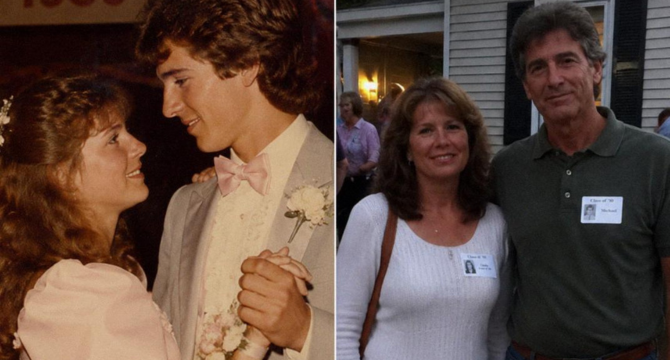
I hadn’t seen Claire since the summer of 1981.
For most people, 43 years is enough time for a face to fade. Enough time for a voice to blur at the edges. Enough time for an old love to become nothing more than a story you tell yourself on quiet nights when the house feels too still.
But Claire had never faded for me.
Back then, we were inseparable. We skipped classes together, danced at prom, and talked for hours in the parking lot behind the diner. I honestly believed we’d spend our lives together.
I could still picture her leaning against my old blue pickup, her arms folded, pretending to be mad because I was late. She wore her hair long then, with a ribbon tied near the end, and she had this way of looking at me like I was already better than I really was.
“You’re going to be late to graduation practice,” she’d say.
“So are you,” I would answer.
Then she would roll her eyes, but she’d be smiling before she even turned away.
We were 17, and everything felt possible.
I thought love was enough back then. I thought if two people wanted the same future badly enough, the world would simply move aside and let them have it.
Then one day, she disappeared.
No goodbye. No explanation. Her family moved away overnight, and after a few unanswered phone calls, she was simply gone from my life.
At first, I told myself there had to be a mistake. Maybe her parents had taken her somewhere for a few days. Maybe there had been an emergency. Maybe she would call me the next morning and laugh through the receiver, telling me I was being dramatic.
But the phone stayed silent.
I rode my bike past her house so many times that summer that the neighbor across the street finally stepped onto his porch and said, “Son, they’re gone.”
Gone.
That was all anyone would tell me.
For 43 years, I never stopped wondering why.
Life went on because it has a cruel way of doing that. I went to college for a while, then dropped out when my father got sick. I worked, married, had a son, divorced, buried both my parents, and learned how to eat dinner alone without making too much food.
But every now and then, especially when a certain song came on the radio or when I passed a diner with neon lights in the window, I thought of Claire.
I wondered if she had ever thought of me.
Last month, I attended my high school reunion mostly out of curiosity.
Truthfully, I almost didn’t go. The invitation sat on my kitchen counter for two weeks, tucked under a grocery list and an unpaid water bill. I told myself reunions were for people who liked to compare grandchildren and blood pressure medication.
I had no interest in standing under cheap balloons while pretending to remember people I had not spoken to in decades.
Still, on the night of the reunion, I put on a navy jacket, trimmed my beard, and drove to the old community hall.
The moment I walked in, I felt 17 and 60 at the same time.
There were photographs taped along one wall.
Football games. School plays. Prom night. A grainy picture of Claire and me caught my eye before I even reached the sign-in table. We were standing close, my hand awkwardly hovering near her waist, both of us too young to understand what time could take.
I looked away before my chest tightened too much.
Then the room shifted.
I almost didn’t recognize Claire when she walked into the hall. Her hair was gray now, and so was mine, but the second our eyes met, it felt like being 17 again.
She stopped near the doorway, one hand gripping the strap of her purse.
For a moment, neither of us moved.
Then she smiled sadly and said, “I always hoped I’d see you one more time.”
My throat closed around every question I had carried for four decades.
“Claire,” I managed.
She stepped closer, and suddenly there she was. Older, softer around the eyes, but still Claire. Still the girl from the diner parking lot. Still the person whose absence had shaped parts of me I never admitted out loud.
We spent hours talking that night. About our lives, our marriages, and our regrets.
She told me she had two daughters and lived three states away. I told her about my son and my small repair shop. We laughed about our old teachers, about prom, and about the time we got caught skipping history class and tried to convince the principal we were “studying architecture” behind the diner.
But underneath every laugh, something sat between us.
The entire evening, she kept nervously holding an old yellow envelope in her purse like it physically hurt her to let it go.
I noticed it when we sat down. I noticed it when she took a sip of coffee. I noticed how her fingers kept brushing over the paper, as if checking whether it was still there.
Finally, just before leaving, she handed it to me.
“I wrote this in 1981,” she whispered. “But I never sent it.”
My hands were shaking as I opened the letter.
The first few lines instantly made my stomach drop.
The paper trembled between my fingers.
Claire stood beside me near the coat rack, her face pale under the soft yellow lights of the hall. Around us, people were laughing, hugging, and calling out old nicknames. Someone had started playing a song from our senior year, but the sound seemed to drift far away.
I looked down at the letter.
“Jeremy, if you are reading this, it means I found a way to tell you the truth.”
My chest tightened.
I read the next line, then the next, and for a moment I forgot how to breathe.
“I did not leave because I stopped loving you. I left because my parents found out I was pregnant.”
I looked up at Claire.
Her eyes were already wet.
“Pregnant?” I whispered.
She nodded once, her lips pressed together as if she had held that single word in her mouth for 43 years and it still hurt to release it.
“With my child?” I asked, though I already knew the answer.
Claire covered her mouth with one hand. “Yes.”
The hallway seemed to tilt beneath my feet. I gripped the letter harder, afraid I might drop it, afraid I might tear it, afraid that if I blinked, I would wake up alone in my kitchen with that old reunion invitation still sitting on the counter.
I forced myself to keep reading.
“My father said you would ruin your life if I told you. My mother cried and said people would talk. They packed our house in one night and drove me to my aunt’s place in Ohio. I called you twice from a pay phone, but my father found out. After that, I was never left alone long enough to try again.”
My eyes burned.
I remembered those phone calls I had waited for. I remembered sitting beside the phone until my father told me to stop punishing myself. I remembered hating Claire for leaving and hating myself for not being worth a goodbye.
“You should have told me,” I said, but there was no anger in my voice.
Only grief.
“I know,” she replied. Her voice cracked. “I was 17, Jeremy. I was scared. They told me you’d hate me. They told me your parents would blame me. I believed too much of what adults said back then.”
I swallowed and looked back at the letter.
“They made me give the baby up. A closed adoption. I begged them to let me write your name down somewhere, but they would not. I named him Samuel in my heart, just for one day. Then they took him from me, and I never saw him again.”
The room blurred.
A son.
Somewhere in this world, Claire and I had a son.
Not a dream. Not a maybe. A living person who had existed all these years while I fixed cars, paid bills, divorced, aged, and wondered why a girl with a ribbon in her hair had vanished without looking back.
I lowered myself onto the bench against the wall.
Claire sat beside me, careful not to touch me.
“I searched,” she said softly. “After my parents died, I tried. Records were sealed. I hired people. I sent forms. Nothing led anywhere.”
“Why tell me now?” I asked.
She reached into her purse again, and this time she pulled out a folded sheet of paper. Her fingers shook as she placed it in my lap.
“Because three months ago,” she said, “he found me.”
I stared at her.
Her tears spilled over, but she smiled through them.
“His name is not Samuel,” she continued. “His adoptive parents named him Daniel. He is 42. He has a wife, a little girl, and your eyes.”
My hand went to my mouth before I could stop it.
Claire unfolded the paper. It was a photograph.
A man stood on a porch with a child on his shoulders. He had Claire’s smile. My jaw. My eyes, exactly as she had said. I stared until the image wavered.
“He knows about you?” I managed.
“He knows I was coming here tonight,” Claire answered. “He asked me not to force anything. He said he understands this is a lot.”
I laughed once, but it broke halfway and turned into something close to a sob.
“For 43 years, I thought you just left me.”
“I know,” she said. “And for 43 years, I hated myself for letting you think that.”
I looked at her then. Really looked at her. Not as the girl who vanished, but as the girl who had been taken, cornered, frightened, and silenced. The anger I had carried for decades softened into something heavier and kinder.
“I missed a whole life,” I murmured.
“So did I,” Claire said.
For a long moment, neither of us spoke.
Then I reached for her hand. Her fingers curled around mine with the same shy warmth I remembered from the diner parking lot.
“Can I meet him?” I asked.
Claire’s face crumpled with relief.
“He hoped you would ask.”
I looked down at the photograph again. At my son. At my granddaughter’s bright grin. At the proof that love, even buried under fear and years and silence, could still leave something living behind.
When I finally stood, the reunion hall no longer felt like a place full of old ghosts.
It felt like a doorway.
Claire squeezed my hand and whispered, “I am sorry, Jeremy.”
I turned to her, my heart aching in ways I could not name.
“I am too,” I said. “But maybe we still have time to learn the rest of the story.”

 admin
admin