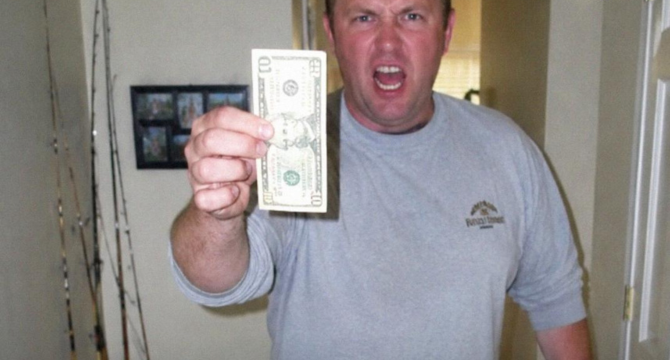
The kitchen smelled faintly of stale coffee and unwashed dishes. I stood by the counter, my fingers tracing the jagged edge of a single, crumpled ten-dollar bill.
My husband, Mark, had tossed it down with the casual flick of a man who thought he was being generous.
“Make it work for the weekend,” he had laughed, slinging his heavy fishing vest over his shoulder.
I didn’t answer him.
I couldn’t.
I watched him saunter toward the door, his gear bag clanking with the promise of beer, bait, and three days of total freedom. The screen door creaked shut behind him, cutting off the afternoon sun and leaving the house in a heavy, suffocating silence.
“Mom… is that all the money we have?” my youngest asked, tugging softly at my apron.
I looked down at the bill.
It was the only thing standing between us and an empty pantry. My heart hammered against my ribs, a frantic rhythm of panic I had become far too familiar with over the last few years.
“It is what we have to work with today,” I said, forcing my face into a calm, reassuring mask.
“But what about dinner?” my oldest daughter whispered, peering into the barren refrigerator. “The shelves are basically empty, Mom.”
I swallowed the lump in my throat and mustered my best smile.
“We’ll figure it out, I promise.”
I didn’t tell them that the electric bill was already two weeks overdue. I didn’t tell them I had been rationing the last of the milk for their cereal while I drank black coffee and called it breakfast.
For years, I had perfected the art of the lie.
I told myself that keeping the family together, no matter how thin the tether, was worth the cost of my own dignity.
“Dad said he would bring home fresh fish,” my son said, his eyes bright with misplaced hope.
“He probably will,” I lied again.
I turned away so my little boy wouldn’t see the flicker of anger in my eyes.
The truth was, this wasn’t the first time Mark had been so carelessly selfish.
He treated the household budget like an afterthought, something I could patch up with magic and willpower while he disappeared to the lake. He viewed my patience as a permanent fixture, like the kitchen table or the leaky faucet he promised to fix every spring.
“Mom, why do you look like you’re going to cry?” my daughter asked, her voice sharp with sudden awareness.
I reached out and brushed a strand of hair from her forehead.
“I’m not crying, honey. I’m just thinking about our plans.”
“Are we going to see Grandma?” she pressed.
“Maybe,” I said, though my mind was racing somewhere else entirely.
I stood there staring at the crumpled bill, wondering how many more times I could pretend this was enough to build a life on.
My hands trembled, not from fear, but from the sudden, cold realization that my sacrifice had only enabled his indulgence.
I was exhausted.
And for the first time, I was truly angry.
That weekend, something inside me finally snapped.
I watched the kids eat, pretending I had already finished my own meal. While Mark posted pictures of fish and beer online, I was cutting sandwiches into tiny pieces so the kids wouldn’t notice I had skipped dinner again.
The hunger was sharp and humiliating, but it was nothing compared to the ache of seeing my children accept less than they deserved.
My oldest daughter hovered by the kitchen door, watching me carefully.
She saw right through my forced smile.
she whispered, her voice trembling slightly.
That question hit harder than anything Mark had ever said.
It wasn’t just a child’s observation. It was a mirror reflecting my own cowardice back at me.
“He just doesn’t understand, honey,” I said, though the lie felt like ash in my mouth.
“He understands,” she replied, stepping closer. “He just doesn’t care about us as much as he cares about his fishing.”
I looked at the empty cupboard.
For a moment, I couldn’t speak.
Then I realized the only way to save my family was to stop saving my marriage.
My daughter’s wisdom stung more than the hunger.
“Are we going to be okay if he keeps doing this?” she asked, looking up at me with wide, searching eyes.
I pulled her into a hug, feeling the tension in her small frame.
“We are going to be more than okay, sweetie. I promise.”
As I held her, another truth settled heavily in my chest.
I had been training my children to accept neglect as normal. Every time I made an excuse for Mark, I was telling them they didn’t deserve better. Every time I smiled through fear, I taught them that love meant going without while someone else took everything.
“Do you mean that?” she asked, pulling back to look at my face.
“I do,” I said firmly. “I’m finished being the one who cleans up the messes while he plays around.”
I grabbed my phone and checked the bank account balance again, just to be sure.
It was still empty.
The number on the screen mocked every sacrifice I had made, every meal I had skipped, every bill I had begged for more time to pay.
“What are we going to do?” she asked, her curiosity replacing some of her fear.
“We’re going to stop waiting for him to provide,” I said, my voice gaining strength. “We’re going to take back what is ours.”
I walked to the closet where Mark kept his expensive fishing gear.
For years, he had guarded that closet like it held treasure.
In a way, it did.
Rods and reels worth a small fortune lined the walls. Specialized tackle boxes were stacked neatly on shelves. He had waterproof boots, brand-name jackets, and lures still sealed in their packaging.
Money he had spent while our bills piled up.
Money he had claimed we didn’t have.
I started pulling the gear out, piece by piece, piling everything in the hallway.
“Are you selling his things?” my daughter asked, wide-eyed.
“I’m selling the things he prioritized over our groceries,” I replied.
“Will he get mad?” she asked quietly.
“He will get mad, yes,” I said, looking at the pile. “But for once, he will have to deal with the consequences of his own choices.”
I looked at the empty cupboard again.
The fight had finally begun.
And I was no longer afraid of the outcome.
By Sunday night, everything was ready.
The door swung open, and Mark stepped into the living room, reeking of lake water and stale beer. He tossed his keys onto the counter with a cocky grin, oblivious to the silence hanging in the air.
“Honey, you won’t believe the size of the bass I caught!” he shouted, kicking his muddy boots aside.
He stopped mid-sentence when he noticed the living room.
All his expensive fly-fishing rods, high-end reels, and specialized tackle boxes were gone.
The wall that had once displayed his pride and joy was empty.
“Where is my gear?” he demanded, his voice rising in panic.
I stood by the kitchen table, my hands folded calmly in my lap.
“The gear is gone, Mark. I sold it.”
He turned slowly, his face turning a blotchy red as he stomped toward me.
“You did what? That was my equipment! That was worth thousands!”
“It was worth groceries, Mark,” I said, keeping my voice steady despite my heart hammering against my ribs. “It was worth the rent that was three months behind because you preferred spending our savings on gear instead of our kids.”
“You had no right!” he roared, slamming his fist onto the table. “That was mine. You are just supposed to take care of this house and stay out of my business!”
“This is my house, too,” I replied, standing up to meet his glare. “And my business is ensuring that my children aren’t starving while you play pretend out on the water.”
He grabbed his hair, pacing in tight, furious circles.
“I worked for that stuff. I made the money for those rods!”
“You made the money, but you never paid the bills,” I corrected him. “I’ve been juggling collection notices for two years while you were out casting lines.”
“So you just sold it all?” he spat, leaning into my personal space. “You’re just going to throw away my life because you’re jealous that I wanted a weekend off?”
“I’m not jealous, Mark. I’m done,” I said, feeling a surge of cold, sharp clarity. “I didn’t just sell your gear to buy food. I sold it to pay the deposit on a new apartment for the kids and me.”
He blinked, his mouth dropping open in genuine shock.
“A what? You’re leaving? You can’t leave me!”
“Watch me,” I said, pointing to the stack of legal papers on the counter. “I’ve filed for separation, and I’ve already secured a new lease in my name.”
“You’re bluffing!” he yelled, though his voice wavered. “You don’t have the guts to do this alone. You’ll be back begging for me to come home in a week.”
“I’m not begging for anything,” I replied. “I’ve spent ten years begging for the bare minimum, and I’m done.”
He reached out to grab my arm, but I stepped back, my eyes cold.
“Don’t touch me, Mark.”
He froze.
For one brief second, the anger in his face faltered.
“The locks are already changed,” I continued. “Your things are on the porch.”
“This isn’t happening,” he whispered, his bravado finally crumbling into confusion. “Where are you going?”
“Somewhere quiet,” I said, walking toward the door. “Somewhere where the money is used to feed the people who live there.”
He looked past me and saw the bags waiting near the entryway.
Small bags.
Not everything we owned, but enough. Clothes for the kids. Documents. School things. The few belongings that mattered.
His face paled.
“You can’t do this to me,” he said. “I’m the head of this house.”
I stopped with my hand on the doorknob and looked back at him.
“You were never the head of this house, Mark. You were just the loudest person in it.”
His mouth opened, but no words came out.
For once, he had nothing clever to say. No joke. No insult. No easy way to twist the moment until I felt guilty for being hurt.
He stood there, surrounded by his own hollowed-out sanctuary, finally looking at the empty walls where his life of leisure used to be.
“But what about me?” he asked, his voice smaller now. “Where am I supposed to go?”
I thought of the ten-dollar bill.
I thought of my children asking about dinner.
I thought of all the nights I had stretched food, stretched money, stretched myself until there was almost nothing left.
Then I picked up my youngest’s backpack and reached for my daughter’s hand.
“That is no longer my problem,” I whispered.
My children followed me onto the porch. The evening air was cool, and for the first time in years, it did not feel like another thing I had to survive.
Behind us, Mark stood in the doorway, staring at the family he had assumed would always be waiting for him.
He had left us with ten dollars and expected me to make it work.
So I did.
I made groceries work. I made overdue rent work. I made a deposit on a new apartment work. And I bought my freedom.
As I walked away, the weight of his selfishness lifted from my shoulders one step at a time.
I wasn’t leaving behind a home.
I was escaping a cage.
And for the first time in a long time, my children and I were walking toward a future that was truly ours.

 admin
admin