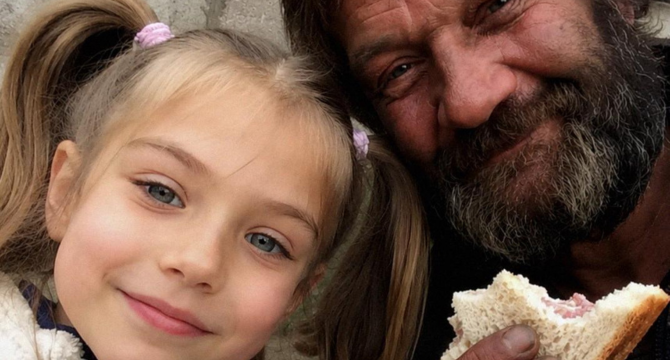
When my daughter Emma was nine years old, I started noticing that food kept disappearing from our refrigerator. At first, I thought I was simply losing track of groceries during my hectic work weeks.
But the reality was much more complicated.
“Emma, did you throw the second one away?” I asked about the sandwich I had packed for lunch, holding up her empty lunchbox.
“No…” she mumbled, looking at the kitchen floor. “I lost it.”
“You lost a sandwich?”
“It fell out of my backpack.”
“Yesterday you told me you dropped your apples in the dirt.”
“I’m just clumsy lately, Mom.”
The next day, I packed her lunch but decided to secretly follow her walking route home from school. She bypassed our street and detoured to the old park near the bus station. A disheveled homeless man sat on a bench in the far corner.
“Today it’s turkey,” Emma said softly, handing him a paper bag. “And an apple too.”
“You are an angel,” the man replied, his hands shaking as he took the food. “Thank you, sweetheart.”
I stormed forward out of the shadows, grabbing Emma’s arm.
“What do you think you are doing?!” I screamed.
“Mom, please don’t be mad!”
“Do you even understand how dangerous this is?!” I snapped at her.
“Mom… he’s always hungry,” Emma said.
“Who are you?” I yelled at the man. “Stay away from my daughter!”
“Ma’am, I didn’t ask her to—”
“Shut up! Don’t you ever speak to her again!”
“Mom, stop it!” Emma cried. “I told you he’s always hungry!”
“I don’t care! Get in the car right now!”
At home, I paced the living room in a panic while my husband, Mark, sat on the couch.
“Mark, our nine-year-old daughter was feeding a homeless vagrant in the park!” I shouted.
“So what?” Mark muttered, keeping his eyes glued to his laptop.
“So what? He could be a dangerous criminal!”
“She’s fine, isn’t she?”
“You need to act like a father and talk to her!”
“Fine,” Mark sighed, slamming his laptop shut. “Emma, get out here!”
Emma slowly walked into the living room, tears streaming down her cheeks.
“Listen to me very closely,” Mark said coldly. “Don’t ever go back to that park.”
“But Dad, he has no one else.”
“That’s not our problem. Stop wasting my hard-earned money on street trash.”
“He’s not trash!”
“Go to your room! Now!”
That was the end of the park visits, but the beginning of our ten-year nightmare. Emma fell seriously ill a few months later with a rare, debilitating neurological disease.
“The hospital bills are destroying us,” I told Mark one evening, holding a stack of past-due medical notices.
“I can’t do this anymore,” he replied, zipping up a travel bag.
“Where are you going?”
“Away from here.”
“You’re abandoning your dying daughter?”
“I’m drowning, Sarah! This illness is a bottomless pit!”
“She needs her father!”
“I won’t let her medical bills ruin the rest of my life.”
He walked out the door and never looked back.
Ten agonizing years passed while I sold absolutely everything that we owned to afford Emma’s treatments. We were completely broke, and the doctors had finally run out of hope.
Yesterday evening, a sharp knock echoed through our tiny, rundown apartment. I opened the door to find a tall man in a tailored, expensive dark suit.
“Does Emma live here?” he asked, his voice calm and authoritative.
“And who are you?” I demanded, blocking the doorway.
“Tell her she can start packing her things.”
“What are you talking about?”
“She won’t be staying in this apartment much longer.”
“Are you threatening us? Because I will call the police.”
“There’s no need for that,” he said, smiling slightly.
“What’s going on? Explain yourself before I slam this door.”
“Ten years ago, your daughter helped me. Now it’s my turn to help her.”
“Helped you how?” I whispered, my heart racing as a cold feeling spread through my chest.
“She brought me turkey sandwiches.”
“Who are you?”
“May I come in?”
Arthur stepped into the apartment, revealing that the homeless man we once pitied now held my daughter’s life in his hands.
“I am Arthur,” the man said, stepping fully into our cramped living room.
“I don’t understand,” I whispered, clutching the doorframe. “Why are you here?”
“Ten years ago, I sat on a park bench by the bus station,” he replied. “I had lost everything. My family, my home, my will to live.”
I stared at his expensive dark suit in sheer disbelief.
“You were the homeless man?” I gasped. “The one Emma fed?”
“Yes,” Arthur said, his eyes welling with tears. “Emma treated me like a human being. Her kindness gave me the strength to rebuild my life.”
“She is incredibly sick now,” I sobbed. “The doctors have given up.”
“I know,” Arthur said gently. “I am the CEO of a logistics company now. I have arranged for an experimental treatment in Switzerland, and I will pay for everything.”
“Everything?” I asked, trembling uncontrollably.
“The flights, the doctors, the housing,” he insisted. “Let me save her, just as she saved me.”
“Are you completely out of your mind?!” a harsh voice suddenly shouted from the hallway.
I spun around in terror.
It was Mark, my estranged ex-husband. He hadn’t visited us in over a year, ignoring our desperate calls for help.
“Mark? What are you doing here?” I demanded.
“I still get the landlord’s eviction notices, Sarah!” Mark sneered, stepping aggressively into the room. “I came to tell you to pack up. Who is this guy?”
“My name is Arthur. I am here to help Emma.”
“Help her?” Mark laughed bitterly. “You’re a scammer. I can smell it from a mile away.”
“He is offering to send her to Switzerland!” I yelled at Mark. “He’s paying for a miracle!”
“There are no miracles, Sarah,” Mark snapped. “Only con artists trying to harvest organs or steal identities.”
“I am fully prepared to transfer the funds to the clinic today,” Arthur stated calmly.
“You aren’t transferring anything,” Mark growled, stepping dangerously close to Arthur.
“Mark, please,” I begged, stepping between them. “Emma is dying. This is our only chance.”
“Emma belongs in a local hospice where she can pass peacefully,” Mark replied coldly. “I won’t let some stranger drag her across the world for a fake cure.”
“You abandoned us!” I screamed, tears streaming down my face. “You walked out when things got hard! You have no right to decide this!”
“I am still her legal father,” Mark fired back. “I retain partial medical guardianship, and I say no.”
Arthur stood his ground, his posture completely rigid.
“I have the international transfer paperwork ready,” Arthur said. “It only requires both parents’ signatures.”
“You will never get mine,” Mark hissed.
“Why are you doing this?” I sobbed, grabbing Mark’s arm. “Do you actually want her to die?”
“I am protecting her from false hope!” Mark shouted, forcefully shaking me off.
“You are just afraid of the medical debt,” I cried. “You’ve always been a selfish coward!”
“Watch your mouth, Sarah,” Mark warned, raising his finger at me.
“I will cover all outstanding debts,” Arthur interjected. “You will not pay a single cent, Mark.”
“I said no!” Mark roared. “I will call the police and have you arrested for fraud!”
“I am trying to save a little girl’s life,” Arthur said, his voice dropping to a dangerous, knowing whisper.
“What exactly are you trying to do, Mark?”
Mark flinched. For a brief second, sheer panic flashed across his eyes.
“I am protecting my family,” Mark muttered, backing away slightly.
“Then sign the medical release,” I pleaded, holding out my trembling hand. “Please, Mark. Just give our daughter a chance.”
“If you try to take her out of the country, I will file kidnapping charges,” Mark threatened.
“You wouldn’t dare,” I whispered, my blood running completely cold.
“Try me,” he sneered.
Mark aggressively reached into his leather briefcase and pulled out a thick stack of court orders.
“I brought these to forcefully transfer her to the state hospice facility,” he said. “It’s over, Sarah.”
“No,” I sobbed, falling to my knees in front of him. “You can’t do this to her.”
Mark slammed the legal documents on the table, proving he had the power to block the treatment and let Emma die.
“Please, Mark,” I begged, grabbing his arm in the hospital corridor. “Just sign the international transfer papers.”
“I am not signing anything,” Mark sneered, pulling his arm away. “That man is a complete fraud.”
He turned and walked toward the elevators, leaving me trembling.
I couldn’t breathe. Arthur had left by then, so I immediately called him and begged him to meet me at the cafe across the street.
“He won’t sign the release,” I sobbed as Arthur sat down. “He said he will take Emma away from me.”
Arthur’s jaw tightened.
“Mark isn’t trying to protect her,” Arthur said quietly.
“He is trying to protect himself.”
“What do you mean?” I asked. “Why does he hate you?”
Did you ever wonder how I ended up starving on that park bench?” Arthur asked.
“You said you lost everything in a terrible accident,” I replied.
“I did,” Arthur stated, pulling a folded paper from his pocket. “It was a hit-and-run.”
He slid an old, creased police report across the table toward me.
“I was left in a coma for a month,” Arthur explained. “My medical bills bankrupted me.”
“That is horrible,” I whispered, scanning the faded document. “But what does this have to do with Mark?”
“Look closely at the vehicle description,” Arthur instructed.
I read the text out loud. “A dark blue SUV with a customized front grille.”
My stomach dropped to the floor.
“Mark drove that exact car,” I gasped, staring at Arthur in shock. “He sold it for scrap ten years ago.”
“He claimed the engine died, didn’t he?” Arthur asked.
“Yes,” I stammered. “He said it wasn’t worth fixing.”
“The engine was fine,” Arthur said bitterly. “The front end was smashed because he hit me and left me to die.”
“No,” I whispered. “Mark is selfish, but he wouldn’t leave a man to bleed out.”
“He did,” Arthur said firmly. “And little Emma knew all about it.”
“Emma was nine years old!” I yelled. “How could she possibly know?”
“Because she overheard him confessing,” Arthur explained. “She heard him crying on the phone about hitting a man near the bus station.”
I sat back, completely stunned by the horrific revelation.
“That is why she started bringing me your groceries,” Arthur said. “She recognized me from the local news.”
“She was silently carrying her father’s guilt,” I whispered, my heart breaking.
“Mark isn’t afraid I’m a scammer,” Arthur said. “He is terrified of me.”
“Because you are a billionaire now,” I realized. “You can reopen the police investigation.”
“Exactly,” Arthur nodded. “If Emma goes abroad on my dime, Mark loses control.”
“He knows you will finally expose him,” I said.
“He let his own daughter suffer to hide his crime,” Arthur added darkly. “He hid his money so no one would look at his past.”
“And now he is willing to let her die to keep his secret safe,” I cried.
I looked down at the official police report in my shaking hands.
The fear that had paralyzed me for a decade suddenly vanished, replaced by a fierce fury.
Holding the evidence of Mark’s hit-and-run, I realized I had to risk destroying my family’s past to save my daughter’s future.
Emma had been admitted again two days earlier after another severe episode, and Mark was waiting in her hospital room when I arrived.
I marched into the hospital room and slammed the police folder onto the table.
“You’re wasting your time,” Mark sneered. “I’m never signing those transfer papers.”
“You will sign them right now,” I said. “Or I am calling the police.”
“The police?” Mark laughed coldly. “For what?”
“For the hit-and-run.”
“What are you talking about?”
“Ten years ago, Mark,” I yelled. “You destroyed Arthur’s life!”
“You don’t know anything!”
“Emma heard you confess that night!” I fired back. “She fed him because she knew what you did!”
“You have no proof!”
“Arthur has the wreckage records,” I warned. “He has your bank transfers. He has everything.”
“He’s bluffing,” Mark stammered.
“Sign the medical release, or I’ll hand this to the detectives right now.”
“You wouldn’t dare.”
“Watch me,” I said. “Sign it and get out of our lives forever.”
“Fine!” Mark shouted. “But you’re making a huge mistake!”
“Just sign it!”
Mark scribbled his name and ran out. Arthur stepped into the room moments later.
“He’s gone?” Arthur asked.
“Yes,” I cried. “We can finally go to the clinic.”
Arthur walked over and took Emma’s fragile hand.
“Are you really going to help me?” Emma whispered.
“Once, you saved me with a single sandwich,” Arthur said softly. “Now let me save you.”
“Thank you, Uncle Arthur.”
Months later, the experimental treatment worked. Emma was fully recovered. We returned to the old park and placed a paper bag on the weathered bench.
“Will someone find it?” Emma asked.
“Someone who needs it,” I promised.
“Just like he did?”
“Exactly like he did.”
“I’ll leave the note,” Emma said.
She placed a handwritten card right on top of the fresh sandwich.
“For someone who needs hope today.”

 admin
admin