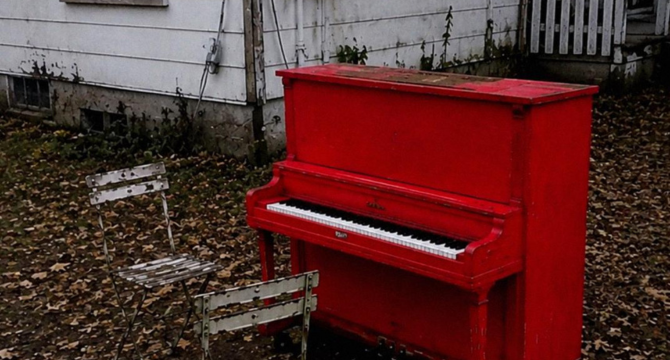
The first time I noticed the piano, rain was tapping softly against my kitchen windows while I cleaned dishes after dinner. Our neighborhood usually went silent around seven in the evening. Garage doors shut, curtains closed, and people disappeared into their homes like they were hiding from one another.
Then the music started.
Slow, gentle, and heartbreakingly beautiful.
I walked to the window and saw Mr. Peterson sitting behind an old upright piano in his front yard. He lived three houses down from me in the pale blue house with peeling shutters and dying rose bushes. Nearly 80 years old, always dressed in cardigans, always alone.
Every evening, without fail, he rolled that piano outside and played for exactly one hour. And every single night, beside the piano, he placed a second folding chair.
Empty.
At first, I assumed he was expecting company. But after weeks passed, no one ever sat there.
“Honestly, the music makes me sad,” my neighbor Cynthia complained one afternoon while checking her mail. “It’s like listening to someone grieve out loud.”
Her husband shrugged. “Old man’s lonely, I guess.”
Across the street, kids rode bikes past his house without even glancing at him anymore. Mr. Peterson had become part of the neighborhood background — like barking dogs or streetlights flickering on at dusk.
But I couldn’t stop noticing him.
Every evening around 6:45, he slowly pushed the piano down his driveway while carrying the folding chair under one arm. Sometimes he paused to catch his breath, shoulders trembling slightly before continuing.
Then he’d carefully place the chair beside him.
Always the same distance away.
Always facing forward.
And before he sat down to play, he’d look at that empty chair like he was waiting for someone.
One chilly evening, curiosity finally pulled me across the street. Mr. Peterson had just finished playing and was covering the piano with an old tarp when I approached him.
“Mr. Peterson?” I called softly.
He turned toward me with tired blue eyes. “Evening, Claire.”
“You know my name?”
A faint smile appeared. “You wave every morning before work.”
I nodded awkwardly, then glanced at the second chair. “Can I ask why you always bring that outside?”
The smile faded.
For a few seconds, only the wind moved between us. Then he rested one hand gently on the chair.
“My wife used to sit here while I played.”
The words hit me harder than I expected. He looked down at the empty seat, his expression softening with memory.
“Every summer evening after dinner, Margaret would bring out tea and listen to me practice.” A quiet laugh escaped him. “Didn’t matter how many mistakes I made. She loved hearing the same songs over and over.”
“What happened to her?” I asked carefully.
His eyes lowered.
“Cancer,” he whispered. “Three years ago.”
My chest tightened instantly.
The street around us suddenly felt too quiet. Mr. Peterson folded the chair slowly, his hands trembling slightly as he spoke again.
“We were married 47 years.” He swallowed hard. “Funny how a person can fill an entire life… then one day the whole world acts like they never existed.”
I didn’t know what to say.
He gave me a small nod, picked up the chair, and started walking toward his garage alone.
That night, I lay awake thinking about the empty chair beside the piano. That’s when I realized how many lonely people were quietly suffering behind closed doors.
The next morning, I couldn’t stop thinking about Mr. Peterson standing beside that empty chair.
All day at work, his words echoed in my mind.
The whole world acts like they never existed.
By the time I got home that evening, the guilt sitting in my chest had become unbearable. For years, we had all watched that man grieve from a distance without ever truly seeing him. So I did something our neighborhood rarely did.
I started knocking on doors.
Cynthia answered first, still wearing her hospital scrubs. “Claire? Everything okay?”
“I need your help,” I said immediately.
Twenty minutes later, we were standing in my driveway along with six other neighbors while dusk settled over the street. Some looked confused. Others looked impatient.
“What’s this about?” Marcus asked, folding his arms.
I glanced toward Mr. Peterson’s dark house across the road.
“He’s been playing piano for his wife every night since she died.”
The group fell silent.
“She used to sit beside him while he played,” I continued. “That empty chair isn’t a decoration. He still brings it out for her.”
Cynthia’s expression changed instantly. “Oh my God.”
“Three years,” I whispered. “He’s been sitting out there alone for three years while we shut our windows.”
Nobody spoke for several seconds.
Then Tyler — the same boy who once called Mr. Peterson weird — quietly asked, “So what do we do?”
That single question changed everything. Within an hour, the entire neighborhood somehow became involved.
Cynthia texted people from the community group chat. Marcus brought folding chairs from his garage. Mrs. Green baked peach cobbler “because nobody should listen to sad music hungry.” Even the kids started helping, hanging small string lights along the fences while arguing over where they looked best.
And neighbors were actually talking to one another instead of rushing inside their homes. At one point, Marcus walked beside me carrying a box of lanterns.
“You know,” he admitted quietly, “I lost my dad last year.”
I looked at him in surprise.
He shrugged awkwardly. “Guess I understand the old man more than I realized.”
As the sky darkened, Cynthia hurried toward us, holding her phone.
“You’re not going to believe this,” she whispered.
“What?”
“I found Mr. Peterson’s daughter online.”
“What?”
“She replied to me.” Cynthia’s eyes widened. “She said her mother’s name was Margaret, and…” Her voice softened. “She sent us a photo.”
She turned the screen toward me.
The woman in the picture had silver curls, bright laughing eyes, and one hand resting lovingly on Mr. Peterson’s shoulder while he played piano beside her.
For a second, my throat completely closed.
“She also said Margaret drank chamomile tea every single evening,” Cynthia added softly.
Without hesitation, Mrs. Green lifted a thermos from the table. “Then we’re making her tea.”
At exactly seven o’clock the following evening, the neighborhood waited silently outside. String lights glowed softly across porches. Folding chairs lined the sidewalks. Children sat cross-legged on blankets, whispering excitedly while adults held paper cups between nervous hands.
Then Mr. Peterson emerged from his garage.
The street instantly fell quiet.
Slowly, he pushed the piano down the driveway like he always did, one careful step at a time. But halfway across the lawn, he stopped. His eyes lifted toward the crowd gathering around him. I watched confusion spread across his face first.
Then disbelief.
The second folding chair was already waiting beside the piano.
And resting on it was a steaming cup of chamomile tea… along with the framed photograph of Margaret.
Mr. Peterson’s hands started trembling so badly he nearly let go of the piano.
Nobody spoke.
Nobody moved.
For several long seconds, he simply stared at the chair like he couldn’t understand what he was seeing. Then little Sophie, only eight years old, stepped forward, clutching the edge of her sweater.
“We thought,” she said shyly, “that she should still be here while you play.”
The old man covered his mouth with one shaking hand and began to cry. That night, nobody rushed back inside when the music ended.
We stayed.
Some neighbors wiped tears from their faces while others sat quietly beneath the string lights, listening to the soft crickets and the faint hum of summer wind moving through the trees. Mr. Peterson remained at the piano long after his final note faded, staring at Margaret’s photograph beside the untouched cup of tea.
Then he looked up at all of us.
“I don’t know what to say,” he whispered.
“You don’t have to,” Cynthia replied gently.
His eyes filled again.
After that evening, something changed in our neighborhood. People who had lived beside each other for years finally began acting like neighbors instead of strangers. Marcus started helping Mrs. Green carry groceries every Thursday. Kids stopped racing past Mr. Peterson’s yard and started sitting with him while he practiced. Sometimes they even requested songs.
And every evening at seven, more folding chairs quietly appeared outside his house.
Mine was always there first.
One chilly October night, after finishing a beautiful old melody, Mr. Peterson looked over at me and smiled.
“You know,” he said softly, “Margaret used to believe music could bring people back together.”
I glanced around the street.
Porch lights glowed warmly now. Neighbors laughed across sidewalks. Someone passed around a homemade pie while children chased each other beneath the hanging lights.
The neighborhood felt alive.
Mr. Peterson rested his fingers gently on the piano keys.
“I thought I lost everything when she died,” he admitted quietly. “But maybe love doesn’t disappear.” His voice cracked slightly as he looked at the chair beside him. “Maybe it just finds its way back differently.”
And under the soft evening sky, surrounded by people who finally saw him, he began to play again.

 admin
admin