I’m 37, I live alone, and honestly, I’ve always valued my peace and the way I keep my home. Everything has its place, everything feels calm, or at least it used to.
My house has never been fancy, but it has always felt like mine. The pale blue mugs sat neatly on the second shelf, right where I liked them. A soft gray throw rested over the arm of the couch. Near the door, a little ceramic bowl held my keys, lip balm, and the tiny coins I always forgot to spend.
After my divorce five years ago, that house became more than just walls and furniture. It became the first place where I could breathe without bracing myself for someone else’s mood.
So yes, maybe I was particular about it.
Maybe I liked wiping the counters before bed and waking up to clean floors. But peace, once you have fought for it, becomes something you protect.
A few nights ago, my 18-year-old niece showed up at my door with a small bag and that same sweet smile I’ve known since she was a kid.
Jenny stood on my porch in an oversized hoodie, her hair pulled into a messy bun, her cheeks pink from the cold. She looked tired, but when she saw me, her mouth curved into that familiar smile that used to get her extra cookies from me when she was six.
“Can I stay just for one night?” she asked. “Please, I don’t want to go home right now.”
I looked past her shoulder, half expecting to see my sister Rina’s car in the driveway.
There was nothing but the streetlights and the quiet row of houses.
“What happened?” I asked, opening the door wider.
Jenny shrugged, stepping inside. “Mom’s being Mom. We fought. I just need one night away from her.”
That was not hard to believe. Rina and Jenny could love each other fiercely one minute and burn the whole house down with words the next. My sister had a sharp tongue, and Jenny had inherited every ounce of her stubbornness.
Still, Jenny was my niece. I had held her when she was a newborn. I had taken her to get ice cream after her first school dance because she cried in the bathroom after a boy ignored her.
We’ve always had a great relationship, so I didn’t even hesitate.
“Of course,” I said. “You can take my bed. Just make yourself comfortable.”
Her shoulders dropped with relief. “Thank you, Aunt Abigail. I promise I won’t be any trouble.”
I gave her a warm look. “You’re not trouble. You’re family.”
She hugged me quickly, the way young people do when they want comfort but do not want to admit they need it. Then she carried her bag to my room while I checked the time.
That same night, I had to leave for a night shift at work. I work at a private care facility, and my shift started at 10 p.m. I had already changed into my scrubs, packed my lunch, and set the coffee machine to start brewing before I got home.
Before I left, I checked on her.
She was lying in bed, scrolling on her phone.
The lamp on my nightstand was glowing softly beside her, and for a second, I saw the little girl she used to be. The one who had asked me to check under the bed for monsters when she slept over.
“Do you need anything before I go?”
Jenny glanced up. “No, I’m good.”
“No friends over, okay? I know you’re 18, but this is still my house.”
She gave me a playful roll of her eyes. “I know.”
I stood there a second longer.
“Don’t worry, I’ll be quiet,” she said with a grin.
I smiled and left.
Work was long and heavy. One of our residents had a bad night, and by sunrise, my back ached from lifting, my eyes burned, and all I wanted was a hot shower and my own clean, quiet bed.
When I came back in the morning, I froze in the doorway.
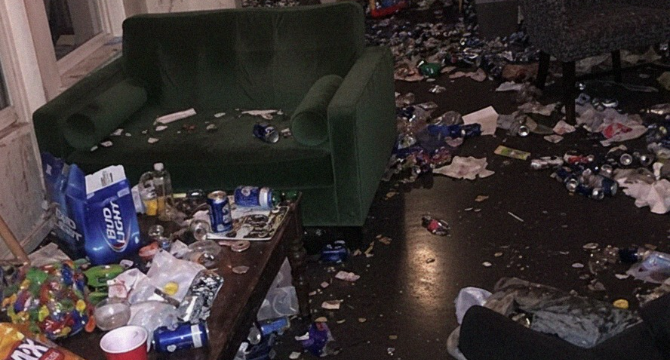
My house looked like a disaster zone. Trash everywhere, empty bottles, food on the floor, furniture moved — it looked like there had been a party for 50 people.
There were greasy paper plates on my coffee table, a sticky puddle near the hallway, and one of my dining chairs was lying on its side. My gray throw was bunched in the corner with something dark spilled across it.
The air smelled like cheap soda, alcohol, and sweat.
“Jenny?” I called.
Silence.
I walked to my bedroom, my heart pounding. My bed was unmade, my pillows were on the floor, and my dresser drawers were half open.
And she was gone.
I called her.
No answer.
Again. Nothing.
Then I called my sister.
Rina picked up on the fourth ring, her voice thick with sleep. “What?”
“Is Jenny with you?”
“She’s home, sleeping,” she said casually.
“What?” I almost yelled. “She trashed my house and just left!”
There was a pause, then she snapped, “You shouldn’t have let her stay. That’s your problem, not mine.”
I stood there in complete shock, staring at the mess around me.
About an hour later, my father arrived.
He took one look inside, and his expression changed instantly.
“That’s enough,” he said firmly. “This family has gone too far. It’s time my daughter and granddaughter learned some manners.”
He looked at me. “Come with me. I have something planned.”
We got into the car, and in that moment, I had no idea that what he was about to do wasn’t just talk.
Dad did not say much as he drove.
That scared me more than if he had yelled.
He was 64, the kind of man who could silence a room just by clearing his throat. But he had always been soft with Jenny. She was his first granddaughter, the baby who used to sit on his lap and steal the cherry from his ice cream.
So when he gripped the steering wheel with both hands and kept his eyes on the road, I knew something inside him had finally snapped.
“Dad,” I said quietly, “what are you planning?”
He glanced at me. “Something I should have done years ago.”
My stomach tightened. “Please don’t make this worse.”
He let out a slow breath.
“Abigail, your sister spoke to you like you were a stranger. Your niece destroyed your home and ran back to bed. You cleaned up after everyone in this family for too long.”
His words landed harder than I expected.
We pulled into Rina’s driveway twenty minutes later. Her curtains were closed, and Jenny’s little red car was parked crookedly near the garage.
Dad knocked once.
Rina opened the door in her robe, her hair messy, her face already annoyed.
“What is this?” she muttered. “Why are you both here?”
Dad stepped inside without waiting for permission.
“Tell Jenny to wake up.”
Rina folded her arms. “Absolutely not. She had a rough night.”
I stared at her. “A rough night? Rina, she threw a party in my house.”
My sister’s eyes flicked toward me. “You always exaggerate.”
That stung because it was so familiar. Rina had a way of shrinking people’s pain until it fit inside her version of events.
Dad raised his voice, not loud, but firm enough to cut through the room.
“Wake her.”
Rina’s mouth tightened, but she turned and yelled, “Jenny! Get down here.”
A few minutes later, Jenny appeared at the top of the stairs in sweatpants and one of my hoodies.
My hoodie.
I looked at it, and the anger I had been holding together started to crack.
“Is that mine?” I asked.
Jenny tugged at the sleeves. “I borrowed it.”
“You borrowed my house, too?” I replied, my voice shaking. “My bed? My trust?”
Her face changed.
For a second, she looked younger than 18.
“Aunt Abigail, I didn’t mean for it to get that bad.”
Rina scoffed. “See? She apologized. Can we be done now?”
“No,” Dad said.
He reached into his coat pocket and pulled out his phone. Then he placed it on the coffee table and tapped the screen.
A video started playing.
I recognized my living room immediately. Loud music. People laughing. Jenny was standing near the kitchen with a bottle in her hand. Someone shouted, “Your aunt is going to kill you!”
Jenny laughed in the video and said, “She won’t do anything. She never does. Mom said Aunt Abigail is too desperate to be loved to kick me out.”
The room went silent.
I felt the words hit me so hard that for a moment, I could not breathe.
Jenny’s eyes filled with panic. “I was joking.”
I looked at Rina.
She did not look surprised.
That was the twist I had not seen coming. Jenny had not just taken advantage of me. Rina had taught her that I was someone who could be used, someone who would swallow hurt if it meant keeping the peace.
Dad turned off the video. “Jenny sent that to her cousin’s group chat. Your cousin Lena showed me this morning.”
Jenny started crying then. Not loudly. Just enough for her face to crumble.
“Aunt Abigail,” she whispered, “I’m sorry. I thought it was funny. Mom always says you act all perfect and make everyone feel bad. I didn’t think about how it would hurt you.”
Rina snapped.
“Don’t blame me.”
Dad looked at her with disappointment so deep it changed his whole face. “She is blaming you because you gave her the words.”
For once, Rina had no answer.
I swallowed the lump in my throat. “Jenny, you are going to come to my house today. You are going to clean every inch of it. You will pay for anything broken. And after that, you are not welcome there until I believe you understand what you did.”
Jenny nodded, crying harder. “Okay.”
Then I faced my sister.
“And you,” I said, my voice steadier now, “do not get to hand people knives and act shocked when they cut me.”
Rina’s eyes flashed, but I did not look away.
Jenny came with us. She scrubbed floors, gathered bottles, apologized in small broken pieces, and cried when she found the stained throw she remembered using during movie nights as a child.
I cried too, but not in front of her.
By evening, my house looked like mine again.
Not exactly the same, though.
Something had shifted.
I had always thought peace meant keeping everyone close, even when they hurt me. That day, I learned peace sometimes means locking the door, loving people from a distance, and finally choosing yourself without apology.

 admin
admin