From the day I married Adrian six years ago, I knew blending our families would not be simple. Love did not magically smooth out sharp edges, and Stacy, his 19-year-old daughter, had more than a few of those.
She moved through our house like a storm that never fully passed.
There were sticky fingerprints on the glass coffee table, makeup stains on the bathroom counter, empty bottles rolling under the furniture, and a steady parade of friends who laughed too loudly and never seemed to know how to close a door.
Every room she entered looked slightly worse when she left it.
Meanwhile, my son, Sam, who is 11, seemed to shrink himself to fit around the chaos. He did his homework at the kitchen table without being asked. He lined up his pencils neatly.
He thanked me for dinner every night, even when it was just soup and sandwiches, because I was too tired to cook.
He never demanded attention.
Never slammed doors. Never made the house feel heavier.
The contrast between them was impossible to ignore.
“This is my dad’s house too,” Stacy would announce, sprawled across the couch with her shoes still on, scrolling on her phone like the rest of us were just background noise in her life.
“Not when you treat it like your personal dumpster,” I’d shoot back.
“You’re not my mom,” she’d snap, her eyes rolling so hard I worried they’d get stuck.
That was our rhythm.
Her pushing, me pushing back. Adrian spent years trying to play peacemaker, always stepping between us with that tired expression that said he wanted peace more than truth.
But for the last 37 days, he had been away on a work trip, bouncing from one city to another, living out of hotel rooms and conference calls. Without him in the middle, the tension in the house had nowhere to go. It just built and built, snapping through the air like something dangerous.
I told myself to stay calm. I told myself Stacy was young, that 19 was still close enough to childhood to explain some of her selfishness.
But every day, it became harder to find excuses for her.
Last week, I was reviewing our bank activity and saw another $200 charge for takeout on Adrian’s card. It was not the first time. Fancy coffee runs, late-night food deliveries, rideshares across town, all of it charged like money simply appeared out of nowhere.
I stood there staring at the number, feeling that familiar pressure rise in my chest.
Enough.
When Stacy came home, she breezed past me and headed straight for the shower, humming to herself. I waited until I heard the water running, then took the card from her purse.
When she came out, wrapped in a towel with her wet hair dripping onto the floor, I was standing in the hallway.
“You’re done using this.”
Her face changed instantly. “You can’t do that!” she screamed, water still dripping from her hair.
“Watch me,” I said, slipping the card into my wallet.
She looked at me like she hated me. Maybe she did. But I had reached the point where I cared more about protecting what little order we had left than being liked by a teenager who treated every boundary like a personal attack.
The silence that followed lasted three glorious days.
Three days with no delivery drivers pulling into the driveway. No shouting into her phone at midnight. No random strangers raiding the fridge. I should have known that kind of quiet never came without a cost.
Then, three days later, I picked Sam up from his art class.
He was smiling before he even got in the car, his cheeks pink with excitement, talking about something his teacher had said about color and movement.
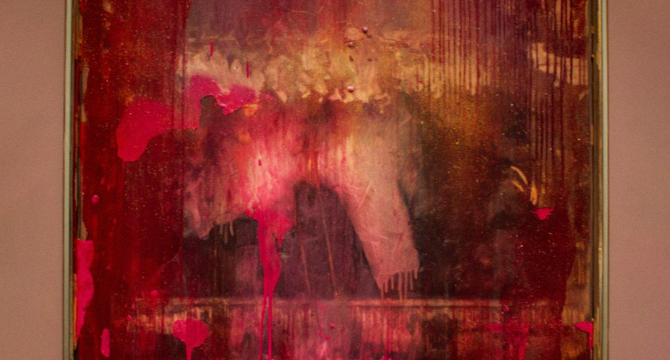
For two months, he had been working on a painting for the school exhibition, and I had watched it slowly come to life on our dining room table. Layers of blues and greens, soft and deep and bright all at once, somehow capturing the way light moved through water.
I did not know much about art, but I knew what I saw when I looked at it. I saw patience. I saw care. I saw a piece of my quiet, thoughtful boy on that canvas.
We were still laughing when I unlocked the front door.
The second Sam stepped inside, he went completely still.
I followed his gaze and felt something inside me drop.
The painting lay in pieces on the living room floor. Acrylic paint pooled in thick puddles across the hardwood, seeping between the boards. Shreds of canvas hung from the coffee table like torn skin.
Sam dropped his backpack.
The sound his breath made, this broken little gasp, will haunt me forever.
I knew exactly who had done this.
I got my phone out with hands that were somehow steady, even though I was shaking inside, and dialed Adrian. When he answered, I did not waste a second.
“She destroyed everything.”
There was a pause on the other end, then his distracted voice came through. “I’m in back-to-back meetings, but I promise you, she’ll regret this.”
I believed him.
What I didn’t expect was how fast karma would show up at my door.
The next morning, someone knocked.
Through the peephole, I saw Adrian’s mother, Rose, standing on the porch, her silver hair perfectly styled despite the early hour.
And she wasn’t alone.
I opened the door with my heart pounding, and for a second, I could only stare.
Rose stood there in a cream coat, her silver hair set perfectly in place, her mouth pulled into a line so tight it looked painful.
Beside her was a woman I recognized from Sam’s school, his art teacher, Mrs. Bennett, clutching a leather folder to her chest. Next to her stood a tall man in glasses with a district badge clipped to his jacket.
My stomach dropped.
“May we come in?” Rose asked quietly.
The second they stepped inside and saw the living room floor, Mrs. Bennett put a hand over her mouth.
“Oh no,” she whispered.
The man beside her stopped cold. “Is that Sam’s painting?”
I nodded, and suddenly my throat burned so badly I could hardly speak. “It was.”
Behind me, I heard footsteps on the stairs.
Stacy had finally decided to show herself. She leaned against the banister in pajama shorts and crossed her arms, her expression flat, but I saw the flicker in her eyes when she noticed the visitors.
Rose turned slowly and looked up at her granddaughter. “Did you do this?”
Stacy lifted one shoulder. “It’s just a painting.”
The silence that followed felt enormous.
Mrs. Bennett looked devastated. “That painting was selected last night for the regional student exhibition,” she said. “I came this morning because I wanted to tell Sam in person. The district coordinator is here because they were considering it for the youth scholarship showcase.”
I blinked.
“What?”
The man gave me a grim nod. “Your son’s work stood out immediately. We do not see that kind of depth very often at 11.”
Sam had come into the hallway without me noticing. He stood there frozen, his face drained of color.
Mrs. Bennett crouched in front of him. “Sam, sweetheart, I am so sorry. Your painting was beautiful.”
He swallowed hard. “Was?”
That one word nearly broke me.
Rose looked back at Stacy. “Do you understand what you destroyed?”
Stacy’s face had changed. The smugness was gone.
“I didn’t know.”
“You did not need to know,” Rose replied, her voice sharp as glass. “It belonged to him. That should have been enough.”
Stacy opened her mouth, then shut it again.
I finally found my voice. “Why, Stacy? What did he ever do to you?”
She stared at the floor. “You took Dad’s card.”
“So you punished an 11-year-old boy?” I asked, and my voice cracked on the last word.
Sam looked at her then, really looked at her, and I saw the hurt on his face settle into something deeper. “I never even touched your stuff,” he said softly.
Stacy’s eyes filled, but Rose did not soften.
“Go upstairs,” Rose told her. “Pack a bag.”
Stacy jerked her head up. “What?”
“You heard me.”
“You can’t just make me leave my dad’s house,” she shot back, but there was no strength behind it now.
Rose took one step toward the stairs. “Oh, I can! Your father’s wife has kept a roof over your head while you behaved like a spoiled guest in someone else’s grief. You are 19 years old. Old enough to know cruelty when you choose it.”
Stacy looked at me, maybe expecting me to stop it. I didn’t.
Just then, my phone rang.
It was Adrian.
I put him on speaker.
“Mom got there?” he asked.
“She’s here,” I said.
Rose took the phone from my hand. “Your daughter admitted she destroyed Sam’s painting.”
A long pause followed. Then Adrian spoke, tired and heavy. “Stacy, pack your things. You’re staying with Grandma until I get back.”
“Dad, no,” she said, panic breaking through at last. “I said I was sorry.”
“You said it was just a painting,” he answered. “That boy worked for two months on something that mattered to him, and you ruined it because you were angry at Tessa. I won’t defend that.”
Tears spilled down Stacy’s face.
“Where am I supposed to go after that?”
Rose answered before Adrian could. “You will stay with me. You will get a job. You will pay for the damage to this floor, every restoration attempt that can be made, and every art supply Sam needs for as long as it takes him to trust this house again.”
For once, Stacy had nothing to say.
After she went upstairs, the room felt strangely hollow.
Mrs. Bennett turned to Sam and gently opened her folder. “The exhibition committee agreed to accept photographs of the work in progress because I documented your project for class records. It is not the same, I know. But your place in the showcase is still yours if you want it.”
Sam stared at her.
“Even without the real painting?”
“Even then,” she said with a sad smile. “Talent does not disappear because someone was cruel.”
Sam’s chin trembled. He nodded once, then stepped into me so suddenly I almost lost my balance. I wrapped both arms around him, holding him as tightly as I could.
That evening, after Rose left with Stacy and the house finally grew still, Sam sat at the kitchen table with a new sheet of paper in front of him. He looked smaller than usual, but steadier.
“Do you think I can make something good again?” he asked.
I sat beside him and brushed the hair off his forehead. “Yes. And this time, nobody gets to take it away from you.”
He picked up his brush.
And for the first time in a long while, our home felt like it was starting to belong to us again.

 admin
admin