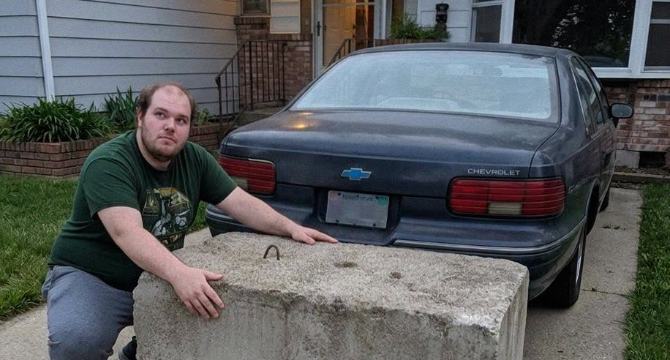
After years of depending on my husband to drive, getting behind the wheel felt like starting over. Then my neighbor decided he had the right to tell me where I could and couldn’t go.
The little plastic card felt heavier than it should have, sitting in my palm like a passport to somewhere I’d never been.
Sixty years old, and I finally had my driver’s license.
I sat in the front seat of my old Chevrolet in the DMV parking lot, adjusted my mirror for the third time, and let out a laugh that surprised me. Paul would’ve teased me for taking so long to pull out.
The little plastic card felt heavier than it should have.
My husband had been gone for two years. Forty-one years of marriage, and he’d driven every single mile of it.
“You planning to sit there all afternoon, or are we getting coffee?”
Stella’s voice came through my open window. My best friend since our filing-cabinet days at the insurance office, she was leaning against her own car with that grin she’d worn since we met.
He’d driven every single mile of it.
“I’m savoring the moment,” I said.
“You’re stalling.”
“Sa-vo-ring.”
“Carol, honey, the car has to move for it to count.”
I checked my mirrors again. Both of them. Twice.
Stella tapped the roof and laughed.
“O Lord. You’re gonna be one of those grandmas going 40 in a 45, aren’t you?”
“Fifty in a fifty-five, thank you very much!”
“You’re stalling.”
Fifteen minutes later, Stella and I were tucked into a booth at a diner. My friend raised her mug as if it were champagne.
“To Carol! Licensed, dangerous, and long overdue!”
“I’m not dangerous.”
“You’re a menace. A slow, careful, blinker-signaling menace.”
I couldn’t stop smiling. I hadn’t smiled like that since before Paul’s funeral.
“I’m not dangerous.”
“You know what the instructor said?” I asked.
“That you drive like you’re transporting a wedding cake?”
“He said I passed on the first try because I actually respected the rules. He said most people don’t.”
“Well, most people had someone driving them around for 40 years and never had to.”
That touched a nerve. She reached across and squeezed my hand.
“He said most people don’t.”
“He’d be proud of you, Carol.”
“He’d be terrified,” I said. “He’d never let me merge!”
We laughed until the waitress refilled our cups.
By the time I pulled onto my street that afternoon, the sun was dipping low, and my little house looked as if it were waiting for me.
“He’d be terrified.”
I eased into my driveway at a crawl. I signaled, even though nobody was behind me.
That’s when I noticed him.
Ryan, the new neighbor across the street, was in his late 30s and standing on his porch with a beer in his hand. He’d moved in a few months ago and barely spoken two words to anybody.
I waved.
He lifted his hand slowly but didn’t smile.
That’s when I noticed him.
“Afternoon,” I called.
Ryan didn’t answer. He just kept watching as I gathered my purse, locked the car, and walked up my front steps.
Probably nothing, I told myself. Probably just me being sensitive.
I turned the key in my front door and told myself the road ahead was wide open.
The pickup was there again on Wednesday morning, its back tire kissing the edge of my driveway as if Ryan had measured the insult with a ruler.
He just kept watching.
I had a doctor’s appointment in 45 minutes. My purse was already on my shoulder, and my keys were in my hand.
I walked across the street in my sensible shoes and knocked on his door.
Ryan opened it, holding a mug that said “World’s Okayest Boss,” which felt like the most honest thing about him.
“Ryan, I’m so sorry to bother you. Could you move your truck? I have an appointment. And please don’t block me in.”
He looked past me at my Chevy, then at me, and laughed.
“I’m so sorry to bother you.”
“Maybe take an Uber, Carol. Women your age have no business driving, anyway.”
I stood there for a second, holding my purse strap as if it were the only thing keeping my hand from doing something my mother would’ve disapproved of.
“That’s a rude thing to say to a neighbor.”
“It’s a true thing to say to a neighbor.”
He shut the door.
“That’s a rude thing to say.”
I called a cab. I paid $28; I did not have to spare. And the whole way to the clinic, I forced myself not to cry because the day Paul died, I had promised myself that I wouldn’t cry because of men who weren’t worth the salt.
I told Stella about the incident that Thursday at her living room table.
“Carol, honey, you call the police.”
“For a truck?”
“For a jackass!”
I forced myself not to cry.
“I don’t want to be that neighbor, Stella.”
My friend pointed a finger at me across her tulip placemats.
“You are already that neighbor. You just haven’t accepted it yet.”
I laughed because Stella has always been able to make me laugh. Then I drove home, obeying the exact speed limit because that’s who I am, and I refuse to apologize for it.
“I don’t want to be that neighbor.”
The parallel parking thing happened that Saturday.
I was easing into a spot, one careful inch at a time, when I heard him.
“Careful, Carol! That mailbox didn’t do anything to you!”
Ryan was leaning against his truck across the street, laughing. Two teenagers on the sidewalk laughed with him because teenagers will laugh at anything that isn’t them.
Two teenagers on the sidewalk laughed.
I finished parking. My spacing was perfect. I did not look at him.
The tires happened on a Tuesday.
I walked out with my travel mug at 7 a.m., and every single one of them was flat in a way tires don’t just go flat.
Four slashes, as if a signature.
I stood in my driveway in my slippers, and I said a word Paul would’ve pretended to be shocked by.
The tires happened on a Tuesday.
Then I marched across the street.
Ryan opened the door wearing a T-shirt with a mustard stain.
“I’m sorry, but this is MY driveway. Why are you doing this?”
He rolled his eyes so hard I worried for his optic nerve.
“I don’t care. I’ve been trying to show you that WOMEN CAN’T DRIVE, especially old ones like you! It’s a man’s job!”
“A man’s job?”
“That’s what I said.”
“I don’t care.”
“Ryan, you work from home selling protein powder on Instagram.” I’d heard that during a barbecue.
His face did something interesting.
“Get off my porch, Carol!”
I left. I called the tire place. I paid $462. And then I drove to Stella’s for coffee because I refused, absolutely refused, to let that man decide where my car went.
“Get off my porch, Carol!”
“You should’ve called the cops.”
“I don’t have proof.”
“Carol.”
“I know.”
My friend pressed a hand against my shoulder.
“Please be careful.”
“I’m always careful, Stella. That’s my whole problem.”
“I don’t have proof.”
That night, I sat on the edge of my bed and talked to Paul the way I still did sometimes, even though I knew it was just me talking to the wallpaper.
“I handled it, honey. New tires. I didn’t give him the satisfaction.”
The wallpaper didn’t answer, but I could almost hear him saying, “Carol, you don’t have to handle everything by yourself.”
“Yes, I do,” I told the wallpaper. “That was the whole point of the license.”
I turned off the lamp. I pulled the quilt up to my chin. I told myself that I had won.
I knew it was just me talking to the wallpaper.
A grinding roar dragged me out of sleep at 6:47 a.m. on Monday. I sat bolt upright, heart hammering, convinced a garbage truck had rolled straight through my living room.
Then I remembered garbage day was Friday.
I threw on my robe and shoved my feet into the slippers Paul had bought me on our last Christmas together. The noise was coming from my driveway.
I rushed to open the front door and froze on the top step.
I sat bolt upright.
Ryan was standing in the middle of my driveway, pointing like some kind of construction foreman.
Two workers in orange vests were guiding a chain from a small crane truck.
And dangling from that chain was a concrete block the size of a loveseat!
They were lowering it directly in front of my Chevy, completely sealing me in!
Ryan was standing in the middle of my driveway.
“What in God’s name are you doing?!”
My neighbor turned around slowly, as if he’d been waiting for the audience.
“Morning, Carol. Nice robe.”
“Get that thing off my property! Right now!”
“See, that’s the funny part.”
He wandered closer, the two workers exchanging looks that told me they wished they were anywhere else on earth.
“Get that thing off my property!”
“It’s not your property. The property line runs right through where that block’s landing. My surveyor came out yesterday.”
“You don’t have a surveyor.”
“I have a guy who owns a tape measure. Close enough.”
The block touched down with a thud I felt in my chest. My Chevy, my beautiful, stubborn old Chevy, was now boxed in like a museum exhibit.
“I’m calling the police!”
“Go ahead.”
Ryan shrugged, actually shrugged, as if I’d just offered him a mint.
“You don’t have a surveyor.”
“They’ll tell you it’s a civil matter. You’ll get a lawyer; he’ll cost you $800. Six months from now, a judge might, MIGHT, order me to move it. Meanwhile, we’ll finally have some peace around here.”
He folded his arms and smirked.
“Take an Uber, sweetheart.”
I felt tears rising, and I hated them.
“We’ll finally have some peace around here.”
I hated that my hands were shaking. I hated that a smug 30-something in a bathrobe was standing on my driveway, telling me my life belonged to him now.
“Why do you hate me?”
“I don’t hate you, Carol. I just think some people need to stay in their lane.”
Ryan winked. He actually winked!
“Driving pun. Get it?”
One of the workers cleared his throat.
“Why do you hate me?”
“Sir, we’re gonna, uh, we’re gonna head out.”
“Yeah, invoice me,” my neighbor remarked.
I stared at Ryan for a moment. That’s when I realized there was absolutely no point in arguing with him.
I didn’t say another word. I turned around, walked back inside, and closed the door with both hands, so I wouldn’t slam it.
“We’re gonna head out.”
Then I stood in my living room and cried for exactly 90 seconds. I timed it on the microwave clock because Paul used to say a good cry has a beginning, a middle, and an end, and you don’t let it run past the credits.
Then I wiped my face.
I was about to reach for the phone to call Stella or the police when something stopped me: a memory, sharp as a mailbox in a parking lot.
Then I wiped my face.
Three weeks ago. The neighborhood barbecue at the Hendersons’.
Ryan had been holding court by the grill, loud as always, telling anyone who’d listen how his mother was “the reason he even had this house.”
“She’ll handle anyone who talks back to me. Trust me.”
Ryan had been holding court by the grill.
Everyone had laughed uncomfortably. Everyone except a small woman in a navy cardigan standing behind him, holding a paper plate of potato salad, her mouth pressed into a line of someone who had run out of patience.
Patricia. His mother.
Later, by the drinks table, she found me. Patricia slipped a folded scrap of paper into my palm like a spy in an old movie.
“Carol, honey. If he ever crosses a line, you call me. Not him. Me. I mean it.”
Everyone had laughed uncomfortably.
I’d tucked the number into my address book and never looked at it again.
I walked to the address book now. Flipped to P.
There it was, in careful cursive.
I picked up the phone.
My finger hovered over the last digit. A little voice in my head, one that sounded suspiciously like Paul, whispered, “You don’t have to do this alone, Carrie.”
I pressed the button.
I’d tucked the number into my address book.
It rang once.
“Hello, Patricia speaking?”
“Patricia, it’s Carol. From across the street from Ryan. I’m so sorry to call this early, but — “
“Carol,” her voice sharpened, alert as a bell. “What did he do?”
I told her everything.
There was a pause on the other end. Then a long, slow breath, as if a teacher were setting down a red pen.
“I’ll be there in less than five minutes, sweetheart. I was in the neighborhood.”
The line went dead.
“What did he do?”
I stood there, still in my robe, and watched through the window as the sun climbed over Ryan’s roof.
Waiting felt like torture. A silver sedan rolled up to the curb, and Patricia stepped out with a folder tucked under her arm like a schoolteacher on the first day back, her phone still pressed to her ear.
“That’s right, Mike, the whole slab. Within the hour,” I heard her say as I stepped outside.
She lowered the phone and slid it into her purse.
Waiting felt like torture.
The workers who’d dropped the slab hadn’t left yet. Patricia walked right up to the concrete block, then to the two workers, who suddenly found their boots very interesting.
“Gentlemen, my contractor is already on his way to remove this. The bill goes to my son.”
Ryan was already walking to his porch. The color drained from his face so fast that I almost felt sorry for him.
He came sprinting across the lawn toward my house in slippers.
“The bill goes to my son.”
I folded my arms.
“Mom, come on! It was a joke! Carol knows it was a joke, right?”
“Funny. I forgot to laugh,” I retorted.
Patricia didn’t even glance at him. She opened the folder and held out a crisp, printed page.
“Ryan, the house is in my name. Your lease forbids harassing neighbors and unauthorized construction. You have 30 days.”
“Mom, no! Anything but this! Please, stop it!”
“It was a joke!”
“You heard me,” his mother replied calmly.
“Thirty days? Where am I supposed to go?”
“Anywhere that teaches you manners.”
My neighbor turned to me, wild-eyed.
“Carol, tell her! Tell her I’ll apologize! I’ll wash your car every week!”
I took a breath. For once, my hands weren’t shaking.
“Where am I supposed to go?”
“Ryan, the world doesn’t belong to you just because you want it to. Or because you’re a man. Maybe try sleeping in an Uber. I hear the cars are great for fitting men your age in the backseat.”
Patricia’s mouth twitched. That was the closest thing to a smile I’d ever seen on her.
By 7:45 a.m, the block was gone. The driveway was mine again.
“Maybe try sleeping in an Uber.”
Weeks later, I drove Stella and Patricia to lunch in the old Chevy.
We laughed the whole way about Ryan’s face that fateful morning.
Getting my license at 60 wasn’t really about driving. It was about learning I could steer my own life and that knowing who to call isn’t weakness.
It’s the wisest turn I ever made.

 admin
admin