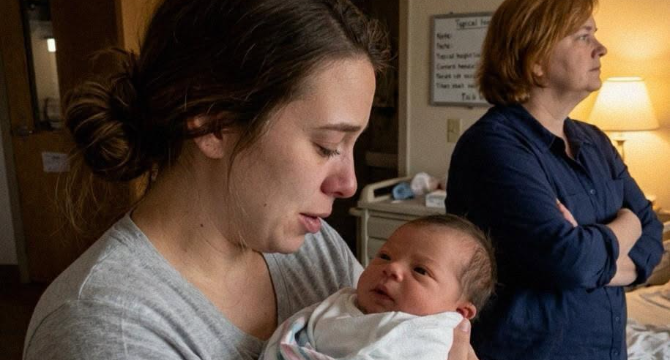
My husband had wanted our baby as badly as I did, but after Noah’s diagnosis, his mother began feeding him every fear she had. When I followed him into the hallway one night, I heard a sentence I thought would end our marriage.
For five years, I could always count on one thing each month.
A negative test.
A locked bathroom door.
And me sitting on the floor trying to cry quietly enough that Brandon would not hear me.
Of course, he always heard me.
He would sit outside the door and say, “Jannet, let me in.”
Sometimes I did.
Sometimes I could not.
We went through blood tests, scans, hormone treatments, and two failed rounds of IVF.
We had enough doctor’s appointments that I started recognizing the magazines in every waiting room.
People told us to relax.
People told us to stop trying so hard.
One woman at work told me, “It happens when you stop thinking about it.”
I wanted to ask her whether she would say that to someone waiting for any other medical treatment to work.
Eventually, I stopped telling people what we were going through.
Brandon and I carried it between us.
Then, after five years, I saw two pink lines.
I took four more tests because I did not trust the first one.
When Brandon came home, I had them lined up on the bathroom counter.
He stared at them.
Then at me.
Then back at them.
“Are those all yours?”
I laughed so hard I started crying.
“No, Brandon. I went around collecting positive pregnancy tests from strangers.”
He dropped to his knees and wrapped both arms around my waist.
“We did it.”
We stood there crying in the bathroom where I had spent years grieving.
For eight months, I was terrified to believe the pregnancy would end with a baby.
Every scan made me hold my breath.
Every time the doctor paused, I thought something was wrong.
But my son, Noah, kept growing.
He kicked constantly.
He seemed to hate whenever I tried to sleep.
Brandon talked to my stomach every night.
Then Noah arrived on a rainy Thursday morning after 16 hours of labor.
He was tiny, warm, furious, and louder than I expected.
The nurse placed him against my chest.
I looked down at his face and forgot everything else.
The treatments.
The waiting.
The negative tests.
The nights I told Brandon I could not keep trying.
All of it disappeared beneath the weight of this seven-pound baby breathing against me.
“We have him,” I whispered.
Brandon kissed my forehead.
“We have him.”
A few hours later, our pediatrician came into the room with a second doctor.
I knew something was wrong.
Doctors do not enter hospital rooms in pairs to tell you everything is ordinary.
The pediatrician pulled up a chair.
“Jannet, Brandon, there are some physical features we’ve noticed in Noah that are consistent with Down syndrome.”
I stared at him.
Brandon’s hand found mine.
The doctor kept speaking.
They would confirm it with genetic testing.
Some children with Down syndrome had heart defects, so Noah needed an echocardiogram.
There could be feeding difficulties.
There could be hearing or thyroid issues.
There were specialists who would guide us.
I heard the words but could not arrange them into meaning.
I looked down at Noah.
He was sleeping.
His mouth was slightly open.
One fist rested beneath his chin.
He looked exactly like the baby I had been holding before the doctors entered.
That realization steadied me.
“What happens now?” I asked.
“We check his heart. We help you feed him. We get you information. And you take this one step at a time.”
Brandon nodded.
Later, when the doctors left, I cried.
Not because I wished Noah were different.
I cried because I was scared.
I had spent five years imagining motherhood.
Suddenly I was being handed a future I had never learned enough about.
Brandon held me while I said every frightened thought out loud.
“What if I don’t know what he needs?”
“We’ll learn.”
“What if kids are cruel to him?”
“Then we teach him how much he is loved before the world gets a vote.”
“What if I mess this up?”
“You will.”
I stared at him.
He shrugged.
“So will I. Every parent does.”
I laughed through my tears.
That was the last peaceful hour we had before Kimberly arrived.
Kimberly was Brandon’s mother.
She had never been warm toward me, but infertility had softened something between us.
Or so I thought.
During the treatments, she sent me vitamins, articles, and prayers.
When I became pregnant, she bought Noah more clothes than he could possibly wear.
She called him “our miracle.”
When she entered my hospital room, I expected tears.
Instead, she looked at Noah, then at Brandon.
Her face changed.
“Brandon texted me.”
I frowned.
“We were going to tell everyone together.”
She barely seemed to hear me.
She walked to Brandon and lowered her voice, but I could still hear her.
“You still have time to leave him.”
For a second, I thought I had misunderstood her.
Brandon went rigid.
“What?”
Kimberly glanced at me.
Then back at him.
“You’re young enough to start over.”
I pulled Noah closer against my chest.
“Get out.”
Kimberly looked at me as though I were the unreasonable one.
She turned to Brandon.
“You don’t understand what this life can become.”
Brandon stared at the floor.
That frightened me more than anything she had said.
I wanted him to shout.
I wanted him to point at the door.
Instead, he stood there in silence.
Kimberly touched his arm.
“Think about it.”
Then she left.
The moment the door closed, I looked at him.
“Say something.”
Brandon rubbed both hands over his face.
“I don’t know what to say.”
“Your mother told you to leave our son.”
“I heard her.”
“And you said nothing.”
His eyes met mine.
“I was shocked.”
“So was I.”
“I need a minute, Jannet.”
I told myself Brandon was in shock.
Then Kimberly started calling.
The next morning, Brandon’s phone buzzed six times before breakfast.
He ignored the first five.
He answered the sixth in the hallway.
When he returned, I asked, “Was that her?”
“Yes.”
“What did she want?”
“The same thing.”
“What did you tell her?”
“That we are not discussing it.”
It should have reassured me.
It did not.
By that afternoon, Kimberly was sending him articles.
I saw the titles when his phone lit up.
Then one message read:
“You have no idea what you are signing up for.”
Then:
“Please do not ruin your life because you feel guilty.”
I watched Brandon read each one.
He never answered in front of me.
He became quieter.
At night, he stepped into the hallway to take her calls.
When I asked what they were discussing, he said, “Nothing you need to worry about.”
That answer made everything worse.
“No, Brandon. I need to know what she is saying.”
“You know what she is saying.”
“What are you saying back?”
He looked toward Noah’s bassinet.
“Please focus on resting.”
I stared at him.
“Do not tell me to rest when I am asking whether my husband agrees with his mother.”
“I don’t.”
“Then why are you whispering with her?”
“Because I am handling it.”
“How?”
He did not answer.
That night, I barely slept.
Noah’s echocardiogram showed a small heart defect that the cardiologist believed might close on its own.
That should have been encouraging.
Instead, my mind kept returning to Brandon.
Every quiet phone call.
Every unreadable expression.
Every time Kimberly’s name flashed across his screen.
I began imagining him leaving the hospital alone.
I imagined raising Noah by myself.
I imagined Kimberly convincing him that our son was a tragedy.
The thought made me sick.
The following evening, Brandon’s phone rang again.
He glanced at me.
“I’ll be right back.”
He stepped into the hallway.
I waited 10 seconds.
Then I followed.
The corridor lights were dimmed for the night.
I could hear his voice around the corner near the family lounge.
I stopped before he could see me.
Kimberly’s voice came faintly through the phone speaker.
“You have to decide now, Brandon.”
He was quiet.
Then he said, “You’re right, Mom.”
My heart stopped.
“I can’t keep doing this.”
I pressed one hand against the wall.
He continued.
“Tomorrow I’m telling her everything.”
I nearly dropped to the floor.
Kimberly exhaled sharply.
“Do not.”
“You’ve had years.”
“Brandon.”
“No. I am done protecting you.”
I froze.
Kimberly’s voice changed.
“She doesn’t need to know about that.”
“She absolutely does.”
“That was my business.”
“You made it my business when you walked into my wife’s hospital room and told me to abandon my son.”
Kimberly said, “I was trying to save you.”
“From what? I don’t want to become you.”
I covered my mouth.
Brandon’s voice was shaking now.
“If Grandma had never told me before she died, I would have never found out.”
I leaned closer to the corner.
“I did what had to be done,” Kimberly said, though her voice already sounded defeated.
“I won’t abandon my son because he has Down syndrome. I won’t do what you did, Mom.”
Kimberly made a sound like she had been hit.
“Do not talk about him.”
“His name was Matthew.”
“Stop talking about him.”
“You had him for only six weeks.”
“Brandon, stop.”
“You signed away your parental rights because your father told you his life would destroy yours.”
“I was scared.”
“And now you’re telling me to do the same thing.”
Kimberly started crying.
“You do not understand.”
“Then explain it.”
“My father told me I would never marry, never have another child, never have a normal life.”
Brandon’s voice softened, but only slightly.
“So you gave him up.”
“I thought I was doing what I had to do.”
“And did it make your life easier?”
Kimberly did not answer.
“Did you ever look for him?”
“No.”
“Why?”
“Because I was ashamed.”
Brandon let out a long breath.
“And now you’re trying to make me repeat it so you can believe you made the right choice.”
Kimberly began sobbing.
“That is not fair.”
“It is exactly what you are doing.”
“I am trying to protect you from the life I was afraid of.”
“Mom, Noah is not your baby. This is not your life.”
The words hit me so hard I had to brace myself against the wall.
“He is my son.”
Kimberly cried harder.
“And I am not leaving him. Not tomorrow. Not in 20 years.”
I could hear Kimberly’s deep sobs.
“Not because he needs extra appointments, not because strangers might stare, and not because you are still terrified of a choice you made years ago.”
I stepped around the corner.
Brandon saw me.
His face drained of color.
“Jannet.”
I looked at the phone in his hand.
“All those secret calls.”
“I wasn’t agreeing with her. I’ve been trying to make her see that she’s wrong.”
“I thought you were.”
“I know.”
“Do you?”
My voice broke.
“I was lying in that room wondering whether you were deciding if Noah was worth staying for.”
Brandon’s eyes filled.
“I am so sorry.”
Kimberly was still on the phone.
“Is Jannet there?”
I held out my hand.
Brandon gave me the phone.
For several seconds, neither Kimberly nor I spoke.
Then she whispered, “I am sorry.”
“Sorry for what?”
“For what I said.”
“Which part?”
She began crying again.
“All of it.”
“You told my husband to abandon our baby.”
“I’m so sorry.”
“Why should I let you near Noah?”
She had no answer.
I almost hung up.
Then she said, “Because I was wrong.”
I stayed silent.
“I was wrong 30 years ago because I let fear make the decision for me. And I was wrong again because when I saw Noah, I saw Matthew.”
Her voice cracked.
“I saw the baby I gave away, and instead of facing what I had done, I tried to make Brandon choose the way I did.”
I sat down in one of the hallway chairs.
“What happened to Matthew?”
“I don’t know.”
“You never found out?”
“No.”
The shame in her voice was almost unbearable.
“I was told he was adopted by a family through the agency. After that, I never asked.”
“Why?”
“Because if he was happy, I had abandoned a child who could have been happy with me. And if he wasn’t, I did not know how I would live with that.”
I closed my eyes.
Kimberly whispered, “May I come tomorrow?”
I hesitated.
“Why?”
“To apologize properly.”
“That does not mean you get to hold him.”
“I understand.”
The next morning, she arrived alone.
She stood near the door with both hands clasped together.
Her eyes were swollen.
“I am sorry, Jannet.”
I waited.
She looked at Brandon.
“I am sorry I tried to make you abandon your baby.”
Then she looked toward Noah.
“And I am sorry I looked at my grandson and saw a problem before I saw him.”
That statement softened me.
Kimberly told us more about Matthew.
She had become pregnant at 21.
His father disappeared before he was born.
Her father convinced her that raising a child with Down syndrome alone would ruin her future.
She signed the adoption papers while still recovering from childbirth.
“I told myself I was giving him a better life,” she said.
“Maybe you were,” I replied.
She looked surprised.
I continued.
“But you do not know. And neither do we. What you do know is that the decision still hurts you.”
She nodded.
“Every day.”
The genetic test confirmed Noah had Down syndrome.
That did not change who he was.
We learned about early intervention, feeding therapy, cardiac follow-ups, and developmental support.
We also learned how quickly people could reduce an entire child to a diagnosis.
I stopped letting them.
Brandon never took another private call from Kimberly about Noah.
If she had a question, she asked both of us.
If she became scared, she did not disguise fear as advice.
Trust did not repair itself overnight.
But she worked at it.
Noah is eight months old now.
He has Brandon’s smile.
He hates socks.
He laughs whenever I sneeze.
His heart defect is being monitored, but so far he is doing well.
Sometimes I still think about that night in the hallway.
I thought I was about to hear my husband choose fear over our son.
Instead, I heard him refuse to inherit his mother’s shame.
Kimberly once told Brandon he still had time to leave.
She was right about one thing.
There was still time.
Time to leave behind the fear that had controlled her for years.
Time to stop treating disability like a ruined future.
And time to choose Noah exactly as he was.
