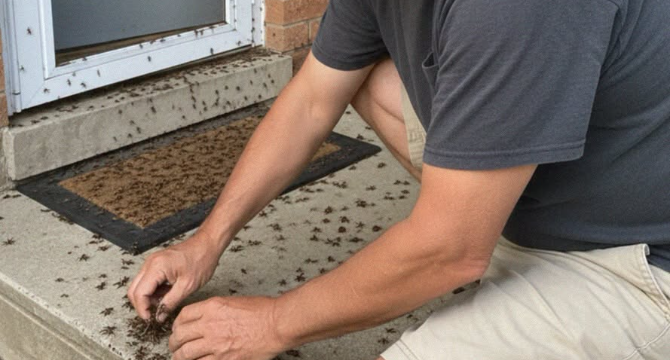
The ants coming through my wall drove me crazy. But when I forced open my neighbor’s door looking for my daughter, what I found made me question everything.
“OPEN UP RIGHT NOW! I KNOW SHE’S IN THERE!”
I pounded on Mr. Henderson’s door so hard my palm started hurting.
“Elizabeth!”
Nothing.
I pressed my ear against the wood.
For one second, there was complete silence.
Then something crashed inside.
My stomach dropped.
“ELIZABETH!”
I grabbed the handle.
Locked.
Every terrible possibility hit me at once.
My eight-year-old daughter was missing from our apartment. Her sneakers were gone. I had stepped into the hallway just in time to see my elderly neighbor’s door close.
And now he would not answer me.
I slammed my shoulder into the door.
Pain shot down my arm.
The frame groaned but held.
I hit it again.
“Mom?”
Elizabeth’s voice came from inside.
That was all I needed.
I threw myself against the door a third time.
The cheap frame cracked, and the lock tore loose.
I stumbled into the apartment.
Then I froze.
There were bugs everywhere.
Not crawling loose across the floor.
Contained.
Dozens of clear boxes and glass tanks covered shelves along every wall. Transparent tubes connected some of them. Inside, thousands of ants moved through tunnels, feeding chambers, and tiny artificial nests.
Black ants.
Brown ants.
Large red ones.
Tiny golden ones.
Each enclosure had a handwritten label under it.
There were heat lamps, magnifying glasses, humidity gauges, notebooks, and jars of what looked like insect food.
It was not a filthy apartment.
It looked like a laboratory.
“Elizabeth?”
“I’m here!”
I followed her voice into the living room.
My daughter was kneeling on the floor beside Mr. Henderson.
He was crying.
Between them sat a cracked plastic enclosure placed over a white sheet.
Hundreds of ants crawled across it.
Elizabeth held a tiny paintbrush and was carefully guiding them toward a clear tube.
“What are you doing?”
She jumped.
“Mom!”
“Come here. Now.”
Mr. Henderson immediately moved away from her.
“Mrs. Carter, please—”
“Don’t.”
Elizabeth stood.
“He didn’t do anything.”
“You disappeared without telling me.”
“He needed help.”
“I don’t care what he needed!”
Mr. Henderson flinched.
Elizabeth stared at me.
“That’s your problem.”
I stopped.
“What?”
“You don’t care why anything happens. You just want it gone.”
I looked from her to Mr. Henderson.
Then back to the thousands of ants surrounding us.
Three weeks earlier, I would have considered this apartment my personal nightmare.
My home is spotless.
Not reasonably clean.
Spotless.
I vacuum almost every night. Dishes never sit in the sink. Shoes remain beside the front door. Counters get disinfected after every meal.
Elizabeth calls me “the cleaning police.”
I always thought she was teasing.
After her father left, cleanliness became one of the few things in my life I felt I could control.
Being a single mother came with endless uncertainty.
Bills.
School problems.
Work schedules.
Fevers.
An ex-husband who remembered some birthdays and forgot others.
But I could control my home.
If everything was clean, ordered, and where it belonged, I felt like I was doing something right.
Then ants appeared on my kitchen counter.
The first morning, there were maybe 12.
I threw away the fruit bowl, emptied my cupboards, bleached every surface, and sprayed along the baseboards until the smell made my eyes water.
The following morning, there were more.
“Mom,” Elizabeth said over breakfast, “that one’s carrying a crumb.”
“Then we apparently have crumbs.”
“People have crumbs.”
“We don’t.”
She stared at me.
“Okay.”
I eventually tracked the ants to the baseboard along the wall we shared with apartment 4B.
Mr. Henderson’s apartment.
He was a frail man in his seventies who barely left home.
When I knocked, he opened his door only a few inches.
“I’m Elena. From next door.”
“I know.”
“I’m having an ant problem.”
His eyes immediately dropped.
“Oh.”
“They’re coming through this wall. Do you have ants?”
“A few.”
“A few?”
“I’m sorry.”
“Can I come inside and see where they’re coming from?”
His fingers tightened around the door.
“No.”
I remember how suspicious that made me.
“Mr. Henderson, if you have garbage or spoiled food in there, it could affect the whole building.”
“There isn’t garbage.”
“Then what is causing it?”
“I’ll handle it.”
He shut the door.
The ants kept coming.
A few days later, Elizabeth found one on her desk.
That was when I lost patience.
I confronted him again.
“You said you would fix this.”
“I’m trying.”
“It’s been days.”
“I know.”
“My daughter lives here.”
His expression changed at the mention of Elizabeth.
“I know.”
“If this continues, I’m calling management. If they find health violations, you could be fined or even evicted.”
He went pale.
“Please don’t.”
“Then tell me what is happening.”
He stared at the floor.
“I just need more time.”
I told him he had until the next day.
When I returned home, Elizabeth was waiting in the kitchen.
“That was mean.”
“What?”
“You scared him.”
“I told him to fix a pest problem.”
“You don’t know his apartment is dirty.”
“Ants are coming out of it.”
“So?”
“So they aren’t appearing magically.”
She frowned.
“Maybe you should ask him instead of yelling.”
“I did.”
“No. You asked to inspect his apartment.”
“I’m protecting you.”
“From ants?”
“From living somewhere unsanitary.”
She rolled her eyes.
“Everything is unsanitary to you.”
I sent her to her room.
The next day, Mr. Henderson stopped answering his door.
Then I came home yesterday, started folding laundry, and realized Elizabeth was gone.
Now I was standing inside his apartment staring at the reason for everything.
“What is this?” I asked.
Mr. Henderson wiped his face.
Elizabeth answered.
“They belonged to his daughter.”
I looked around again.
That was when I noticed the photographs.
The same young woman appeared in almost all of them.
Curly dark hair.
Large glasses.
A huge smile.
In one picture, she held an ant enclosure. In another, she stood in a field carrying collection equipment.
A framed university certificate hung nearby.
Dr. Caroline Henderson.
Department of Entomology.
Mr. Henderson looked at the photograph.
“Caroline was my only child.”
“She studied ants?”
He nodded.
“Social insects. Mostly colony behavior.”
Elizabeth sat beside him again.
I wanted to tell her to move.
I didn’t.
Mr. Henderson explained that Caroline had been a university researcher.
When she was diagnosed with ovarian cancer, she moved back into his apartment.
Stage four.
She continued caring for several ant colonies because, according to him, “they gave her something to get out of bed for.”
He converted his spare bedroom into a small research room.
Caroline died 14 months ago.
“You kept everything?” I asked.
“I promised her.”
His voice broke.
“She asked me to keep the colonies alive as long as I could.”
Suddenly the apartment looked completely different.
These weren’t random bugs he had allowed to multiply in garbage.
They were living pieces of his daughter’s work.
Mr. Henderson had spent more than a year following Caroline’s notebooks.
Feeding each colony.
Maintaining temperature and humidity.
Cleaning equipment.
Recording changes.
But his arthritis had worsened.
His hands shook.
Several weeks earlier, a connector tube cracked.
Ants escaped into the wall.
“You knew?” I asked Elizabeth.
She nodded.
“For weeks.”
My heart sank.
“You’ve been coming in here?”
“Sometimes.”
“Without telling me?”
“I tried to tell you.”
“No, you didn’t.”
“Yes, I did.”
Then she reminded me.
She had asked why ants walked in lines.
I was cleaning the stove and told her to look it up.
She asked whether people kept insects as pets.
I was organizing the pantry and said absolutely not.
She told me Mr. Henderson looked sad.
I was spraying the baseboards and said I did not want to discuss him until he fixed his problem.
I remembered every conversation.
I just had not understood any of them.
“How did you even start coming over here?”
Elizabeth looked at Mr. Henderson.
“I knocked.”
She had seen him in the hallway trying to carry a box of supplies.
He dropped it.
She helped pick everything up.
Then she noticed his hands shaking.
The next afternoon, she knocked again and asked whether he needed help.
Mr. Henderson taught her how to refill the tiny water containers.
Then how to use a soft paintbrush to move ants without hurting them.
“She should have told you,” he said.
“Yes, she should have.”
“I told her that.”
Elizabeth crossed her arms.
“You also said Mom would make you throw them away.”
Mr. Henderson looked ashamed.
“I did say that.”
I stared at him.
“You told my daughter to hide this from me?”
“I asked her not to mention the colonies until I repaired the leak. That was wrong.”
“Very wrong.”
“I know.”
Elizabeth looked at me.
“You threatened to get him evicted.”
“I didn’t know what was happening.”
“You never wanted to know.”
“Elizabeth.”
“You just wanted the ants gone.”
“They were inside our home.”
“So?”
“So I thought his apartment was filthy.”
“His apartment is cleaner than mine.”
That was technically true.
Then she said something that silenced me.
“You think messy things don’t matter.”
“What does that mean?”
“You threw away my frog.”
I blinked.
“What frog?”
“The clay one I made.”
I remembered.
Months earlier, she brought home a lopsided green frog from art class.
One leg broke off.
It sat on her dresser for weeks.
Eventually, I threw it away.
She cried.
I offered to buy her a nicer decoration.
“You threw away my leaf collection too,” she said.
“They were dead leaves.”
“I liked them.”
“And Dad’s birthday card.”
“I didn’t throw that away.”
“You put it in the junk drawer because it looked messy.”
That one hurt.
She was right.
I had moved the card because she kept it propped beside her lamp at an angle.
Standing there surrounded by everything Mr. Henderson had preserved because it reminded him of someone he loved, I understood what Elizabeth was saying.
I had started deciding what was valuable based on whether it disrupted my sense of order.
Broken pottery.
Leaves. Cards. Ants.
Maybe even people.
Mr. Henderson cleared his throat.
“We need to finish transferring them.”
I looked at the white sheet.
“What do I do?”
Elizabeth’s expression changed.
“You’ll help?”
“Tell me what to do.”
For the next hour, I sat on the floor helping my daughter and my neighbor rescue ants.
Mr. Henderson showed me how to position a clear tube.
Elizabeth used the tiny brush.
His hands shook too much for the delicate work.
Hers were steady.
At one point she said, “This one keeps trying to bite me.”
Mr. Henderson almost smiled.
“She does not appreciate being relocated.”
“She?”
“Most worker ants are female.”
Elizabeth looked at me.
“See? Girls do everything.”
I laughed despite myself.
So did Mr. Henderson.
It was the first time I had ever heard him laugh.
Afterward, while Elizabeth washed her hands, I spoke to him privately.
“I owe you an apology.”
He shook his head.
“You had a legitimate problem.”
“I had a legitimate concern. I didn’t have the right to humiliate you.”
“I should have explained.”
“Why didn’t you?”
He looked toward Caroline’s photograph.
“Because when I tell people I’m an old man keeping my dead daughter’s ant colonies alive, I know how it sounds.”
I winced.
That was almost exactly how I would have judged him.
“Why were you so afraid of management?”
“Caroline had permission for the colonies when she lived here. I never updated anything after she died.”
He lived on a fixed income.
If management demanded professional removal or major pest treatment, he could not afford it.
Worse, he feared they would order him to destroy the colonies.
“They aren’t all I have left of her,” he said. “But they’re something she trusted me to protect.”
I swallowed.
“I called management yesterday.”
His face fell.
“They’re coming tomorrow.”
He closed his eyes.
“I understand.”
“I’ll talk to them.”
He looked at me.
“What?”
“I’ll tell them the truth.”
Management arrived the next morning with a pest-control specialist.
They were not happy.
Neither was I when I learned how easily ants could travel through our walls.
But the situation was manageable.
Most of the colonies were legally contained.
The escaped ants were treated.
The damaged connectors were replaced.
Two colonies violated the building’s updated rules, but Caroline’s former university agreed to take them.
Mr. Henderson was not evicted.
I paid part of the sealing cost.
He tried to refuse.
I reminded him I had destroyed his front door.
That evening, I sat beside Elizabeth on her bed.
“I’m sorry.”
“For breaking his door?”
“For more than that.”
I picked up a drawing from her nightstand.
It showed an enormous ant wearing a crown.
Normally, I would have asked her to put it away.
Instead, I studied it.
“Queen?”
“Beatrice.”
“Naturally.”
She smiled.
Then I said, “I think I’ve made our apartment so perfect that sometimes you don’t feel like you’re allowed to live in it.”
Her smile disappeared.
“Sometimes.”
It hurt.
But I needed to hear it.
“I thought keeping everything controlled meant I was being a good mom.”
“You are a good mom.”
“You can love me and still tell me when I’m wrong.”
She thought about that.
“Okay. You’re wrong a lot about cleaning.”
I laughed.
“Fair.”
Then I became serious.
“But you cannot disappear into another adult’s apartment again.”
“I know.”
“And adults should never ask you to keep secrets from me.”
“Mr. Henderson isn’t bad.”
“I know. But that rule still matters.”
She nodded.
“And if you ever vanish like that again, cleaning police will be the least of your problems.”
She grinned.
Things have changed since then.
Not completely.
I still clean too much.
Crumbs still bother me.
But Elizabeth’s drawings stay on the refrigerator.
Her books do not have to be perfectly aligned.
There is now a glass jar on her desk filled with rocks, leaves, and a feather I am trying very hard not to think about.
Mr. Henderson’s apartment changed too.
Caroline’s university helped replace several aging enclosures.
A graduate student visits twice a month.
Elizabeth visits every Saturday.
With my permission.
Usually, I go too.
Mr. Henderson teaches her about colony behavior, queens, workers, and how ants communicate.
Elizabeth taught him how to make video calls.
Now he occasionally speaks to Caroline’s former students about caring for her colonies during her illness.
Last week, he handed Elizabeth a small acrylic ant habitat.
Empty.
I pointed at him.
“No.”
Elizabeth groaned.
“Mom!”
Mr. Henderson laughed.
“I was only showing her.”
“Keep showing.”
There are still thousands of ants next door.
Strangely, they do not bother me much anymore.
I sometimes think about that afternoon when I broke down Mr. Henderson’s door, convinced something horrible was waiting behind it.
Something was.
Just not what I expected.
There was grief.
Loneliness.
A father trying desperately to protect the last project his daughter had loved.
And there was my own daughter, sitting beside him because she had noticed pain while I was too busy trying to remove every imperfection from our lives.
I thought a spotless apartment proved I was taking care of Elizabeth.
I was wrong.
She did not need a home without mess.
She needed a home where she was allowed to leave evidence that she lived there.
Drawings.
Books.
Broken clay frogs.
Dead leaves.
Even crumbs sometimes.
Mr. Henderson learned that grief could not be protected by shutting everyone out.
Elizabeth learned that helping someone did not mean keeping secrets from me.
And I learned something I wish I had understood much earlier.
Not every mess is evidence that something has gone wrong.
Sometimes, it is evidence that someone was here.
That someone loved something.
And that it mattered enough to leave behind.

 admin
admin